


What is the Global N-Butanol Market Size and Growth Rate?
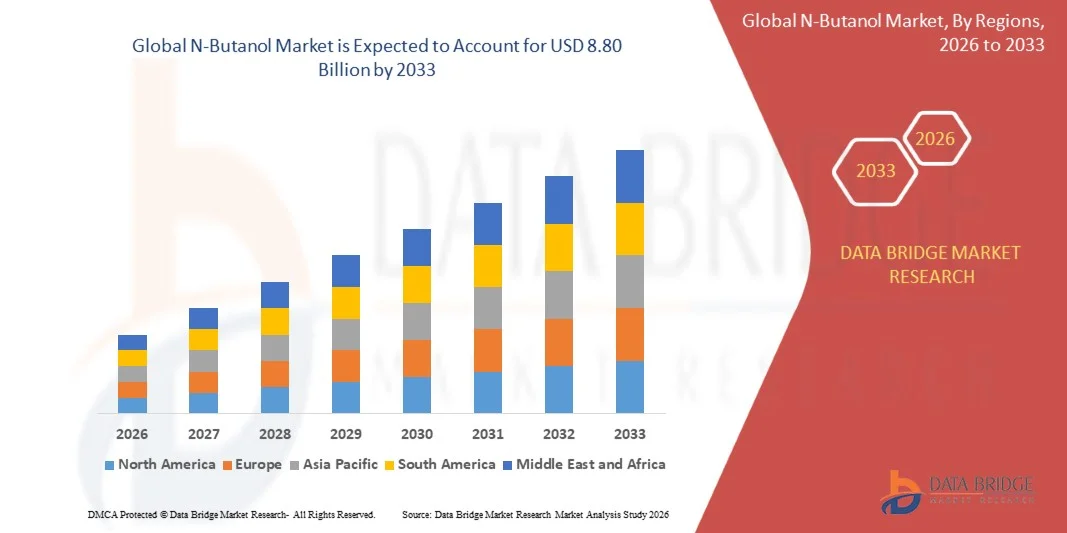
- The global N-Butanol market size was valued at USD 5.91 billion in 2025 and is expected to reach USD 8.80 billion by 2033, at a CAGR of5.10% during the forecast period
- The high demand for construction industry in emerging countries major factor accelerating the growth of the n-butanol market
What are the Major Takeaways of N-Butanol Market?
- Continuous Low consumption of Dop (Bis (2-Ethylhexyl) Phthalate) in Europe and North America restrains the n-butanol market, whereas, high cost and safety hazard will challenge market growth
- In addition, increasing focus of n-Butanol manufacturers and other market players on enhancing the increasing use of n-butanol as bio-fuel will create ample opportunities for the n-butanol market
- North America dominated the N-Butanol market with a 38.6% revenue share in 2025, driven by strong demand from paints & coatings, adhesives, personal care, pharmaceuticals, and industrial solvent applications across the U.S. and Canada
- Asia-Pacific is projected to register the fastest CAGR of 6.9% from 2026 to 2033, driven by rapid industrialization, strong chemical manufacturing ecosystems, and rising demand across China, India, Japan, and Southeast Asia
- The Butyl Acrylate segment dominated the market with a 34.8% share in 2025, owing to its extensive use in the production of paints, coatings, adhesives, sealants, textiles, and construction chemicals
Report Scope and N-Butanol Market Segmentation
|
Attributes |
N-Butanol Key Market Insights |
|
Segments Covered |
|
|
Countries Covered |
North America
Europe
Asia-Pacific
Middle East and Africa
South America
|
|
Key Market Players |
|
|
Market Opportunities |
|
|
Value Added Data Infosets |
In addition to the insights on market scenarios such as market value, growth rate, segmentation, geographical coverage, and major players, the market reports curated by the Data Bridge Market Research also include in-depth expert analysis, pricing analysis, brand share analysis, consumer survey, demography analysis, supply chain analysis, value chain analysis, raw material/consumables overview, vendor selection criteria, PESTLE Analysis, Porter Analysis, and regulatory framework. |
What is the Key Trend in the N-Butanol Market?
“Increasing Shift Toward Bio-Based Production and High-Performance Solvent Applications”
- The N-Butanol market is witnessing a strong shift toward bio-based and low-emission production technologies, driven by rising sustainability targets across the chemicals, coatings, and fuels industries
- Manufacturers are increasingly focusing on fermentation-based bio-butanol processes, improved catalyst systems, and energy-efficient production routes to reduce carbon footprint and dependence on fossil feedstocks
- Growing demand from paints, coatings, adhesives, sealants, printing inks, and plasticizers is accelerating the use of N-Butanol as a high-performance industrial solvent
- For instance, major companies such as BASF, Dow, Sinopec, and Mitsubishi Chemical are expanding production capabilities and strengthening downstream solvent applications
- Increasing adoption in construction chemicals, automotive coatings, and packaging inks is further driving market expansion
- As industrial applications continue to diversify, N-Butanol will remain a critical feedstock for solvents, acrylates, and specialty chemicals globally
What are the Key Drivers of N-Butanol Market?
- Rising demand for paints, coatings, adhesives, and sealants across construction, automotive, and industrial manufacturing sectors is a major driver of the N-Butanol market
- For instance, increasing use of butyl acrylate and butyl acetate derivatives in surface coatings and industrial formulations continues to boost demand globally
- Growing consumption from plasticizers, glycol ethers, and resin production is supporting long-term market growth
- Expanding infrastructure development and rapid industrialization across Asia-Pacific, especially China and India, are significantly increasing solvent demand
- Rising interest in biofuel blending and bio-based chemical intermediates is creating new growth opportunities for bio-butanol
- Supported by steady investments in petrochemicals, green chemicals, and downstream specialty applications, the N-Butanol market is expected to witness strong long-term growth
Which Factor is Challenging the Growth of the N-Butanol Market?
- Volatility in raw material prices, particularly propylene and syngas, remains a major challenge for market growth
- For instance, fluctuations in crude oil prices and petrochemical feedstock costs have increased production uncertainty for global manufacturers
- Environmental regulations related to VOC emissions and solvent handling standards increase compliance costs
- High capital investment required for bio-based fermentation infrastructure and process scaling restricts rapid commercialization
- Supply chain disruptions, energy cost fluctuations, and regulatory approvals in emerging markets further slow expansion
- To address these issues, companies are focusing on feedstock diversification, sustainable production technologies, and bio-based innovation to strengthen global adoption of N-Butanol
How is the N-Butanol Market Segmented?
The market is segmented on the basis of application, commercial manufacturing process, and end-user industry.
• By Application
On the basis of application, the N-Butanol market is segmented into Butyl Acrylate, Butyl Acetate, Glycol Ethers, Direct Solvent, Plasticizers, and Others. The Butyl Acrylate segment dominated the market with a 34.8% share in 2025, owing to its extensive use in the production of paints, coatings, adhesives, sealants, textiles, and construction chemicals. Rising infrastructure development, growing automotive refinishing demand, and increasing use of water-based coatings are significantly supporting segment growth. Butyl acrylate serves as a key raw material for acrylic emulsions widely used in architectural coatings and industrial applications.
The Glycol Ethers segment is expected to grow at the fastest CAGR from 2026 to 2033, driven by increasing demand from cleaning agents, printing inks, electronics cleaning solutions, and specialty industrial solvents. Growing demand for high-performance solvents in electronics, pharmaceuticals, and surface treatment applications is further accelerating this segment’s expansion.
• By Commercial Manufacturing Process
On the basis of commercial manufacturing process, the N-Butanol market is segmented into Hydroformylation Reaction of Propene and Biosynthesis Using Clostridium Acetobutylicum. The Hydroformylation Reaction of Propene segment dominated the market with a 78.6% share in 2025, as it remains the most widely adopted industrial production route due to its high yield, cost efficiency, scalability, and established petrochemical infrastructure. Major chemical manufacturers rely heavily on this process for large-scale production to meet global demand from coatings, plastics, and solvents industries.
The Biosynthesis Using Clostridium Acetobutylicum segment is projected to grow at the fastest CAGR from 2026 to 2033, supported by rising demand for bio-based chemicals, sustainability initiatives, and reduced carbon emissions. Increasing investments in green chemistry, renewable feedstocks, and industrial biotechnology are driving strong momentum for bio-based N-Butanol production.
• By End-user Industry
On the basis of end-user industry, the N-Butanol market is segmented into Varnishes, Paints, Coatings, Resins, Camphor, Dyes, Fats Vegetable Oils, Waxes, Shellac, Rubbers, Alkaloids, and Others. The Paints, Coatings, and Resins segment dominated the market with a 41.3% share in 2025, driven by extensive usage of N-Butanol as a solvent, intermediate, and viscosity regulator in industrial and decorative coating formulations. Rising construction activities, automotive production, furniture manufacturing, and industrial maintenance coatings continue to strengthen segment demand globally.
The Rubbers and Specialty Chemicals segment is anticipated to grow at the fastest CAGR from 2026 to 2033, propelled by increasing use in synthetic rubber processing, adhesives, specialty formulations, and elastomer production. Growing demand from automotive tires, industrial goods, and flexible packaging applications is expected to support future expansion.
Which Region Holds the Largest Share of the N-Butanol Market?
- North America dominated the N-Butanol market with a 38.6% revenue share in 2025, driven by strong demand from paints & coatings, adhesives, personal care, pharmaceuticals, and industrial solvent applications across the U.S. and Canada. High consumption of butyl acrylate, butyl acetate, and glycol ethers in automotive coatings, construction chemicals, and packaging applications continues to strengthen regional market leadership. In addition, abundant petrochemical infrastructure, shale gas-based feedstock availability, and the presence of major manufacturers such as Dow and Eastman further support growth
- Leading companies in North America are expanding production capacities and investing in bio-based N-Butanol technologies, strengthening the region’s technological advantage and supply chain resilience
- Strong industrial manufacturing, innovation in specialty chemicals, and high demand from downstream sectors continue to reinforce long-term market expansion
U.S. N-Butanol Market Insight
The U.S. is the largest contributor in North America, supported by strong demand from coatings, resins, pharmaceuticals, and personal care industries. Rising use of N-Butanol derivatives in automotive paints, construction coatings, cleaning formulations, and packaging chemicals is significantly driving market growth. The presence of established petrochemical hubs, low-cost feedstock availability, and strong investment in chemical manufacturing further strengthens the country’s leadership.
Canada N-Butanol Market Insight
Canada contributes significantly to regional growth, driven by increasing demand from industrial solvents, paints, adhesives, and specialty chemicals. Expanding infrastructure development and growing packaging and automotive sectors are supporting market expansion. Strong trade integration with the U.S. and reliable raw material supply further improve market penetration.
Asia-Pacific N-Butanol Market
Asia-Pacific is projected to register the fastest CAGR of 6.9% from 2026 to 2033, driven by rapid industrialization, strong chemical manufacturing ecosystems, and rising demand across China, India, Japan, and Southeast Asia. Expanding construction, automotive, packaging, textiles, and consumer goods sectors are significantly increasing the use of N-Butanol and its derivatives.
China N-Butanol Market Insight
China is the largest contributor to Asia-Pacific due to massive demand from automotive coatings, adhesives, construction chemicals, and industrial solvents. Strong domestic production capacity and government-backed industrial growth policies continue to support expansion.
Japan N-Butanol Market Insight
Japan shows steady growth supported by advanced chemical manufacturing, automotive coatings demand, and specialty solvent applications. High emphasis on premium industrial formulations and precision coatings supports sustained growth.
India N-Butanol Market Insight
India is emerging as a major growth hub, driven by expanding construction chemicals, paints, adhesives, and packaging industries. Rapid infrastructure projects and industrial expansion are accelerating market penetration.
South Korea N-Butanol Market Insight
South Korea contributes significantly due to strong demand from electronics chemicals, automotive coatings, industrial solvents, and specialty polymers. Expanding manufacturing ecosystems and export-driven chemical production support continued growth.
Which are the Top Companies in N-Butanol Market?
The N-Butanol industry is primarily led by well-established companies, including:
- Green Biologics, Inc. (U.K.)
- Eastman Renewable Materials, LLC (U.S.)
- The Dow Chemical Company (U.S.)
- BASF SE (Germany)
- Mitsubishi Chemical Corporation (Japan)
- BASF Petronas Chemicals (Malaysia)
- Sinopec (China)
- KH Neochem (Japan)
- Oxochimie (France)
- Andhra Petrochemicals (India)
- Azoty Zak Spółka Akcyjna (Poland)
- Cobalt Technologies (U.S.)
- China National Petroleum Corporation (CNPC) (China)
- Formosa Plastics Corp (Taiwan)
- INEOS Oxide Ltd (U.K.)
- Perstorp Holding AB (Sweden)
- Saudi Kayan Petrochemical Company (Saudi Arabia)
What are the Recent Developments in Global N-Butanol Market?
- In August 2024, BASF entered into a Memorandum of Understanding (MoU) with UPC Technology Corporation to support the rising market demand from UPC, particularly across South China, with planned supply of N-Butanol and 2-Ethylhexanol (2-EH) from its Oxo plant at the Zhanjiang Verbund site starting in 2025. This strategic agreement is expected to strengthen BASF’s regional supply capabilities and support long-term growth in the N-Butanol market across Asia-Pacific
- In July 2024, Eastman Chemical Company strengthened its downstream distribution network as Univar Solutions LLC became its distributor, supporting the broader supply chain for products such as butyl acetate, butyl acrylate plasticizers, and solvent intermediates derived from N-Butanol. This development is anticipated to enhance market accessibility and reinforce demand for N-Butanol across industrial solvent and plasticizer applications
- In May 2022, Mitsubishi Chemical Group Corporation established Mitsubishi Chemical Holdings Asia Pacific Pte. Ltd. in Singapore to expand its regional footprint and support the manufacturing and marketing of N-Butanol and other specialty chemicals across Asia-Pacific. This expansion is expected to improve regional market penetration and accelerate future growth opportunities in the N-Butanol industry

- Interactive Data Analysis Dashboard
- Company Analysis Dashboard for high growth potential opportunities
- Research Analyst Access for customization & queries
- Competitor Analysis with Interactive dashboard
- Latest News, Updates & Trend analysis
- Harness the Power of Benchmark Analysis for Comprehensive Competitor Tracking
Global N Butanol Market, Supply Chain Analysis and Ecosystem Framework
To support market growth and help clients navigate the impact of geopolitical shifts, DBMR has integrated in-depth supply chain analysis into its Global N Butanol Market research reports. This addition empowers clients to respond effectively to global changes affecting their industries. The supply chain analysis section includes detailed insights such as Global N Butanol Market consumption and production by country, price trend analysis, the impact of tariffs and geopolitical developments, and import and export trends by country and HSN code. It also highlights major suppliers with data on production capacity and company profiles, as well as key importers and exporters. In addition to research, DBMR offers specialized supply chain consulting services backed by over a decade of experience, providing solutions like supplier discovery, supplier risk assessment, price trend analysis, impact evaluation of inflation and trade route changes, and comprehensive market trend analysis.
Data collection and base year analysis are done using data collection modules with large sample sizes. The stage includes obtaining market information or related data through various sources and strategies. It includes examining and planning all the data acquired from the past in advance. It likewise envelops the examination of information inconsistencies seen across different information sources. The market data is analysed and estimated using market statistical and coherent models. Also, market share analysis and key trend analysis are the major success factors in the market report. To know more, please request an analyst call or drop down your inquiry.
The key research methodology used by DBMR research team is data triangulation which involves data mining, analysis of the impact of data variables on the market and primary (industry expert) validation. Data models include Vendor Positioning Grid, Market Time Line Analysis, Market Overview and Guide, Company Positioning Grid, Patent Analysis, Pricing Analysis, Company Market Share Analysis, Standards of Measurement, Global versus Regional and Vendor Share Analysis. To know more about the research methodology, drop in an inquiry to speak to our industry experts.
Data Bridge Market Research is a leader in advanced formative research. We take pride in servicing our existing and new customers with data and analysis that match and suits their goal. The report can be customized to include price trend analysis of target brands understanding the market for additional countries (ask for the list of countries), clinical trial results data, literature review, refurbished market and product base analysis. Market analysis of target competitors can be analyzed from technology-based analysis to market portfolio strategies. We can add as many competitors that you require data about in the format and data style you are looking for. Our team of analysts can also provide you data in crude raw excel files pivot tables (Fact book) or can assist you in creating presentations from the data sets available in the report.













