


What is the NAND Flash Memory Market Size and Growth Rate ?
As per Data Bridge Market Research Analysis the global NAND flash memory market was valued at USD 78.70 billion in 2025 and is projected to reach USD 115.83 billion by 2033, growing at a CAGR of 4.95% from 2026 to 2033. The market is experiencing strong growth driven by rising demand for high-speed data storage solutions, increasing adoption of smartphones and consumer electronics, and expanding deployment of cloud computing and hyperscale data center infrastructure. Rapid advancements in 3D NAND architecture, combined with growing integration of AI, IoT, and edge computing technologies, are further accelerating market expansion globally.
The increasing generation of digital data worldwide, combined with growing enterprise demand for faster, compact, and energy-efficient storage technologies, is encouraging organizations and device manufacturers to adopt advanced NAND flash memory solutions across smartphones, laptops, SSDs, automotive electronics, and enterprise storage systems. High-capacity and high-performance NAND storage devices are increasingly replacing traditional hard disk drives in many applications by offering lower power consumption, faster read-write speeds, and improved durability. Expanding adoption of connected devices, autonomous systems, and AI-driven workloads is further supporting demand for scalable NAND flash memory technologies across consumer, industrial, and enterprise environments.
Key Market Trends & Insights
- North America dominated the global NAND flash memory market with the largest revenue share of 36.8% in 2025, driven by strong adoption of hyperscale cloud infrastructure, AI-driven computing systems, and high-performance enterprise storage technologies.
- Asia-Pacific is expected to be the fastest-growing region at a CAGR from 2026 to 2033, fueled by rapid semiconductor manufacturing expansion, increasing smartphone production, and rising adoption of connected consumer electronics across countries such as China, Japan, South Korea, and India.
- The TLC segment held the largest market revenue share of approximately 57.9% in 2025 driven by its higher storage density, lower cost per gigabyte, and widespread adoption across smartphones, SSDs, laptops, and consumer electronics devices.
- The MLC segment is projected to register the fastest growth at a CAGR of 8.4% from 2026 to 2033, driven by rising demand for higher endurance and improved performance in enterprise SSDs, industrial storage systems, and high-performance computing environments. Increasing adoption across data centers and AI-driven workloads is accelerating segment expansion.
- The 3-D Structure segment accounted for the largest market share of nearly 76.3% in 2025 driven by increasing industry transition toward high-layer NAND architectures capable of delivering improved storage density, faster processing speeds, and lower power consumption.
- The 3-D Structure segment is projected to register the fastest growth at a CAGR of 8.9% from 2026 to 2033, driven by continuous advancements in layer-stacking technology, increasing demand for hyperscale data center storage infrastructure, and rapid adoption of AI-powered computing systems.
- The Smartphones segment dominated the market with a revenue share of approximately 38.7% in 2025 driven by rising global smartphone production, increasing mobile data consumption, and growing consumer demand for high-capacity storage devices supporting AI-enabled applications, 5G connectivity, and high-resolution multimedia content.
- The SSD segment is projected to register the fastest growth at a CAGR of 9.3% from 2026 to 2033, driven by increasing enterprise migration toward flash-based storage infrastructure, growing cloud computing adoption, and rising deployment of AI and hyperscale data center technologies.
- The Consumer Electronics segment accounted for the largest market share of approximately 46.8% in 2025 driven by rising demand for smartphones, laptops, gaming consoles, wearable devices, and smart home technologies requiring high-speed and compact storage solutions.
- The Automotive segment is projected to register the fastest growth at a CAGR of 9.8% from 2026 to 2033, driven by increasing integration of advanced driver assistance systems (ADAS), autonomous driving technologies, connected infotainment platforms, and electric vehicle computing infrastructure.
Market Size & Forecast
- Global Market Value (2025): USD 78.70 Billion
- Expected Market Value (2033): USD 115.83 Billion
- Forecast CAGR (2026–2033): 4.95%
- Leading Region in 2025: North America
- Fastest Growing Region: Asia-Pacific
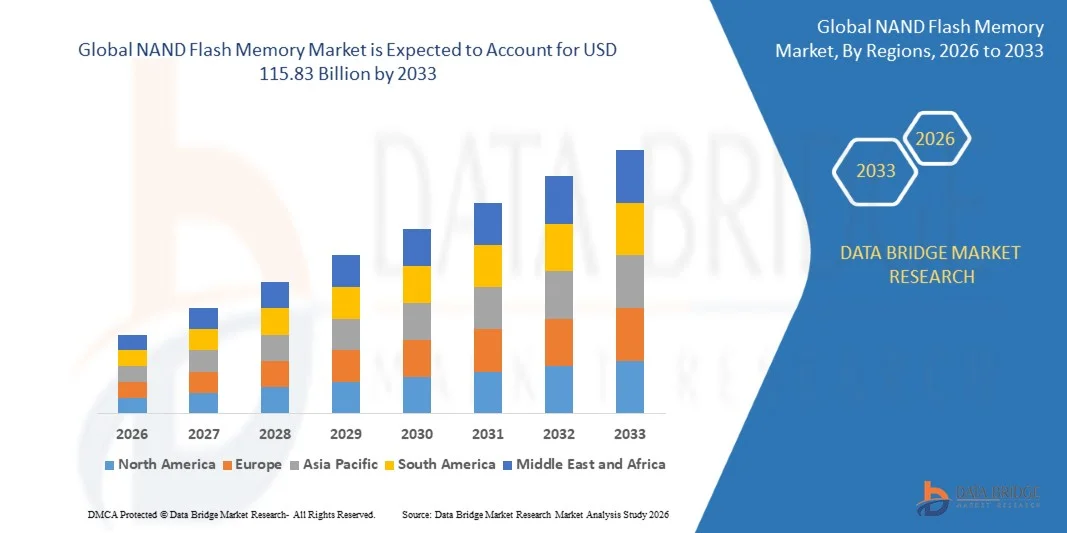
Report Scope and NAND Flash Memory Market Segmentation
|
Attributes |
NAND Flash Memory Key Market Insights |
|
Segments Covered |
· By Type: SLC, MLC, and TLC · By Structure: 2-D Structure and 3-D Structure · By Application: Smartphones, SSD, Memory Cards, and Tablets · By Industry Vertical: Consumer Electronics, Communication & Technology, Automotive, and Manufacturing |
|
Countries Covered |
North America · U.S. · Canada · Mexico Europe · Germany · France · U.K. · Netherlands · Switzerland · Belgium · Russia · Italy · Spain · Turkey · Rest of Europe Asia-Pacific · China · Japan · India · South Korea · Singapore · Malaysia · Australia · Thailand · Indonesia · Philippines · Rest of Asia-Pacific Middle East and Africa · Saudi Arabia · U.A.E. · South Africa · Egypt · Israel · Rest of Middle East and Africa South America · Brazil · Argentina · Rest of South America |
|
Key Market Players |
• SAMSUNG (South Korea) |
|
Market Opportunities |
• Expansion Of AI And Hyperscale Data Center Storage Infrastructure |
|
Value Added Data Infosets |
In addition to the insights on market scenarios such as market value, growth rate, segmentation, geographical coverage, and major players, the market reports curated by the Data Bridge Market Research also include in-depth expert analysis, geographically represented company-wise production and capacity, network layouts of distributors and partners, detailed and updated price trend analysis and deficit analysis of supply chain and demand. |
What is the Key Trend in the NAND Flash Memory Market ?
Trend: Growth In High-Density 3D NAND Architecture And AI-Driven Storage Applications
Increasing digital content generation, rapid cloud computing expansion, and growing AI-driven workloads are accelerating demand for high-capacity, energy-efficient, and high-speed storage technologies across enterprise and consumer environments. Traditional hard disk drives often struggle to meet modern requirements for low latency, compact form factors, and fast data access speeds, encouraging device manufacturers and hyperscale cloud providers to adopt advanced NAND flash memory technologies with higher storage density and improved performance efficiency.
Technology companies are increasingly integrating advanced 3D NAND architectures, For instance in enterprise SSDs and AI data center storage systems, to improve storage scalability, reduce power consumption, and support faster data processing workloads. Smartphone manufacturers, gaming console providers, and laptop OEMs are also deploying high-layer NAND flash memory solutions to support rising consumer demand for larger storage capacities and high-speed application performance.
The rapid expansion of edge computing, autonomous vehicles, and industrial IoT infrastructure is further increasing demand for durable and compact NAND-based storage devices capable of operating under intensive data workloads. In addition, hyperscale cloud service providers continue investing heavily in NAND-based SSD infrastructure to improve AI training efficiency and cloud storage scalability. Data center deployments during 2025 integrating next-generation 232-layer 3D NAND SSDs demonstrated nearly 25–30% improvement in storage density and around 18–22% reduction in power consumption compared to previous-generation NAND architectures.
Global NAND Flash Memory Market Dynamics
Key Market Driver: Rising Adoption Of Cloud Computing And High-Speed Data Storage Infrastructure
Enterprises worldwide are increasingly generating massive volumes of structured and unstructured digital data through AI applications, connected devices, cloud platforms, and digital business operations. Traditional storage technologies are often unable to provide the speed, scalability, and energy efficiency required for modern high-performance computing environments, creating strong demand for advanced NAND flash memory solutions capable of supporting real-time data processing and low-latency storage applications.
Cloud service providers, hyperscale data centers, and enterprise IT organizations are increasingly deploying NAND-based SSD infrastructure to improve storage performance, reduce operational latency, and support AI-driven workloads. Technology companies are integrating NAND flash memory solutions, For instance within enterprise servers, smartphones, and high-performance computing systems, to improve processing speed and optimize power efficiency across digital ecosystems.
Similarly, rising adoption of 5G infrastructure, edge computing networks, and connected consumer electronics is accelerating deployment of high-capacity NAND storage devices globally. Large-scale hyperscale data center expansion projects across the U.S., China, and South Korea during 2024 demonstrated nearly 35–40% increase in enterprise SSD deployment volumes to support AI and cloud computing workloads.
Key Restraint/Challenge: High Capital Investment And Semiconductor Supply Volatility
Manufacturing advanced NAND flash memory requires highly sophisticated semiconductor fabrication facilities, expensive lithography equipment, and continuous investment in next-generation process technologies, significantly increasing operational and capital expenditure requirements for manufacturers. Fluctuations in semiconductor supply chains, raw material availability, and wafer production capacity can further create pricing instability and inventory imbalances across the market.
In addition, rapid technological transitions toward higher-layer NAND architectures require continuous R&D investment and process optimization, creating competitive pressure for smaller manufacturers with limited financial resources. Market oversupply cycles and fluctuations in consumer electronics demand also contribute to NAND pricing volatility and margin pressures for storage suppliers.
Industry pricing assessments indicate that NAND flash memory, For instance enterprise-grade SSD storage modules, experienced average pricing fluctuations of nearly 18–25% during semiconductor inventory correction cycles between 2023 and 2024, impacting profitability and production planning across the storage industry.
Key Market Opportunity: Expansion Of AI Infrastructure And Automotive Storage Applications
AI computing systems, autonomous vehicles, smart industrial systems, and connected consumer devices increasingly require high-speed, compact, and high-endurance storage technologies capable of processing large real-time datasets efficiently. Conventional storage solutions often lack the performance scalability and low-latency capabilities required for AI-driven computing environments and automotive edge processing applications, creating strong demand for advanced NAND flash memory technologies.
Automotive manufacturers and AI infrastructure providers are increasingly integrating NAND flash memory solutions, For instance within autonomous driving systems, infotainment platforms, and AI training servers, to support real-time analytics, machine learning processing, and intelligent mobility applications. Rising adoption of electric vehicles, industrial automation systems, and smart consumer electronics is also accelerating demand for high-capacity NAND-based storage architectures globally.
In addition, advancements in QLC NAND technology, controller optimization, and high-layer 3D NAND architectures are improving storage density, endurance, and cost efficiency across enterprise and consumer applications. AI server deployments conducted during 2025 across North America and Asia-Pacific reported storage performance improvements of nearly 20–28% after integrating next-generation PCIe Gen5 NAND SSD infrastructure into high-performance computing environments.
How is the NAND Flash Memory Market Segmented ?
The market is segmented on the basis of type, structure, application, and industry vertical.
- By Type
On the basis of type, the NAND flash memory market is segmented into SLC, MLC, and TLC. The TLC segment held the largest market revenue share of approximately 57.9% in 2025 driven by its higher storage density, lower cost per gigabyte, and widespread adoption across smartphones, SSDs, laptops, and consumer electronics devices. TLC NAND technology is increasingly preferred by manufacturers because it offers an optimal balance between storage capacity, performance, and affordability for high-volume consumer and enterprise storage applications.
The MLC segment is projected to register the fastest growth at a CAGR of 8.4% from 2026 to 2033, driven by rising demand for higher endurance and improved performance in enterprise SSDs, industrial storage systems, and high-performance computing environments. Increasing adoption across data centers and AI-driven workloads is accelerating segment expansion.
- By Structure
On the basis of structure, the NAND flash memory market is segmented into 2-D Structure and 3-D Structure. The 3-D Structure segment accounted for the largest market share of nearly 76.3% in 2025 driven by increasing industry transition toward high-layer NAND architectures capable of delivering improved storage density, faster processing speeds, and lower power consumption. Technology companies are increasingly deploying 3-D NAND solutions across enterprise SSDs, cloud storage infrastructure, smartphones, and gaming systems to support growing high-capacity data storage requirements.
The 3-D Structure segment is projected to register the fastest growth at a CAGR of 8.9% from 2026 to 2033, driven by continuous advancements in layer-stacking technology, increasing demand for hyperscale data center storage infrastructure, and rapid adoption of AI-powered computing systems. Expanding deployment of high-performance SSDs and edge computing infrastructure is further accelerating segment growth.
- By Application
On the basis of application, the NAND flash memory market is segmented into Smartphones, SSD, Memory Cards, and Tablets. The Smartphones segment dominated the market with a revenue share of approximately 38.7% in 2025 driven by rising global smartphone production, increasing mobile data consumption, and growing consumer demand for high-capacity storage devices supporting AI-enabled applications, 5G connectivity, and high-resolution multimedia content. Smartphone manufacturers increasingly rely on advanced NAND flash memory technologies to improve device performance, storage scalability, and energy efficiency.
The SSD segment is projected to register the fastest growth at a CAGR of 9.3% from 2026 to 2033, driven by increasing enterprise migration toward flash-based storage infrastructure, growing cloud computing adoption, and rising deployment of AI and hyperscale data center technologies. Expanding replacement of traditional hard disk drives with high-speed SSD solutions is accelerating segment expansion globally.
- By Industry Vertical
On the basis of industry vertical, the NAND flash memory market is segmented into Consumer Electronics, Communication & Technology, Automotive, and Manufacturing. The Consumer Electronics segment accounted for the largest market share of approximately 46.8% in 2025 driven by rising demand for smartphones, laptops, gaming consoles, wearable devices, and smart home technologies requiring high-speed and compact storage solutions. Increasing digital content consumption and rapid adoption of connected consumer devices continue to support widespread deployment of NAND flash memory technologies across the electronics sector.
The Automotive segment is projected to register the fastest growth at a CAGR of 9.8% from 2026 to 2033, driven by increasing integration of advanced driver assistance systems (ADAS), autonomous driving technologies, connected infotainment platforms, and electric vehicle computing infrastructure. Rising demand for real-time data processing and high-endurance storage systems within modern intelligent vehicles is accelerating segment expansion globally.
Which Region Holds the Largest Share of the NAND Flash Memory Market?
- North America dominated the NAND flash memory market with the largest revenue share of 36.8% in 2025, driven by strong adoption of hyperscale cloud infrastructure, AI-driven computing systems, and high-performance enterprise storage technologies
- Enterprises and consumers across the region highly prioritize high-speed, energy-efficient, and scalable storage solutions for applications such as cloud computing, gaming, AI processing, and connected consumer electronics
- This widespread adoption is further supported by advanced semiconductor infrastructure, strong presence of leading technology companies, and rising investments in next-generation data center expansion projects, establishing NAND flash memory as a critical component of modern digital infrastructure and enterprise computing ecosystems
U.S. NAND Flash Memory Market Insight
The U.S. NAND flash memory market captured the largest revenue share in 2025 within North America, fueled by rapid expansion of hyperscale cloud data centers and increasing deployment of AI-powered computing infrastructure. Enterprises are increasingly prioritizing high-performance SSD storage systems to support low-latency data processing, cloud applications, and real-time analytics workloads. Rising adoption of gaming consoles, high-end consumer electronics, and AI-enabled enterprise applications is further propelling demand for advanced NAND flash memory technologies. Moreover, increasing investments in semiconductor manufacturing expansion and next-generation storage architecture development are significantly contributing to market growth across the country.
Europe NAND Flash Memory Market Insight
The Europe NAND flash memory market is expected to witness the fastest growth rate from 2026 to 2033, primarily driven by increasing enterprise digitalization and growing demand for high-capacity storage infrastructure across automotive, industrial automation, and cloud computing sectors. The rapid expansion of AI applications, connected industrial systems, and edge computing infrastructure is accelerating adoption of advanced NAND-based SSD solutions across the region. European enterprises are increasingly integrating high-performance storage systems into digital engineering, industrial IoT, and enterprise cloud environments to improve operational efficiency and data accessibility. The region is also witnessing rising investments in semiconductor innovation and advanced automotive electronics infrastructure.
U.K. NAND Flash Memory Market Insight
The U.K. NAND flash memory market is expected to witness the fastest growth rate from 2026 to 2033, driven by increasing cloud computing adoption, rapid growth of AI-enabled business operations, and rising demand for enterprise digital storage solutions. Organizations across the country are increasingly deploying NAND-based SSD infrastructure to support high-speed data processing, remote collaboration platforms, and enterprise analytics applications. The country’s strong digital services ecosystem, combined with rising investments in fintech, cybersecurity, and cloud-native software infrastructure, is further accelerating market growth across enterprise and consumer sectors.
Germany NAND Flash Memory Market Insight
The Germany NAND flash memory market is expected to witness the fastest growth rate from 2026 to 2033, fueled by the country’s strong automotive manufacturing base and increasing deployment of Industry 4.0 technologies across industrial environments. German enterprises are increasingly integrating NAND flash memory technologies into connected vehicles, industrial automation systems, and smart manufacturing infrastructure to support real-time data processing and edge computing applications. Rising emphasis on industrial digitalization, autonomous mobility technologies, and enterprise cloud adoption is significantly supporting market expansion. Integration of high-performance SSD storage systems into advanced automotive electronics and AI-driven industrial systems is also becoming increasingly prevalent.
Asia-Pacific NAND Flash Memory Market Insight
The Asia-Pacific NAND flash memory market is expected to witness the fastest growth rate from 2026 to 2033, driven by rapid semiconductor manufacturing expansion, increasing smartphone production, and rising adoption of connected consumer electronics across countries such as China, Japan, South Korea, and India. Growing investments in AI infrastructure, cloud computing platforms, and 5G-enabled digital ecosystems are accelerating deployment of advanced NAND flash memory technologies across the region. Furthermore, APAC continues to dominate global semiconductor production and electronics manufacturing, significantly supporting market expansion and supply chain growth.
Japan NAND Flash Memory Market Insight
The Japan NAND flash memory market is expected to witness the fastest growth rate from 2026 to 2033 due to the country’s advanced semiconductor technology ecosystem and increasing demand for high-performance storage solutions across consumer electronics and automotive applications. Japanese companies are increasingly investing in next-generation 3D NAND technologies, AI-enabled storage systems, and enterprise SSD infrastructure to improve storage efficiency and processing performance. The growing integration of NAND flash memory into gaming systems, industrial robotics, and connected mobility platforms is further supporting market growth. Moreover, increasing investments in semiconductor R&D and advanced manufacturing capabilities are accelerating adoption of innovative NAND storage technologies across the country.
China NAND Flash Memory Market Insight
The China NAND flash memory market accounted for the largest market revenue share in Asia-Pacific in 2025, attributed to the country’s massive electronics manufacturing ecosystem, rapidly expanding cloud computing infrastructure, and strong consumer demand for smartphones and connected devices. China is one of the world’s largest markets for NAND flash memory applications across smartphones, data centers, enterprise storage systems, and AI infrastructure deployments. The country’s large-scale investments in semiconductor self-sufficiency, AI computing infrastructure, and hyperscale cloud expansion projects, alongside strong domestic electronics manufacturing capabilities, are key factors propelling market growth in China.
Which are the Top Companies in NAND Flash Memory Market?
The NAND Flash Memory industry is primarily led by well-established companies, including:
• SAMSUNG (South Korea)
• Intel Corporation (U.S.)
• Micron Technology, Inc. (U.S.)
• SK HYNIX INC. (South Korea)
• Western Digital Corporation (U.S.)
• KIOXIA Corporation (Japan)
• ATP Electronics,Inc. (U.S.)
• Renesas Electronics Corporation (Japan)
• Powerchip Semiconductor Manufacturing Corp. (Taiwan)
• Infineon Technologies AG. (Germany)
• Everspin Technologies Inc. (U.S.)
• FUJITSU (Japan)
• IBM Corporation (U.S.)
• ADATA Technology Co., Ltd. (Taiwan)
• Kingston Technology Europe Co LLP (U.S.)
What are Latest Developments in NAND Flash Memory Market?
- In June 2025, Kioxia (Japan) introduced its CD9P Series PCIe 5.0 NVMe SSDs based on eighth-generation BiCS FLASH technology as part of its advanced enterprise storage expansion strategy. The new SSD lineup delivers nearly 60% higher sequential read performance per watt and storage capacities reaching 61.44 TB, specifically designed to support AI servers and high-performance data center workloads. The development is expected to improve storage efficiency, reduce energy consumption, and strengthen Kioxia’s competitive position in hyperscale cloud and AI infrastructure markets. Rising deployment of GPU-intensive AI systems is expected to accelerate adoption of high-capacity NAND flash storage solutions globally
- In February 2025, Samsung (South Korea) unveiled its tenth-generation V-NAND technology featuring more than 400 storage layers and transfer speeds of 5.6 GT/s using advanced hybrid bonding technology. The development is aimed at supporting next-generation PCIe 6.0 SSD platforms with improved storage density, faster data transfer performance, and lower power consumption for AI-driven computing applications. The innovation is expected to strengthen Samsung’s leadership position in premium NAND flash memory technologies while supporting growing demand for high-performance enterprise and consumer storage systems. Increasing AI computing workloads and hyperscale data center expansion are expected to further drive market demand for advanced V-NAND architectures
- In February 2025, Kioxia (Japan) and SanDisk (U.S.) jointly demonstrated a 4.8 Gb/s Toggle DDR 6.0 interface integrated with a 332-layer NAND flash memory die to accelerate development of next-generation high-bandwidth storage technologies. The partnership is focused on improving data transfer speed, storage scalability, and operational efficiency for AI accelerators, cloud computing infrastructure, and enterprise SSD applications. The collaboration is expected to reduce product development timelines and strengthen both companies’ positions within the advanced NAND flash memory ecosystem. Growing enterprise demand for faster AI data processing and high-density storage systems is expected to further support adoption of advanced NAND technologies globally

- Interactive Data Analysis Dashboard
- Company Analysis Dashboard for high growth potential opportunities
- Research Analyst Access for customization & queries
- Competitor Analysis with Interactive dashboard
- Latest News, Updates & Trend analysis
- Harness the Power of Benchmark Analysis for Comprehensive Competitor Tracking
Global Nand Flash Memory Market, Supply Chain Analysis and Ecosystem Framework
To support market growth and help clients navigate the impact of geopolitical shifts, DBMR has integrated in-depth supply chain analysis into its Global Nand Flash Memory Market research reports. This addition empowers clients to respond effectively to global changes affecting their industries. The supply chain analysis section includes detailed insights such as Global Nand Flash Memory Market consumption and production by country, price trend analysis, the impact of tariffs and geopolitical developments, and import and export trends by country and HSN code. It also highlights major suppliers with data on production capacity and company profiles, as well as key importers and exporters. In addition to research, DBMR offers specialized supply chain consulting services backed by over a decade of experience, providing solutions like supplier discovery, supplier risk assessment, price trend analysis, impact evaluation of inflation and trade route changes, and comprehensive market trend analysis.
Data collection and base year analysis are done using data collection modules with large sample sizes. The stage includes obtaining market information or related data through various sources and strategies. It includes examining and planning all the data acquired from the past in advance. It likewise envelops the examination of information inconsistencies seen across different information sources. The market data is analysed and estimated using market statistical and coherent models. Also, market share analysis and key trend analysis are the major success factors in the market report. To know more, please request an analyst call or drop down your inquiry.
The key research methodology used by DBMR research team is data triangulation which involves data mining, analysis of the impact of data variables on the market and primary (industry expert) validation. Data models include Vendor Positioning Grid, Market Time Line Analysis, Market Overview and Guide, Company Positioning Grid, Patent Analysis, Pricing Analysis, Company Market Share Analysis, Standards of Measurement, Global versus Regional and Vendor Share Analysis. To know more about the research methodology, drop in an inquiry to speak to our industry experts.
Data Bridge Market Research is a leader in advanced formative research. We take pride in servicing our existing and new customers with data and analysis that match and suits their goal. The report can be customized to include price trend analysis of target brands understanding the market for additional countries (ask for the list of countries), clinical trial results data, literature review, refurbished market and product base analysis. Market analysis of target competitors can be analyzed from technology-based analysis to market portfolio strategies. We can add as many competitors that you require data about in the format and data style you are looking for. Our team of analysts can also provide you data in crude raw excel files pivot tables (Fact book) or can assist you in creating presentations from the data sets available in the report.













