


Nanobody Therapeutics Market Overview
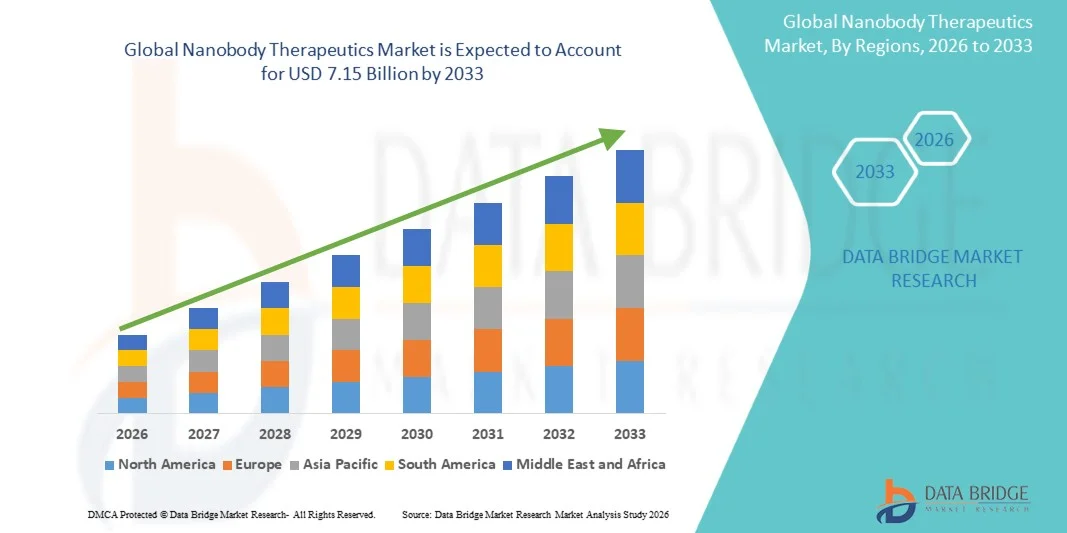
As per Data Bridge Market Research analysis The Nanobody Therapeutics Market was valued at USD 2.34 billion in 2025 and is projected to reach USD 7.15 billion by 2033, growing at a CAGR of 15.00% from 2026 to 2033. The market is experiencing steady growth driven by rising demand for highly specific next-generation biologics, increasing prevalence of chronic and rare diseases, and rapid advancements in antibody engineering and biologic drug development platforms.
The growing focus on targeted therapies in oncology, autoimmune disorders, and hematological diseases, combined with the limitations of conventional monoclonal antibodies in terms of size, tissue penetration, and stability, is accelerating the adoption of nanobody-based therapeutics. Pharmaceutical and biotechnology companies are increasingly investing in single-domain antibody platforms, leveraging their superior solubility, thermal stability, and ability to target hard-to-reach epitopes, thereby expanding their use in precision medicine and advanced biologics development.
Key Market Trends & Insights
- North America dominated the Nanobody Therapeutics Market with the largest revenue share of 38.6% in 2025, supported by strong biopharmaceutical R&D infrastructure, high adoption of advanced biologics, and the presence of leading biotechnology companies.
- The Caplacizumab segment led the market with a 44.6% share in 2025, driven by its established clinical approval for treating acquired thrombotic thrombocytopenic purpura (aTTP) and strong real-world adoption in hematology settings
- Asia-Pacific is expected to be the fastest-growing region at a CAGR of 8.5% from 2026 to 2033, fueled by rising biopharmaceutical manufacturing capacity, increasing clinical trials, and strong government support in China, India, Japan, and South Korea.
- Envafolimab are the fastest-growing molecule type, projected to register a CAGR of 18.9%, reflecting the surge in expanding oncology applications and immune checkpoint inhibition therapies
- The Fc-fused nanobodies segment dominated the nanobody format category with a 38.9% revenue share in 2025, led by improved half-life, better pharmacokinetics, and enhanced therapeutic stability.
- Hematological disorders accounted for 41.3% of the market, preferred by strong clinical use of Caplacizumab in aTTP treatment. Hospitals widely rely on nanobody therapies for rapid intervention in blood-related emergencies.
- The Oncology segment is the fastest-growing indication category, with a CAGR of 19.6%, driven by the increasing use of nanobody-based immunotherapies and tumor-targeting biologics.
Market Size & Forecast
- Global Market Value (2025): USD 2.34 Billion
- Expected Market Value (2033): USD 7.15 Billion
- Forecast CAGR (2026–2033): 15.00%
- Leading Region in 2025: North America
- Fastest Growing Region: Asia Pacific
Report Scope and Nanobody Therapeutics Market Segmentation
|
Attributes |
Nanobody Therapeutics Key Market Insights |
|
Segments Covered |
|
|
Countries Covered |
North America · U.S. · Canada · Mexico Europe · Germany · France · U.K. · Netherlands · Switzerland · Belgium · Russia · Italy · Spain · Turkey · Rest of Europe Asia-Pacific · China · Japan · India · South Korea · Singapore · Malaysia · Australia · Thailand · Indonesia · Philippines · Rest of Asia-Pacific Middle East and Africa · Saudi Arabia · U.A.E. · South Africa · Egypt · Israel · Rest of Middle East and Africa South America · Brazil · Argentina · Rest of South America |
|
Key Market Players |
· Sanofi (France) · Argenx SE (Belgium) · Taisho Pharmaceutical Co., Ltd. (Japan) · Genmab A/S (Denmark) · F. Hoffmann-La Roche Ltd (Switzerland) · Merck KGaA (Germany) · AbbVie Inc. (U.S.) · Pfizer Inc. (U.S.) · Amgen Inc. (U.S.) · Johnson & Johnson Services, Inc. (U.S.) · Bristol-Myers Squibb Company (U.S.) · Novartis AG (Switzerland) · AstraZeneca (U.K.) · GSK plc (U.K.) · Takeda Pharmaceutical Company Limited (Japan) · Eli Lilly and Company (U.S.) · Boehringer Ingelheim International GmbH (Germany) · Regeneron Pharmaceuticals, Inc. (U.S.) · Alpine Immune Sciences, Inc. (U.S.) · Ablynx NV (Belgium) |
|
Market Opportunities |
· Expansion of nanobody-based oncology pipelines targeting hard-to-reach tumor antigens · Growing adoption of nanobodies in CNS and brain-targeted drug delivery · Increasing use of nanobody platforms in diagnostic imaging and companion diagnostics |
|
Value Added Data Infosets |
In addition to the insights on market scenarios such as market value, growth rate, segmentation, geographical coverage, and major players, the market reports curated by the Data Bridge Market Research also include in-depth expert analysis, patient epidemiology, pipeline analysis, pricing analysis, and regulatory framework. |
Nanobody Therapeutics Market Trends
Trend: Expansion of Precision Oncology and Targeted Biologics Adoption
Professional Pharmaceutical and biotechnology companies are increasingly shifting toward nanobody-based drug development as part of the broader move toward precision medicine, especially in oncology and rare diseases. Nanobodies offer superior tumor penetration due to their small molecular size and can bind to hidden or hard-to-reach epitopes that conventional monoclonal antibodies often cannot access. This is driving the development of more advanced formats such as bispecific and multispecific nanobodies, which enhance therapeutic selectivity and efficacy while reducing systemic toxicity. The integration of advanced protein engineering, computational drug design, and next-generation biologics platforms is also accelerating pipeline development and shortening discovery timelines.
For instance, Ablynx (now part of Sanofi) advancing Caplacizumab and expanding nanobody-based oncology and immunology research programs.
Nanobody Therapeutics Market Dynamics
Key Market Driver: Rising Demand for Highly Targeted Biologic Therapies
The increasing global burden of cancer, autoimmune diseases, and rare hematological disorders is significantly boosting demand for highly selective and efficient treatment options. Nanobody therapeutics are gaining traction because they combine high antigen-binding affinity with excellent stability, low immunogenicity, and improved tissue penetration compared to traditional antibodies. Their ability to be engineered into multifunctional formats also enables combination targeting strategies, which are particularly valuable in complex diseases such as cancer and inflammatory conditions. Pharmaceutical companies are heavily investing in nanobody discovery platforms and biologics R&D to improve treatment precision and reduce side effects, while also addressing unmet clinical needs in difficult-to-treat diseases.
For instance, Sanofi and Genmab expanding biologics pipelines with nanobody-based candidates targeting oncology and immune-mediated disorders.
Key Restraint/Challenge: Limited Clinical Maturity and High Development Complexity
Despite strong potential, the nanobody therapeutics market faces significant barriers related to early-stage clinical maturity and the complexity of biologic development. Only a limited number of nanobody-based drugs have reached commercialization, which restricts widespread clinical adoption and slows market expansion. In addition, challenges such as optimizing half-life extension, ensuring stable large-scale production, and meeting stringent regulatory requirements increase both development timelines and costs. The need for specialized manufacturing infrastructure and advanced protein engineering expertise further limits participation to a small group of well-funded pharmaceutical and biotechnology companies.
For instance, multiple pipeline nanobody candidates in oncology and autoimmune diseases still undergoing Phase I/II clinical trials requiring extensive validation before approval.
Key Market Opportunity: Expansion into Multispecific and Next-Generation Biologic Platforms
A major opportunity in the nanobody therapeutics market lies in the rapid evolution toward multispecific biologics, antibody-drug conjugates, and combination therapeutic platforms. Nanobodies can be easily engineered into modular structures, enabling simultaneous targeting of multiple disease pathways, which is especially valuable in oncology, neurodegenerative disorders, and inflammatory diseases. In addition, advancements in AI-driven drug discovery, structural biology, and protein engineering are opening new possibilities for CNS-penetrating nanobodies and personalized medicine approaches. The expansion of partnerships between biotech firms and academic research institutions is also accelerating innovation and broadening therapeutic applications beyond traditional indications.
For instance, Ablynx-led collaborations and emerging biotech startups developing multispecific nanobody constructs for next-generation cancer and autoimmune therapies.
Nanobody Therapeutics Market Scope
The nanobody therapeutics market is segmented on the basis of molecule type, nanobody format, indication, and distribution channel.
- By Molecule Type
On the basis of molecule type, the Nanobody Therapeutics Market is segmented into Caplacizumab, Envafolimab, Ozoralizumab, and Others. The Caplacizumab segment dominated the market with the largest share of 2025 at 44.6%, owing to its established clinical approval for treating acquired thrombotic thrombocytopenic purpura (aTTP) and strong real-world adoption in hematology settings. Its rapid mechanism of action in preventing microvascular thrombosis has made it a critical therapy in emergency and hospital-based care. Strong commercialization support and inclusion in treatment protocols further reinforce its leadership. Increasing awareness of rare blood disorders continues to support steady demand. However, its application remains limited to a narrow indication set.
The Envafolimab segment is expected to be the fastest-growing, registering a CAGR of 18.9% from 2026 to 2033, driven by expanding oncology applications and immune checkpoint inhibition therapies. Its subcutaneous formulation improves patient convenience and reduces hospital dependency. Rising adoption in Asia-Pacific markets and increasing regulatory approvals are strengthening its growth trajectory. Strong clinical pipeline expansion in cancer immunotherapy is further accelerating demand. Pharmaceutical companies are increasingly investing in PD-L1 targeting nanobody platforms.
- By Nanobody Format
On the basis of nanobody format, the market is segmented into Monovalent nanobodies, Bivalent nanobodies, Multivalent nanobodies, and Fc-fused nanobodies. The Fc-fused nanobodies segment dominated the market with the largest share of 2025 at 38.9%, due to improved half-life, better pharmacokinetics, and enhanced therapeutic stability. These formats overcome rapid renal clearance limitations of traditional nanobodies. Strong adoption in oncology and autoimmune pipelines supports continued dominance. Pharmaceutical firms prefer Fc-fused structures for chronic disease applications. Compatibility with existing antibody production systems further strengthens scalability.
The Multivalent nanobodies segment is expected to be the fastest-growing, registering a CAGR of 20.4% from 2026 to 2033, driven by rising demand for multifunctional and highly specific biologics. These constructs enable simultaneous targeting of multiple disease pathways, improving treatment efficacy. Advances in protein engineering and recombinant technologies are accelerating development. Increasing focus on next-generation immunotherapies is boosting adoption. Growing research in combination biologics further supports expansion.
- By Indication
On the basis of indication, the market is segmented into Hematological disorders, Oncology, Autoimmune diseases, Inflammatory diseases, and Others. The Hematological disorders segment dominated the market with the largest share of 2025 at 41.3%, driven by strong clinical use of Caplacizumab in aTTP treatment. Hospitals widely rely on nanobody therapies for rapid intervention in blood-related emergencies. Increasing diagnosis of rare hematological conditions is supporting demand. Strong clinical guideline inclusion ensures consistent adoption. Pharmaceutical companies continue to prioritize hematology-focused nanobody development.
The Oncology segment is expected to be the fastest-growing, registering a CAGR of 19.6% from 2026 to 2033, driven by increasing use of nanobody-based immunotherapies and tumor-targeting biologics. Their superior tumor penetration and binding specificity provide major clinical advantages. Rising global cancer burden is accelerating clinical trials. Expansion of bispecific and multispecific constructs is strengthening pipeline growth. Strong investment in precision oncology is further driving adoption.
- By Distribution Channel
On the basis of distribution channel, the market is segmented into Hospital pharmacies, Specialty pharmacies, and Retail pharmacies. The Hospital pharmacies segment dominated the market with the largest share of 2025 at 53.8%, due to widespread use of nanobody therapeutics in acute care and oncology treatment settings. Most approved therapies are administered under hospital supervision. Strong infrastructure for biologic administration supports dominance. High patient inflow for rare diseases and cancers reinforces demand. Hospitals remain primary centers for critical biologic treatments.
The Specialty pharmacies segment is expected to be the fastest-growing, registering a CAGR of 17.8% from 2026 to 2033, driven by increasing shift toward outpatient biologic therapy and chronic disease management. Growing demand for home-based administration is accelerating adoption. Expansion of patient support programs is strengthening distribution networks. Pharmaceutical companies are increasingly partnering with specialty pharmacy chains. Rising focus on convenience-driven healthcare delivery is further boosting growth.
Nanobody Therapeutics Market Regional Analysis
North America dominated the Nanobody Therapeutics Market with the largest revenue share of 38.6% in 2025, supported by strong biopharmaceutical R&D infrastructure, high adoption of advanced biologics, and the presence of leading biotechnology companies. The region also benefits from high clinical trial activity, strong investment in antibody engineering platforms, and well-established regulatory pathways for biologics approval. Increasing focus on precision medicine, expanding oncology pipelines, and growing use of nanobody-based therapeutics in rare and hematological diseases continue to strengthen North America’s leadership position in the global market.
U.S. Nanobody Therapeutics Market Insight
The U.S. nanobody therapeutics market is witnessing strong growth due to rising investments in advanced biologics research, expanding oncology and rare disease pipelines, and increasing adoption of precision medicine approaches. The country’s highly developed biopharmaceutical ecosystem, along with strong presence of biotechnology firms and academic research centers, is driving innovation in nanobody engineering and clinical development. In addition, growing focus on next-generation antibody formats, increasing clinical trials for targeted cancer therapies, and strong regulatory support for biologics approval are accelerating market adoption across hospitals, research institutes, and pharmaceutical companies.
Europe Nanobody Therapeutics Market Insight
The Europe nanobody therapeutics market remains a major contributor to global revenue, driven by strong academic–industry collaborations, advanced biotechnology infrastructure, and supportive regulatory frameworks for biologics development. The widespread use of nanobody platforms in oncology, hematology, and autoimmune disease research is supporting market expansion across the region. Increasing investments in antibody engineering, growing clinical trial activity, and strong government funding for life sciences innovation continue to enhance adoption of nanobody-based therapies throughout Europe.
U.K. Nanobody Therapeutics Market Insight
The U.K. nanobody therapeutics market is experiencing steady growth, supported by rising adoption of advanced biologics in clinical research, strong pharmaceutical R&D capabilities, and increasing focus on precision medicine. Leading academic institutions and biotech startups are actively engaged in nanobody discovery and therapeutic development for oncology and inflammatory diseases. Furthermore, integration of AI-driven drug discovery platforms, growing investment in biotech innovation hubs, and supportive healthcare research funding are improving development efficiency and strengthening the country’s position in the global nanobody ecosystem.
Germany Nanobody Therapeutics Market Insight
The Germany nanobody therapeutics market is expanding steadily due to the country’s strong pharmaceutical manufacturing base, advanced biotechnology research capabilities, and increasing adoption of next-generation antibody formats. Biopharmaceutical companies and research institutes are actively utilizing nanobody platforms for oncology, autoimmune disorders, and rare disease applications. Continuous advancements in protein engineering, strong focus on translational research, and government support for life sciences innovation are further driving clinical development and commercialization activities in Germany.
Asia-Pacific Nanobody Therapeutics Market Insight
The Asia-Pacific nanobody therapeutics market is expected to witness rapid growth, driven by expanding biopharmaceutical manufacturing, rising clinical research activity, and increasing investments in advanced biologics across countries such as China, India, Japan, and South Korea. Growing focus on affordable biologic therapies, increasing prevalence of chronic diseases, and supportive government initiatives for biotech development are fueling regional market expansion. In addition, the rising presence of contract research and manufacturing organizations (CROs/CMOs) is accelerating clinical pipeline development and commercialization of nanobody-based therapeutics.
Japan Nanobody Therapeutics Market Insight
The Japan nanobody therapeutics market is witnessing consistent growth due to strong investments in advanced biotechnology, increasing focus on precision medicine, and expanding research in antibody engineering. Pharmaceutical companies and academic institutes are increasingly adopting nanobody platforms for oncology, autoimmune diseases, and neurological disorder research. Moreover, integration of cutting-edge drug discovery technologies, strong regulatory framework for biologics, and the country’s emphasis on innovative healthcare solutions are further supporting market development.
China Nanobody Therapeutics Market Insight
The China nanobody therapeutics market is growing rapidly, driven by rising government support for biotechnology innovation, expanding biopharmaceutical R&D capabilities, and increasing clinical trial activity in advanced biologics. Growing adoption of nanobody-based platforms in oncology and immunotherapy applications is significantly boosting market demand. In addition, increasing investments in domestic biotech firms, strong expansion of contract development and manufacturing organizations, and rising focus on affordable precision medicines are positioning China as one of the fastest-growing markets for nanobody therapeutics globally.
Nanobody Therapeutics Market Share
The nanobody therapeutics industry is primarily led by well-established companies, including:
- Sanofi (France)
- Argenx SE (Belgium)
- Taisho Pharmaceutical Co., Ltd. (Japan)
- Genmab A/S (Denmark)
- Hoffmann-La Roche Ltd (Switzerland)
- Merck KGaA (Germany)
- AbbVie Inc. (U.S.)
- Pfizer Inc. (U.S.)
- Amgen Inc. (U.S.)
- Johnson & Johnson Services, Inc. (U.S.)
- Bristol-Myers Squibb Company (U.S.)
- Novartis AG (Switzerland)
- AstraZeneca (U.K.)
- GSK plc (U.K.)
- Takeda Pharmaceutical Company Limited (Japan)
- Eli Lilly and Company (U.S.)
- Boehringer Ingelheim International GmbH (Germany)
- Regeneron Pharmaceuticals, Inc. (U.S.)
- Alpine Immune Sciences, Inc. (U.S.)
- Ablynx NV (Belgium)
Latest Developments in Nanobody Therapeutics Market
- In June 2024, clinical-stage biotechnology programs reported via ClinicalTrials.gov, showed continued progression of multiple nanobody-based candidates in oncology and autoimmune disease indications into Phase II and Phase III trials. These developments highlight increasing industry confidence in nanobody formats for multispecific biologics, improved pharmacokinetics, and advanced therapeutic stability, supporting broader commercialization potential in precision medicine
- In March 2023, Sanofi announced continued advancement of its VHH nanobody antibody platform, focusing on next-generation multispecific biologics for oncology and immunology applications. The development emphasized improved tumor targeting, enhanced tissue penetration, and modular antibody engineering, reflecting the company’s strategic expansion of nanobody-based pipelines to address complex and high-unmet-need diseases
- In August 2022, Taisho Pharmaceutical announced the approval of Ozoralizumab, a trivalent anti-TNF nanobody therapeutic, by Japan’s Pharmaceuticals and Medical Devices Agency (PMDA) for the treatment of rheumatoid arthritis. The therapy demonstrated strong clinical efficacy in reducing inflammation and improving patient outcomes, showcasing the advantages of multivalent nanobody engineering in autoimmune disease management and reinforcing Japan’s leadership in advanced biologics innovation
- In November 2021, Alphamab Oncology, a leading biotechnology company, announced the approval of Envafolimab, a first-in-class subcutaneously administered PD-L1 nanobody, by China’s National Medical Products Administration (NMPA) for the treatment of MSI-H/dMMR solid tumors. The approval marked a significant milestone in nanobody-based immune checkpoint therapy, highlighting the growing clinical adoption of single-domain antibody platforms in oncology and expanding treatment accessibility through convenient subcutaneous administration
- In September 2021, Sanofi (via Ablynx platform) expanded the European use of Caplacizumab (Cablivi) for treating acquired thrombotic thrombocytopenic purpura (aTTP). The therapy gained broader adoption in hospital protocols due to its rapid inhibition of von Willebrand factor-mediated platelet aggregation, significantly improving survival outcomes in acute hematology cases and strengthening the clinical position of nanobody therapeutics in rare blood disorders

- Interactive Data Analysis Dashboard
- Company Analysis Dashboard for high growth potential opportunities
- Research Analyst Access for customization & queries
- Competitor Analysis with Interactive dashboard
- Latest News, Updates & Trend analysis
- Harness the Power of Benchmark Analysis for Comprehensive Competitor Tracking
Data collection and base year analysis are done using data collection modules with large sample sizes. The stage includes obtaining market information or related data through various sources and strategies. It includes examining and planning all the data acquired from the past in advance. It likewise envelops the examination of information inconsistencies seen across different information sources. The market data is analysed and estimated using market statistical and coherent models. Also, market share analysis and key trend analysis are the major success factors in the market report. To know more, please request an analyst call or drop down your inquiry.
The key research methodology used by DBMR research team is data triangulation which involves data mining, analysis of the impact of data variables on the market and primary (industry expert) validation. Data models include Vendor Positioning Grid, Market Time Line Analysis, Market Overview and Guide, Company Positioning Grid, Patent Analysis, Pricing Analysis, Company Market Share Analysis, Standards of Measurement, Global versus Regional and Vendor Share Analysis. To know more about the research methodology, drop in an inquiry to speak to our industry experts.
Data Bridge Market Research is a leader in advanced formative research. We take pride in servicing our existing and new customers with data and analysis that match and suits their goal. The report can be customized to include price trend analysis of target brands understanding the market for additional countries (ask for the list of countries), clinical trial results data, literature review, refurbished market and product base analysis. Market analysis of target competitors can be analyzed from technology-based analysis to market portfolio strategies. We can add as many competitors that you require data about in the format and data style you are looking for. Our team of analysts can also provide you data in crude raw excel files pivot tables (Fact book) or can assist you in creating presentations from the data sets available in the report.












