




Global Nanocapsules Market
Market Size in USD Billion
CAGR :
% 
 USD
4.65 Billion
USD
9.09 Billion
2025
2033
USD
4.65 Billion
USD
9.09 Billion
2025
2033
 Forecast Period Forecast Period |
2026 –2033 |
 Market Size (Base Year) Market Size (Base Year) |
USD 4.65 Billion |
 Market Size (Forecast Year) Market Size (Forecast Year) |
USD 9.09 Billion |
 CAGR CAGR |
% |
| Major Markets Players |
|
Nanocapsules Market Size
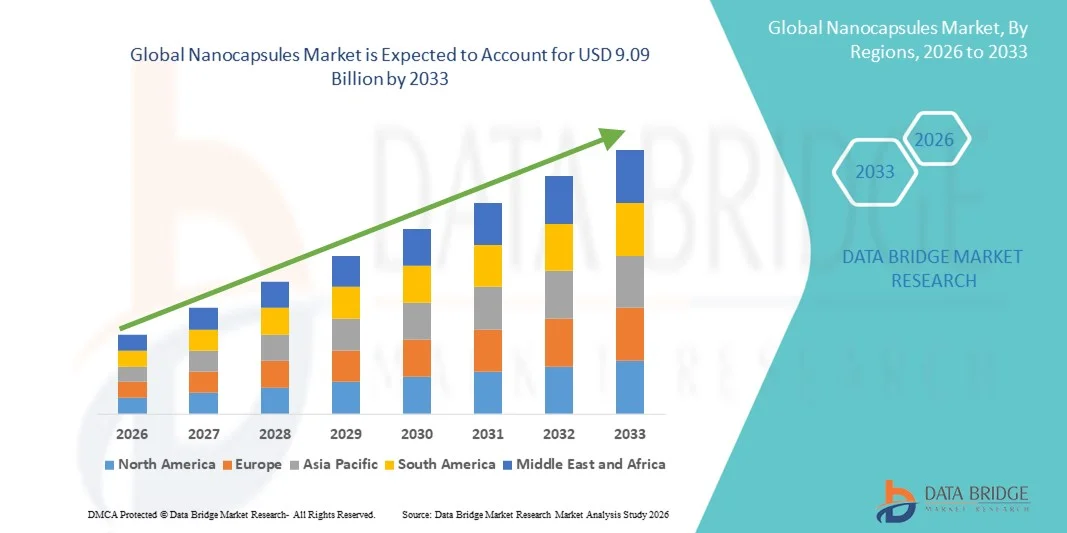
- The global nanocapsules market size was valued at USD 4.65 billion in 2025 and is expected to reach USD 9.09 billion by 2033, at a CAGR of 8.75% during the forecast period
- The market growth is largely fueled by the increasing adoption of advanced nanotechnology‑enabled delivery systems especially in pharmaceuticals, cosmetics, food science, and agriculture that enhance targeted delivery, bioavailability and controlled release of active compounds
- Furthermore, rising demand for efficient drug delivery solutions, personalized medicine, and multifunctional nanocapsule applications across industries is driving innovation and expanding the use of nanocapsules as a preferred platform for high‑performance formulations. These converging factors are accelerating market uptake and significantly boosting industry growth
Nanocapsules Market Analysis
- Nanocapsules, providing encapsulation and controlled release of active compounds, are increasingly vital across pharmaceuticals, cosmetics, and other applications due to their enhanced bioavailability, targeted delivery capabilities, and ability to improve stability of sensitive ingredients
- The escalating demand for nanocapsules is primarily fueled by the growing adoption of advanced drug delivery systems, rising need for personalized medicine, and increasing focus on multifunctional formulations that optimize efficacy while minimizing side effects
- North America dominated the nanocapsules market with the largest revenue share of 38.5% in 2025, characterized by strong pharmaceutical and biotech industries, early adoption of nanotechnology-based solutions, and significant R&D investments, with the U.S. leading in innovative nanocapsule formulations for drug delivery and cosmetic applications
- Asia-Pacific is expected to be the fastest growing region in the nanocapsules market during the forecast period due to rapid industrialization, expanding pharmaceutical and cosmetic sectors, rising healthcare expenditure, and increasing consumer awareness of advanced delivery systems
- Synthetic polymers segment dominated the nanocapsules market with a share of 51.2% in 2025, driven by their tunable properties, reproducibility, and suitability for large-scale pharmaceutical and cosmetic production
Report Scope and Nanocapsules Market Segmentation
|
Attributes |
Nanocapsules Key Market Insights |
|
Segments Covered |
|
|
Countries Covered |
North America
Europe
Asia-Pacific
Middle East and Africa
South America
|
|
Key Market Players |
|
|
Market Opportunities |
|
|
Value Added Data Infosets |
In addition to the insights on market scenarios such as market value, growth rate, segmentation, geographical coverage, and major players, the market reports curated by the Data Bridge Market Research also include in-depth expert analysis, patient epidemiology, pipeline analysis, pricing analysis, and regulatory framework |
Nanocapsules Market Trends
Advancement in Targeted and Controlled Drug Delivery Systems
- A significant and accelerating trend in the global nanocapsules market is the growing emphasis on targeted and controlled drug delivery technologies aimed at improving therapeutic efficacy while minimizing systemic side effects across multiple therapy areas
- For instance, nanocapsule-based formulations are increasingly being adopted in oncology to enable site-specific delivery of chemotherapeutic agents, enhancing drug accumulation at tumor sites while reducing toxicity to healthy tissues
- Advancements in polymer engineering are enabling the development of nanocapsules with tunable release profiles, improved stability, and enhanced biocompatibility. For instance, synthetic polymer nanocapsules are being designed to respond to pH or enzymatic triggers for precise drug release
- The integration of nanocapsules into cosmetic and dermatological formulations is also gaining traction, as they allow controlled release of active ingredients and improved skin penetration, resulting in enhanced product performance and longer-lasting effects
- This trend toward multifunctional and smart nanocapsule systems is reshaping formulation strategies across pharmaceutical and cosmetic industries. Consequently, companies and research institutions are focusing on scalable nanocapsule platforms suitable for both parenteral and oral routes of administration
- Continuous research advancements are enabling the incorporation of multiple active agents within a single nanocapsule system, supporting combination therapies that improve treatment outcomes, particularly in oncology and pain management
- The demand for advanced nanocapsule technologies offering targeted delivery, controlled release, and improved bioavailability is rising steadily across pharmaceutical and cosmetic applications, supporting sustained market expansion
Nanocapsules Market Dynamics
Driver
Rising Demand for Advanced Drug Delivery and Personalized Medicine
- The increasing demand for advanced drug delivery systems, coupled with the growing focus on personalized medicine, is a key driver accelerating the adoption of nanocapsules in pharmaceutical applications
- For instance, pharmaceutical companies are increasingly investing in nanocapsule-based formulations to improve the therapeutic index of existing drugs and extend product life cycles through novel delivery mechanisms
- As healthcare providers seek more effective and patient-centric treatment options, nanocapsules offer advantages such as enhanced bioavailability, controlled release, and reduced dosing frequency compared to conventional formulations
- Furthermore, the rising prevalence of chronic diseases, including cancer and endocrine disorders, is driving demand for nanocapsule-enabled therapies that enable precise targeting and sustained drug release
- Increasing investments in pharmaceutical research and nanotechnology innovation by public and private organizations are accelerating the commercialization of nanocapsule-based drug delivery platforms worldwide
- The expanding use of nanocapsules in cosmetic and dermatological products to enhance ingredient stability, controlled release, and product differentiation is further supporting overall market demand
- The ability of nanocapsules to support both parenteral and oral administration routes, along with their compatibility with a wide range of active ingredients, is significantly contributing to their growing adoption across global healthcare markets
Restraint/Challenge
Complex Manufacturing Processes and Regulatory Compliance Hurdles
- The complexity associated with nanocapsule manufacturing, including precise control over particle size, encapsulation efficiency, and batch-to-batch consistency, presents a significant challenge to large-scale commercialization
- For instance, stringent regulatory requirements for nanotechnology-based drug delivery systems often demand extensive safety, toxicity, and stability data, increasing development timelines and costs for manufacturers
- Ensuring reproducibility and scalability of nanocapsule formulations while maintaining performance characteristics remains a technical hurdle, particularly for oral and parenteral pharmaceutical products
- In addition, limited standardized regulatory frameworks for nanomedicine across different regions can create uncertainty for market participants, potentially delaying product approvals and market entry
- High capital requirements for specialized manufacturing equipment and quality control systems can limit market entry for small and mid-sized companies, restricting competitive diversity
- Limited clinical familiarity and cautious adoption among healthcare providers regarding nanotechnology-based formulations may slow market penetration, particularly in emerging economies with conservative regulatory environments
- Overcoming these challenges through process optimization, regulatory harmonization, and increased collaboration between industry and regulatory bodies will be critical for the sustained growth of the global nanocapsules market
Nanocapsules Market Scope
The market is segmented on the basis of polymer type, application, therapy area, and route of administration.
- By Polymer Type
On the basis of polymer type, the global nanocapsules market is segmented into natural polymers and synthetic polymers. The synthetic polymers segment dominated the market in 2025 with a market share of 51.2%, driven by their superior physicochemical stability, tunable release characteristics, and strong compatibility with a wide range of active pharmaceutical ingredients. Synthetic polymers allow precise control over particle size, degradation rate, and encapsulation efficiency, making them highly suitable for large-scale pharmaceutical manufacturing. Their reproducibility and ease of functional modification further support adoption in both parenteral and oral drug delivery applications. In addition, synthetic polymers are widely preferred in oncology formulations due to their predictable performance and regulatory familiarity.
The natural polymers segment is expected to witness the fastest growth during the forecast period, fueled by rising demand for biocompatible, biodegradable, and patient-friendly drug delivery systems. Increasing emphasis on reducing long-term toxicity and improving safety profiles is driving interest in natural polymer-based nanocapsules. These materials are gaining traction in oral delivery and cosmetic applications due to their favorable interaction with biological systems. Growing research activity and regulatory encouragement for sustainable materials are further accelerating adoption.
- By Application
On the basis of application, the nanocapsules market is segmented into pharmaceutical, cosmetic, and others. The pharmaceutical segment held the largest market revenue share in 2025, driven by the widespread use of nanocapsules in advanced drug delivery systems. Pharmaceutical companies increasingly utilize nanocapsules to enhance bioavailability, protect unstable drugs, and enable controlled and targeted release. Their role in improving therapeutic efficacy while minimizing side effects makes them integral to modern formulation strategies. Strong investment in nanomedicine research and rising prevalence of chronic diseases further support dominance of this segment.
The cosmetic segment is anticipated to grow at the fastest rate during the forecast period, supported by increasing demand for high-performance skincare and personal care products. Nanocapsules enable controlled release of active ingredients, improved skin penetration, and prolonged product efficacy. Rising consumer preference for premium cosmetic formulations and functional beauty products is accelerating adoption. In addition, innovation in anti-aging, dermatological, and sun-care formulations is expanding nanocapsule usage in this segment.
- By Therapy Area
On the basis of therapy area, the market is segmented into oncology, pain management, endocrinology, and others. The oncology segment dominated the market in 2025, driven by the critical need for targeted drug delivery systems that reduce systemic toxicity of chemotherapeutic agents. Nanocapsules improve drug accumulation at tumor sites while minimizing damage to healthy tissues, making them highly valuable in cancer treatment. The rising global cancer burden and strong pipeline of nanotechnology-based oncology drugs support this segment’s leadership. Ongoing clinical research and favorable outcomes further reinforce its dominance.
The endocrinology segment is expected to witness the fastest growth over the forecast period, driven by increasing prevalence of metabolic and hormonal disorders such as diabetes and thyroid conditions. Nanocapsules improve stability and controlled release of endocrine drugs, enhancing therapeutic consistency. Growing demand for patient-friendly and long-acting formulations is accelerating adoption. Advances in oral nanocapsule delivery systems are further supporting rapid growth in this therapy area.
- By Route of Administration
On the basis of route of administration, the global nanocapsules market is segmented into parenteral route and oral route. The parenteral route segment accounted for the largest revenue share in 2025, driven by its widespread use in oncology and hospital-based treatments requiring precise dosing and rapid therapeutic action. Parenteral nanocapsules allow direct systemic delivery, improved bioavailability, and controlled drug release. Their suitability for injectable formulations makes them highly preferred for critical and acute therapies. Strong clinical acceptance and regulatory clarity further support dominance of this segment.
The oral route segment is projected to be the fastest growing during the forecast period, driven by rising demand for non-invasive and patient-compliant drug delivery options. Nanocapsules enhance oral bioavailability by protecting drugs from degradation in the gastrointestinal tract. Increasing focus on chronic disease management and home-based treatment is accelerating growth. Continuous advancements in polymer science are further improving the feasibility of oral nanocapsule formulations.
Nanocapsules Market Regional Analysis
- North America dominated the nanocapsules market with the largest revenue share of 38.5% in 2025, characterized by strong pharmaceutical and biotech industries, early adoption of nanotechnology-based solutions, and significant R&D investments, with the U.S. leading in innovative nanocapsule formulations for drug delivery and cosmetic applications
- Healthcare providers and pharmaceutical companies in the region highly value the enhanced bioavailability, targeted delivery capabilities, and controlled release profiles offered by nanocapsules, particularly in oncology and chronic disease treatments
- This widespread adoption is further supported by a robust regulatory framework, well-established clinical research infrastructure, and growing demand for personalized and high-efficacy therapies, positioning nanocapsules as a preferred solution across pharmaceutical and cosmetic applications
U.S. Nanocapsules Market Insight
The U.S. nanocapsules market captured the largest revenue share within North America in 2025, driven by strong pharmaceutical and biotechnology industries and high investments in advanced drug delivery research. Pharmaceutical companies and research institutions are increasingly prioritizing nanocapsule-based formulations to improve therapeutic efficacy and reduce side effects. The growing focus on personalized medicine, oncology therapeutics, and chronic disease management further propels market growth. Moreover, the presence of advanced clinical research infrastructure and favorable regulatory pathways for innovative drug delivery systems is significantly contributing to market expansion.
Europe Nanocapsules Market Insight
The Europe nanocapsules market is projected to expand at a substantial CAGR throughout the forecast period, primarily driven by strong emphasis on pharmaceutical innovation and stringent regulatory standards for drug safety and efficacy. Increasing investments in nanomedicine research and rising demand for advanced therapeutic solutions are fostering market adoption. European manufacturers are also leveraging nanocapsules in cosmetic and dermatological formulations to enhance product performance. The region is witnessing steady growth across pharmaceutical, cosmetic, and research applications, supported by both public and private funding initiatives.
U.K. Nanocapsules Market Insight
The U.K. nanocapsules market is anticipated to grow at a noteworthy CAGR during the forecast period, driven by expanding pharmaceutical research activities and increasing adoption of advanced drug delivery technologies. The growing burden of chronic diseases and cancer is encouraging the development of targeted nanocapsule-based therapies. In addition, strong collaboration between academic institutions and pharmaceutical companies is accelerating innovation. The U.K.’s supportive regulatory environment and focus on life sciences are expected to sustain market growth.
Germany Nanocapsules Market Insight
The Germany nanocapsules market is expected to expand at a considerable CAGR during the forecast period, fueled by the country’s strong pharmaceutical manufacturing base and emphasis on technological innovation. Germany’s focus on high-quality, precision-driven healthcare solutions supports the adoption of nanocapsule-based drug delivery systems. Increasing use of nanocapsules in oncology and endocrinology therapies is contributing to growth. Furthermore, the integration of nanotechnology into pharmaceutical and cosmetic product development aligns well with local industry strengths.
Asia-Pacific Nanocapsules Market Insight
The Asia-Pacific nanocapsules market is poised to grow at the fastest CAGR during the forecast period, driven by rapid expansion of pharmaceutical manufacturing, rising healthcare expenditure, and increasing adoption of advanced drug delivery technologies in countries such as China, Japan, and India. The region’s growing focus on affordable and effective therapies is accelerating demand for nanocapsule formulations. In addition, APAC’s emergence as a major hub for pharmaceutical production and clinical research is improving accessibility and scalability of nanocapsule-based products.
Japan Nanocapsules Market Insight
The Japan nanocapsules market is gaining momentum due to the country’s strong focus on technological innovation, advanced healthcare infrastructure, and rising demand for high-efficacy therapeutic solutions. The adoption of nanocapsules is supported by increasing research in oncology and chronic disease management. Integration of nanotechnology into pharmaceutical and cosmetic applications is further fueling growth. Moreover, Japan’s aging population is likely to drive demand for targeted and controlled-release drug delivery systems.
India Nanocapsules Market Insight
The India nanocapsules market accounted for a significant revenue share within Asia Pacific in 2025, attributed to the country’s rapidly expanding pharmaceutical sector and growing investment in drug formulation research. Increasing prevalence of chronic diseases and rising demand for cost-effective advanced therapies are driving adoption of nanocapsules. India’s strong generic drug manufacturing base and expanding clinical research capabilities support market growth. In addition, government initiatives promoting pharmaceutical innovation and domestic manufacturing are further propelling the nanocapsules market in India.
Nanocapsules Market Share
The Nanocapsules industry is primarily led by well-established companies, including:
- Camurus AB (Sweden)
- L’Oréal (France)
- Evonik Industries AG (Germany)
- Capsulæ SAS (France)
- Lipoid GmbH (Germany)
- Nanoshell Company, LLC (U.S.)
- Microtek Laboratories, Inc. (U.S.)
- Cerbios-Pharma SA (Switzerland)
- NanoPack Technologies (U.S.)
- Capsulution Pharma AG (Switzerland)
- Cerulean Pharma Inc. (U.S.)
- NanoCarrier Co., Ltd. (Japan)
- NanoNutra (U.S.)
- NanoSphere Health Science (U.S.)
- Nano Green Sciences, Inc. (U.S.)
- PolyMicrospheres, Inc. (U.S.)
- GAT Food Essentials (U.S.)
- Nucaps (Spain)
- Evonik Nutrition & Care GmbH (Germany)
- Cambridge Nanotheranostics Ltd. (U.K.)
What are the Recent Developments in Global Nanocapsules Market?
- In April 2025, the EMA’s Committee for Medicinal Products for Human Use (CHMP) adopted a positive opinion for market authorization of Oczyesa® (CAM2029) a once-monthly octreotide nanocapsule depot for maintenance treatment of acromegaly pushing this targeted delivery technology closer to clinical use in the EU
- In November 2024, a study published reported the creation of lipid nanocapsule–chitosan and iota-carrageenan hydrogel composites for sustained hydrophobic drug delivery, demonstrating novel nanocapsule designs that improve stability and controlled release for challenging drug molecules
- In May 2024, Camurus announced that the European Medicines Agency (EMA) accepted the Market Authorization Application (MAA) for its octreotide subcutaneous depot (CAM2029), a novel nanocapsule-based long-acting formulation for acromegaly, marking a key regulatory advancement for nanocapsule drug delivery systems in endocrine therapy
- In April 2024, scientists at Nanyang Technological University (NTU) Singapore announced the development of self-assembling peptide-based nanocapsules inspired by caterpillars, which can be fine-tuned for drug and mRNA delivery without templates, opening customizable biomedical applications
- In October 2023, researchers at UCLA developed a drug-filled nanocapsule that significantly improves the effectiveness of cancer immunotherapy in mice, showing that lactate-oxidase encapsulated nanocapsules can boost immune cell activity against solid tumors and potentially enhance checkpoint blockade therapies
SKU-
Get online access to the report on the World's First Market Intelligence Cloud

- Interactive Data Analysis Dashboard
- Company Analysis Dashboard for high growth potential opportunities
- Research Analyst Access for customization & queries
- Competitor Analysis with Interactive dashboard
- Latest News, Updates & Trend analysis
- Harness the Power of Benchmark Analysis for Comprehensive Competitor Tracking
Research Methodology
Data collection and base year analysis are done using data collection modules with large sample sizes. The stage includes obtaining market information or related data through various sources and strategies. It includes examining and planning all the data acquired from the past in advance. It likewise envelops the examination of information inconsistencies seen across different information sources. The market data is analysed and estimated using market statistical and coherent models. Also, market share analysis and key trend analysis are the major success factors in the market report. To know more, please request an analyst call or drop down your inquiry.
The key research methodology used by DBMR research team is data triangulation which involves data mining, analysis of the impact of data variables on the market and primary (industry expert) validation. Data models include Vendor Positioning Grid, Market Time Line Analysis, Market Overview and Guide, Company Positioning Grid, Patent Analysis, Pricing Analysis, Company Market Share Analysis, Standards of Measurement, Global versus Regional and Vendor Share Analysis. To know more about the research methodology, drop in an inquiry to speak to our industry experts.
Customization Available
Data Bridge Market Research is a leader in advanced formative research. We take pride in servicing our existing and new customers with data and analysis that match and suits their goal. The report can be customized to include price trend analysis of target brands understanding the market for additional countries (ask for the list of countries), clinical trial results data, literature review, refurbished market and product base analysis. Market analysis of target competitors can be analyzed from technology-based analysis to market portfolio strategies. We can add as many competitors that you require data about in the format and data style you are looking for. Our team of analysts can also provide you data in crude raw excel files pivot tables (Fact book) or can assist you in creating presentations from the data sets available in the report.












