


What is the Global Nanocellulose / Nanocellulose-reinforced Packaging Films Market Size and Growth Rate?
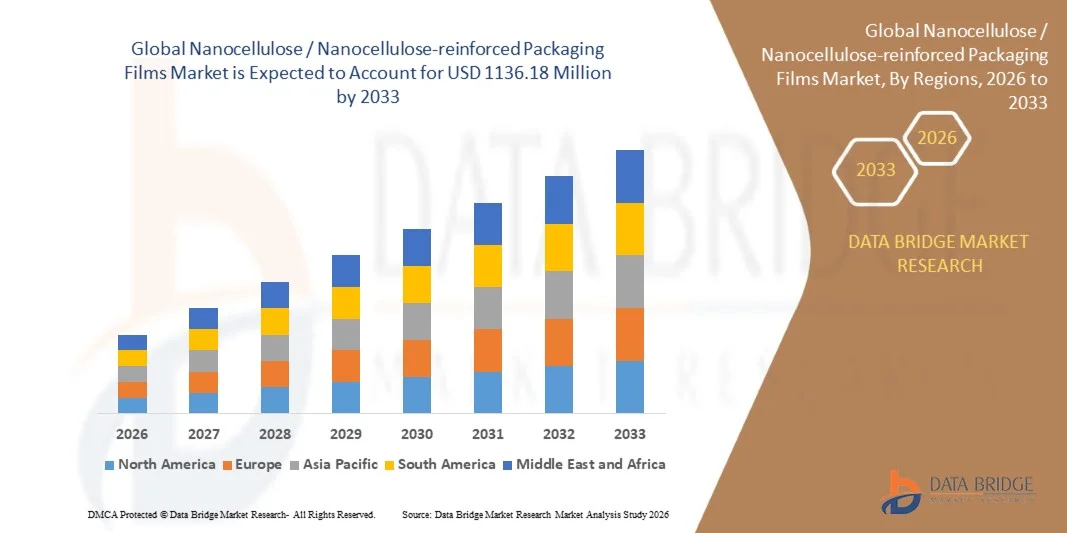
- As per Data Bridge Market Research Analysis the global Nanocellulose / Nanocellulose-reinforced Packaging Films market size was valued at USD 366.24 million in 2025 and is expected to reach USD 1136.18 million by 2033, at a CAGR of 15.20% during the forecast period
- The nanocellulose market is experiencing significant traction due to its rapid integration into innovative product development, especially in sectors emphasizing lightweight and high-strength materials
- Companies are increasingly investing in nanocellulose to enhance product performance, reduce environmental impact, and meet evolving consumer preferences for green alternatives
Market Size & Forecast
- Global Market Value (2025): USD 366.24 million
- Expected Market Value (2033): USD 1136.18 million
- Forecast CAGR (2026–2033): 15.20%
What are the Major Takeaways of Nanocellulose / Nanocellulose-reinforced Packaging Films Market?
- This growth is driven by factors such as the rising demand for sustainable materials and expanding applications across diverse industries
- North America dominated the Nanocellulose / Nanocellulose-reinforced Packaging Films market with a 41.03% revenue share in 2025, driven by strong growth in sustainable packaging adoption, high demand for biodegradable films, and rapid expansion of R&D activities across the U.S. and Canada
- Asia-Pacific is projected to register the fastest CAGR of 8.69% from 2026 to 2033, driven by rising packaging demands in China, India, Japan, South Korea, and Southeast Asia
- The Microfibrillated and Nanofibrillated Cellulose segment dominated the market with a 46.5% share in 2025, driven by its superior mechanical strength, flexibility, high aspect ratio, and excellent barrier properties against oxygen and grease
Report Scope and Nanocellulose / Nanocellulose-reinforced Packaging Films Market Segmentation
|
Attributes |
Nanocellulose / Nanocellulose-reinforced Packaging Films Key Market Insights |
|
Segments Covered |
|
|
Countries Covered |
North America
Europe
Asia-Pacific
Middle East and Africa
South America
|
|
Key Market Players |
|
|
Market Opportunities |
|
|
Value Added Data Infosets |
In addition to the insights on market scenarios such as market value, growth rate, segmentation, geographical coverage, and major players, the market reports curated by the Data Bridge Market Research also include in-depth expert analysis, pricing analysis, brand share analysis, consumer survey, demography analysis, supply chain analysis, value chain analysis, raw material/consumables overview, vendor selection criteria, PESTLE Analysis, Porter Analysis, and regulatory framework. |
What is the Key Trend in the Nanocellulose / Nanocellulose-reinforced Packaging Films Market?
“Rising Use of Nanocellulose in Electronics”
- Nanocellulose is gaining momentum as a sustainable material for use in electronics due to its lightweight and high-strength features
- It is increasingly being integrated into flexible displays, wearable tech, and printable electronics, thanks to its natural compatibility with conductive materials
- For instance, scientists have developed nanocellulose-based films that serve as biodegradable substrates for semiconductors in smart devices
- The demand for green alternatives in electronics is pushing manufacturers to explore nanocellulose for circuit boards and sensor technologies
- As innovation continues, nanocellulose is becoming a top choice for enhancing the performance and eco-friendliness of tech products
- In conclusion, the trend of nanocellulose adoption in electronics is shaping the current market. Its blend of sustainability and high performance is transforming how devices are built and used
What are the Key Drivers of Nanocellulose / Nanocellulose-reinforced Packaging Films Market?
- Increasing global awareness around plastic pollution is pushing industries to adopt biodegradable and renewable alternatives such as nanocellulose in packaging
- Nanocellulose offers high strength lightweight structure and excellent barrier properties which make it ideal for replacing traditional plastics in food and consumer goods packaging
- For instance, companies such as UPM and Melodea Ltd are already developing nanocellulose-based films and coatings to meet eco-friendly packaging needs
- Regulatory bans on single-use plastics in multiple countries are accelerating the shift toward sustainable materials creating strong market momentum
- Brands are actively adopting nanocellulose to enhance their environmental profile respond to consumer demand and align with global sustainability goals
- In conclusion, the packaging industry’s move toward green materials is driving nanocellulose adoption
Which Factor is Challenging the Growth of the Nanocellulose / Nanocellulose-reinforced Packaging Films Market?
- Extracting nanocellulose from plant or bacterial sources requires energy-heavy methods such as mechanical shearing acid hydrolysis or enzyme treatment which demand advanced infrastructure and high operational costs
- The production cost of nanocellulose is still significantly higher than conventional materials such as polyethylene or wood pulp making it less feasible for mass-market applications
- For instance, CelluForce in Canada and Borregaard in Norway have invested in pilot-scale facilities but still face challenges in scaling up while maintaining quality and cost control
- Water-intensive processes and waste management during production further complicate industrial scalability especially for companies lacking the resources to adopt such technologies
- Inconsistent batch quality and lack of industry-standard procedures continue to delay large-scale adoption despite increasing interest across sectors
- In conclusion, high cost and scale challenges slow market entry for nanocellulose
How is the Nanocellulose / Nanocellulose-reinforced Packaging Films Market Segmented?
The market is segmented on the basis of type, application, and distribution channel.
• By Type
On the basis of type, the Nanocellulose / Nanocellulose-reinforced Packaging Films market is segmented into Microfibrillated and Nanofibrillated Cellulose (MFC/NFC), Cellulose Nanocrystal (CNC)/Nanocrystalline Cellulose, and Others. The Microfibrillated and Nanofibrillated Cellulose segment dominated the market with a 46.5% share in 2025, driven by its superior mechanical strength, flexibility, high aspect ratio, and excellent barrier properties against oxygen and grease. These properties make MFC/NFC highly suitable for sustainable packaging films and lightweight composite structures.
The Cellulose Nanocrystal (CNC) segment is projected to grow at the fastest CAGR from 2026 to 2033, supported by rising demand for high-stiffness reinforcement materials, transparent films, and advanced biodegradable packaging solutions.
• By Application
On the basis of application, the market is segmented into Paper Processing, Composites and Packaging, Paints and Coatings, Oil and Gas, Biomedical and Pharmaceuticals, Electronics and Sensors, and Food and Beverages. The Composites and Packaging segment dominated the market with a 38.9% share in 2025, owing to increasing demand for lightweight, biodegradable, and high-barrier packaging films in food, personal care, and industrial applications. Nanocellulose enhances tensile strength, reduces plastic usage, and improves sustainability profiles.
The Biomedical and Pharmaceuticals segment is expected to grow at the fastest CAGR from 2026 to 2033, driven by expanding use of nanocellulose in wound dressings, drug delivery systems, tissue engineering scaffolds, and biocompatible films.
• By Distribution Channel
On the basis of distribution channel, the Nanocellulose / Nanocellulose-reinforced Packaging Films market is segmented into Online and Offline. The Offline segment dominated the market with a 63.4% share in 2025, supported by direct procurement contracts, industrial supplier networks, and bulk purchasing agreements between manufacturers and packaging converters. Technical consultations and customized product development further strengthen offline channel dominance.
The Online segment is projected to grow at the fastest CAGR from 2026 to 2033, fueled by increasing digital procurement platforms, B2B e-commerce expansion, and growing accessibility for small and medium enterprises seeking sustainable packaging materials.
Which Region Holds the Largest Share of the Nanocellulose / Nanocellulose-reinforced Packaging Films Market?
- North America dominated the nanocellulose / nanocellulose-reinforced packaging films market with a 41.03% revenue share in 2025, driven by strong growth in sustainable packaging adoption, high demand for biodegradable films, and rapid expansion of R&D activities across the U.S. and Canada. Increasing awareness of eco-friendly packaging, regulatory mandates for reduced plastic usage, and strong industrial demand continue to fuel market growth across food, personal care, and industrial packaging sectors
- Leading companies in North America are investing in high-performance nanocellulose production facilities, scalable manufacturing processes, and innovative packaging solutions, strengthening the region’s technological leadership. Continuous investments in green packaging technologies, bio-based composites, and sustainable supply chains support long-term market expansion
- High concentration of packaging manufacturers, research institutions, and government-backed sustainability programs further reinforce regional market dominance
U.S. Nanocellulose / Nanocellulose-reinforced Packaging Films Market Insight
The U.S. is the largest contributor in North America, supported by increasing demand for biodegradable and nanocellulose-reinforced films in food, beverage, electronics, and pharmaceutical packaging. Rising sustainability regulations, adoption of lightweight high-barrier packaging, and growing consumer preference for eco-friendly products drive market expansion. Presence of leading packaging companies, strong innovation ecosystems, and investments in pilot-scale nanocellulose plants strengthen domestic growth and technology adoption.
Canada Nanocellulose / Nanocellulose-reinforced Packaging Films Market Insight
Canada contributes significantly to regional growth, fueled by sustainable packaging initiatives, rising adoption of bio-based films in food and personal care industries, and government incentives for green technologies. Packaging R&D centers, industrial collaborations, and expanding nanocellulose manufacturing capabilities enable the country to strengthen market penetration.
Asia-Pacific Nanocellulose / Nanocellulose-reinforced Packaging Films Market
Asia-Pacific is projected to register the fastest CAGR of 8.69% from 2026 to 2033, driven by rising packaging demands in China, India, Japan, South Korea, and Southeast Asia. Rapid growth in food and beverage production, e-commerce packaging, and pharmaceutical packaging is increasing demand for high-performance, biodegradable, and nanocellulose-reinforced films. Expanding manufacturing hubs and investments in sustainable packaging solutions further accelerate market growth.
China Nanocellulose / Nanocellulose-reinforced Packaging Films Market Insight
China is the largest contributor to Asia-Pacific, supported by large-scale manufacturing of bio-based films, government policies promoting green packaging, and rising investments in nanocellulose R&D. Strong industrial adoption in food, cosmetics, and electronics packaging drives domestic and export market demand.
Japan Nanocellulose / Nanocellulose-reinforced Packaging Films Market Insight
Japan exhibits steady growth due to precision manufacturing, high adoption of advanced packaging technologies, and regulatory compliance for sustainable materials. Demand for lightweight, transparent, and high-barrier films supports the market expansion of nanocellulose-reinforced packaging.
India Nanocellulose / Nanocellulose-reinforced Packaging Films Market Insight
India is emerging as a major growth hub, driven by rising food and pharmaceutical packaging demand, increasing startup activity, and government-backed initiatives for sustainable materials. Growing investments in nanocellulose production and packaging innovation accelerate market penetration.
South Korea Nanocellulose / Nanocellulose-reinforced Packaging Films Market Insight
South Korea contributes significantly, supported by advanced packaging technology adoption, high consumer demand for eco-friendly products, and investments in biocomposite manufacturing. Expanding electronics and food packaging industries further boost market growth.
Which are the Top Companies in Nanocellulose / Nanocellulose-reinforced Packaging Films Market?
The nanocellulose / nanocellulose-reinforced packaging films industry is primarily led by well-established companies, including:
- FPInnovations (Canada)
- CelluForce (Canada)
- Stora Enso (Finland)
- Kruger Inc. (Canada)
- DAICEL FINECHEM LTD. (Japan)
- Borregaard (Norway)
- NIPPON PAPER INDUSTRIES CO. LTD. (Japan)
- UPM (Finland)
- Melodea Ltd. (Israel)
- CelluComp (United Kingdom)
- Blue Goose Biorefineries Inc. (Canada)
- Oji Holdings Corporation (Japan)
- VTT (Finland)
- Sappi (South Africa)
- Weidmann Holding AG (Switzerland)
- BioVision Technologies Inc. (Canada)
- J. RETTENMAIER and SÖHNE GmbH + Co KG (Germany)
- Novozymes (Denmark)
- INEOS AG (United Kingdom)
- Triveni Interchem Private Limited (Group Of Triveni Chemicals) (India)
What are the Recent Developments in Global Nanocellulose / Nanocellulose-reinforced Packaging Films Market?
- In April 2025, CSIR-IICT licensed its innovative technology for nanocellulose-engineered compostable plastics to three companies. This development aims to provide a sustainable alternative to conventional plastics using biodegradable materials. The initiative reflects growing industry interest in eco-friendly packaging solutions and aligns with India's push for green innovation
- In November 2024, Biesterfeld partnered with Anomera Inc. to distribute nanocellulose-based additives for the CASE industry. The collaboration supports sustainable innovation with enhanced performance in coatings and adhesives
- In October 2022, Toyoda Gosei developed cellulose nanofiber-reinforced plastics for automotive applications, achieving a 6% weight and CO₂ reduction in transport containers. The material maintains strength after recycling, making it suitable for future use in vehicle parts
- In April 2025, CSIR-IICT licensed its innovative technology for nanocellulose-engineered compostable plastics to three companies. This development aims to provide a sustainable alternative to conventional plastics using biodegradable materials. The initiative reflects growing industry interest in eco-friendly packaging solutions and aligns with India's push for green innovation
- In November 2024, PreScouter assisted an advanced materials company in commercializing a patented nanocellulose additive for cement-based products. Through expert interviews and market research, PreScouter provided strategic insights on development timelines, commercialization strategies, and potential partnerships to accelerate market entry

- Interactive Data Analysis Dashboard
- Company Analysis Dashboard for high growth potential opportunities
- Research Analyst Access for customization & queries
- Competitor Analysis with Interactive dashboard
- Latest News, Updates & Trend analysis
- Harness the Power of Benchmark Analysis for Comprehensive Competitor Tracking
Global Nanocellulose Nanocellulose Reinforced Packaging Films Market, Supply Chain Analysis and Ecosystem Framework
To support market growth and help clients navigate the impact of geopolitical shifts, DBMR has integrated in-depth supply chain analysis into its Global Nanocellulose Nanocellulose Reinforced Packaging Films Market research reports. This addition empowers clients to respond effectively to global changes affecting their industries. The supply chain analysis section includes detailed insights such as Global Nanocellulose Nanocellulose Reinforced Packaging Films Market consumption and production by country, price trend analysis, the impact of tariffs and geopolitical developments, and import and export trends by country and HSN code. It also highlights major suppliers with data on production capacity and company profiles, as well as key importers and exporters. In addition to research, DBMR offers specialized supply chain consulting services backed by over a decade of experience, providing solutions like supplier discovery, supplier risk assessment, price trend analysis, impact evaluation of inflation and trade route changes, and comprehensive market trend analysis.
Data collection and base year analysis are done using data collection modules with large sample sizes. The stage includes obtaining market information or related data through various sources and strategies. It includes examining and planning all the data acquired from the past in advance. It likewise envelops the examination of information inconsistencies seen across different information sources. The market data is analysed and estimated using market statistical and coherent models. Also, market share analysis and key trend analysis are the major success factors in the market report. To know more, please request an analyst call or drop down your inquiry.
The key research methodology used by DBMR research team is data triangulation which involves data mining, analysis of the impact of data variables on the market and primary (industry expert) validation. Data models include Vendor Positioning Grid, Market Time Line Analysis, Market Overview and Guide, Company Positioning Grid, Patent Analysis, Pricing Analysis, Company Market Share Analysis, Standards of Measurement, Global versus Regional and Vendor Share Analysis. To know more about the research methodology, drop in an inquiry to speak to our industry experts.
Data Bridge Market Research is a leader in advanced formative research. We take pride in servicing our existing and new customers with data and analysis that match and suits their goal. The report can be customized to include price trend analysis of target brands understanding the market for additional countries (ask for the list of countries), clinical trial results data, literature review, refurbished market and product base analysis. Market analysis of target competitors can be analyzed from technology-based analysis to market portfolio strategies. We can add as many competitors that you require data about in the format and data style you are looking for. Our team of analysts can also provide you data in crude raw excel files pivot tables (Fact book) or can assist you in creating presentations from the data sets available in the report.













