


What is the Global Nanoclays Market Size and Growth Rate?
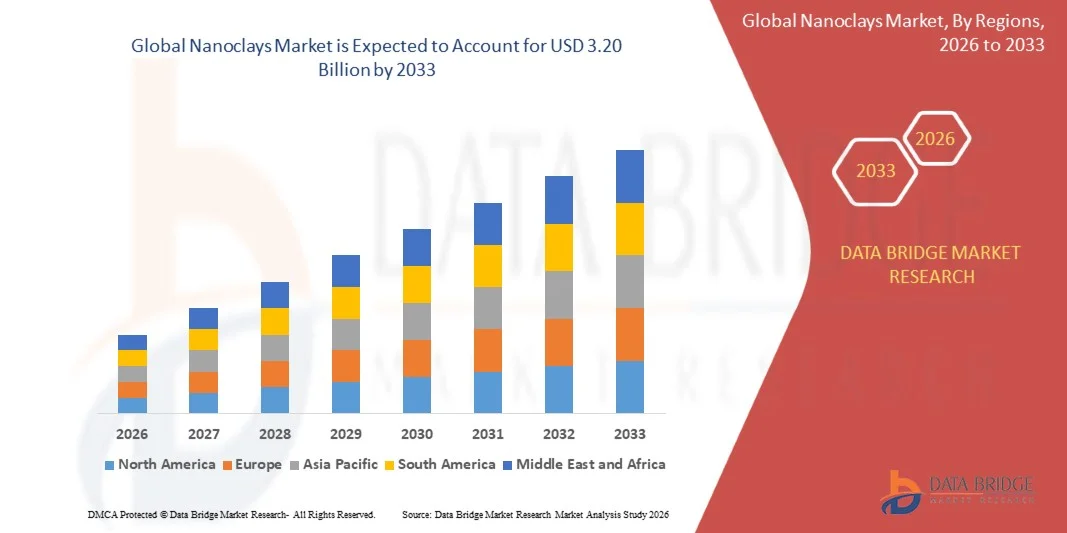
- The global nanoclays market size was valued at USD 1.20 billion in 2025 and is expected to reach USD 3.20 billion by 2033, at a CAGR of 13.00% during the forecast period
- The increase in the demand from packaging and coating application across the globe acts as one of the major factors driving the growth of nanoclays market. The widespread applications in various industries including automotive, biomaterials, pigments, aerospace and aviation, toiletries, medical and dyes, and paints, among others accelerate the market growth
What are the Major Takeaways of Nanoclays Market?
- The rise in demand for packaging which include lifestyle, end-use product demand distribution and renewability, and surge in the use for drug delivery for treatment of various diseases further influence the market
- In addition, rise in awareness, implementation of stringent regulations, and increase in demand for nanoclay-based reinforced polymer positively affect the nanoclays market
- North America dominated the nanoclays market with a 40.9% revenue share in 2025, driven by strong demand from the packaging, automotive, paints & coatings, water treatment, and construction industries across the U.S. and Canada
- Asia-Pacific is projected to register the fastest CAGR of 10.8% from 2026 to 2033, driven by rapid industrialization, expanding automotive production, strong packaging demand, and large-scale manufacturing activities across China, Japan, India, South Korea, and Southeast Asia
- The Smectite segment dominated the market with a 49.2% share in 2025, as it remains the most widely used nanoclay type across polymer reinforcement, coatings, packaging films, and industrial applications
Report Scope and Nanoclays Market Segmentation
|
Attributes |
Nanoclays Key Market Insights |
|
Segments Covered |
|
|
Countries Covered |
North America
Europe
Asia-Pacific
Middle East and Africa
South America
|
|
Key Market Players |
|
|
Market Opportunities |
|
|
Value Added Data Infosets |
In addition to the insights on market scenarios such as market value, growth rate, segmentation, geographical coverage, and major players, the market reports curated by the Data Bridge Market Research also include in-depth expert analysis, pricing analysis, brand share analysis, consumer survey, demography analysis, supply chain analysis, value chain analysis, raw material/consumables overview, vendor selection criteria, PESTLE Analysis, Porter Analysis, and regulatory framework. |
What is the Key Trend in the Nanoclays Market?
“Increasing Shift Toward Sustainable, High-Barrier, and Lightweight Material Solutions”
- The Nanoclays market is witnessing strong adoption of advanced clay-based nanomaterials designed to improve mechanical strength, thermal stability, flame resistance, and barrier performance across packaging, automotive, construction, and coatings applications
- Manufacturers are increasingly introducing surface-modified and organo-functional nanoclays that offer enhanced dispersion, compatibility with polymer matrices, and superior performance in lightweight composite materials
- Growing demand for cost-efficient, eco-friendly, and high-performance materials is driving usage across packaging films, automotive components, paints & coatings, and infrastructure materials
- For instance, companies such as BASF SE, Dow, Elementis, Minerals Technologies, and UBE are expanding their nanoclay portfolios to support advanced polymer reinforcement and sustainable industrial solutions
- Increasing need for lightweight composites, improved shelf-life packaging, and high-durability construction materials is accelerating market adoption globally
- As industries continue to focus on material efficiency, sustainability, and product performance enhancement, nanoclays will remain vital for next-generation composite applications
What are the Key Drivers of Nanoclays Market?
- Rising demand for lightweight, durable, and high-strength materials to support automotive lightweighting, aerospace components, and sustainable packaging solutions is a major growth driver
- For instance, in 2025, leading companies across advanced materials and polymer manufacturing increased focus on nanoclay-reinforced composites for packaging films, coatings, and automotive parts
- Growing adoption across food packaging, construction, automotive, electronics, and water treatment applications is significantly boosting market demand across the U.S., Europe, and Asia-Pacific
- Advancements in nanoclay dispersion technology, polymer compatibility, and surface modification processes have strengthened product performance, scalability, and commercial adoption
- Rising use of biodegradable polymers, flame-retardant materials, and moisture-resistant films is creating strong demand for high-performance nanoclays
- Supported by steady investments in materials R&D, sustainable packaging innovation, and industrial manufacturing infrastructure, the Nanoclays market is expected to witness strong long-term growth
Which Factor is Challenging the Growth of the Nanoclays Market?
- High costs associated with advanced nanoclay processing, surface treatment, and specialized dispersion technologies restrict adoption among small manufacturers and cost-sensitive industries
- For instance, during 2024–2025, fluctuations in raw mineral prices, processing costs, and specialized equipment requirements increased manufacturing expenses for several global vendors
- Complexity in achieving uniform dispersion, consistent quality, and high-performance polymer integration increases the need for technical expertise and specialized production capabilities
- Limited awareness in emerging markets regarding nanoclay benefits, application techniques, and performance optimization slows adoption
- Competition from traditional fillers, glass fibers, carbon black, and alternative nanomaterials creates pricing pressure and reduces product differentiation
- To address these issues, companies are focusing on cost-optimized processing methods, sustainable material development, and improved technical support to increase global adoption of nanoclays
How is the Nanoclays Market Segmented?
The market is segmented on the basis of product, application, and end-user.
• By Product
On the basis of product, the nanoclays market is segmented into Kaolinite, Smectite, and Others. The Smectite segment dominated the market with a 49.2% share in 2025, as it remains the most widely used nanoclay type across polymer reinforcement, coatings, packaging films, and industrial applications. Smectite-based nanoclays, particularly montmorillonite, offer superior layered structure, high surface area, excellent swelling properties, and strong compatibility with polymer matrices, making them highly suitable for enhancing mechanical strength, barrier properties, and thermal stability. Their broad commercial availability and cost-effectiveness continue to support large-scale industrial adoption.
The Kaolinite segment is expected to grow at the fastest CAGR from 2026 to 2033, driven by rising demand in specialty coatings, advanced ceramics, paper applications, and eco-friendly composites. Increasing focus on sustainable materials and high-performance fillers is expected to accelerate segment growth globally.
• By Application
On the basis of application, the market is segmented into Polymer Composites, Water Treatment, Inks, and Clay. The Polymer Composites segment dominated the market with a 43.7% share in 2025, supported by rapid growth in automotive lightweighting, advanced packaging materials, electronics components, and construction applications. Nanoclays are extensively used in polymer composites to improve mechanical strength, flame resistance, gas barrier performance, dimensional stability, and durability. Their compatibility with thermoplastics and thermosets makes them essential for advanced material development across multiple industries.
The Water Treatment segment is projected to grow at the fastest CAGR from 2026 to 2033, driven by increasing demand for adsorbent materials, contaminant removal solutions, and sustainable filtration technologies. Rising investments in wastewater treatment infrastructure and industrial water purification systems are expected to significantly boost segment growth.
• By End-User
On the basis of end-user, the nanoclays market is segmented into Packaging, Flame Retardants, Automotive, Paints and Coatings, and Others. The Packaging segment dominated the market with a 34.9% share in 2025, driven by extensive use in food packaging, pharmaceutical containers, flexible films, and consumer goods applications. Nanoclays improve moisture resistance, oxygen barrier properties, product shelf life, and structural durability, making them highly suitable for modern lightweight packaging solutions. Growing emphasis on sustainable and high-performance packaging continues to strengthen this segment’s market leadership.
The Automotive segment is expected to grow at the fastest CAGR from 2026 to 2033, propelled by rising adoption of lightweight materials in interior components, under-the-hood parts, EV systems, and structural composites. Increasing focus on fuel efficiency, reduced emissions, and EV production is driving strong future demand for nanoclay-based materials.
Which Region Holds the Largest Share of the Nanoclays Market?
- North America dominated the nanoclays market with a 40.9% revenue share in 2025, driven by strong demand from the packaging, automotive, paints & coatings, water treatment, and construction industries across the U.S. and Canada. The region has witnessed significant adoption of nanoclay-based additives to improve barrier properties, flame resistance, mechanical strength, and durability in advanced material applications
- Leading companies in North America are continuously investing in surface-modified nanoclays, polymer reinforcement technologies, and sustainable packaging materials, strengthening the region’s technological advantage. Strong presence of material science companies, research institutions, and industrial manufacturing clusters continues to support market leadership
- High R&D expenditure, rapid commercialization of advanced clay minerals, and strong focus on lightweight and sustainable materials further reinforce regional dominance in the global market
U.S. Nanoclays Market Insight
The U.S. is the largest contributor in North America, supported by strong growth in food packaging, automotive lightweight components, specialty coatings, and water treatment systems. Rising use of nanoclays in polymer composites, flame-retardant materials, and industrial coatings continues to drive market expansion. Presence of major players such as Dow, BASF SE, and Minerals Technologies Inc. further strengthens regional growth.
Canada Nanoclays Market Insight
Canada contributes significantly to regional growth, driven by increasing investments in advanced packaging materials, sustainable construction products, and industrial filtration systems. Growing use of nanoclays in eco-friendly composite solutions supports long-term adoption.
Asia-Pacific Nanoclays Market
Asia-Pacific is projected to register the fastest CAGR of 10.8% from 2026 to 2033, driven by rapid industrialization, expanding automotive production, strong packaging demand, and large-scale manufacturing activities across China, Japan, India, South Korea, and Southeast Asia. Rising demand for lightweight automotive parts, high-barrier packaging films, electronics materials, and advanced coatings is significantly accelerating regional market growth. Increasing government support for manufacturing expansion, infrastructure development, and domestic advanced material production continues to create strong market opportunities
China Nanoclays Market Insight
China is the largest contributor to Asia-Pacific due to massive investments in packaging manufacturing, automotive production, industrial coatings, and construction materials. Strong domestic production capabilities and cost-efficient mineral processing continue to support rapid market expansion.
Japan Nanoclays Market Insight
Japan shows steady growth supported by advanced automotive engineering, electronics materials, specialty coatings, and high-performance industrial applications. Strong focus on quality materials and product innovation strengthens nanoclay demand.
India Nanoclays Market Insight
India is emerging as a major growth hub, driven by expanding packaging industries, automotive manufacturing, infrastructure projects, and water treatment investments. Rising use of nanoclays in polymer composites and industrial materials is accelerating market penetration.
South Korea Nanoclays Market Insight
South Korea contributes significantly due to strong demand from consumer electronics, automotive systems, advanced coatings, and industrial composites. Continuous innovation in high-performance materials supports sustained market growth.
Which are the Top Companies in Nanoclays Market?
The nanoclays industry is primarily led by well-established companies, including:
- Southern Clay Products Inc. (U.S.)
- StatNano (Hungary)
- Techmer PM (U.S.)
- Kowa Company, Ltd. (Japan)
- Dow (U.S.)
- BASF SE (Germany)
- Eastman Chemical Company (U.S.)
- Huntsman International LLC. (U.S.)
- Saint-Gobain (France)
- SABIC (Saudi Arabia)
- Exxon Mobil Corporation (U.S.)
- Wacker Chemie AG (Germany)
- Shin-Etsu Chemical Co., Ltd. (Japan)
- Elementis (U.K.)
- UNICOOP Firenze (Italy)
- Sun Chemical (U.S.)
- KUNIMINE INDUSTRIES CO., LTD. (Japan)
- UBE (Japan)
- Minerals Technologies Inc. (U.S.)
What are the Recent Developments in Global Nanoclays Market?
- In November 2025, BYK announced a 5.2% price increase across its additive portfolio, effective February 1, 2026, in response to rising production costs and ongoing market consolidation, reflecting industry-wide cost pressures and reinforcing the company’s commitment toward continued investment in sustainable and high-performance additive innovation, thereby strengthening long-term market positioning
- In July 2024, Elementis successfully established operations at its new NiSAT manufacturing facility in Songjiang, China, enabling the company to cater to demand across 17 Asian countries with localized production and technical support, resulting in significant growth in architectural coatings applications and new business opportunities, thereby enhancing regional market presence and accelerating expansion in the Asia-Pacific nanoclays market
- In June 2024, Elementis launched a 100% naturally derived, hectorite-based suspension and stabilization solution designed for natural skincare formulations, marking the first product in its Hydroluxe series and gaining strong customer traction, thereby strengthening its footprint in the growing natural rheology modifiers segment and supporting sustainable product innovation
- In June 2022, RTP Company introduced advanced nanoclay compounds with enhanced barrier properties, specifically designed to meet stringent performance requirements in fuel system applications, thereby improving material efficiency and expanding its application scope in high-performance industrial and automotive sectors
- In February 2022, Merck Group completed the acquisition of Exelead for approximately USD 780 million, significantly enhancing its nanoclay and lipid production capabilities, thereby strengthening its advanced materials portfolio and expanding its position in high-growth specialty materials markets

- Interactive Data Analysis Dashboard
- Company Analysis Dashboard for high growth potential opportunities
- Research Analyst Access for customization & queries
- Competitor Analysis with Interactive dashboard
- Latest News, Updates & Trend analysis
- Harness the Power of Benchmark Analysis for Comprehensive Competitor Tracking
Global Nanoclays Market, Supply Chain Analysis and Ecosystem Framework
To support market growth and help clients navigate the impact of geopolitical shifts, DBMR has integrated in-depth supply chain analysis into its Global Nanoclays Market research reports. This addition empowers clients to respond effectively to global changes affecting their industries. The supply chain analysis section includes detailed insights such as Global Nanoclays Market consumption and production by country, price trend analysis, the impact of tariffs and geopolitical developments, and import and export trends by country and HSN code. It also highlights major suppliers with data on production capacity and company profiles, as well as key importers and exporters. In addition to research, DBMR offers specialized supply chain consulting services backed by over a decade of experience, providing solutions like supplier discovery, supplier risk assessment, price trend analysis, impact evaluation of inflation and trade route changes, and comprehensive market trend analysis.
Data collection and base year analysis are done using data collection modules with large sample sizes. The stage includes obtaining market information or related data through various sources and strategies. It includes examining and planning all the data acquired from the past in advance. It likewise envelops the examination of information inconsistencies seen across different information sources. The market data is analysed and estimated using market statistical and coherent models. Also, market share analysis and key trend analysis are the major success factors in the market report. To know more, please request an analyst call or drop down your inquiry.
The key research methodology used by DBMR research team is data triangulation which involves data mining, analysis of the impact of data variables on the market and primary (industry expert) validation. Data models include Vendor Positioning Grid, Market Time Line Analysis, Market Overview and Guide, Company Positioning Grid, Patent Analysis, Pricing Analysis, Company Market Share Analysis, Standards of Measurement, Global versus Regional and Vendor Share Analysis. To know more about the research methodology, drop in an inquiry to speak to our industry experts.
Data Bridge Market Research is a leader in advanced formative research. We take pride in servicing our existing and new customers with data and analysis that match and suits their goal. The report can be customized to include price trend analysis of target brands understanding the market for additional countries (ask for the list of countries), clinical trial results data, literature review, refurbished market and product base analysis. Market analysis of target competitors can be analyzed from technology-based analysis to market portfolio strategies. We can add as many competitors that you require data about in the format and data style you are looking for. Our team of analysts can also provide you data in crude raw excel files pivot tables (Fact book) or can assist you in creating presentations from the data sets available in the report.













