


What is the Global Nanoelectronics Market Size and Growth Rate?
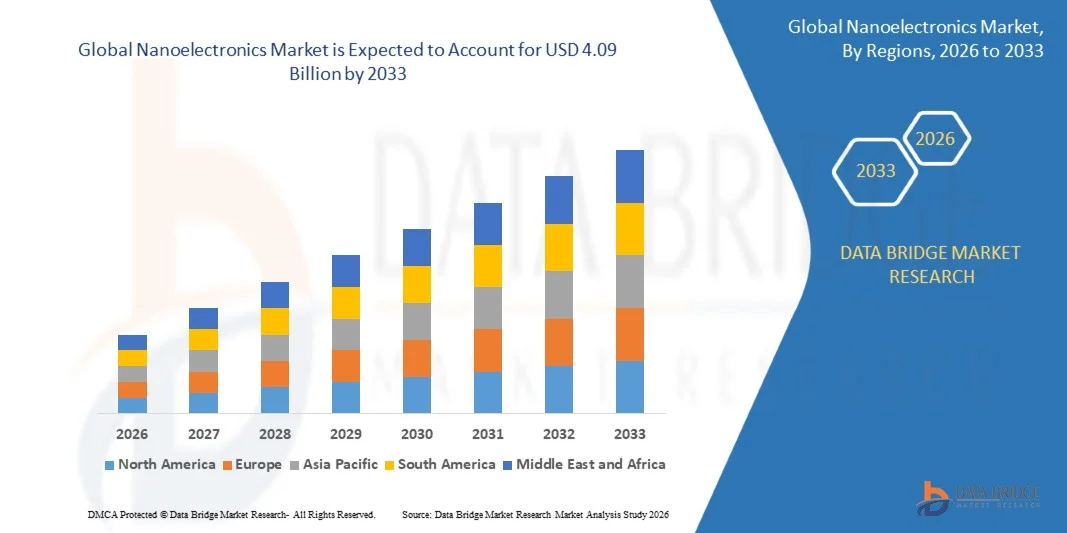
- The global nanoelectronics market size was valued at USD 1.57 billion in 2025 and is expected to reach USD 4.09 billion by 2033, at a CAGR of 12.7% during the forecast period
- The rapid developments in healthcare technology across the globe acts as one of the major factors driving the growth of nanoelectronics market. The increase in the demand for Nanotechnology-based applications escalating highly sophisticated research centers and laboratories for making use of nanomaterial and nanocomponents effectively and efficiently accelerate the market growth
What are the Major Takeaways of Nanoelectronics Market?
- The wide application in the biomedical sector, because of the increasing occurrence of chronic diseases and rising elderly population further influence the market. In addition, smart mobile penetration, rise in the adoption of Internet of things, and usage of nanotechnology for electronic components utilizing technology positively affect the nanoelectronics market
- Furthermore, development of Nano electronics components such as light weight photovoltaic cells, molecular memory and biosensors extend profitable opportunities to the market players
- North America dominated the Nanoelectronics market with a 37.87% revenue share in 2025, driven by strong growth in semiconductor innovation, nanoscale material research, advanced chip design, and high-performance electronics manufacturing across the U.S. and Canada
- Asia-Pacific is projected to register the fastest CAGR of 7.81% from 2026 to 2033, driven by rapid expansion in semiconductor manufacturing, electronics production, 5G infrastructure, EV systems, and consumer device demand across China, Japan, India, South Korea, and Southeast Asia
- The Graphene segment dominated the market with a 34.7% share in 2025, owing to its exceptional electrical conductivity, thermal efficiency, flexibility, and strength, making it highly suitable for next-generation semiconductors, flexible electronics, sensors, and high-speed transistors
Report Scope and Nanoelectronics Market Segmentation
|
Attributes |
Nanoelectronics Key Market Insights |
|
Segments Covered |
|
|
Countries Covered |
North America
Europe
Asia-Pacific
Middle East and Africa
South America
|
|
Key Market Players |
|
|
Market Opportunities |
|
|
Value Added Data Infosets |
In addition to the insights on market scenarios such as market value, growth rate, segmentation, geographical coverage, and major players, the market reports curated by the Data Bridge Market Research also include in-depth expert analysis, pricing analysis, brand share analysis, consumer survey, demography analysis, supply chain analysis, value chain analysis, raw material/consumables overview, vendor selection criteria, PESTLE Analysis, Porter Analysis, and regulatory framework. |
What is the Key Trend in the Nanoelectronics Market?
“Rising Shift Toward Miniaturized, Energy-Efficient, and High-Performance Semiconductor Components”
- The Nanoelectronics market is witnessing strong momentum due to the increasing demand for smaller, faster, and power-efficient electronic devices across consumer electronics, automotive, healthcare, and telecom sectors
- Manufacturers are focusing on advanced nanoscale transistors, memory devices, quantum dots, graphene-based chips, and nanosensors to improve processing speed and reduce energy consumption
- Growing integration of AI processors, IoT-enabled devices, wearable electronics, and edge computing systems is accelerating demand for ultra-compact semiconductor components
- For instance, companies such as Intel Corporation, IBM, STMicroelectronics, and Infineon Technologies AG are expanding investments in nanoscale chip architectures and next-generation transistor technologies
- Increasing adoption of graphene, carbon nanotubes, and quantum dot-based components is improving device performance, heat efficiency, and storage capabilities
- As demand for high-speed computing and smart connected devices continues to rise, nanoelectronics will remain critical for future semiconductor innovation and advanced digital infrastructure
What are the Key Drivers of Nanoelectronics Market?
- Rising demand for miniaturized consumer electronics, smartphones, wearables, and compact medical devices is significantly driving market growth
- For instance, in 2025, global semiconductor companies increased investments in AI chips, advanced memory modules, and nanoscale transistors to support high-performance computing applications
- Growing adoption of electric vehicles, autonomous driving systems, 5G infrastructure, and industrial automation is boosting demand for high-density nanoelectronic components
- Advancements in nanofabrication technologies, lithography, quantum dot engineering, and graphene integration have improved speed, efficiency, and scalability
- Rising use of AI hardware, data centers, IoT ecosystems, and high-speed communication devices is creating sustained long-term demand
- Supported by strong R&D investments in semiconductor innovation and next-generation computing technologies, the Nanoelectronics market is expected to witness robust growth
Which Factor is Challenging the Growth of the Nanoelectronics Market?
- High costs associated with advanced nanofabrication equipment, cleanroom infrastructure, and precision manufacturing processes remain a major growth restraint
- For instance, during 2024–2025, rising costs of semiconductor-grade raw materials and supply chain disruptions increased manufacturing expenses for global chipmakers
- Complexity in designing and integrating nanoscale devices with conventional semiconductor systems increases technical barriers and development timelines
- Limited availability of highly skilled nanotechnology engineers and fabrication specialists continues to slow market expansion in emerging regions
- Geopolitical risks, raw material dependency, and IP-related challenges are creating additional pressure on production and commercialization
- To address these challenges, companies are focusing on cost-efficient fabrication methods, advanced material research, and strategic semiconductor investments to improve scalability and market penetration
How is the Nanoelectronics Market Segmented?
The market is segmented on the basis of type, application, and end user.
• By Type
On the basis of type, the nanoelectronics market is segmented into Carbon Nanotubes, Graphene, Nanofibers, Nanosilver, Nanowires, Nanobuds, and Other. The Graphene segment dominated the market with a 34.7% share in 2025, owing to its exceptional electrical conductivity, thermal efficiency, flexibility, and strength, making it highly suitable for next-generation semiconductors, flexible electronics, sensors, and high-speed transistors. Increasing use of graphene in AI chips, wearable devices, nano-transistors, and energy-efficient electronic circuits continues to support its strong market position. Its compatibility with advanced nanofabrication techniques and superior performance over conventional silicon-based materials further enhances adoption.
The Carbon Nanotubes segment is expected to grow at the fastest CAGR from 2026 to 2033, driven by rising demand for miniaturized circuits, nano-scale interconnects, conductive films, and advanced sensor applications. Increasing R&D investments in quantum electronics, ultra-fast computing systems, and low-power semiconductor components are accelerating the adoption of carbon nanotube-based nanoelectronic devices.
• By Application
On the basis of application, the market is segmented into Coatings and Films, Data Storage and Processing, Displays, Electronic Packaging, and Other. The Data Storage and Processing segment dominated the market with a 38.9% share in 2025, supported by the growing need for high-speed memory devices, nanoscale processors, AI accelerators, and advanced semiconductor storage architectures. Nanoelectronics plays a critical role in improving data processing speed, storage density, energy efficiency, and chip miniaturization, making it highly essential across data centers, consumer electronics, and computing applications.
The Displays segment is projected to grow at the fastest CAGR from 2026 to 2033, driven by increasing demand for OLED, micro-LED, flexible screens, foldable devices, and high-resolution smart displays. Rapid advancements in nanomaterials such as graphene, nanowires, and nanosilver are enhancing display brightness, conductivity, flexibility, and durability, thereby fueling strong growth across smartphones, wearables, automotive displays, and smart home devices.
• By End User
On the basis of end user, the nanoelectronics market is segmented into Healthcare, Automobile, Telecom, Aerospace, and Electronics. The Electronics segment dominated the market with a 41.3% share in 2025, driven by extensive deployment of nanoelectronic components in smartphones, laptops, wearables, IoT devices, consumer appliances, and semiconductor manufacturing. Increasing demand for compact, energy-efficient, and high-speed electronic products continues to strengthen market penetration in this segment.
The Automobile segment is expected to grow at the fastest CAGR from 2026 to 2033, propelled by rising adoption of electric vehicles, ADAS systems, battery management systems, infotainment units, and autonomous driving technologies. Growing complexity in automotive electronics, along with rising investments in EV semiconductor infrastructure, is significantly boosting the demand for advanced nanoelectronic components across the global automotive industry.
Which Region Holds the Largest Share of the Nanoelectronics Market?
- North America dominated the Nanoelectronics market with a 37.87% revenue share in 2025, driven by strong growth in semiconductor innovation, nanoscale material research, advanced chip design, and high-performance electronics manufacturing across the U.S. and Canada. Rising adoption of AI processors, memory devices, nanosensors, and miniaturized semiconductor components continues to support strong regional demand across consumer electronics, automotive, healthcare, and aerospace applications
- Leading companies in North America are investing in graphene-based semiconductors, carbon nanotube transistors, nanoscale memory architectures, and quantum electronic devices, strengthening the region’s technological leadership. Continuous R&D funding in AI chips, data centers, EV power electronics, and next-generation telecom infrastructure further accelerates market expansion
- Strong innovation ecosystems, advanced fabrication facilities, and high concentration of semiconductor design talent continue to reinforce North America’s market dominance
U.S. Nanoelectronics Market Insight
The U.S. is the largest contributor in North America, supported by extensive investments in semiconductor R&D, nanomaterial innovation, AI chip development, and advanced microprocessor manufacturing. Increasing deployment of nanoelectronics in defence systems, EV electronics, healthcare devices, data centers, and telecom equipment is intensifying market demand. Presence of major semiconductor companies, advanced research laboratories, and strong government support for domestic chip manufacturing continues to drive growth
Canada Nanoelectronics Market Insight
Canada contributes significantly to regional growth, driven by expanding nanotechnology research clusters, electronics innovation hubs, and semiconductor material development programs. Universities and R&D centers are increasingly focusing on nanosensors, nanochips, quantum electronics, and healthcare device applications. Government-backed innovation initiatives and a skilled engineering workforce further strengthen market adoption across the country
Asia-Pacific Nanoelectronics Market
Asia-Pacific is projected to register the fastest CAGR of 7.81% from 2026 to 2033, driven by rapid expansion in semiconductor manufacturing, electronics production, 5G infrastructure, EV systems, and consumer device demand across China, Japan, India, South Korea, and Southeast Asia. High-volume production of smartphones, processors, memory devices, displays, and automotive electronics significantly boosts demand for nanoelectronic components. Rising investment in AI hardware, flexible electronics, and advanced nanomaterials continues to accelerate regional growth
China Nanoelectronics Market Insight
China is the largest contributor to Asia-Pacific due to massive investments in semiconductor fabs, nanochip production, AI processors, and display technologies. Strong government support, large-scale electronics manufacturing, and increasing domestic semiconductor capacity continue to expand market adoption
Japan Nanoelectronics Market Insight
Japan shows steady growth supported by advanced precision electronics manufacturing, nanomaterial research, automotive semiconductor systems, and robotics innovation. Strong focus on quality engineering and miniaturized high-performance devices continues to support market expansion
India Nanoelectronics Market Insight
India is emerging as a major growth hub, driven by expanding semiconductor design centers, startup innovation, electronics manufacturing initiatives, and telecom infrastructure development. Increasing demand for nanoelectronics in IoT devices, healthcare systems, EV components, and smart devices continues to support market penetration
South Korea Nanoelectronics Market Insight
South Korea contributes significantly due to strong demand for memory chips, advanced displays, AI servers, 5G systems, and high-performance consumer electronics. Technological innovation and strong semiconductor manufacturing capacity continue to support sustained market growth
Which are the Top Companies in Nanoelectronics Market?
The nanoelectronics industry is primarily led by well-established companies, including:
- Everspin Technologies Inc. (U.S.)
- IBM (U.S.)
- HP Development Company L.P. (U.S.)
- Bühler PARTEC GmbH (Germany)
- STMicroelectronics (Switzerland)
- Robert Bosch GmbH (Germany)
- Intel Corporation (U.S.)
- Koninklijke Philips N.V (Netherlands)
- Hewlett-Packard Development Company, L.P. (U.S.)
- Siemens AG (Germany)
- Infineon Technologies AG (Germany)
- OD Vision (South Korea)
What are the Recent Developments in Global Nanoelectronics Market?
- In October 2023, Asahi Kasei significantly expanded its coating capacity for lithium-ion battery separators to strengthen support for the growing electric vehicle and energy storage markets, reinforcing its long-term commitment to advanced battery material innovation and future market expansion
- In September 2023, Ansell introduced Ansell Earth, a new communication framework designed to clearly present and strengthen its sustainability initiatives, further enhancing the company’s focus on responsible business practices and environmentally aligned brand positioning

- Interactive Data Analysis Dashboard
- Company Analysis Dashboard for high growth potential opportunities
- Research Analyst Access for customization & queries
- Competitor Analysis with Interactive dashboard
- Latest News, Updates & Trend analysis
- Harness the Power of Benchmark Analysis for Comprehensive Competitor Tracking
Data collection and base year analysis are done using data collection modules with large sample sizes. The stage includes obtaining market information or related data through various sources and strategies. It includes examining and planning all the data acquired from the past in advance. It likewise envelops the examination of information inconsistencies seen across different information sources. The market data is analysed and estimated using market statistical and coherent models. Also, market share analysis and key trend analysis are the major success factors in the market report. To know more, please request an analyst call or drop down your inquiry.
The key research methodology used by DBMR research team is data triangulation which involves data mining, analysis of the impact of data variables on the market and primary (industry expert) validation. Data models include Vendor Positioning Grid, Market Time Line Analysis, Market Overview and Guide, Company Positioning Grid, Patent Analysis, Pricing Analysis, Company Market Share Analysis, Standards of Measurement, Global versus Regional and Vendor Share Analysis. To know more about the research methodology, drop in an inquiry to speak to our industry experts.
Data Bridge Market Research is a leader in advanced formative research. We take pride in servicing our existing and new customers with data and analysis that match and suits their goal. The report can be customized to include price trend analysis of target brands understanding the market for additional countries (ask for the list of countries), clinical trial results data, literature review, refurbished market and product base analysis. Market analysis of target competitors can be analyzed from technology-based analysis to market portfolio strategies. We can add as many competitors that you require data about in the format and data style you are looking for. Our team of analysts can also provide you data in crude raw excel files pivot tables (Fact book) or can assist you in creating presentations from the data sets available in the report.













