Global Nanoemulsion Market
Market Size in USD Billion
CAGR :
% 
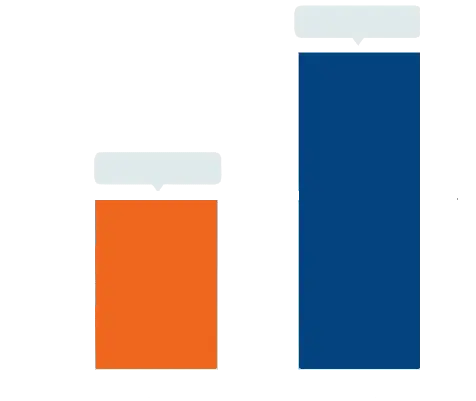 USD
14.63 Billion
USD
27.32 Billion
2025
2033
USD
14.63 Billion
USD
27.32 Billion
2025
2033
 Forecast Period Forecast Period |
2026 –2033 |
 Market Size (Base Year) Market Size (Base Year) |
USD 14.63 Billion |
 Market Size (Forecast Year) Market Size (Forecast Year) |
USD 27.32 Billion |
 CAGR CAGR |
% |
| Major Markets Players |
|
Nanoemulsion Market Size
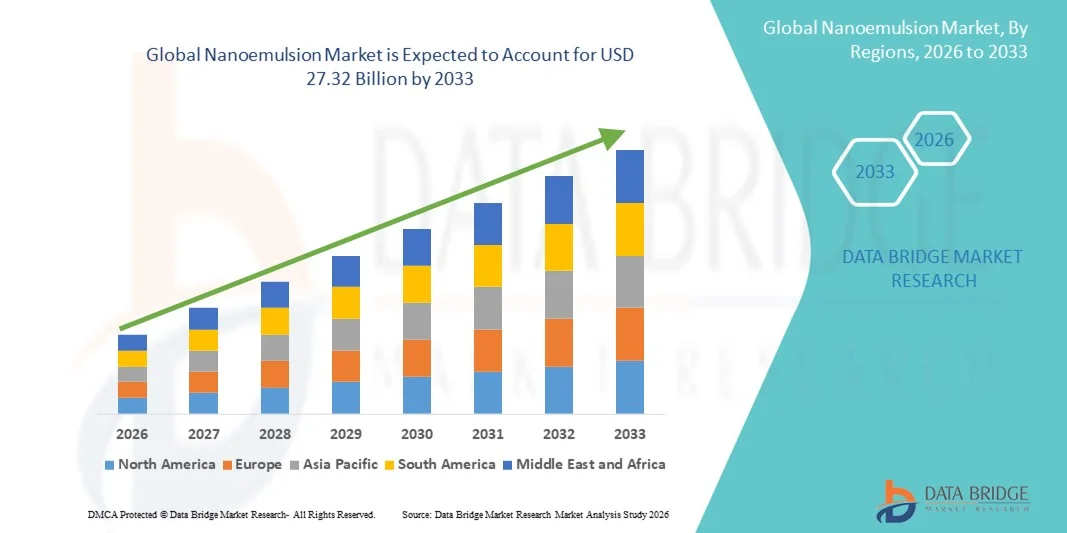
- The global nanoemulsion market size was valued at USD 14.63 billion in 2025 and is expected to reach USD 27.32 billion by 2033, at a CAGR of 8.12% during the forecast period
- The market growth is largely fueled by the increasing adoption of nanotechnology in pharmaceuticals, cosmetics, and food & beverage industries, along with continuous technological advancements in nanoemulsion formulation techniques, leading to enhanced bioavailability, stability, and targeted delivery of active ingredients
- Furthermore, rising demand for effective drug delivery systems, improved cosmetic formulations, and functional food products is establishing nanoemulsions as a preferred solution for multiple applications. These converging factors are accelerating the uptake of nanoemulsion solutions, thereby significantly boosting the growth of the nanoemulsion market
Nanoemulsion Market Analysis
- Nanoemulsions, widely used in pharmaceuticals, cosmetics, and food & beverage industries, are gaining traction due to their enhanced solubility, bioavailability, and stability, enabling efficient delivery of active ingredients across multiple applications
- The growing demand for advanced drug delivery systems, improved cosmetic formulations, and functional foods is driving market expansion, supported by technological innovations in high-shear homogenization, ultrasonication, and microfluidization for nanoemulsion production
- North America dominated the nanoemulsion market, accounting for approximately 38.5% of global revenue in 2025, driven by high R&D investment, established pharmaceutical and cosmetic industries, strong regulatory support, and growing adoption of advanced delivery systems in the U.S.
- Asia-Pacific is expected to be the fastest-growing region, registering a robust CAGR of around 14.2% during the forecast period, fueled by increasing urbanization, rising disposable incomes, expansion of pharmaceutical and cosmetic manufacturing, and growing healthcare and personal care awareness in countries such as China, India, and Japan
- The parenteral segment accounted for the largest market revenue share of 41.2% in 2025, due to its superior bioavailability, rapid onset of action, and suitability for hospital use
Report Scope and Nanoemulsion Market Segmentation
|
Attributes |
Nanoemulsion Key Market Insights |
|
Segments Covered |
|
|
Countries Covered |
North America
Europe
Asia-Pacific
Middle East and Africa
South America
|
|
Key Market Players |
|
|
Market Opportunities |
|
|
Value Added Data Infosets |
In addition to the insights on market scenarios such as market value, growth rate, segmentation, geographical coverage, and major players, the market reports curated by the Data Bridge Market Research also include in-depth expert analysis, patient epidemiology, pipeline analysis, pricing analysis, and regulatory framework. |
Nanoemulsion Market Trends
Rising Adoption of Nanoemulsions Across Pharmaceuticals and Cosmetic
- A significant and accelerating trend in the global Nanoemulsion market is the growing focus on advanced formulations that enhance drug delivery, bioavailability, and cosmetic efficacy. Nanoemulsions are increasingly used in pharmaceuticals, nutraceuticals, and personal care products due to their ability to improve solubility of poorly water-soluble compounds and ensure faster absorption
- For instance, major pharmaceutical companies are incorporating nanoemulsion-based formulations in topical and oral drug delivery systems to improve therapeutic outcomes, reduce dosage frequency, and enhance patient compliance. Similarly, cosmetic manufacturers are leveraging nanoemulsions to create lightweight, fast-absorbing skincare products that offer better hydration and nutrient penetration
- Technological developments such as high-pressure homogenization, ultrasonication, and microfluidization are enabling the production of highly stable nanoemulsions with uniform droplet size, extended shelf life, and controlled release properties. This trend toward formulation innovation is helping manufacturers differentiate their products in a competitive market
- The increasing research focus on functional foods, vaccines, and nutraceuticals is further driving the development of specialized nanoemulsion systems to encapsulate sensitive bioactive ingredients, ensuring their stability and bioefficacy
- Global awareness about the advantages of nanoemulsions, combined with a surge in demand for innovative healthcare and cosmetic solutions, is pushing the market toward rapid expansion. Companies are emphasizing R&D investments and strategic partnerships to introduce next-generation nanoemulsion products that meet evolving consumer and clinical needs
Nanoemulsion Market Dynamics
Driver
Growing Demand for Enhanced Drug Delivery and Personal Care Applications
- The rising prevalence of chronic diseases, increasing geriatric population, and need for effective drug delivery solutions are major drivers for the Nanoemulsion market. These systems improve solubility, stability, and bioavailability of active pharmaceutical ingredients, making treatments more effective
- For instance, pharmaceutical companies are adopting nanoemulsions for oral, topical, and injectable drug delivery, providing targeted therapeutic action and improved patient compliance
- Furthermore, the booming cosmetics and personal care industry is leveraging nanoemulsion technology to develop creams, lotions, and serums that offer better skin penetration, faster absorption, and enhanced stability of active ingredients
- The growing trend toward functional foods and nutraceuticals is also driving demand, as nanoemulsions allow incorporation of vitamins, antioxidants, and omega fatty acids in food and beverage products with improved bioavailability
- Global expansion of healthcare and cosmetic industries, along with increasing consumer awareness regarding product efficacy, is supporting the continuous adoption of nanoemulsion-based solutions across regions
Restraint/Challenge
High Production Costs and Stability Concerns
- The relatively high production costs associated with nanoemulsion formulation and manufacturing remain a significant challenge, especially for small and mid-sized companies looking to enter the market
- Advanced techniques such as high-pressure homogenization, ultrasonication, or microfluidization require specialized equipment and skilled operators
- For instance, the need for precise control of droplet size, stability, and encapsulation efficiency adds to manufacturing complexity and operational expenses, potentially limiting adoption in cost-sensitive markets
- Furthermore, nanoemulsions are thermodynamically unstable, and factors such as temperature fluctuations, pH variations, and long-term storage conditions can affect their stability, necessitating additional formulation optimization and rigorous quality control
- Regulatory hurdles in different regions, particularly for pharmaceutical and food applications, can slow market entry and increase compliance costs
- Addressing these challenges through technological improvements, cost-effective production methods, and robust quality assurance processes will be critical for sustained growth in the global Nanoemulsion market
Nanoemulsion Market Scope
The Nanoemulsion market is segmented into four notable segments based on drug class, route of administration, and distribution channel.
- By Drug Class
On the basis of drug class, the market is segmented into anesthetics, antibiotics, NSAIDs, immunosuppressants, antiretroviral, antimicrobials, vasodilators, steroids, and others. The antibiotics segment dominated the market with a revenue share of 34.5% in 2025, driven by the growing prevalence of bacterial infections, increasing adoption of nanoemulsion-based drug delivery systems for enhanced bioavailability, and reduced dosing frequency. Nanoemulsions improve solubility of poorly water-soluble antibiotics, enhancing therapeutic outcomes. Hospitals and outpatient care centers heavily rely on nanoemulsion formulations for critical care and pediatric applications. Regulatory approvals for innovative formulations have accelerated their clinical uptake. Rising investments in pharmaceutical R&D and increasing preference for lipid-based delivery systems further strengthen the segment’s dominance. Enhanced patient compliance, targeted drug delivery, and reduction in side effects contribute to sustained revenue. Antibiotic resistance management strategies are also boosting adoption globally.
The immunosuppressants segment is expected to witness the fastest CAGR of 10.8% from 2026 to 2033, driven by the increasing number of organ transplant procedures and autoimmune disease prevalence. Nanoemulsion formulations improve bioavailability and reduce systemic toxicity. Rising adoption in hospitals, specialized clinics, and home care settings contributes to growth. Technological advancements such as targeted delivery and controlled release further enhance therapeutic efficiency. Emerging economies with rising transplant and autoimmune patient populations fuel demand. Investment in formulation research and growing awareness among healthcare professionals accelerate uptake. Improved solubility and reduced dosing frequency make nanoemulsion-based immunosuppressants highly attractive. The segment is particularly gaining traction in Asia-Pacific and North America.
- By Route of Administration
On the basis of route of administration, the market is segmented into oral, parenteral, topical, intravenous, and others. The parenteral segment accounted for the largest market revenue share of 41.2% in 2025, due to its superior bioavailability, rapid onset of action, and suitability for hospital use. Nanoemulsion-based parenteral formulations are widely used for critical care, oncology, and pediatric treatments. Hospitals and clinical settings prefer parenteral routes for high precision dosing and systemic delivery. Regulatory approvals and established safety profiles reinforce dominance. Technological advancements such as sterile production, controlled particle size, and stability further support adoption. The parenteral route is preferred for both hydrophobic and hydrophilic drugs, enhancing flexibility. Frequent use in intravenous therapies and injectable formulations sustains revenue. The segment benefits from rising hospital admissions and procedural interventions globally.
The topical segment is expected to witness the fastest CAGR of 11.3% from 2026 to 2033, driven by increasing use in dermatological applications, local drug delivery, and cosmetic products. Nanoemulsion enhances skin penetration, stability, and controlled release. Growing awareness of advanced dermatological therapies and increasing adoption of home care treatments accelerate growth. Expansion in the personal care and cosmeceutical industry further supports uptake. Hospitals, clinics, and retail consumers are increasingly adopting nanoemulsion-based topical products. The segment is favored for anti-inflammatory, analgesic, and antimicrobial formulations. Emerging markets in Asia-Pacific and Latin America show strong growth potential.
- By Distribution Channel
On the basis of distribution channel, the market is segmented into hospital pharmacies, retail pharmacies, and e-commerce. The hospital pharmacies segment dominated with a revenue share of 48.7% in 2025, driven by the growing demand for specialized drug delivery systems in inpatient and critical care settings. Hospitals maintain a steady supply of nanoemulsion-based formulations for oncology, anesthesia, and pediatric care. Bulk procurement, centralized distribution, and integration with patient care protocols strengthen market dominance. Hospitals in North America and Europe account for significant adoption due to advanced infrastructure. Clinician trust in quality-assured formulations further reinforces preference. The segment benefits from increasing hospitalization rates and procedural volumes. High adoption in tertiary and quaternary care centers supports continued revenue growth.
The e-commerce segment is expected to witness the fastest CAGR of 12.1% from 2026 to 2033, fueled by growing online pharmacy adoption, home healthcare expansion, and consumer preference for convenience. Patients increasingly order nanoemulsion-based drugs online, particularly for chronic treatments and OTC formulations. Digital platforms improve accessibility, especially in rural and remote regions. Integration with telemedicine and home care services further drives uptake. Cost-effective delivery, product variety, and improved supply chain logistics enhance market growth. Expansion of e-pharmacy platforms in Asia-Pacific and Latin America supports rapid adoption. Online marketing and patient education campaigns further accelerate segment growth.
Nanoemulsion Market Regional Analysis
- North America dominated the global nanoemulsion market, accounting for approximately 38.5% of total revenue in 2025
- This leadership is driven by the region’s strong pharmaceutical and cosmetic industries, substantial investment in R&D, well-established regulatory frameworks, and growing adoption of advanced drug and cosmetic delivery systems
- Increasing focus on improving bioavailability of drugs and enhancing cosmetic formulations has further fueled market growth in this region
U.S. Nanoemulsion Market Insight
The U.S. global nanoemulsion market accounted for the majority of North America’s market share in 2025. Growth in the U.S. is supported by high R&D expenditure in pharmaceutical and personal care sectors, the presence of leading nanoemulsion technology developers, and rising demand for advanced drug delivery systems. The market is further bolstered by increased adoption of nanoemulsions in topical, oral, and cosmetic formulations, as well as government support for innovations in healthcare and personal care industries.
Europe Nanoemulsion Market Insight
The Europe global nanoemulsion market is expected to expand at a strong CAGR during the forecast period, fueled by the growth of the pharmaceutical and cosmetic sectors across major European countries. Rising consumer awareness about skin care and healthcare products, combined with increasing urbanization and technological advancements in drug delivery, is driving adoption.
U.K. Nanoemulsion Market Insight
In the U.K., the Nanoemulsion market is growing steadily, supported by strong pharmaceutical and personal care industries, high consumer awareness of advanced skincare and therapeutic products, and increasing demand for innovative drug delivery solutions. The country’s well-established healthcare infrastructure and regulatory support for novel formulations contribute to market growth.
Germany Nanoemulsion Market Insight
Germany global nanoemulsion market is projected to witness robust market growth due to its advanced pharmaceutical R&D capabilities, high adoption of innovative nanoemulsion-based drug and cosmetic formulations, and rising awareness of effective healthcare and personal care solutions. Germany’s focus on sustainable and high-performance cosmetic products also encourages the adoption of nanoemulsion technologies.
Asia-Pacific Nanoemulsion Market Insight
The Asia-Pacific global nanoemulsion market region is expected to be the fastest-growing market, registering a CAGR of approximately 14.2% during the forecast period. Growth is driven by rapid urbanization, rising disposable incomes, increasing healthcare and personal care awareness, and expansion of pharmaceutical and cosmetic manufacturing capacities. Emerging economies such as China, India, and Japan are witnessing significant adoption of nanoemulsion-based formulations, fueled by increasing demand for innovative drug delivery systems and high-performance cosmetic products.
Japan Nanoemulsion Market Insight
Japan’s global nanoemulsion market is gaining momentum due to its technologically advanced pharmaceutical and cosmetic industries. Rising demand for high-quality drug delivery systems and anti-aging or therapeutic cosmetic products, coupled with an aging population seeking convenient and effective solutions, is driving market growth.
China Nanoemulsion Market Insight
China global nanoemulsion market accounted for the largest revenue share in the Asia-Pacific region in 2025. Strong domestic manufacturing capabilities, rapid urbanization, a growing middle class, and government initiatives promoting pharmaceutical and cosmetic innovations are key factors supporting market expansion. Increasing awareness of high-performance drug formulations and cosmetic solutions has led to widespread adoption of nanoemulsion technologies in both healthcare and personal care sectors.
Nanoemulsion Market Share
The Nanoemulsion industry is primarily led by well-established companies, including:
• Gattefossé (France)
• Croda International Plc (U.K.)
• BASF SE (Germany)
• Evonik Industries AG (Germany)
• Lubrizol Corporation (U.S.)
• Finar Limited (India)
• Dow Inc. (U.S.)
• Fine Chemical Co., Ltd. (China)
• Lipoid GmbH (Germany)
• Capmul®/Abitec Corporation (U.S.)
• Croda Health Care (U.K.)
• TCI Chemicals (Japan)
• Neuland Laboratories Ltd. (India)
• AkzoNobel N.V. (Netherlands)
• Croda Specialty Chemicals (France)
Latest Developments in Global Nanoemulsion Market
- In December 2022, Pressure BioSciences announced the first commercial production of a revolutionary UltraShear™ nanoemulsion product, which was shipped, booked, and paid under a multi‑year agreement. This marked the initial commercial application of its high‑performance nanoemulsion technology—starting with an UltraShear‑enabled CBD oral spray product designed for rapid absorption, highlighting commercialization progress in nanoemulsion production
- In June 2023, Ascendia Pharmaceuticals received IND approval from the U.S. FDA for its novel nanoemulsion IV formulation of clopidogrel, developed in partnership with AcuteBio, aimed at improving acute care treatment by enabling immediate onset of action compared to traditional oral therapy
- In November 2024, Organigram Holdings Inc. launched Edison Sonics gummies powered by FAST™ nanoemulsion technology, representing a consumer‑oriented product that uses nanoemulsions to achieve significantly faster onset and improved bioavailability compared to conventional edible formulations
- In March 2025, Evonik Industries announced a strategic partnership with Kraft Heinz to co‑develop nanoemulsion‑based clean‑label fat reduction emulsions for beverages and food applications, showing cross‑industry expansion of nanoemulsion technologies beyond pharmaceuticals into functional foods
- In April 2025, Thermo Fisher Scientific announced a significant product launch of a new nanoemulsion characterization platform, designed to support rapid quality assurance and control (QA/QC) testing for nanoemulsion‑based beverages and other formulations—indicating growing infrastructure investment in nanoemulsion analytic
SKU-
Get online access to the report on the World's First Market Intelligence Cloud

- Interactive Data Analysis Dashboard
- Company Analysis Dashboard for high growth potential opportunities
- Research Analyst Access for customization & queries
- Competitor Analysis with Interactive dashboard
- Latest News, Updates & Trend analysis
- Harness the Power of Benchmark Analysis for Comprehensive Competitor Tracking
Research Methodology
Data collection and base year analysis are done using data collection modules with large sample sizes. The stage includes obtaining market information or related data through various sources and strategies. It includes examining and planning all the data acquired from the past in advance. It likewise envelops the examination of information inconsistencies seen across different information sources. The market data is analysed and estimated using market statistical and coherent models. Also, market share analysis and key trend analysis are the major success factors in the market report. To know more, please request an analyst call or drop down your inquiry.
The key research methodology used by DBMR research team is data triangulation which involves data mining, analysis of the impact of data variables on the market and primary (industry expert) validation. Data models include Vendor Positioning Grid, Market Time Line Analysis, Market Overview and Guide, Company Positioning Grid, Patent Analysis, Pricing Analysis, Company Market Share Analysis, Standards of Measurement, Global versus Regional and Vendor Share Analysis. To know more about the research methodology, drop in an inquiry to speak to our industry experts.
Customization Available
Data Bridge Market Research is a leader in advanced formative research. We take pride in servicing our existing and new customers with data and analysis that match and suits their goal. The report can be customized to include price trend analysis of target brands understanding the market for additional countries (ask for the list of countries), clinical trial results data, literature review, refurbished market and product base analysis. Market analysis of target competitors can be analyzed from technology-based analysis to market portfolio strategies. We can add as many competitors that you require data about in the format and data style you are looking for. Our team of analysts can also provide you data in crude raw excel files pivot tables (Fact book) or can assist you in creating presentations from the data sets available in the report.