


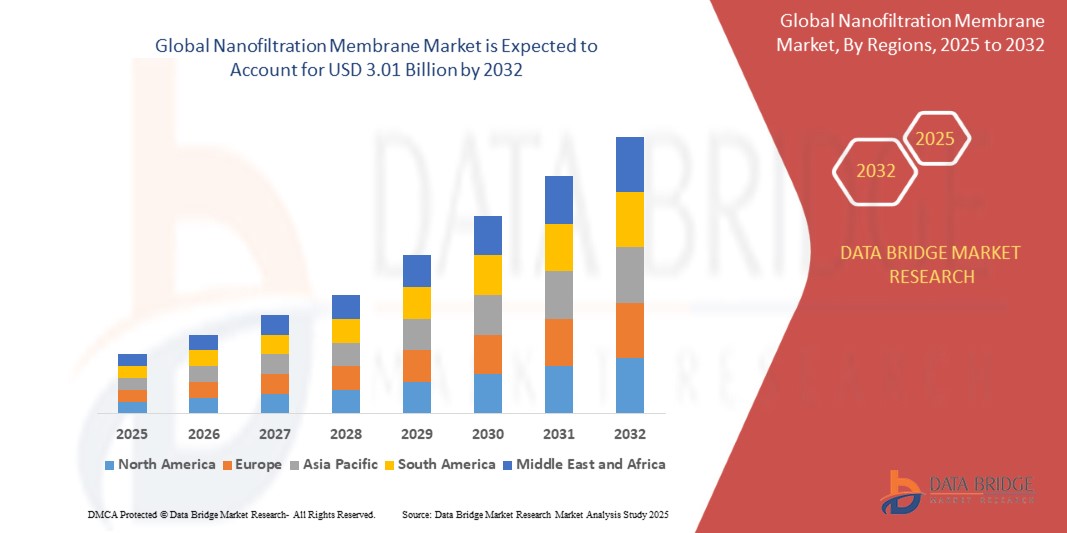
Nanofiltration Membrane Market Size
- The global Nanofiltration Membrane market size was valued at USD 1.39 billion in 2024 and is expected to reach USD 3.01 billion by 2032, at a CAGR of 10.2% during the forecast period
- Rapid growth is driven by increasing demand for advanced water purification, wastewater recycling, and stringent environmental regulations targeting industrial effluent treatment worldwide.
- Widespread adoption in food & beverage, pharmaceuticals, and chemical processing further accelerates market expansion, as manufacturers seek more energy-efficient, selective, and sustainable filtration solutions.
Nanofiltration Membrane Market Analysis
- Nanofiltration membranes bridge the gap between ultrafiltration and reverse osmosis, exhibiting selective permeability that allows water and monovalent ions to pass while rejecting multivalent ions, organic compounds, and micro-contaminants. This makes them highly effective in applications requiring partial demineralization, water softening, and contaminant removal.
- Municipal utilities increasingly deploy nanofiltration to treat drinking water and remove micropollutants that conventional processes do not capture.
- Industrial sectors are integrating these membranes for process water recycling, dye and salt separation, and effluent minimization, responding to tightening wastewater discharge norms.
- In the food & beverage industry, nanofiltration is used for concentration, clarification, fractionation, and removal of undesirable components without affecting taste or nutritional value, supporting product quality and regulatory compliance.
- Pharmaceutical and chemical companies leverage nanofiltration for purification, solvent recovery, and selective separation, reducing environmental impact and production costs.
- Continuous innovation in polymeric and ceramic membrane chemistry improves fouling resistance, mechanical strength, and overall performance, opening new avenues in biotechnology, mining, and specialty separation applications.
- Despite significant benefits, adoption is often constrained by the need for periodic cleaning, fouling management, and higher up-front costs compared to conventional filtration methods.
Report Scope and Nanofiltration Membrane Market Segmentation
|
Attributes |
Nanofiltration Membrane Key Market Insights |
|
Segments Covered |
|
|
Countries Covered |
North America
Europe
Asia-Pacific
Middle East and Africa
South America
|
|
Key Market Players |
|
|
Market Opportunities |
|
|
Value Added Data Infosets |
In addition to the insights on market scenarios such as market value, growth rate, segmentation, geographical coverage, and major players, the market reports curated by the Data Bridge Market Research also include in-depth expert analysis, pricing analysis, brand share analysis, consumer survey, demography analysis, supply chain analysis, value chain analysis, raw material/consumables overview, vendor selection criteria, PESTLE Analysis, Porter Analysis, and regulatory framework. |
Nanofiltration Membrane Market Trends
Advances in Sustainable Filtration and Industry-Specific Specialization
- Increasing adoption of eco-friendly membrane technologies to reduce resource consumption, minimize waste, and support circular water economies.
- Shift from purely polymeric designs toward hybrid and ceramic membranes with enhanced fouling resistance and operational longevity.
- Rising use in niche applications such as zero-liquid discharge (ZLD) plants, direct potable reuse, and high-value industrial separations.
- Growing integration of digital monitoring, predictive maintenance, and remote control systems to optimize membrane performance and reduce downtime.
Nanofiltration Membrane Market Dynamics
Driver
Escalating Demand for Advanced Water Treatment and Selective Industrial Separation
- Global urbanization, population growth, and mounting water scarcity are increasing pressure on municipalities and industries to secure sustainable, high-quality water resources. Nanofiltration membranes provide a critical solution by offering selective removal of divalent ions, organic molecules, and micro-contaminants while allowing passage of monovalent ions and water, thus enabling advanced purification and resource recovery.
- Industrial expansion—across sectors such as food & beverage, petrochemicals, pharmaceuticals, and power generation—drives demand for high-efficiency separation and purification processes. Nanofiltration’s ability to minimize energy consumption while providing specific separations (e.g., color, salt, toxins) is highly valued in process water recycling, zero-liquid discharge initiatives, and specialty product manufacturing.
- Stricter global and regional regulations (especially in North America, Europe, and Asia-Pacific) regarding effluent discharge, potable water quality, and resource sustainability are prompting utilities and manufacturers to upgrade to next-generation membrane technologies like nanofiltration.
- Ongoing advancements in membrane materials—especially in fouling resistance, chemical stability, and operational lifespan—broaden nanofiltration’s appeal, making it suitable for severe or variable feedwaters, harsh industrial environments, and multi-stage water treatment plants.
- The convergence of digitalization and membrane operation (via smart sensors, AI-driven monitoring, and predictive maintenance) further increases adoption by reducing operational risks, controlling costs, and optimizing membrane asset performance.
Restraint/Challenge
Fouling, Maintenance Cost, and Market Penetration Barriers
- Membrane fouling—caused by suspended solids, organic matter, scaling agents, biofilm, or oily contaminants—remains a persistent challenge. Fouling reduces treatment efficiency, increases cleaning frequency and chemical use, and shortens overall membrane lifespan, raising total cost of ownership.
- High initial investment and replacement costs for advanced nanofiltration systems can deter adoption among small- and mid-sized end users or municipalities with limited capital budgets.
- Variations in feedwater quality, extreme pH, temperature, or high concentrations of challenging contaminants may require pre-treatment steps, increasing system complexity and overall cost.
- Lack of universal regulations and inconsistent global membrane standards create supply chain and certification hurdles for manufacturers aiming to expand internationally.
- Competition from alternative membrane and separation technologies—such as reverse osmosis for tighter separations or ultrafiltration for lower cost—places constant pressure on nanofiltration vendors to demonstrate clear application-specific advantages.
- Skill gaps in operator expertise, especially in developing markets, create additional barriers to reliable membrane system integration and long-term performance.
Nanofiltration Membrane Market Scope
The market is segmented on the basis of membrane type, module configuration, and application.
- By Membrane Type
On the basis of membrane type, the nanofiltration membrane market is segmented into polymeric, ceramic, hybrid, and others. The polymeric segment holds the largest market revenue share in 2024, primarily due to its cost-effectiveness, versatility, and ease of manufacturing for diverse applications. Ceramic membranes are gaining traction for their exceptional thermal, chemical, and mechanical stability, especially in demanding industrial and high-temperature environments. Hybrid membranes, which combine the benefits of polymeric and ceramic materials, are projected to witness the fastest growth rate from 2025 to 2032, driven by increasing adoption in challenging process separations and advanced water treatment systems.
- By Module Configuration
On the basis of module configuration, the market is segmented into spiral wound, tubular, hollow fiber, flat sheet, and plate & frame modules. Spiral wound modules dominate the largest market share in 2024 due to their compactness, scalability, and widespread use in municipal and industrial water treatment settings. Tubular and hollow fiber modules are preferred for specialized industrial processes requiring high-flow and fouling-resistant designs. Flat sheet and plate & frame modules are adopted for specific laboratory, pilot-scale, and niche industrial applications requiring easy cleaning and maintenance.
- By Application
On the basis of application, the market is segmented into water & wastewater treatment, food & beverage, chemicals & pharmaceuticals, biotechnology, and others. Water & wastewater treatment represents the largest market revenue share in 2024, fueled by global emphasis on safe drinking water, effluent recycling, and regulatory mandates. The food & beverage segment is expected to register the fastest CAGR from 2025 to 2032, supported by rising demand for high-purity, clarified, and fractionated ingredients, as well as stringent industry standards for product safety and quality. Chemicals & pharmaceuticals and biotechnology sectors are increasingly integrating nanofiltration membranes for separation, purification, and process efficiency improvements.
Nanofiltration Membrane Market Regional Analysis
- Asia-Pacific holds the largest share in the global nanofiltration membrane market with approximately 45.03% revenue share in 2024, reflecting its dominance driven by rapid industrial growth, urbanization, and significant investments in water treatment infrastructure across key countries like China, India, Japan, and South Korea.
- Growing adoption of nanofiltration membranes is further supported by government regulations aimed at improving water quality, strengthening pollution control, and encouraging sustainable resource management. Industrial and municipal end users across Asia-Pacific increasingly rely on nanofiltration for selective removal of salts, heavy metals, colorants, and micro-pollutants, particularly in densely populated and rapidly urbanizing areas.
- The region benefits from expanding infrastructure for clean water provision, strong demand in the food & beverage, chemical, and pharmaceutical sectors, and the presence of low-cost skilled labor and raw material supply chains. Collaborative ventures between local governments, research institutions, and global membrane technology providers also foster innovation and regional market leadership.
- Asia-Pacific’s dynamic approach to environmental challenges and ongoing upgrades to industrial and municipal water networks ensure its continued dominance and fastest growth trajectory in the global nanofiltration membrane market. Global Nanofiltration Membrane Market Regional Analysis
U.S. Nanofiltration Membrane Market Insight
The U.S. dominates the North American nanofiltration membrane market in 2024, supported by advanced water treatment infrastructure, strict regulatory standards for clean water, and robust demand across industrial, municipal, and food & beverage sectors. High levels of investment in research, sustainability, and digital monitoring technologies drive continuous innovation and market penetration. Major companies focus on fouling-resistant membranes and energy-efficient designs to meet evolving environmental and operational standards.
Europe Nanofiltration Membrane Market Insight
Europe’s nanofiltration membrane market is poised for strong growth, propelled by rigorous water quality and environmental regulations, rapid industrial modernization, and surging demand for sustainable separation technologies. Key contributors—Germany, France, and the U.K.—drive regional expansion with innovation in ceramic and hybrid membranes, supporting advanced applications in pharmaceuticals, biotechnology, and high-purity water production. EU-funded research and industry collaborations further foster technological advancement and adoption.
U.K. Nanofiltration Membrane Market Insight
The U.K. nanofiltration membrane market is set to grow significantly, fuelled by investments in municipal water quality projects, adoption in specialty food processing, and demand for cutting-edge filtration in industrial and research settings. Increasing awareness of water sustainability and government incentives for modern treatment facilities encourage early adoption and expansion.
Germany Nanofiltration Membrane Market Insight
Germany’s market benefits from its engineering excellence, strong chemical and pharmaceutical sectors, and progressive environmental policies. Local manufacturers and users prioritize advanced, durable, and eco-friendly membrane solutions for industrial wastewater recycling, food & beverage processing, and pharmaceutical purification, strengthening the country’s leadership in European membrane innovation.
Asia-Pacific Nanofiltration Membrane Market Insight
Asia-Pacific maintains its leading share, driven by unprecedented industrial growth, severe water scarcity, and public initiatives for clean drinking water across China, India, Japan, and South Korea. The region’s market is propelled by investments in large-scale municipal water treatment projects, upgrades to industrial wastewater systems, and growing adoption in biotechnology, food & beverage, and electronics manufacturing. Abundant skilled workforce, government-backed infrastructure, and rapid urbanization accelerate demand and international investment.
India Nanofiltration Membrane Market Insight
India is projected to achieve a substantial CAGR over the forecast period, driven by ambitious government programs to expand rural and urban water treatment, rising investments in industrial filtration, and the need for advanced, cost-effective solutions in food, pharmaceuticals, and energy sectors. The “Make in India” drive and public-private partnerships spur local production and application innovation.
China Nanofiltration Membrane Market Insight
China leads Asia-Pacific in both market size and growth, underpinned by massive investments in municipal and industrial water treatment, fast-expanding manufacturing sectors, and integration of advanced membrane technologies. Strong domestic consumption and aggressive export strategies combined with adoption of next-gen hybrid and ceramic membranes reinforce China’s dominant global position.
Nanofiltration Membrane Market Share
The Nanofiltration Membrane industry is primarily led by well-established companies, including:
- Toray Industries (Japan)
- DuPont Water Solutions (U.S.)
- Hydranautics – Nitto Denko (Japan)
- Suez Water Technologies (France)
- Koch Membrane Systems (U.S.)
- Alfa Laval (Sweden)
- GE Water (U.S.)
- Synder Filtration (U.S.)
- Microdyn-Nadir (Germany)
- Pall Corporation (U.S.)
- Aqua Membranes (U.S.)
- Pentair (U.S.)
- LG Chem (South Korea)
- Dow Water & Process Solutions (U.S.)
- Mitsubishi Chemical Corporation (Japan)
- LANXESS (Germany)
- Membranium (Russia)
Latest Developments in Global Nanofiltration Membrane Market
- In March 2025 Toray Industries introduced a new fouling-resistant polymeric nanofiltration membrane for industrial wastewater recycling.
- In October 2024 DuPont Water Solutions announced next-gen ceramic–polymer composite membrane modules enhancing operational lifespan and selectivity.
- In July 2024 Suez Water Technologies expanded its Asia-Pacific presence by opening a new manufacturing and R&D center in China focused on municipal and industrial water markets.
- In June 2023 Hydranautics patented low-energy nanofiltration modules for brackish water desalination, targeting utility-scale projects.

- Interactive Data Analysis Dashboard
- Company Analysis Dashboard for high growth potential opportunities
- Research Analyst Access for customization & queries
- Competitor Analysis with Interactive dashboard
- Latest News, Updates & Trend analysis
- Harness the Power of Benchmark Analysis for Comprehensive Competitor Tracking
Global Nanofiltration Membrane Market, Supply Chain Analysis and Ecosystem Framework
To support market growth and help clients navigate the impact of geopolitical shifts, DBMR has integrated in-depth supply chain analysis into its Global Nanofiltration Membrane Market research reports. This addition empowers clients to respond effectively to global changes affecting their industries. The supply chain analysis section includes detailed insights such as Global Nanofiltration Membrane Market consumption and production by country, price trend analysis, the impact of tariffs and geopolitical developments, and import and export trends by country and HSN code. It also highlights major suppliers with data on production capacity and company profiles, as well as key importers and exporters. In addition to research, DBMR offers specialized supply chain consulting services backed by over a decade of experience, providing solutions like supplier discovery, supplier risk assessment, price trend analysis, impact evaluation of inflation and trade route changes, and comprehensive market trend analysis.
Data collection and base year analysis are done using data collection modules with large sample sizes. The stage includes obtaining market information or related data through various sources and strategies. It includes examining and planning all the data acquired from the past in advance. It likewise envelops the examination of information inconsistencies seen across different information sources. The market data is analysed and estimated using market statistical and coherent models. Also, market share analysis and key trend analysis are the major success factors in the market report. To know more, please request an analyst call or drop down your inquiry.
The key research methodology used by DBMR research team is data triangulation which involves data mining, analysis of the impact of data variables on the market and primary (industry expert) validation. Data models include Vendor Positioning Grid, Market Time Line Analysis, Market Overview and Guide, Company Positioning Grid, Patent Analysis, Pricing Analysis, Company Market Share Analysis, Standards of Measurement, Global versus Regional and Vendor Share Analysis. To know more about the research methodology, drop in an inquiry to speak to our industry experts.
Data Bridge Market Research is a leader in advanced formative research. We take pride in servicing our existing and new customers with data and analysis that match and suits their goal. The report can be customized to include price trend analysis of target brands understanding the market for additional countries (ask for the list of countries), clinical trial results data, literature review, refurbished market and product base analysis. Market analysis of target competitors can be analyzed from technology-based analysis to market portfolio strategies. We can add as many competitors that you require data about in the format and data style you are looking for. Our team of analysts can also provide you data in crude raw excel files pivot tables (Fact book) or can assist you in creating presentations from the data sets available in the report.













