


Nanophotonics Market Analysis
The nanophotonics market is experiencing significant growth due to its potential applications in various industries, including telecommunications, healthcare, energy, and consumer electronics. Nanophotonics involves the use of nanotechnology to manipulate light on the nanometer scale, enabling advancements in areas such as optical communication, imaging systems, and solar energy. The demand for high-speed data transmission and miniaturized devices has accelerated the need for nanophotonic components such as optical fibers, lasers, and sensors. Recent developments include innovations in quantum dot-based displays and photonic crystal structures, which promise to improve efficiency and performance. Companies are increasingly focusing on research and development to enhance light manipulation capabilities and integrate nanophotonic solutions into consumer products. As the technology continues to mature, the market is expected to grow rapidly, driven by the increasing adoption of nanophotonics in key sectors. These advancements position nanophotonics as a crucial element in next-generation optical and electronic systems.
Nanophotonics Market Size
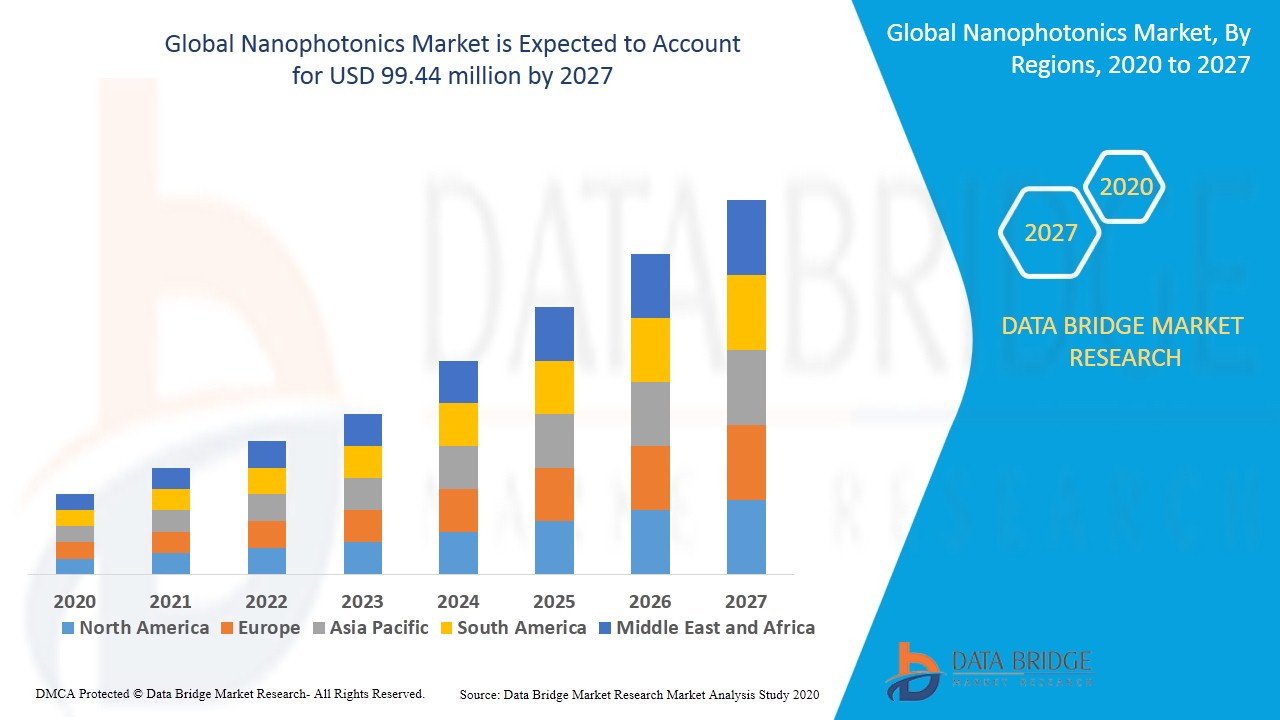
The global nanophotonics market size was valued at USD 42.74 billion in 2024 and is projected to reach USD 406.08 billion by 2032, with a CAGR of 32.50 % during the forecast period of 2025 to 2032. In addition to the insights on market scenarios such as market value, growth rate, segmentation, geographical coverage, and major players, the market reports curated by the Data Bridge Market Research also include depth expert analysis, patient epidemiology, pipeline analysis, pricing analysis, and regulatory framework.
Nanophotonics Market Trends
“Integration of Nanophotonics Technologies”
A key trend in the nanophotonics market is the increasing integration of nanophotonics technologies in consumer devices such as smartphones, wearables, and displays. These advanced materials, such as quantum dots and plasmonic structures, enable enhanced performance by improving light manipulation and energy efficiency. Nanophotonics allows for miniaturization, making it possible to create smaller, more powerful devices without compromising functionality. In smartphones, it enhances display quality with brighter, more vibrant screens, while in wearables, it improves battery life and overall energy efficiency. In addition, nanophotonics is playing a crucial role in developing next-generation displays, such as OLEDs and microLEDs, that offer superior resolution, color accuracy, and energy savings. As demand for compact and high-performing electronics grows, nanophotonics is becoming essential for pushing the boundaries of device design and functionality.
Report Scope and Nanophotonics Market Segmentation
|
Attributes |
Nanophotonics Key Market Insights |
|
Segments Covered |
|
|
Countries Covered |
U.S., Canada and Mexico in North America, Germany, France, U.K., Netherlands, Switzerland, Belgium, Russia, Italy, Spain, Turkey, Rest of Europe in Europe, China, Japan, India, South Korea, Singapore, Malaysia, Australia, Thailand, Indonesia, Philippines, Rest of Asia-Pacific (APAC) in the Asia-Pacific (APAC), Saudi Arabia, U.A.E., South Africa, Egypt, Israel, Rest of Middle East and Africa (MEA) as a part of Middle East and Africa (MEA), Brazil, Argentina and Rest of South America as part of South America |
|
Key Market Players |
Veeco Instruments Inc. (U.S.), Oxford Instruments (Germany), Anders Electronics PLC (U.K.), Crystalfontz America, Inc. (U.S.), Novaled GmbH. (Germany), ams-OSRAM AG. (Germany), SAMSUNG SDI (South Korea), AspenCore, Inc. (U.S.), Newport Corporation (U.S.), Schott AG (Germany), RTP (U.S.), STMicroelectronics (Switzerland), Shoei Electronic Materials, Inc. (U.S.), Headwall Photonics, Inc. (U.S.) |
|
Market Opportunities |
|
|
Value Added Data Infosets |
In addition to the insights on market scenarios such as market value, growth rate, segmentation, geographical coverage, and major players, the market reports curated by the Data Bridge Market Research also include in-depth expert analysis, geographically represented company-wise production and capacity, network layouts of distributors and partners, detailed and updated price trend analysis and deficit analysis of supply chain and demand. |
Nanophotonics Market Definition
Nanophotonics is the study and application of nanotechnology to manipulate and control light on the nanoscale, typically at the level of individual photons. It involves using nanomaterials, such as quantum dots, photonic crystals, and plasmonics, to enhance light-matter interactions for a wide range of applications. Nanophotonics enables advancements in areas such as optical communication, imaging, sensing, and energy harvesting by improving the efficiency, performance, and miniaturization of photonic devices. This technology is essential for the development of high-speed data transmission systems, advanced medical diagnostics, and next-generation consumer electronics.
Nanophotonics Market Dynamics
Drivers
- Rising Demand for High-Speed Data Transmission
The demand for faster data transfer is growing, particularly within telecommunications networks and data centers, as businesses and consumers increasingly rely on real-time communication, cloud services, and data-heavy applications. Nanophotonic technologies are at the forefront of addressing this need, offering advanced solutions that enable higher data transmission speeds and greater efficiency. By utilizing nanomaterials such as quantum dots and photonic crystals, nanophotonics enhances light-matter interactions, improving the performance of optical communication systems. As global data traffic continues to rise, the ability to transfer information quickly and efficiently becomes crucial, thus driving the widespread adoption of nanophotonic technologies in the market.
- Advancements in Quantum Technologies
The rapid advancements in quantum computing and quantum communication technologies are significantly boosting the nanophotonics market. These cutting-edge technologies require precise control over light at the quantum level, which is where nanophotonics excels. Quantum dots, photonic crystals, and other nanomaterials enable the manipulation of photons in ways that traditional technologies cannot, making them essential for the development of quantum systems. These materials facilitate improved performance in quantum computers, quantum communication networks, and other related applications. As quantum technologies continue to evolve, the demand for nanophotonics to support these innovations drives market growth, positioning nanophotonics as a crucial component in the future of quantum technology.
Opportunities
- Integrated Photonics for Communication Systems
The growing demand for high-speed, energy-efficient data transmission in telecom networks and data centers presents a significant opportunity for nanophotonics. As the volume of data continues to increase, traditional electrical interconnects are becoming less effective due to bandwidth and power consumption limitations. Nanophotonic solutions, such as optical interconnects, offer an advanced alternative by enabling faster data transfer with reduced energy requirements. By using photonic materials such as quantum dots and photonic crystals, nanophotonics can drastically improve the performance of communication systems, facilitating the handling of vast amounts of data more efficiently. This technology-driven advancement opens up substantial growth opportunities in the telecom and data center markets.
- Medical Imaging and Diagnostics
Nanophotonics holds significant potential to transform medical imaging and diagnostic technologies. The development of highly sensitive sensors and advanced imaging techniques, such as fluorescence microscopy and optoacoustic imaging, enables more precise visualization of biological structures at the nanoscale. These innovations can greatly enhance the early detection of diseases, allowing for timely intervention and improving patient outcomes. In addition, nanophotonic technologies enable non-invasive diagnostic methods, reducing the need for traditional, more invasive procedures. As healthcare continues to prioritize early diagnosis and minimally invasive treatments, the demand for nanophotonic solutions in medical imaging and diagnostics presents substantial market opportunities.
Restraints/Challenges
- Limited Awareness and Understanding
Despite its immense potential, nanophotonics remains a relatively new and complex field, which limits its widespread adoption. Many businesses and consumers are still unfamiliar with the benefits and applications of nanophotonic technologies, leading to a slower rate of integration into mainstream industries. The lack of awareness and understanding makes it challenging to convey the advantages of nanophotonics, such as enhanced data transmission, improved medical imaging, and energy-efficient solutions. As a result, industries may be hesitant to invest in nanophotonic solutions, hindering the technology's growth and preventing it from achieving its full market potential.
- High Production Costs
The fabrication of nanophotonic materials, such as quantum dots and photonic crystals, involves sophisticated and expensive manufacturing processes that require specialized equipment and expertise. These high production costs pose a significant barrier to the widespread adoption of nanophotonic technologies, especially in price-sensitive markets where cost efficiency is a key consideration. The need for advanced materials and precise fabrication techniques increases the overall expense of nanophotonic solutions, making it difficult for companies to scale production or offer affordable products to consumers. As a result, the high cost of manufacturing remains a major restraint for the growth of the nanophotonics market.
This market report provides details of new recent developments, trade regulations, import-export analysis, production analysis, value chain optimization, market share, impact of domestic and localized market players, analyses opportunities in terms of emerging revenue pockets, changes in market regulations, strategic market growth analysis, market size, category market growths, application niches and dominance, product approvals, product launches, geographic expansions, technological innovations in the market. To gain more info on the market contact Data Bridge Market Research for an Analyst Brief, our team will help you take an informed market decision to achieve market growth.
Nanophotonics Market Scope
The market is segmented on the basis of product, ingredients, and application. The growth amongst these segments will help you analyse meagre growth segments in the industries and provide the users with a valuable market overview and market insights to help them make strategic decisions for identifying core market applications.
Product
- LEDs
- OLEDs
- Near Field Optics
- Photovoltaic Cells
- Optical Amplifiers
- Optical Switches
- Holographic Memory
Ingredients
- Plasmonics
- Photonic Crystals
- Nanotubes
- Nanoribbons
- Quantum Dots
Application
- Entertainment
- Consumer Electronics
- Indicators and Signs
- Lighting
- Telecommunication
- Non-visual Applications
Nanophotonics Market Regional Analysis
The market is analysed and market size insights and trends are provided by country, product, ingredients, and application as referenced above.
The countries covered in the market report are U.S., Canada and Mexico in North America, Germany, France, U.K., Netherlands, Switzerland, Belgium, Russia, Italy, Spain, Turkey, Rest of Europe in Europe, China, Japan, India, South Korea, Singapore, Malaysia, Australia, Thailand, Indonesia, Philippines, Rest of Asia-Pacific (APAC) in the Asia-Pacific (APAC), Saudi Arabia, U.A.E., South Africa, Egypt, Israel, Rest of Middle East and Africa (MEA) as a part of Middle East and Africa (MEA), Brazil, Argentina and Rest of South America as part of South America.
North America is expected to dominates the nanophotonics market, driven by a growing number of research initiatives and technological advancements in the region. The presence of key players and strong investment in R&D further strengthens the market potential. As innovation in nanophotonics accelerates, North America remains at the forefront of market growth and development.
Asia-Pacific region is projected to experience significant growth from 2025 to 2032, driven by the expanding populations in India and China. This demographic shift is expected to create a higher demand for nanophotonic technologies across various sectors. As these countries continue to advance technologically, the market for nanophotonics in Asia-Pacific is set to flourish.
The country section of the report also provides individual market impacting factors and changes in regulation in the market domestically that impacts the current and future trends of the market. Data points such as down-stream and upstream value chain analysis, technical trends and porter's five forces analysis, case studies are some of the pointers used to forecast the market scenario for individual countries. Also, the presence and availability of global brands and their challenges faced due to large or scarce competition from local and domestic brands, impact of domestic tariffs and trade routes are considered while providing forecast analysis of the country data.
Nanophotonics Market Share
The market competitive landscape provides details by competitor. Details included are company overview, company financials, revenue generated, market potential, investment in research and development, new market initiatives, global presence, production sites and facilities, production capacities, company strengths and weaknesses, product launch, product width and breadth, application dominance. The above data points provided are only related to the companies' focus related to market.
Nanophotonics Market Leaders Operating in the Market Are:
- Veeco Instruments Inc. (U.S.)
- Oxford Instruments (Germany)
- Anders Electronics PLC (U.K.)
- Crystalfontz America, Inc. (U.S.)
- Novaled GmbH. (Germany)
- ams-OSRAM AG. (Germany)
- SAMSUNG SDI (South Korea)
- AspenCore, Inc. (U.S.)
- Newport Corporation (U.S.)
- Schott AG (Germany)
- RTP (U.S.)
- STMicroelectronics (Switzerland)
- Shoei Electronic Materials, Inc. (U.S.)
- Headwall Photonics, Inc. (U.S.)
Latest Developments in Nanophotonics Market
- In February 2024, Cree Lighting introduced the OSQP Pathway Bollard, featuring NanoComfort Technology, expanding their successful OSQ family of lighting products with improved functionality and energy efficiency
- In May 2024, Lumileds launched the LUXEON HL4X power LED, offering the highest output and efficiency in the lighting industry, enabling lighting manufacturers to standardize designs and achieve better performance
- In November 2023, researchers from FAU and Stanford University demonstrated a nanophotonic electron accelerator, using lasers to accelerate electrons within photonic nanostructures. This breakthrough could lead to compact and cost-effective accelerators for medical and scientific applications
- In October 2022, the Foremost Photonics 2022 workshop took place in Erice, Italy, organized by Nanophotonics Europe (NEA). Leading experts in the field discussed the future of nanophotonics and outlined strategies to support the career growth of emerging researchers
- In March 2021, Hamamatsu Photonics developed the MiNYTM PL micro-LED PL inspection system, capable of evaluating micro-LEDs for next-generation displays at full speed. This technology enhances micro-LED R&D efficiency and product yield by quickly identifying anomalies

- Interactive Data Analysis Dashboard
- Company Analysis Dashboard for high growth potential opportunities
- Research Analyst Access for customization & queries
- Competitor Analysis with Interactive dashboard
- Latest News, Updates & Trend analysis
- Harness the Power of Benchmark Analysis for Comprehensive Competitor Tracking
Global Nanophotonics Market, Supply Chain Analysis and Ecosystem Framework
To support market growth and help clients navigate the impact of geopolitical shifts, DBMR has integrated in-depth supply chain analysis into its Global Nanophotonics Market research reports. This addition empowers clients to respond effectively to global changes affecting their industries. The supply chain analysis section includes detailed insights such as Global Nanophotonics Market consumption and production by country, price trend analysis, the impact of tariffs and geopolitical developments, and import and export trends by country and HSN code. It also highlights major suppliers with data on production capacity and company profiles, as well as key importers and exporters. In addition to research, DBMR offers specialized supply chain consulting services backed by over a decade of experience, providing solutions like supplier discovery, supplier risk assessment, price trend analysis, impact evaluation of inflation and trade route changes, and comprehensive market trend analysis.
Data collection and base year analysis are done using data collection modules with large sample sizes. The stage includes obtaining market information or related data through various sources and strategies. It includes examining and planning all the data acquired from the past in advance. It likewise envelops the examination of information inconsistencies seen across different information sources. The market data is analysed and estimated using market statistical and coherent models. Also, market share analysis and key trend analysis are the major success factors in the market report. To know more, please request an analyst call or drop down your inquiry.
The key research methodology used by DBMR research team is data triangulation which involves data mining, analysis of the impact of data variables on the market and primary (industry expert) validation. Data models include Vendor Positioning Grid, Market Time Line Analysis, Market Overview and Guide, Company Positioning Grid, Patent Analysis, Pricing Analysis, Company Market Share Analysis, Standards of Measurement, Global versus Regional and Vendor Share Analysis. To know more about the research methodology, drop in an inquiry to speak to our industry experts.
Data Bridge Market Research is a leader in advanced formative research. We take pride in servicing our existing and new customers with data and analysis that match and suits their goal. The report can be customized to include price trend analysis of target brands understanding the market for additional countries (ask for the list of countries), clinical trial results data, literature review, refurbished market and product base analysis. Market analysis of target competitors can be analyzed from technology-based analysis to market portfolio strategies. We can add as many competitors that you require data about in the format and data style you are looking for. Our team of analysts can also provide you data in crude raw excel files pivot tables (Fact book) or can assist you in creating presentations from the data sets available in the report.













