


Nanorobotics for Targeted Drug Delivery Market Size
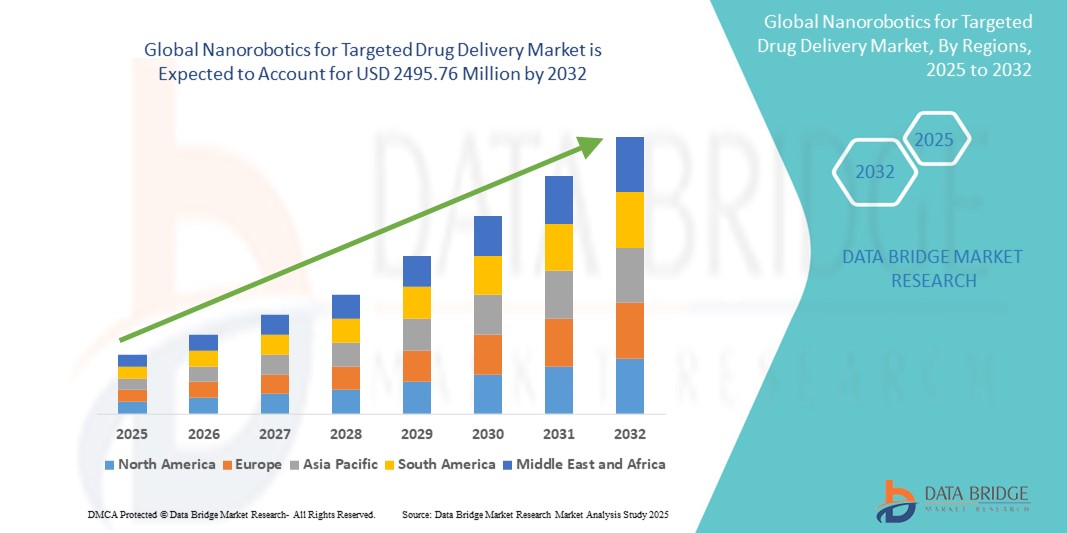
- The global nanorobotics for targeted drug delivery market size was valued at USD 317.49 million in 2024 and is expected to reach USD 2495.76 million by 2032, at a CAGR of 29.40% during the forecast period
- The market growth is largely fueled by the rise in the prevalence of chronic diseases such as cancer, cardiovascular disorders, and neurological conditions that necessitate targeted and efficient drug delivery, alongside the increasing global geriatric population who are more susceptible to these diseases
- Technological advancements in nanomaterial synthesis, nanorobot design, and remote control mechanisms are enhancing the precision, effectiveness, and safety of these systems. The growing preference for minimally invasive treatment options that reduce systemic toxicity and improve patient outcomes compared to traditional chemotherapy and other systemic therapies is also a significant driver
Nanorobotics for Targeted Drug Delivery Market Analysis
- Nanorobotics for targeted drug delivery involves using nanoscale robots (1-100 nm) for precise transport and release of therapeutics to specific body locations. This is increasingly vital in modern healthcare due to its ability to deliver drugs with high accuracy and reduce overall side effects
- The growing use of this technology is mainly due to the rising occurrence of diseases needing localized treatment, increasing understanding of the downsides of traditional drug delivery, and a growing desire for more effective and less invasive therapies
- North America is expected to dominate the nanorobotics for targeted drug delivery market with a share of 38.0% due to significant investment in research and development within nanotechnology and nanorobotics, alongside a well-established healthcare infrastructure that facilitates the adoption of advanced treatment modalities
- Asia-Pacific is expected to be the fastest growing region in the nanorobotics for targeted drug delivery market during the forecast period due to increasing investments in healthcare and biotechnology, a growing middle-class population with greater access to advanced medical treatments, and rising healthcare expenditure across countries such as China, Japan, South Korea, and India
- Biochips segment is expected to dominate the market with a market share of 28.5% due to their critical role in enhancing precision drug delivery, biomarker detection, and integration with diagnostic tools, making them highly effective in oncology and personalized medicine applications
Report Scope and Nanorobotics for Targeted Drug Delivery Market Segmentation
|
Attributes |
Nanorobotics for Targeted Drug Delivery Key Market Insights |
|
Segments Covered |
|
|
Countries Covered |
North America
Europe
Asia-Pacific
Middle East and Africa
South America
|
|
Key Market Players |
|
|
Market Opportunities |
|
|
Value Added Data Infosets |
In addition to the insights on market scenarios such as market value, growth rate, segmentation, geographical coverage, and major players, the market reports curated by the Data Bridge Market Research also include depth expert analysis, patient epidemiology, pipeline analysis, pricing analysis, and regulatory framework. |
Nanorobotics for Targeted Drug Delivery Market Trends
“Increasing Focus on Precision Medicine”
- A significant and accelerating trend in the global Nanorobotics for Targeted Drug Delivery market is the increasing focus on precision medicine, aiming to deliver therapies specifically to diseased cells or tissues while minimizing harm to healthy areas
- For instance, major players in the pharmaceutical and biotechnology industries, such as Novartis AG and AstraZeneca, are actively exploring and investing in nanorobotics and nanoparticle-based drug delivery systems to achieve higher precision in their treatments. Similarly, companies such as Johnson & Johnson and Merck & Co., Inc. are engaged in research and development to leverage nanotechnology for targeted drug delivery in areas such as oncology and immunology
- This heightened focus enables the development of nanorobots capable of recognizing specific biomarkers on target cells, ensuring that therapeutic payloads are delivered directly to the site of disease. This approach significantly reduces the exposure of healthy tissues to drugs, thereby minimizing side effects and improving treatment efficacy
- The growing emphasis on personalized medicine, where treatments are tailored to individual patient needs and disease characteristics, further fuels the demand for precise drug delivery methods such as nanorobotics. Healthcare professionals are increasingly recognizing the potential of this technology to enhance treatment outcomes and improve patient quality of life
- This trend towards greater precision in medicine, coupled with the advancements in nanotechnology and the involvement of leading companies such as Pfizer Inc. and Sanofi S.A. in exploring nanorobotic solutions, is fundamentally reshaping the landscape of drug delivery
- The demand for Nanorobotics for Targeted Drug Delivery is growing rapidly across various therapeutic areas, as the focus on precision medicine encourages the development and adoption of these innovative technologies. This targeted approach to treatment is vital for improving therapeutic outcomes and reducing the burden of diseases, significantly boosting the Nanorobotics for Targeted Drug Delivery market
Nanorobotics for Targeted Drug Delivery Market Dynamics
Driver
“Increased Awareness of Nanotechnology”
- The increasing awareness of nanotechnology across various sectors, including healthcare, is a significant driver for the heightened demand for Nanorobotics for Targeted Drug Delivery
- For instance, scientific literature published in journals such as Nature Nanotechnology and ACS Nano, alongside media coverage by organizations such as the National Nanotechnology Initiative (NNI), consistently highlight the potential of nanotechnology to revolutionize medicine, including targeted drug delivery
- As the understanding of nanotechnology's capabilities in medicine expands, Nanorobotics for Targeted Drug Delivery offers a potentially superior approach compared to conventional drug administration by promising increased efficacy and reduced side effects
- Furthermore, the growing recognition of the limitations of traditional drug delivery methods and the potential of nanotechnology to overcome these limitations is prompting more research and development in this field. This increased awareness, driven by scientific advancements and the potential for personalized medicine, further fuels the demand for nanorobotics solutions
- The increasing accessibility of information about nanotechnology and its applications in targeted drug delivery, coupled with the growing interest from researchers, clinicians, and patients, makes it an attractive area for innovation and investment. The trend towards more advanced and personalized medical treatments and the desire for therapies with improved outcomes are also key factors propelling the adoption and development of Nanorobotics for Targeted Drug Delivery
Restraint/Challenge
“Navigating Biological Barriers”
- Effectively navigating the intricate biological barriers within the human body presents a significant challenge to the widespread adoption of nanorobotics for targeted drug delivery. While the potential for precision is high, the complexity of biological systems poses hurdles for these nanoscale devices
- For instance, the blood-brain barrier, a highly selective membrane protecting the brain, restricts the passage of many therapeutic agents. Developing nanorobots capable of traversing this barrier efficiently and delivering drugs specifically to brain tumors or neurological disease sites remains a complex task for researchers at institutions and companies such as Novartis AG exploring neurodegenerative disease therapies
- Addressing these navigational challenges requires the development of sophisticated nanorobot designs, surface modifications to prevent immune system clearance, and precise control mechanisms to guide them through dense tissues
- While the potential long-term benefits of overcoming these barriers such as highly targeted cancer therapy with minimized side effects or effective treatment of previously inaccessible diseases, are substantial, the current limitations in reliably navigating these biological complexities hinder broader clinical translation and market growth
- Overcoming these challenges through innovations in material science, bioengineering, and remote control technologies by companies such as research-focused entities and emerging nanorobotics firms will be vital for realizing the full potential of targeted drug delivery in the Nanorobotics sector
Nanorobotics for Targeted Drug Delivery Market Scope
The market is segmented on the basis of type, propulsion methods, application, and end-user.
- By Type
On the basis of type, the market is segmented into 3D-motion nanomachines, bacteria powered nanobots, biochips, nubots, nanorockets, and others. The biochips segment dominates the largest market revenue share of 28.5% in 2025, driven by their critical role in enhancing precision drug delivery, biomarker detection, and integration with diagnostic tools, making them highly effective in oncology and personalized medicine applications.
The bacteria powered nanobots segment is expected to witness the fastest CAGR from 2025 to 2032, driven by growing interest in bio-hybrid nanorobots for targeted therapies, particularly in environments where chemical propulsion is less effective or biocompatibility is essential.
- By Propulsion Methods
On the basis of propulsion methods, the market is segmented into endogenous and exogenous. The exogenous segment dominates the largest market revenue share in 2025, driven by its established control mechanisms using external stimuli such as magnetic fields or ultrasound, which enhance precision in targeted delivery.
The endogenous segment is expected to witness the fastest CAGR from 2025 to 2032, driven by increasing research into autonomous nanorobots powered by biochemical reactions within the human body, offering higher biocompatibility and efficiency.
- By Application
On the basis of application, the market is segmented into chemotherapy, radiotherapy, in-vitro, and in-vivo applications. The chemotherapy segment dominates the largest market revenue share in 2025, driven by the critical demand for targeted nanorobotics to reduce systemic toxicity and enhance therapeutic precision in cancer treatment.
The in-vivo segment is expected to witness the fastest CAGR from 2025 to 2032, driven by advancements in real-time navigation and deployment of nanorobots within the human body for diagnostics, monitoring, and localized treatment.
- By End-User
On the basis of end-user, the market is segmented into pharmaceutical, biotechnology firms, and research laboratories. The pharmaceutical segment dominates the largest market revenue share in 2025, driven by major investments in nanotechnology-based drug delivery systems to improve pipeline efficiency and therapeutic outcomes.
The research laboratories segment is expected to witness the fastest CAGR from 2025 to 2032, driven by increasing academic and institutional R&D activities focusing on innovative propulsion methods, biocompatible materials, and novel applications for nanorobotics in medicine.
Nanorobotics for Targeted Drug Delivery Market Regional Analysis
- North America dominates the nanorobotics for targeted drug delivery market with the largest revenue share of 38.0% in 2024, driven by significant investment in research and development within nanotechnology and nanorobotics, alongside a well-established healthcare infrastructure that facilitates the adoption of advanced treatment modalities
- The high prevalence of chronic diseases requiring targeted therapies further contributes to the region's market leadership. The strong presence of leading pharmaceutical and biotechnology companies actively investing in innovative drug delivery technologies also plays a crucial role
- Businesses in the region prioritize advanced medical solutions to enhance patient outcomes, supported by favorable funding landscapes and a proactive approach to managing various diseases
U.S. Nanorobotics for Targeted Drug Delivery Market Insight
U.S. nanorobotics for targeted drug delivery market is expected to capture the largest revenue share within North America in 2025. This is fueled by a substantial patient population seeking more effective and less invasive treatment options, particularly for cancer and other chronic conditions. The increasing emphasis on precision medicine and the active research and development of sophisticated nanorobotic systems for targeted drug release are key drivers. Moreover, the growing awareness of the benefits of minimizing systemic drug exposure through targeted delivery is contributing to greater adoption.
Europe Nanorobotics for Targeted Drug Delivery Market Insight
The European nanorobotics for targeted drug delivery market is projected to expand at a substantial CAGR throughout the forecast period. This regional market growth is largely due to increasing investments in nanotechnology research and development and a growing preference for advanced and targeted therapeutic approaches. Consequently, research institutions and biotechnology firms across Europe are increasingly focusing on developing and implementing nanorobotic drug delivery systems. Furthermore, rising government initiatives and funding aimed at promoting innovation in healthcare and providing advanced treatment options are fueling the need for effective and patient-friendly solutions such as nanorobotics.
U.K. Nanorobotics for Targeted Drug Delivery Market Insight
U.K. nanorobotics for targeted drug delivery market is anticipated to grow at a noteworthy CAGR during the forecast period, driven by increasing diagnosis rates of chronic diseases and a growing demand for innovative and targeted treatment alternatives to conventional drug administration. In addition, the rising recognition of the potential of nanotechnology in revolutionizing medicine and the presence of strong research institutions and pharmaceutical companies are encouraging greater adoption. The U.K.'s well-established healthcare system and increasing focus on personalized medicine are expected to continue to stimulate market growth.
Germany Nanorobotics for Targeted Drug Delivery Market Insight
The German nanorobotics for targeted drug delivery market is expected to expand at a considerable CAGR during the forecast period, fueled by increasing awareness of the limitations of traditional drug delivery methods and the demand for technologically advanced and patient-specific treatment options. Germany’s strong focus on high-quality medical devices and its well-established research and industrial infrastructure promote the development and adoption of sophisticated nanorobotic systems. The integration of nanotechnology into pharmaceutical research and the preference for minimally invasive and highly effective interventions are also becoming increasingly prevalent.
Asia-Pacific Nanorobotics for Targeted Drug Delivery Market Insight
Asia-Pacific nanorobotics for targeted drug delivery market is poised to grow at the fastest CAGR of 23.7% in 2025, driven by increasing investments in healthcare and biotechnology, a growing middle-class population with greater access to advanced medical treatments, and rising healthcare expenditure across countries such as China, Japan, South Korea, and India. The region's growing focus on improving healthcare infrastructure and embracing cutting-edge medical technologies is driving the adoption of nanorobotic drug delivery. Furthermore, as APAC emerges as a hub for technological innovation and with a large population base, the potential for market expansion is significant.
Japan Nanorobotics for Targeted Drug Delivery Market Insight
Japan's nanorobotics for targeted drug delivery market is gaining momentum due to the country’s advanced healthcare system, increasing awareness of the benefits of nanotechnology in medicine, and demand for highly effective and minimally invasive treatment solutions. The Japanese market places a significant emphasis on precision and patient outcomes, and the adoption of sophisticated nanorobotic systems is driven by the increasing need for personalized therapy. The strong collaboration between research institutions, government bodies, and the pharmaceutical industry is fueling growth.
China Nanorobotics for Targeted Drug Delivery Market Insight
China's nanorobotics for targeted drug delivery market is expected to account for the largest market revenue share in Asia Pacific in 2025. This is attributed to the country's large population base, increasing prevalence of diseases requiring targeted interventions, and growing healthcare access, coupled with significant government investment in nanotechnology and advanced medical research. China represents a significant market for medical devices and innovative therapies, and nanorobotics is becoming increasingly recognized as a promising approach for targeted drug delivery. The increasing investment in healthcare infrastructure and the rising awareness of the potential of nanotechnology in medicine among the population are key factors propelling the market in China.
Nanorobotics for Targeted Drug Delivery Market Share
The nanorobotics for targeted drug delivery industry is primarily led by well-established companies, including:
- Novartis AG (Switzerland)
- AstraZeneca (U.K.)
- Pfizer Inc. (U.S.)
- Sanofi S.A. (France)
- AbbVie (U.S.)
- Hitachi Ltd. (Japan)
- Bruker Corporation (U.S.)
- Johnson & Johnson (U.S.)
- Merck & Co., Inc. (U.S.)
- Thermo Fisher Scientific Inc (U.S.)
- Imina Technologies (Switzerland)
- Klocke Nanotechnik GmbH (India)
- Kleindiek Nanotechnik GmbH (Germany)
- Nanonics Imaging Ltd. (Israel)
- Hummingbird Scientific (U.S.)
Latest Developments in Global Nanorobotics for Targeted Drug Delivery Market
- In July 2024, researchers at Sweden's Karolinska Institute developed nanorobots, equipped with concealed lethal peptides. In trials on mice, these nanorobots specifically targeted and eliminated cancer cells while sparing healthy tissue. In these trials, they achieved a 70% reduction in tumor growth
- In April 2024, The Chinese University of Hong Kong (CUHK) launched novel nanorobots. In particular, these nanorobots are retrievable and designed for targeted and enhanced thrombolysis. In doing so, they potentially offer a way to save stroke patients from brain damage
- In December 2023, researchers from universities in New York and Ningbo, China, announced the creation of tiny robots. In this instance, the robots were built from DNA and can reproduce themselves. In the future, this breakthrough has potential applications in drug delivery and molecular diagnostics

- Interactive Data Analysis Dashboard
- Company Analysis Dashboard for high growth potential opportunities
- Research Analyst Access for customization & queries
- Competitor Analysis with Interactive dashboard
- Latest News, Updates & Trend analysis
- Harness the Power of Benchmark Analysis for Comprehensive Competitor Tracking
Data collection and base year analysis are done using data collection modules with large sample sizes. The stage includes obtaining market information or related data through various sources and strategies. It includes examining and planning all the data acquired from the past in advance. It likewise envelops the examination of information inconsistencies seen across different information sources. The market data is analysed and estimated using market statistical and coherent models. Also, market share analysis and key trend analysis are the major success factors in the market report. To know more, please request an analyst call or drop down your inquiry.
The key research methodology used by DBMR research team is data triangulation which involves data mining, analysis of the impact of data variables on the market and primary (industry expert) validation. Data models include Vendor Positioning Grid, Market Time Line Analysis, Market Overview and Guide, Company Positioning Grid, Patent Analysis, Pricing Analysis, Company Market Share Analysis, Standards of Measurement, Global versus Regional and Vendor Share Analysis. To know more about the research methodology, drop in an inquiry to speak to our industry experts.
Data Bridge Market Research is a leader in advanced formative research. We take pride in servicing our existing and new customers with data and analysis that match and suits their goal. The report can be customized to include price trend analysis of target brands understanding the market for additional countries (ask for the list of countries), clinical trial results data, literature review, refurbished market and product base analysis. Market analysis of target competitors can be analyzed from technology-based analysis to market portfolio strategies. We can add as many competitors that you require data about in the format and data style you are looking for. Our team of analysts can also provide you data in crude raw excel files pivot tables (Fact book) or can assist you in creating presentations from the data sets available in the report.













