


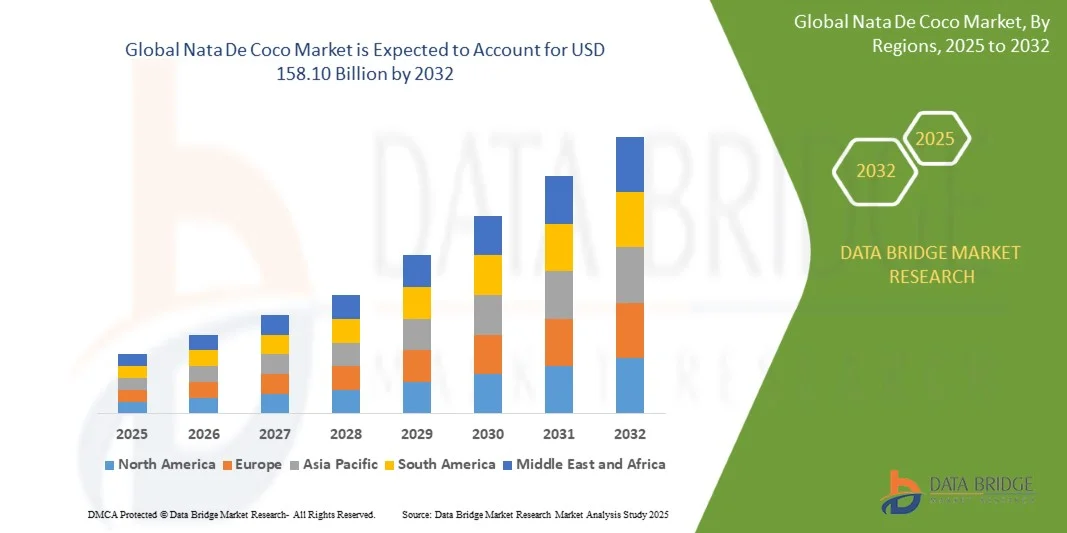
Nata De Coco Market Size
- The Nata De Coco Market size was valued at USD 739.20 billion in 2024 and is projected to reach USD 158.10 billion by 2032, growing at a CAGR of 7.90% during the forecast period.
- The market growth is primarily driven by increasing consumer preference for healthy and natural food products, coupled with rising awareness about the benefits of fermented foods.
- Additionally, expanding applications of Nata De Coco in beverages, desserts, and confectionery, along with innovations in flavor and packaging, are propelling demand and fueling market expansion globally.
Nata De Coco Market Analysis
- Nata De Coco, a chewy, translucent, jelly-like food product made from fermented coconut water, is gaining popularity in both the food and beverage industries due to its unique texture, health benefits, and versatility in various culinary applications.
- The rising consumer preference for natural, low-calorie, and fiber-rich ingredients is driving increased demand for Nata De Coco, especially in desserts, beverages, and confectionery products.
- Asia-Pacific dominated the Nata De Coco market with the largest revenue share of 40.5% in 2024, supported by high coconut production, traditional consumption, and growing adoption in emerging markets such as China and India, where health-conscious consumers are increasingly incorporating Nata De Coco into their diets.
- North America is expected to be the fastest-growing region during the forecast period due to rising demand for healthy and exotic food products, along with expanding distribution channels in retail and foodservice sectors.
- The Juice Drink segment dominated the market with the largest market revenue share of 34.5% in 2024, driven by its widespread use in fruit-based beverages and the increasing popularity of functional drinks with chewy textures
Report Scope and Nata De Coco Market Segmentation
|
Attributes |
Nata De Coco Key Market Insights |
|
Segments Covered |
|
|
Countries Covered |
North America
Europe
Asia-Pacific
Middle East and Africa
South America
|
|
Key Market Players |
|
|
Market Opportunities |
|
|
Value Added Data Infosets |
In addition to the insights on market scenarios such as market value, growth rate, segmentation, geographical coverage, and major players, the market reports curated by the Data Bridge Market Research also include in-depth expert analysis, pricing analysis, brand share analysis, consumer survey, demography analysis, supply chain analysis, value chain analysis, raw material/consumables overview, vendor selection criteria, PESTLE Analysis, Porter Analysis, and regulatory framework. |
Nata De Coco Market Trends
“Innovation in Flavor, Packaging, and Functional Benefits”
- A significant and accelerating trend in the Nata De Coco Market is the growing innovation in flavor variety, health-oriented formulations, and modern packaging solutions. Manufacturers are expanding their product lines beyond traditional offerings to include fruit-infused, low-sugar, and vitamin-enriched Nata De Coco variants, catering to evolving consumer preferences for taste and wellness.
- For instance, brands are introducing Nata De Coco in exotic flavors such as lychee, mango, and passion fruit, enhancing appeal among younger consumers and health-conscious individuals. Simultaneously, packaging innovations such as single-serve cups, resealable pouches, and eco-friendly containers are improving convenience and shelf appeal, especially in urban and on-the-go markets.
- Functional enhancements are also gaining traction, with producers incorporating added fiber, collagen, or probiotics into Nata De Coco products. These functional variants support digestive health, skin care, and general wellness, aligning with global trends toward nutraceutical and better-for-you foods.
- The rising demand for plant-based and low-calorie dessert alternatives is also pushing manufacturers to create cleaner-label Nata De Coco offerings — free from artificial colors, preservatives, or added sugars. These developments are resonating strongly with millennials and Gen Z consumers, who favor transparency and health-focused snacking.
- Additionally, Nata De Coco is increasingly being used as an ingredient in fusion beverages, bubble teas, yogurts, and frozen desserts across markets in Asia, North America, and Europe. This has created opportunities for cross-industry collaborations and co-branded products that amplify visibility and consumption.
- Companies like Happy Alliance and HTK Foods are leading this innovation wave by investing in R&D to develop fortified, flavorful, and sustainable Nata De Coco products aimed at both domestic and global markets. These efforts are reshaping consumer expectations and broadening the use of Nata De Coco in modern food and beverage applications.
Nata De Coco Market Dynamics
Driver
“Growing Demand Driven by Health Trends and Versatile Applications”
- The Nata De Coco Market is experiencing significant growth, largely fueled by rising health consciousness among consumers and a growing preference for natural, plant-based, and low-calorie food options. As people increasingly shift away from processed sugars and high-calorie desserts, Nata De Coco offers an appealing alternative due to its high fiber content, refreshing texture, and minimal caloric value.
- For instance, the inclusion of Nata De Coco in popular functional beverages like bubble tea, fruit juices, and probiotic drinks has become a prominent trend, especially in Asia-Pacific and North America. The product’s ability to enhance texture while adding nutritional value makes it highly attractive for beverage and dessert manufacturers aiming to meet health and wellness demands.
- Additionally, the product's versatility allows it to be incorporated into yogurts, ice creams, puddings, and fruit cups, making it suitable for both retail and foodservice applications. This widespread usage is driving growth in both developed and emerging markets, with producers introducing new flavor variants and fortified options to cater to diverse consumer preferences.
- The demand is also being supported by the rising popularity of Asian cuisine globally, where Nata De Coco is traditionally used in desserts. As global consumers become more adventurous in their food choices, they are increasingly open to incorporating ingredients like Nata De Coco into their daily diets.
- Manufacturers such as Happy Alliance, HTK Foods, and Prosper Foods Industry are expanding their global footprint through improved production techniques, attractive packaging, and clean-label marketing strategies. These companies are actively investing in product R&D and expanding distribution networks to capture growing demand in regions like Europe, the Middle East, and Latin America.
Restraint/Challenge
“Supply Chain Vulnerabilities and Limited Awareness in Non-Core Markets”
- A key challenge in the Nata De Coco Market is its high dependence on coconut-producing countries, which makes the supply chain vulnerable to disruptions. Since Nata De Coco is derived from fermented coconut water, fluctuations in coconut availability due to seasonal changes, climate events, or labor shortages in major producing countries like the Philippines, Indonesia, and Vietnam can significantly impact production and export capacities.
- For instance, extreme weather conditions such as typhoons or droughts in Southeast Asia have previously caused delays in coconut harvesting, affecting the consistent supply of raw materials needed for Nata De Coco manufacturing and disrupting fulfillment for international buyers.
- Another critical barrier is the relatively low consumer awareness and limited product familiarity in regions outside of Asia-Pacific. In markets like North America, Europe, and Africa, many consumers are unaware of what Nata De Coco is, how it’s used, or its potential health benefits. This knowledge gap has limited market penetration and restricted demand, despite growing global interest in plant-based and functional foods.
- Furthermore, small and mid-sized producers often face difficulties complying with strict international food safety, quality, and labeling standards required to enter premium markets. Certification processes such as HACCP, ISO, or FDA approvals can be costly and time-consuming, creating entry barriers for exporters seeking global expansion.
- While some established players like Happy Alliance and HTK Foods are addressing these challenges through modernized production facilities and strategic global marketing, the broader market still faces hurdles in scaling up awareness and supply resilience.
- Overcoming these challenges will require targeted consumer education, improved branding and packaging to appeal to Western audiences, diversification of sourcing and production locations, and stronger compliance with international quality standards. These steps are essential for ensuring long-term, sustainable growth of Nata De Coco in global markets.
Nata De Coco Market Scope
The market is segmented on the basis of product, application, packaging, distribution channel.
• By Product
On the basis of product, the Nata De Coco market is segmented into Juice Drink, Jelly Drink, Jelly, Pudding, and Others. The Juice Drink segment dominated the market with the largest market revenue share of 34.5% in 2024, driven by its widespread use in fruit-based beverages and the increasing popularity of functional drinks with chewy textures. Nata De Coco juice drinks are especially favored in Asian countries and are expanding globally due to their low-calorie content and perceived digestive health benefits.
The Jelly Drink segment is projected to witness the fastest growth rate from 2025 to 2032, fueled by growing demand for convenient, ready-to-consume products with textural appeal. The increasing use of jelly drinks among younger consumers, combined with innovative flavors and vibrant packaging, is significantly enhancing their market traction, especially through retail and e-commerce channels in emerging markets.
• By Application
On the basis of application, the market is segmented into Food and Beverages, Cosmetics, Pharmaceutical, and Others. The Food and Beverages segment held the largest market revenue share of 78.2% in 2024, due to Nata De Coco’s wide use in desserts, fruit cups, drinks, and yogurts. Its fibrous texture and neutral flavor make it suitable for a variety of product formulations in both domestic and commercial food applications.
The Cosmetics segment is expected to register the fastest CAGR from 2025 to 2032, supported by increasing demand for natural, plant-based ingredients in skincare and personal care products. Nata De Coco, as a fermented coconut derivative, is increasingly used in facial masks and hydrating skin gels due to its moisturizing and texturizing properties. The global trend toward clean beauty and sustainable formulations is further accelerating this segment’s growth.
• By Packaging
On the basis of packaging, the market is segmented into Bottle, Can, Box, Sachet, Cup, and Others. The Cup segment dominated the market in 2024 with a revenue share of 31.4%, owing to its convenience and popularity in single-serve dessert and jelly drink packaging. Cups are widely used for on-the-go consumption and are highly favored in retail settings due to their appealing presentation and ease of storage.
The Sachet segment is expected to witness the fastest growth from 2025 to 2032. Sachets offer affordability, ease of distribution, and convenience for single-use consumption, especially in price-sensitive and emerging markets. Their lightweight design, reduced packaging waste, and suitability for small-format retail make sachets a preferred option for expanding into rural and semi-urban regions.
• By Distribution Channel
On the basis of distribution channel, the market is segmented into Supermarket, Hypermarket, Convenience Shop, E-Commerce, and Others. The Supermarket segment held the largest revenue share of 36.7% in 2024, driven by strong consumer preference for in-store purchases of food and beverage products, visibility of Nata De Coco variants on shelves, and the availability of promotional offers.
The E-Commerce segment is projected to witness the fastest CAGR from 2025 to 2032. Growth is fueled by rising online grocery adoption, greater accessibility of specialty products, and increasing digital marketing efforts by Nata De Coco brands. Direct-to-consumer models and social media-driven promotions have enabled brands to reach health-conscious consumers and global markets efficiently, especially in the post-pandemic landscape where online food shopping has surged.
Nata De Coco Market Regional Analysis
- Asia-Pacific dominated the Nata De Coco Market with the largest revenue share of 40.5% in 2024, driven by strong consumption in countries such as the Philippines, Indonesia, Thailand, and Japan, where Nata De Coco is a staple in desserts and beverages.
- Consumers in the region appreciate Nata De Coco for its refreshing texture, health benefits such as high fiber and low calories, and versatility in both traditional and modern food and drink applications.
- This strong regional demand is further fueled by the established coconut processing industry, abundant raw material supply, and a growing trend of health-conscious eating. Additionally, local manufacturers are actively innovating with flavored variants and convenient packaging, reinforcing the product's popularity across both domestic and export markets.
U.S. Nata De Coco Market Insight
The U.S. Nata De Coco market captured the largest revenue share of 78% in North America in 2024, fueled by the growing popularity of functional beverages and low-calorie dessert options. Consumers are increasingly drawn to plant-based, fiber-rich ingredients, and Nata De Coco is gaining traction in fruit drinks, yogurt products, and bubble teas. The rise of Asian cuisine and fusion food trends, along with expanding availability in health food stores and e-commerce platforms, is driving consumption. Additionally, the strong presence of Asian-American communities and increased marketing by importers and brands are helping introduce Nata De Coco to mainstream American consumers.
Europe Nata De Coco Market Insight
The Europe Nata De Coco market is projected to expand at a strong CAGR throughout the forecast period, supported by rising demand for clean-label, vegan-friendly, and functional food ingredients. European consumers are increasingly seeking high-fiber, natural alternatives in snacks and beverages, with Nata De Coco emerging as a preferred option. The region is also witnessing a surge in popularity of bubble tea cafés and Asian-inspired desserts, boosting Nata De Coco usage. Additionally, growing health awareness and preferences for reduced-sugar and plant-based formulations are driving demand across the U.K., Germany, France, and the Netherlands.
U.K. Nata De Coco Market Insight
The U.K. Nata De Coco market is expected to grow at a significant CAGR over the forecast period, driven by increased consumer interest in Asian foods and functional ingredients. The rise of health-conscious eating, along with a growing bubble tea culture, has popularized Nata De Coco as a chewy, low-calorie add-in for drinks and desserts. Retailers and specialty stores are expanding their product offerings to include more fruit-based jelly drinks and dessert cups featuring Nata De Coco. The U.K.'s diverse population and strong import infrastructure are also supporting the market's upward trajectory.
Germany Nata De Coco Market Insight
The Germany Nata De Coco market is anticipated to expand steadily, fueled by demand for natural, organic, and gut-friendly food products. German consumers are showing growing interest in functional foods, and Nata De Coco is increasingly being included in fruit preserves, drinkable yogurts, and alternative snack products. The country’s well-developed food manufacturing sector is also experimenting with innovative product formats and flavor infusions. Moreover, sustainability-conscious consumers value the minimal processing and natural origin of Nata De Coco, making it a good fit for the clean-label movement prevalent in the German food market.
Asia-Pacific Nata De Coco Market Insight
The Asia-Pacific Nata De Coco market is projected to grow at the fastest CAGR of 22.4% from 2025 to 2032, driven by strong cultural affinity, abundant coconut supply, and expanding applications in the food and beverage industry. Countries such as the Philippines, Indonesia, Thailand, and Vietnam dominate both production and consumption. Rising health awareness and demand for fiber-rich, low-calorie snacks are contributing to growth. Moreover, the regional boom in bubble tea, jelly drinks, and ready-to-eat desserts has significantly increased domestic and export demand. Government support for food processing and coconut farming also strengthens the supply chain.
Japan Nata De Coco Market Insight
The Japan Nata De Coco market continues to demonstrate steady growth, with a long-standing demand for the product in fruit desserts, drinkable jellies, and yogurt-based beverages. Japanese consumers value the chewy texture and digestive benefits of Nata De Coco, often featured in convenience store snacks and health drinks. The country’s high standard for food quality and innovation encourages continuous product development. Additionally, Japan imports a large volume of Nata De Coco from Southeast Asia, with partnerships focused on maintaining quality standards and developing new flavor profiles.
China Nata De Coco Market Insight
The China Nata De Coco market held the largest revenue share in Asia-Pacific in 2024, driven by the rapid expansion of the beverage industry, especially bubble tea and fruit-based drinks. With a growing middle class, increasing health awareness, and demand for novel textures in food products, Nata De Coco is becoming a key ingredient in a wide range of ready-to-drink and dessert applications. Local manufacturers are expanding capacity and offering innovative flavored variants to meet rising domestic demand. Additionally, China’s strong e-commerce sector facilitates broader access to Nata De Coco products across urban and rural markets.
Nata De Coco Market Share
The Nata De Coco industry is primarily led by well-established companies, including:
- Hainan Yeguo Foods (China)
- HTK Foods (Vietnam)
- Schmecken Agro Food Products (India)
- Shireli (Philippines)
- Siva Foods (India)
- Nata De Coco Manufacturing Sdn Bhd (Malaysia)
- Happy Alliance Sdn Bhd (Malaysia)
- Del Monte Asia Pte Ltd (Singapore)
- HTK CO., LTD. (Vietnam)
- Nata Food Manufacturing Sdn Bhd (Malaysia)
- Prosper Foods Industry, Ltd. (Thailand)
- PT. Denikin Industri Nusantara (Indonesia)
- The Tea Planet (Malaysia)
- VIET DELTA CORPORATION (Vietnam)
- PT Pulau Sambu (Kara) (Indonesia)
What are the Recent Developments in Nata De Coco Market?
- In April 2023, Happy Alliance (M) Sdn Bhd (Malaysia) announced the expansion of its research into medical-grade Nata De Coco, exploring its application in wound dressings and skincare products. This move reflects the company’s broader strategic objective to diversify beyond traditional food segments and position itself within the growing health and wellness sector. By leveraging the functional properties of Nata De Coco, the initiative underscores Happy Alliance's focus on innovation and added-value applications.
- In March 2023, HTK CO., LTD. (Vietnam) significantly scaled up its production capacity by modernizing facilities and launching new processing lines aimed at meeting growing demand from Europe and North America. The expansion supports its ambition to become a global supplier of clean-label, high-quality Nata De Coco products, especially as international markets increasingly demand natural, fiber-rich ingredients in functional beverages and snacks.
- In March 2023, Happy Alliance (M) Sdn Bhd participated in ISM Middle East, showcasing its latest innovations in Nata De Coco-based jelly, pudding, and juice drinks. The company revealed next-generation automated production lines aimed at enhancing consistency, flavor diversity, and scalability. This public presentation highlighted the brand’s leadership in manufacturing technology and its intent to capture more market share in the Middle East and Europe.
- In February 2023, Schmecken Agro Food Products (India) entered a strategic agreement with a leading beverage chain to supply fruit-flavored Nata De Coco inclusions for its dessert drinks across multiple locations. The collaboration is designed to cater to rising demand for textured, health-oriented beverages and positions Schmecken as a key supplier to the fast-growing foodservice segment.
- In January 2023, Nata Food Manufacturing Sdn Bhd (Malaysia) launched a co-branded low-sugar Nata De Coco juice in partnership with a regional health beverage company. This product line, aimed at health-conscious consumers in Southeast Asia, emphasizes dietary fiber and low-calorie content. The collaboration reflects an emerging trend toward functional beverages and supports the brand’s positioning in the wellness product segment.

- Interactive Data Analysis Dashboard
- Company Analysis Dashboard for high growth potential opportunities
- Research Analyst Access for customization & queries
- Competitor Analysis with Interactive dashboard
- Latest News, Updates & Trend analysis
- Harness the Power of Benchmark Analysis for Comprehensive Competitor Tracking
Global Nata De Coco Market, Supply Chain Analysis and Ecosystem Framework
To support market growth and help clients navigate the impact of geopolitical shifts, DBMR has integrated in-depth supply chain analysis into its Global Nata De Coco Market research reports. This addition empowers clients to respond effectively to global changes affecting their industries. The supply chain analysis section includes detailed insights such as Global Nata De Coco Market consumption and production by country, price trend analysis, the impact of tariffs and geopolitical developments, and import and export trends by country and HSN code. It also highlights major suppliers with data on production capacity and company profiles, as well as key importers and exporters. In addition to research, DBMR offers specialized supply chain consulting services backed by over a decade of experience, providing solutions like supplier discovery, supplier risk assessment, price trend analysis, impact evaluation of inflation and trade route changes, and comprehensive market trend analysis.
Data collection and base year analysis are done using data collection modules with large sample sizes. The stage includes obtaining market information or related data through various sources and strategies. It includes examining and planning all the data acquired from the past in advance. It likewise envelops the examination of information inconsistencies seen across different information sources. The market data is analysed and estimated using market statistical and coherent models. Also, market share analysis and key trend analysis are the major success factors in the market report. To know more, please request an analyst call or drop down your inquiry.
The key research methodology used by DBMR research team is data triangulation which involves data mining, analysis of the impact of data variables on the market and primary (industry expert) validation. Data models include Vendor Positioning Grid, Market Time Line Analysis, Market Overview and Guide, Company Positioning Grid, Patent Analysis, Pricing Analysis, Company Market Share Analysis, Standards of Measurement, Global versus Regional and Vendor Share Analysis. To know more about the research methodology, drop in an inquiry to speak to our industry experts.
Data Bridge Market Research is a leader in advanced formative research. We take pride in servicing our existing and new customers with data and analysis that match and suits their goal. The report can be customized to include price trend analysis of target brands understanding the market for additional countries (ask for the list of countries), clinical trial results data, literature review, refurbished market and product base analysis. Market analysis of target competitors can be analyzed from technology-based analysis to market portfolio strategies. We can add as many competitors that you require data about in the format and data style you are looking for. Our team of analysts can also provide you data in crude raw excel files pivot tables (Fact book) or can assist you in creating presentations from the data sets available in the report.













