What is the Native Collagen Market Size and Growth Rate?
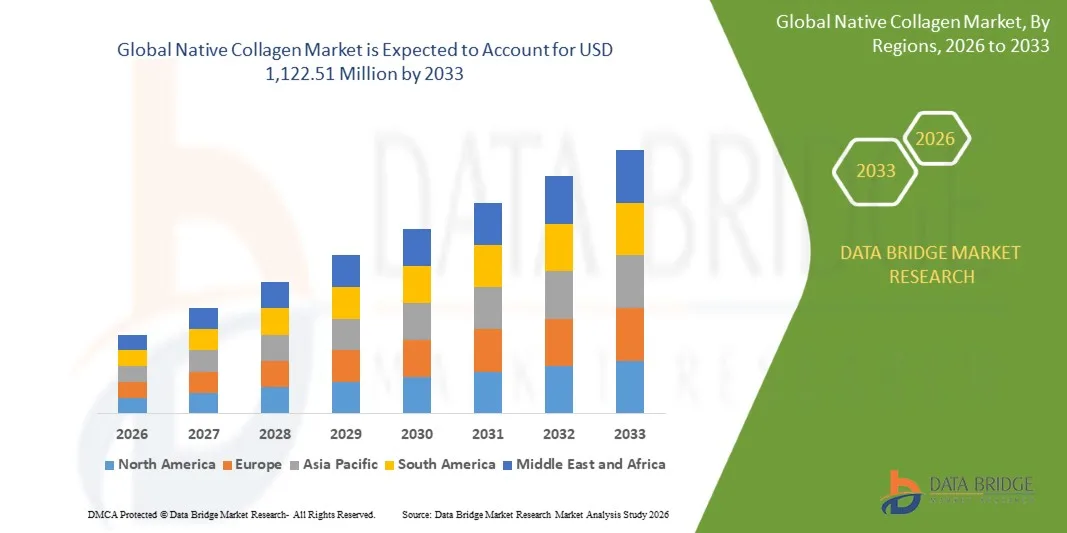
- As per Data Bridge Market Research analysis, the native collagen market was valued at USD 820.21 million in 2025 and is projected to reach USD 1,122.51 million by 2033, growing at a CAGR of 4.00% from 2026 to 2033.
- The market is experiencing steady growth driven by rising demand for joint health supplements, increasing use of intact collagen in wound care and regenerative products, and expanding applications across functional foods, beverages, and cosmetics.
- The increasing shift toward preventive joint care, clean-label nutrition, and bio-based medical materials, combined with growing consumer awareness of collagen as a structural protein, is supporting market adoption. Native collagen is being positioned across dietary supplements, functional beverages, skin care, and tissue repair products, offering manufacturers greater functionality from native collagen, collagen, and joint health ingredients that retain the natural triple-helix structure.
Market Size & Forecast
- Global Market Value (2025): USD 820.21 Million
- Expected Market Value (2033): USD 1,122.51 Million
- Forecast CAGR (2026–2033): 4.00%
- Leading Region in 2025: North America
- Fastest Growing Region: Asia-Pacific
What are the Major Takeaways of the Native Collagen Market?
- North America dominated the native collagen market with the largest revenue share of 35.60% in 2025, supported by a large dietary supplement industry, strong joint health awareness, and established biomedical and wound care manufacturers.
- Asia-Pacific is expected to be the fastest-growing region at a CAGR of 5.40% from 2026 to 2033, fueled by an aging population, rising beauty and wellness spending, and expanding functional food and supplement industries.
- The bovine segment led the market with a 47.30% share in 2025, driven by large raw material availability, established processing, and wide use in supplements and medical products.
- Marine collagen is the fastest-growing source, projected to register a CAGR of 5.80%, reflecting rising demand for pescatarian, halal-friendly, and low-risk alternatives to land animal sources.
- The Type I segment dominated the type category with a 52.60% revenue share in 2025, led by its abundance in skin, tendons, and bone.
- Nutraceuticals & dietary supplements accounted for 38.40% of the market share in 2025, preferred for joint health, mobility, and healthy aging products.
- The biomedical & wound care segment is the fastest-growing application, with a CAGR of 6.10%, driven by regenerative medicine, wound dressings, and tissue engineering products.
Report Scope and Native Collagen Market Segmentation
|
Attributes |
Native Collagen Key Market Insights |
|
Segments Covered |
|
|
Countries Covered |
North America
Europe
Asia-Pacific
Middle East and Africa
South America
|
|
Key Market Players |
|
|
Market Opportunities |
|
|
Value Added Data Infosets |
In addition to the insights on market scenarios such as market value, growth rate, segmentation, geographical coverage, and major players, the market reports curated by the Data Bridge Market Research also include in-depth expert analysis, pricing analysis, brand share analysis, consumer survey, demography analysis, supply chain analysis, value chain analysis, raw material/consumables overview, vendor selection criteria, PESTLE Analysis, Porter Analysis, and regulatory framework. |
What is the Key Trend in the Native Collagen Market?
- Native collagen is increasingly moving beyond capsules into functional foods, beverages, and companion animal products, combining clinically studied low doses, intact triple-helix structure, and clean-label positioning for joint and mobility support.
- For instance, in January 2026, Bioiberica and Lactalis Spain entered a strategic partnership to commercialize Spain’s first milk beverage enriched with native type II collagen, Collavant n2, showing the shift of native collagen into everyday food and beverage formats and the growing interest of dairy companies in joint health nutrition
- Ingredient suppliers are expanding the evidence base and range of sources, as brands look for poultry sternum, bovine, and marine native collagen with documented purity, consistent protein content, and traceable sourcing.
- Brands are increasingly targeting younger and active consumers, as buyers compare joint health ingredients on clinical evidence, dose size, taste in beverages, and compatibility with other nutrients such as vitamin C and omega-3.
- For instance, in July 2026, according to Lonza Capsugel, its UC-II undenatured type II collagen continues to drive innovation across new formats and applications, including the fast-growing companion animal segment, with a UC-FLEX pet food blend launching at Interzoo 2026, extending native collagen into pet nutrition
- As clinical research, new delivery formats, pet nutrition, and food and beverage innovation continue to advance, native collagen is expected to expand beyond traditional supplements into everyday functional foods, regenerative medicine, and personalized nutrition.
What are the Key Drivers of the Native Collagen Market?
- The rapid growth of the aging population and the rising prevalence of joint discomfort have significantly increased demand for evidence-backed ingredients that support mobility, cartilage health, and active lifestyles.
- For instance, in July 2026, according to Lonza Capsugel, its UC-II undenatured type II collagen is supported by more than 20 studies, including 11 human clinical trials, and is the most researched branded undenatured type II collagen ingredient, supporting trust among supplement formulators and encouraging new product launches across joint health categories.
- Supplement brands, food manufacturers, medical device makers, and cosmetic companies are adopting native collagen to deliver structural benefits, improve product differentiation, and meet consumer demand for natural, minimally processed ingredients.
- For instance, in March 2026, according to Nutrition Journal, a randomized, double-blind, placebo-controlled study evaluated native undenatured type II collagen at 40 mg per day for 180 days in healthy volunteers with activity-related joint discomfort, adding to the clinical evidence for the ingredient.
- With distributors, ingredient suppliers, and brands expanding joint health portfolios and pet nutrition ranges, native collagen can gain wider visibility, trial, and repeat purchases across supplements, foods, and healthcare channels.
What Factors Are Challenging the Growth of the Native Collagen Market?
- Native collagen requires specialized extraction, purification, and processing techniques to preserve its natural molecular structure, increasing manufacturing costs and limiting adoption among price-sensitive manufacturers.
- Hydrolyzed collagen peptides offer better solubility, easier formulation, and broader suitability for beverages and dietary supplements, challenging native collagen adoption in mass-market applications.
- For instance, in February 2025, Bioiberica partnered with Stauber to expand distribution of its branded ingredients, including Collavant n2, in the U.S. Although this supports market access for native type II collagen, competition from alternative collagen formats remains a challenge for wider adoption.
- Inconsistent clinical outcomes across collagen types, formulations, and dosages can restrict confidence in certain health benefits and make it difficult for manufacturers to substantiate product claims.
- Dependence on bovine, porcine, poultry, and marine sources creates challenges related to traceability, raw-material consistency, religious dietary requirements, and consumer acceptance.
- Maintaining structural integrity, purity, batch consistency, and source traceability requires stringent quality controls. Compliance costs and limitations on permissible health claims can further challenge market expansion, particularly for smaller manufacturers.
How is the Native Collagen Market Segmented?
The native collagen market is segmented on the basis of source, type, application, and form.
- By Source
On the basis of source, the native collagen market is segmented into bovine, porcine, marine, poultry, and others. The bovine segment dominated the market with 47.30% share in 2025, supported by large raw material availability, established processing infrastructure, and wide use in supplements, medical products, and cosmetics. Hides, tendons, and bones provide consistent supply of Type I collagen. Producers can scale output efficiently and meet diverse specifications. Established quality standards and long-term customer relationships strengthen demand. Strict sourcing controls and traceability programs also support confidence among regulated buyers and the segment’s continued leadership.
The marine segment is projected to register the fastest growth at a CAGR of 5.80% from 2026 to 2033, driven by increasing demand for pescatarian, halal-friendly, and lower-risk alternatives to land animal sources. Fish skin and scales provide Type I collagen with high bioavailability. Use of fisheries by-products supports sustainability claims. Cosmetics, wound care, and supplement brands are expanding marine product lines. Improvements in extraction at low temperatures are preserving native structure, while premium pricing is supported by clean-label positioning and growing consumer interest in ocean-derived ingredients. Investments in fish processing waste recovery and certified sustainable fisheries are also helping secure supply.
- By Type
On the basis of type, the native collagen market is segmented into Type I, Type II, Type III, and others. The Type I segment dominated the market with 52.60% share in 2025, supported by its abundance in skin, tendons, and bone and its wide use in medical, cosmetic, and nutritional products. Type I forms strong fibers that provide structure for wound dressings, scaffolds, and skin care. Established extraction methods and large raw material supplies support steady output. The segment also benefits from decades of research and regulatory familiarity. Its versatility across industries continues to strengthen its leadership, and wide supplier availability helps keep prices competitive.
The Type II segment is projected to register the fastest growth at a CAGR of 5.70% from 2026 to 2033, driven by strong demand for undenatured type II collagen in joint health supplements. Derived mainly from chicken sternum cartilage, it is used at low daily doses of around 40 mg. Clinical trials on knee comfort and flexibility are supporting category growth. New formats such as beverages and pet foods are creating additional opportunities. Strategic partnerships and distribution agreements are expanding access, while younger, active consumers are widening the customer base. Brand owners also use patents and branded ingredients to protect their position.
- By Application
On the basis of application, the native collagen market is segmented into nutraceuticals & dietary supplements, biomedical & wound care, cosmetics & personal care, food & beverage, and others. The nutraceuticals & dietary supplements segment dominated the application category with 38.40% share in 2025, supported by consumer interest in joint health, mobility, and healthy aging. Capsules, tablets, and powders deliver low doses of intact collagen. Brands highlight clinical studies, patented ingredients, and clean labels. Established distribution through pharmacies, specialty retailers, and online platforms continues to reinforce this segment's leadership and supports repeat purchase. Rising sports participation and healthy aging trends add further momentum.
The biomedical & wound care segment is projected to register the fastest growth at a CAGR of 6.10% from 2026 to 2033, driven by increasing use of native collagen in wound dressings, tissue scaffolds, and regenerative medicine. Intact triple-helix collagen supports cell attachment and tissue repair. Aging populations and chronic wounds are increasing demand for advanced dressings. Medical device makers value consistent purity and biocompatibility. Regulatory requirements and quality standards remain important, and partnerships between suppliers and device companies are supporting new product development. Growth in dental, orthopedic, and burn care applications is creating additional opportunities for suppliers of medical-grade collagen.
- By Form
On the basis of form, the native collagen market is segmented into powder, liquid, and gel & sheets. The powder segment dominated the market with 61.20% share in 2025, supported by easy storage, long shelf life, and compatibility with capsules, tablets, and food formulations. Powders allow accurate dosing and simple transport. Manufacturers can blend them with other nutrients and excipients. Established production lines and wide supplier availability continue to reinforce this segment's leadership, while freeze-drying and gentle processing help maintain the native structure. Lower logistics costs compared with liquids also support adoption among global brands and contract manufacturers.
The liquid segment is projected to register the fastest growth at a CAGR of 5.50% from 2026 to 2033, driven by demand for ready-to-drink shots, functional beverages, and topical serums. Liquid formats offer convenience and appeal to consumers who prefer not to take capsules. Formulators are working on stability, taste, and clarity for beverage use. Skin care brands use liquid native collagen in serums and ampoules. Advances in stabilization and packaging are improving shelf life and expanding use in dairy and plant-based drinks. Cold-chain handling and preservation systems remain important considerations for long-term growth.
Which Region Holds the Largest Share of the Native Collagen Market?
- North America dominated the native collagen market with the largest revenue share of 35.60% in 2025, supported by a large dietary supplement industry, strong joint health awareness, and established biomedical and wound care manufacturers.
- The region also benefits from strong consumer awareness of joint health, a mature supplement retail network, and the presence of leading biomedical, nutraceutical, and ingredient companies. Increasing demand for clinically studied ingredients and companion animal nutrition, along with active clinical research programs, continues to strengthen North America’s position in the global market.
U.S. Native Collagen Market Insight
The U.S. native collagen market is witnessing steady growth due to a large dietary supplement industry, an aging population, and strong demand for joint health and beauty-from-within products. The country’s well-developed retail and e-commerce channels, along with active research and clinical studies, are driving demand for undenatured and native collagen ingredients. In addition, growing use in pet nutrition, wound care products, and functional beverages, together with investment in ingredient distribution, is accelerating adoption across consumer and medical applications.
Canada Native Collagen Market Insight
The Canada native collagen market is driven by growing demand for premium health supplements, joint-health products, medical biomaterials, and regenerative medicine applications. Increasing consumer interest in healthy aging and mobility is supporting collagen-based product development. Canada's established food and natural health product industries provide opportunities for market expansion. However, high production costs, dependence on animal-derived raw materials, regulatory requirements, and competition from hydrolyzed collagen peptides may constrain growth. Investments in product innovation, quality assurance, and sustainable sourcing could support future market development.
Asia-Pacific Native Collagen Market Insight
The Asia-Pacific native collagen market is expected to witness rapid growth, driven by an aging population, rising beauty and wellness spending, and expanding supplement and functional food industries across countries such as China, India, and Japan. Growing consumer interest in skin and joint health, along with strong fish and livestock by-product supply, is supporting regional market expansion. In addition, the region’s e-commerce growth, local manufacturing capacity, and rising healthcare investment are accelerating availability and demand for native collagen.
Japan Native Collagen Market Insight
The Japan native collagen market is witnessing consistent growth due to strong beauty and wellness culture, advanced biomaterials research, and a rapidly aging society. Consumers, supplement brands, and medical companies are increasingly adopting collagen products for skin, joint, and tissue repair uses. Moreover, strong demand for high-quality ingredients, innovation in functional foods, and established collagen producers is further contributing to market growth in Japan.
China Native Collagen Market Insight
The China native collagen market is growing rapidly, driven by rising consumer spending on beauty and health, expanding nutraceutical production, and growing biomedical device manufacturing. Growing online retail and social commerce are significantly boosting market demand. In addition, strong domestic collagen producers, government support for biomaterials, rising interest in marine and bovine collagen, and an expanding middle class are positioning China as a key growth market across Asia-Pacific.
Which are the Top Companies in Native Collagen Market?
The native collagen industry is primarily led by well-established companies, including:
- Lonza Group AG (Switzerland)
- Bioiberica S.A.U. (Spain)
- GELITA AG (Germany)
- Darling Ingredients Inc. (Rousselot) (U.S.)
- Nitta Gelatin Inc. (Japan)
- Weishardt Holding SA (France)
- PB Leiner (Tessenderlo Group NV) (Belgium)
- LAPI GELATINE S.p.A. (Italy)
- Collagen Solutions Plc (U.K.)
- Symatese (France)
- Advanced BioMatrix, Inc. (U.S.)
- Human BioSciences (U.S.)
- Viscofan S.A. (Spain)
- Vital Proteins LLC (U.S.)
- Merck KGaA (Germany)
- BioCell Technology, LLC (U.S.)
- Synkol (Poland)
- Titan Biotech Ltd. (India)
- Collagen Matrix, Inc. (U.S.)
- ITALGELATINE S.p.A. (Italy)
What are Latest Developments in Native Collagen Market?
- In July 2026, Lonza Capsugel marked 25 years of its UC-II undenatured type II collagen and highlighted expansion into new formats and applications, including the fast-growing companion animal segment. The company also planned to launch UC-FLEX, a pet food blend combining UC-II with calcium carbonate, at Interzoo 2026, and noted growing interest among younger consumers.
- In March 2026, Lone Star Funds signed an agreement to acquire Lonza’s Capsules & Health Ingredients division, which includes UC-II type II collagen products. The transaction is expected to give the business a dedicated focus on nutraceutical and health ingredient growth and reflects strong investor interest in joint health ingredients, while supporting continuity for customers, partners, and employees.
- In January 2026, Bioiberica and Lactalis Spain entered a strategic partnership to commercialize Spain’s first milk beverage enriched with native type II collagen, Collavant n2. The collaboration brings clinically validated native collagen into mainstream dairy and supports the expansion of joint health nutrition beyond capsules, reaching consumers who prefer food-based formats and daily routines.
- In December 2025, Greenvit acquired a majority stake in Synkol, a Polish producer of type II chicken sternal collagen, to expand its joint health ingredient portfolio. The investment strengthens supply of native type II collagen and supports growing demand from supplement and functional food brands in Europe, while improving control over raw material sourcing and quality.
- In October 2025, Caldic North America and Lonza Capsugel announced an exclusive North American distribution partnership for UC-II undenatured type II collagen. The agreement aims to expand commercialization of the joint health ingredient across supplement, food, and pet applications and to improve technical support for formulators and regional customers.
- In May 2025, Darling Ingredients Inc. announced a strategic partnership with Tessenderlo Group to combine their collagen and gelatin businesses, Rousselot and PB Leiner, into a proposed joint venture named Nextida, strengthening their scale and product development capabilities in collagen-based health, nutrition, and wellness markets.
- In October 2024, RTI Surgical announced an agreement to acquire Collagen Solutions, expanding its medical-grade collagen capabilities and strengthening its portfolio for cardiac, orthopedic, sports medicine, and regenerative medicine applications.
- Interactive Data Analysis Dashboard
- Company Analysis Dashboard for high growth potential opportunities
- Research Analyst Access for customization & queries
- Competitor Analysis with Interactive dashboard
- Latest News, Updates & Trend analysis
- Harness the Power of Benchmark Analysis for Comprehensive Competitor Tracking
Global Native Collagen Market, Supply Chain Analysis and Ecosystem Framework
To support market growth and help clients navigate the impact of geopolitical shifts, DBMR has integrated in-depth supply chain analysis into its Global Native Collagen Market research reports. This addition empowers clients to respond effectively to global changes affecting their industries. The supply chain analysis section includes detailed insights such as Global Native Collagen Market consumption and production by country, price trend analysis, the impact of tariffs and geopolitical developments, and import and export trends by country and HSN code. It also highlights major suppliers with data on production capacity and company profiles, as well as key importers and exporters. In addition to research, DBMR offers specialized supply chain consulting services backed by over a decade of experience, providing solutions like supplier discovery, supplier risk assessment, price trend analysis, impact evaluation of inflation and trade route changes, and comprehensive market trend analysis.
Data collection and base year analysis are done using data collection modules with large sample sizes. The stage includes obtaining market information or related data through various sources and strategies. It includes examining and planning all the data acquired from the past in advance. It likewise envelops the examination of information inconsistencies seen across different information sources. The market data is analysed and estimated using market statistical and coherent models. Also, market share analysis and key trend analysis are the major success factors in the market report. To know more, please request an analyst call or drop down your inquiry.
The key research methodology used by DBMR research team is data triangulation which involves data mining, analysis of the impact of data variables on the market and primary (industry expert) validation. Data models include Vendor Positioning Grid, Market Time Line Analysis, Market Overview and Guide, Company Positioning Grid, Patent Analysis, Pricing Analysis, Company Market Share Analysis, Standards of Measurement, Global versus Regional and Vendor Share Analysis. To know more about the research methodology, drop in an inquiry to speak to our industry experts.
Data Bridge Market Research is a leader in advanced formative research. We take pride in servicing our existing and new customers with data and analysis that match and suits their goal. The report can be customized to include price trend analysis of target brands understanding the market for additional countries (ask for the list of countries), clinical trial results data, literature review, refurbished market and product base analysis. Market analysis of target competitors can be analyzed from technology-based analysis to market portfolio strategies. We can add as many competitors that you require data about in the format and data style you are looking for. Our team of analysts can also provide you data in crude raw excel files pivot tables (Fact book) or can assist you in creating presentations from the data sets available in the report.