


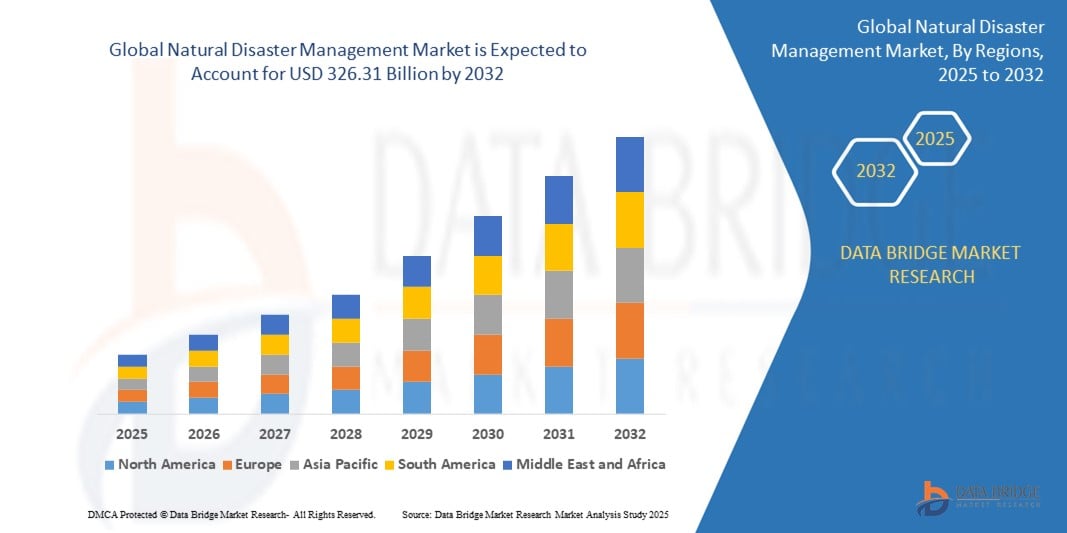
Natural Disaster Management Market Size
- The global natural disaster management market size was valued at USD 137.58 billion in 2024 and is expected to reach USD 326.31 billion by 2032, at a CAGR of 11.40% during the forecast period
- The market growth is primarily driven by the increasing frequency and intensity of natural disasters, rising government investments in disaster preparedness, and growing adoption of advanced technologies for early detection and response
- Heightened awareness of climate change impacts and the need for efficient disaster management systems are further propelling demand across government and private sectors
Natural Disaster Management Market Analysis
- The natural disaster management market is experiencing robust growth due to the rising need for real-time monitoring, early warning systems, and effective disaster response mechanisms
- Growing adoption of AI, IoT, and satellite-based technologies is encouraging solution providers to innovate with high-performance disaster detection and communication systems
- North America dominates the natural disaster management market with the largest revenue share of 35.2% in 2024, driven by advanced technological infrastructure and significant government funding for disaster preparedness
- Asia-Pacific is expected to be the fastest-growing region during the forecast period, fueled by increasing occurrences of natural disasters, rapid urbanization, and rising investments in disaster management technologies in countries such as China, India, and Japan
- The flood detection segment holds the largest market revenue share of 65% in 2024, supported by the increasing use of IoT-based sensors and satellite-assisted systems that provide real-time flood monitoring and early warnings. Stringent government regulations and growing investments in flood management systems are also driving this growth
Report Scope and Natural Disaster Management Market Segmentation
|
Attributes |
Natural Disaster Management Key Market Insights |
|
Segments Covered |
|
|
Countries Covered |
North America
Europe
Asia-Pacific
Middle East and Africa
South America
|
|
Key Market Players |
|
|
Market Opportunities |
|
|
Value Added Data Infosets |
In addition to the market insights such as market value, growth rate, market segments, geographical coverage, market players, and market scenario, the market report curated by the Data Bridge Market Research team includes in-depth expert analysis, import/export analysis, pricing analysis, production consumption analysis, and pestle analysis |
Natural Disaster Management Market Trends
“Rising Adoption of IoT and AI-Powered Detection Systems”
- IoT-enabled sensors and AI-driven analytics are increasingly preferred for their ability to provide real-time monitoring and early warnings for disasters such as floods, earthquakes, and wildfires
- These systems ensure seamless data transmission, maintaining operational efficiency even in areas with disrupted communication networks
- In disaster-prone regions such as Asia-Pacific, IoT and AI solutions are favored for their precision in detecting seismic activity and climate-related events, reducing response times
- Government agencies and private organizations seek these technologies for enhanced preparedness and resilience
- For instance, Japan’s early warning system uses IoT sensors to detect seismic activity and alert the public, improving safety outcomes
- Emergency response teams are increasingly integrating IoT-based tools into their operations, with solutions such as BlackBerry’s AtHoc platform being adopted for critical event management
Natural Disaster Management Market Dynamics
Driver
“Increasing Frequency and Severity of Climate-Induced Disasters”
- Growing awareness of climate change and its impact on increasing the frequency and intensity of natural disasters, such as floods, wildfires, and hurricanes, is driving demand for advanced disaster management solutions
- These technologies, including early warning systems and geospatial mapping, help mitigate economic losses and casualties by enabling proactive response strategies
- They enhance situational awareness, reduce response times, and contribute to safer and more effective disaster management, particularly in high-risk regions such as Asia-Pacific and North America
- Governments and organizations are responding by investing in advanced tools such as AI-powered predictive analytics and satellite-based monitoring systems
- For instance, FEMA in the U.S. coordinates with stakeholders to fund mitigation projects incorporating IoT and AI technologies for enhanced disaster preparedness
- The rise of smart cities and resilient infrastructure initiatives is further fueling the adoption of high-performance disaster management systems to protect assets and populations
Restraint/Challenge
“High Implementation Costs and Integration Challenges”
- High costs associated with deploying advanced disaster management technologies, such as IoT sensors, satellite systems, and AI analytics, limit adoption, particularly in developing regions
- Different regions have varying technological infrastructures, complicating standardization efforts for manufacturers and service providers operating globally
- Integration with legacy systems poses technical challenges, often requiring significant upgrades or replacements, which can delay implementation
- For instance, developing countries in Africa and parts of Asia face barriers due to limited funding and infrastructure for advanced disaster management solutions
- These challenges discourage widespread adoption and may slow market growth in regions with high disaster risk but limited resources, impacting overall market expansion
Natural Disaster Management Market Scope
The market is segmented on the basis of component, application, end-user, and communication system.
- By Component
On the basis of component, the natural disaster management market is segmented into solutions and services. The solutions segment holds the largest market revenue share of 62.4% in 2024, driven by the increasing deployment of advanced technologies such as AI-powered analytics, IoT sensors, and real-time monitoring systems for disaster detection and response. These solutions are highly sought after for their ability to provide predictive insights and automated alerts, enabling proactive disaster management. Governments and organizations prioritize solutions for their scalability and integration with existing infrastructure.
The services segment is anticipated to witness the fastest CAGR of 18.9% from 2025 to 2032, fueled by the growing demand for consulting, training, and maintenance services. These services ensure the effective implementation and operation of disaster management systems, particularly for organizations transitioning to advanced technologies. The need for customized solutions and ongoing support drives the rapid growth of this segment.
- By Application
On the basis of application, the natural disaster management market is segmented into flood detection, volcano detection, forest fire detection, landslide detection, earthquake detection, and others. The flood detection segment holds the largest market revenue share of 65% in 2024, supported by the increasing use of IoT-based sensors and satellite-assisted systems that provide real-time flood monitoring and early warnings. Stringent government regulations and growing investments in flood management systems are also driving this growth.
The earthquake detection segment is expected to witness the fastest CAGR from 2025 to 2032, propelled by advancements in seismic monitoring technologies and growing investments in earthquake-prone regions. These systems provide critical early warnings, enabling timely evacuations and reducing potential casualties.
- By End-user
On the basis of end-user, the natural disaster management market is segmented into government organizations, private companies, law enforcement agencies, and rescue personnel. The government organizations accounted for the largest market revenue share in 2024, driven by substantial investments in disaster preparedness and response infrastructure. Governments worldwide are adopting advanced disaster management systems to enhance public safety and comply with international disaster risk reduction frameworks.
The private companies segment is expected to witness the fastest CAGR from 2025 to 2032, driven by the increasing adoption of disaster management solutions in industries such as logistics, manufacturing, and insurance. Private companies leverage these systems for risk assessment, business continuity planning, and asset protection.
- By Communication System
On the basis of communication system, the natural disaster management market is segmented into first responder tools, satellite-assisted equipment, vehicle-ready gateways, and emergency response radars. The satellite-assisted equipment holds the largest market revenue share in 2024, driven by its ability to provide reliable communication in remote and disaster-affected areas. These systems ensure seamless coordination during emergencies, especially in regions with damaged or limited terrestrial networks.
The first responder tools segment is expected to witness the fastest CAGR from 2025 to 2032, fueled by the increasing need for portable, real-time communication devices for rescue operations. These tools, including handheld radios and mobile command units, enhance coordination and situational awareness for first responders.
Natural Disaster Management Market Regional Analysis
- North America dominates the natural disaster management market with the largest revenue share of 35.2% in 2024, driven by advanced technological infrastructure and significant government funding for disaster preparedness
- Asia-Pacific is expected to be the fastest-growing region during the forecast period, fueled by increasing occurrences of natural disasters, rapid urbanization, and rising investments in disaster management technologies in countries such as China, India, and Japan
U.S. Natural Disaster Management Market Insight
The U.S. natural disaster management market is anticipated to grow at a substantial CAGR during the forecast period, fueled by the rising occurrence of climate-related disasters and significant federal investments in disaster preparedness. Technologies such as AI-powered predictive modeling, IoT-enabled sensors, and mobile-based emergency alert systems are gaining traction. The growing emphasis on community resilience, coupled with the integration of disaster management systems into smart city frameworks, is driving demand. In addition, heightened awareness of disaster risks among businesses and homeowners is promoting the adoption of advanced monitoring and mitigation tools.
Europe Natural Disaster Management Market Insight
The European natural disaster management market is projected to expand at a notable CAGR through the forecast period, driven by increasing occurrences of floods, heatwaves, and storms, alongside stringent EU regulations on disaster risk reduction. Countries such as Germany, France, and the Netherlands are investing heavily in flood defense systems, early warning technologies, and climate adaptation strategies. The adoption of AI and big data analytics for real-time disaster monitoring is growing, while cross-border collaboration within the EU enhances regional preparedness. Urbanization and the need for sustainable infrastructure further bolster market growth.
U.K. Natural Disaster Management Market Insight
The U.K. natural disaster management market is expected to grow at a significant CAGR, driven by increasing risks of flooding and coastal erosion, alongside government initiatives to strengthen national resilience. The integration of advanced technologies, such as satellite-based flood forecasting and IoT-enabled early warning systems, is gaining momentum. Public awareness campaigns and investments in infrastructure adaptation are encouraging the adoption of disaster management solutions. The U.K.'s robust digital infrastructure and emphasis on climate resilience further support market expansion in both public and private sectors.
Germany Natural Disaster Management Market Insight
The German natural disaster management market is poised for considerable growth, driven by the increasing frequency of floods and heatwaves, coupled with Germany’s focus on technological innovation and sustainability. The market is supported by strong government policies promoting climate adaptation and disaster preparedness, with significant investments in AI-driven forecasting tools and resilient infrastructure. The integration of disaster management systems with smart city initiatives and the emphasis on eco-conscious solutions align with Germany’s environmental priorities, fostering widespread adoption in residential, commercial, and industrial applications.
Asia-Pacific Natural Disaster Management Market Insight
The Asia-Pacific natural disaster management market is expected to grow at the fastest CAGR of over 22% in 2025, driven by the region’s vulnerability to earthquakes, tsunamis, typhoons, and floods, particularly in countries such as China, Japan, and India. Rapid urbanization, rising populations, and government-led digitalization initiatives are accelerating the adoption of advanced disaster management technologies. The region’s emergence as a hub for AI, IoT, and satellite technology manufacturing is enhancing affordability and accessibility. Increasing investments in smart cities and disaster-resilient infrastructure further drive market growth.
Japan Natural Disaster Management Market Insight
The Japan natural disaster management market is gaining significant traction due to the country’s high exposure to earthquakes, tsunamis, and typhoons, combined with its advanced technological ecosystem. The market is driven by widespread adoption of seismic monitoring systems, AI-based early warning tools, and IoT-enabled disaster response networks. Japan’s focus on smart city development and its aging population are increasing demand for user-friendly, automated disaster management solutions. Government initiatives promoting resilience and public-private collaborations are further propelling market growth across residential and commercial sectors.
China Natural Disaster Management Market Insight
The China natural disaster management market holds the largest revenue share in the Asia-Pacific region in 2024, driven by rapid urbanization, a growing middle class, and government-led initiatives to enhance disaster resilience. The country’s susceptibility to floods, earthquakes, and typhoons has spurred investments in AI-driven predictive analytics, satellite-based monitoring, and IoT-enabled early warning systems. China’s role as a manufacturing hub for disaster management technologies ensures affordability and scalability, while smart city projects and policies promoting digital transformation further accelerate the adoption of advanced solutions in residential, commercial, and public sectors.
Natural Disaster Management Market Share
The natural disaster management industry is primarily led by well-established companies, including:
- NEC Corporation (Japan)
- Hexagon AB (Sweden)
- Nokia (Finland)
- Xylem (U.S.)
- Esri (California)
- EVERBRIDGE (U.S.)
- BLACKBERRY (Canada)
- VAISALA (Finland)
- SAS Institute, Inc. (U.S.)
- SuperMap (China)
- Simplisafe (U.S.)
- Kinemetrics (U.S.)
- Nanometrics (Canada)
- Sanlien Technology (Taiwan)
Latest Developments in Global Natural Disaster Management Market
- In January 2025, Hexagon AB announced its acquisition of Septentrio NV, a leading OEM provider of GNSS technologies, to enhance Resilient Assured Positioning solutions. This strategic move integrates Septentrio’s advanced GNSS platform with Hexagon’s positioning portfolio, including sensor fusion, anti-jamming, correction services, and perception technologies. The acquisition aims to accelerate autonomous system adoption across UAVs, robotics, and mission-critical applications. Septentrio, headquartered in Leuven, Belgium, will operate within Hexagon’s Autonomous Solutions division
- In November 2024, Everbridge and Riskonnect announced a strategic partnership to integrate emergency communications with business continuity management. This collaboration enables organizations to enhance crisis response, resilience, and recovery through streamlined communication and real-time alerts. The Everbridge Critical Event Management (CEM) platform will be fully connected with Riskonnect’s business continuity program, allowing enterprises to automate responses, bolster collaboration, and improve situational awareness. The integration ensures faster incident management, reducing downtime and operational risks
- In October 2024, NEC Indonesia and Sinar Mas Land established a strategic partnership to enhance climate change resilience through Adaptation Finance, an initiative by the United Nations Environment Programme (UNEP). This collaboration focuses on assessing climate-related disaster risks and developing mitigation strategies using disaster mitigation visualization technology. The partnership aims to strengthen business resilience and promote sustainable development, particularly in Indonesia’s financial services sector
- In August 2024, Swisscom Broadcast partnered with Nokia to deploy a nationwide Drones-as-a-Service network across Switzerland. The initiative includes 300 Nokia Drone-in-a-Box units, designed to enhance emergency response, perimeter protection, and infrastructure inspection. This marks Nokia’s second nationwide drone deployment, following its Citymesh project in Belgium. The drones will support public safety agencies, enabling remote monitoring and real-time situational awareness. The collaboration also advances industrial automation, integrating mission-critical edge computing for beyond visual line of sight (BVLOS) operations

- Interactive Data Analysis Dashboard
- Company Analysis Dashboard for high growth potential opportunities
- Research Analyst Access for customization & queries
- Competitor Analysis with Interactive dashboard
- Latest News, Updates & Trend analysis
- Harness the Power of Benchmark Analysis for Comprehensive Competitor Tracking
Data collection and base year analysis are done using data collection modules with large sample sizes. The stage includes obtaining market information or related data through various sources and strategies. It includes examining and planning all the data acquired from the past in advance. It likewise envelops the examination of information inconsistencies seen across different information sources. The market data is analysed and estimated using market statistical and coherent models. Also, market share analysis and key trend analysis are the major success factors in the market report. To know more, please request an analyst call or drop down your inquiry.
The key research methodology used by DBMR research team is data triangulation which involves data mining, analysis of the impact of data variables on the market and primary (industry expert) validation. Data models include Vendor Positioning Grid, Market Time Line Analysis, Market Overview and Guide, Company Positioning Grid, Patent Analysis, Pricing Analysis, Company Market Share Analysis, Standards of Measurement, Global versus Regional and Vendor Share Analysis. To know more about the research methodology, drop in an inquiry to speak to our industry experts.
Data Bridge Market Research is a leader in advanced formative research. We take pride in servicing our existing and new customers with data and analysis that match and suits their goal. The report can be customized to include price trend analysis of target brands understanding the market for additional countries (ask for the list of countries), clinical trial results data, literature review, refurbished market and product base analysis. Market analysis of target competitors can be analyzed from technology-based analysis to market portfolio strategies. We can add as many competitors that you require data about in the format and data style you are looking for. Our team of analysts can also provide you data in crude raw excel files pivot tables (Fact book) or can assist you in creating presentations from the data sets available in the report.













