


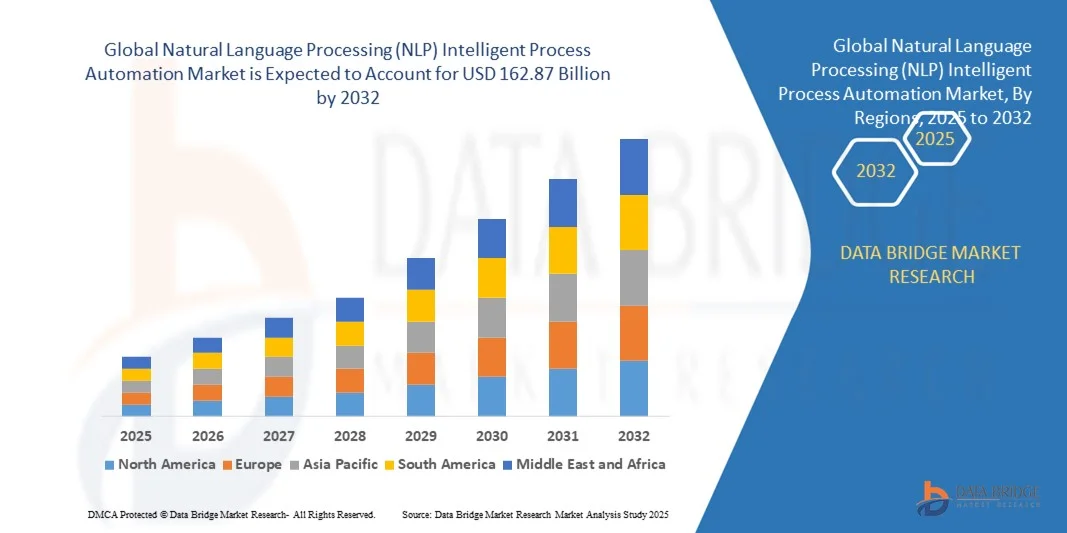
Global Natural Language Processing (NLP) Intelligent Process Automation Market Size
- The Global Natural Language Processing (NLP) Intelligent Process Automation Market size was valued at USD 29.71 billion in 2024 and is projected to reach USD 162.87 billion by 2032, growing at a CAGR of 23.70% during the forecast period.
- The market’s expansion is largely driven by the increasing adoption of AI-driven technologies and automation across various industries, as organizations seek to improve operational efficiency, reduce manual workloads, and enhance customer experience through intelligent data processing.
- Additionally, the rising demand for scalable, intuitive, and integrated process automation solutions—particularly those that can understand and act on unstructured language data—is positioning NLP as a core component of next-generation enterprise systems. These converging factors are accelerating the deployment of NLP-powered automation platforms, thereby significantly contributing to market growth across both developed and emerging regions.
Global Natural Language Processing (NLP) Intelligent Process Automation Market Analysis
- Natural Language Processing (NLP)-powered Intelligent Process Automation (IPA) systems, which combine AI-driven language understanding with robotic process automation (RPA), are becoming essential tools across various industries. These solutions enable businesses to automate complex, language-based tasks such as customer support, document processing, and data analysis, delivering enhanced efficiency, accuracy, and scalability.
- The accelerating demand for NLP-based IPA is primarily driven by the growing need for intelligent automation, increasing enterprise digital transformation initiatives, and the rising volume of unstructured data generated from emails, chat interactions, and business documents.
- North America dominated the NLP Intelligent Process Automation market with the largest revenue share of 34% in 2024, supported by early enterprise AI adoption, robust technological infrastructure, and the strong presence of major market players such as IBM, Microsoft, and Google. The U.S., in particular, has seen widespread implementation of NLP-enabled automation across sectors like finance, healthcare, and customer service, fueled by increasing investment in AI technologies and scalable automation platforms.
- Asia-Pacific is expected to be the fastest-growing region in the NLP IPA market during the forecast period, driven by rapid digitalization, expanding IT infrastructure, and increasing demand for AI solutions across emerging economies like India, China, and Southeast Asia.
- The solutions segment dominated the market with the largest market revenue share of 68.9% in 2024, owing to rising demand for integrated smart lock systems that offer advanced features such as remote monitoring, mobile access, real-time alerts, and smart home integration
Report Scope and Global Natural Language Processing (NLP) Intelligent Process Automation Market Segmentation
|
Attributes |
Natural Language Processing (NLP) Intelligent Process Key Market Insights |
|
Segments Covered |
|
|
Countries Covered |
North America
Europe
Asia-Pacific
Middle East and Africa
South America
|
|
Key Market Players |
|
|
Market Opportunities |
|
|
Value Added Data Infosets |
In addition to the market insights such as market value, growth rate, market segments, geographical coverage, market players, and market scenario, the market report curated by the Data Bridge Market Research team includes in-depth expert analysis, import/export analysis, pricing analysis, production consumption analysis, and pestle analysis. |
Global Natural Language Processing (NLP) Intelligent Process Automation Market Trends
Enhanced Efficiency Through AI and Voice Integration in NLP Intelligent Process Automation
- A significant and accelerating trend in the global Natural Language Processing (NLP) Intelligent Process Automation Market is the deepening integration of AI with popular voice-controlled ecosystems such as Amazon Alexa, Google Assistant, and Apple Siri. This fusion is driving enhanced operational efficiency and user interaction capabilities across diverse industries.
- For Instance, leading NLP automation platforms like UiPath and Automation Anywhere have incorporated voice assistant compatibility, enabling users to trigger automated workflows and query business processes through simple voice commands. Similarly, Microsoft Power Automate integrates seamlessly with Cortana to provide voice-activated automation for enterprise users.
- AI-powered NLP engines enable systems to understand complex natural language queries, allowing for more intuitive and context-aware automation. These advancements include sentiment analysis, intent recognition, and conversational AI that improve the accuracy and responsiveness of intelligent process automation. For instance, IBM Watson’s NLP capabilities adapt to user interactions over time, optimizing workflow suggestions and delivering proactive alerts.
- Voice integration enhances hands-free interaction, enabling professionals to initiate, monitor, or adjust automated processes remotely via voice commands. This capability streamlines operations in environments where manual interaction is limited, such as manufacturing floors or healthcare settings.
- The seamless integration of NLP-based intelligent automation with digital assistants and enterprise software ecosystems facilitates centralized control over workflows, data processing, and customer engagement. Users can manage complex processes, analytics, and communications from a unified interface, driving higher productivity and smarter decision-making.
- This trend toward more intelligent, conversational, and interconnected automation solutions is fundamentally transforming user expectations for enterprise process management. Consequently, companies such as Automation Anywhere and Blue Prism are investing in AI-enabled NLP solutions featuring voice command support and adaptive learning to boost automation efficiency.
- The demand for NLP intelligent process automation with integrated AI and voice control is rapidly growing across sectors including finance, healthcare, customer service, and manufacturing, as organizations seek to enhance operational agility, reduce costs, and improve user experience through advanced conversational AI technologies.
Global Natural Language Processing (NLP) Intelligent Process Automation Market Dynamics
Driver
Growing Need Due to Rising Demand for Operational Efficiency and Intelligent Automation
- The increasing need for operational efficiency, cost reduction, and enhanced customer experiences across industries is a key driver for the rising demand in the Global Natural Language Processing (NLP) Intelligent Process Automation Market. As businesses look to streamline repetitive tasks and extract actionable insights from unstructured data, NLP-powered automation solutions are becoming indispensable.
- For instance, in March 2024, UiPath introduced a new suite of AI-powered NLP tools designed to automate complex document processing and customer support interactions. These advancements highlight the industry’s shift toward more intelligent and autonomous workflow solutions.
- As enterprises deal with growing volumes of textual data from emails, customer feedback, chat logs, and documentation, NLP technologies offer the ability to process and analyze this information in real time. Intelligent Process Automation (IPA) powered by NLP can categorize requests, extract key data, and trigger workflows without human intervention, significantly improving productivity and accuracy.
- Furthermore, the rise of hybrid and remote work models has increased the need for automation tools that are not only efficient but also intuitive. NLP allows non-technical users to interact with systems using natural language commands, reducing reliance on IT departments and enabling faster task execution.
- The growing adoption of digital transformation initiatives, cloud platforms, and conversational AI interfaces is making NLP-integrated automation a central component of enterprise technology strategies. From healthcare and finance to retail and logistics, organizations are implementing NLP-driven IPA solutions to enhance agility, decision-making, and customer service.
Restraint/Challenge
Concerns Regarding Data Privacy, Implementation Complexity, and High Initial Investment
- Despite its rapid growth, the NLP Intelligent Process Automation market faces challenges related to data privacy concerns, integration complexity, and high upfront investment. As NLP systems process sensitive and unstructured data, ensuring compliance with data protection regulations (such as GDPR or HIPAA) remains a critical concern for organizations.
- For Instance, high-profile data breaches involving AI-powered platforms have led to heightened scrutiny and hesitation among businesses to fully entrust NLP systems with sensitive customer or proprietary data. Ensuring secure data handling and offering transparent AI models are essential to fostering trust.
- Additionally, the implementation of NLP-driven IPA solutions can be technically complex, requiring skilled personnel, data training, and integration with legacy systems. Smaller enterprises or those lacking in-house AI expertise may find it difficult to deploy such solutions effectively.
- The relatively high initial cost associated with deploying comprehensive NLP automation platforms, especially those that offer advanced AI capabilities such as contextual understanding or multilingual support, can be a barrier for many organizations—particularly in emerging markets or among SMEs with limited budgets. While open-source options and cloud-based solutions are helping to reduce costs, full-scale implementation can still require significant investment in infrastructure and training.
- Overcoming these challenges will require vendors to focus on simplified deployment models, stronger data privacy features, and scalable pricing structures. Market leaders such as Microsoft, IBM, and Automation Anywhere are actively working on making NLP automation more accessible through low-code platforms, pre-built models, and enterprise-grade security protocols.
Global Natural Language Processing (NLP) Intelligent Process Automation Market Scope
The market is segmented on the basis of component, deployment, organization size, technology, vertical, application,
- By Component
On the basis of component, the Natural Language Processing market is segmented into solutions and services. The solutions segment dominated the market with the largest market revenue share of 68.9% in 2024, owing to rising demand for integrated smart lock systems that offer advanced features such as remote monitoring, mobile access, real-time alerts, and smart home integration. These comprehensive solutions cater to both residential and enterprise users by providing flexible, scalable, and secure access management. Their compatibility with IoT platforms and voice assistants further strengthens adoption.
The services segment is expected to witness the fastest growth rate of 20.3% from 2025 to 2032, driven by the increasing need for professional installation, maintenance, and managed services. As adoption scales across sectors like hospitality, commercial real estate, and multi-unit dwellings, service providers play a vital role in deployment, customization, and lifecycle support of smart locking systems, enhancing overall customer experience and system performance.
- By Deployment
On the basis of deployment, the market is segmented into on-premise and cloud-based models. The cloud-based segment held the largest market revenue share of 61.4% in 2024, driven by the convenience of remote access, centralized control, and seamless software updates. Cloud deployment enables users to manage locks from anywhere, supports multi-device access, and integrates easily with smart home platforms and mobile apps. Its scalability makes it particularly attractive to both residential users and enterprises managing distributed locations.
The on-premise segment is projected to witness the fastest growth rate of 17.8% from 2025 to 2032, particularly in security-sensitive environments like government facilities and critical infrastructure. On-premise solutions offer greater control over data and network infrastructure, aligning with strict data protection policies. Organizations with internal IT teams and regulatory compliance requirements often prefer on-premise deployment for enhanced privacy, reliability, and customization.
- By Organization Size
By organization size, the Natural Language Processing market is divided into large-size organizations and medium and small-size organizations. The large-size organization segment led the market with a 59.7% revenue share in 2024, as enterprises increasingly invest in centralized access control and smart building infrastructure. These organizations benefit from enterprise-grade features such as user-level access permissions, remote monitoring, and integration with HR and security systems across multiple locations.
The medium and small-size organization segment is anticipated to witness the fastest CAGR of 21.2% from 2025 to 2032, driven by the decreasing cost of smart lock systems and the availability of cloud-based, plug-and-play solutions. SMEs are increasingly adopting smart locks for office spaces, co-working hubs, and retail outlets to improve operational efficiency, reduce key management challenges, and enhance security, especially in growing urban environments.
- By Technology
On the basis of technology, the Natural Language Processing market is segmented into natural language processing (NLP), machine and deep learning, neural networks, virtual agents, mini bots and RPA, computer vision, and others. The machine and deep learning segment dominated the market with a 28.6% share in 2024, due to its role in enabling smart locks to learn user behavior, detect anomalies, and provide intelligent recommendations for access control and threat prevention.
The computer vision segment is expected to witness the fastest growth rate of 24.5% from 2025 to 2032, driven by the increasing use of facial recognition and image-based authentication in residential and high-security commercial settings. Computer vision-based smart locks offer a contactless, secure, and user-friendly experience, making them ideal for settings where hygiene and identity verification are critical. This technology is also gaining traction in smart city and public infrastructure applications.
- By Vertical
By vertical, the Natural Language Processing market spans multiple industries. The BFSI segment held the largest market revenue share of 19.3% in 2024, driven by high security demands, regulatory compliance, and the need for controlled access to sensitive areas such as vaults and server rooms. Financial institutions leverage smart locks for real-time monitoring, access logging, and risk mitigation.
The healthcare and life sciences segment is forecasted to grow at the fastest CAGR of 23.6% from 2025 to 2032, as hospitals, labs, and pharmaceutical facilities implement smart locks to restrict access to critical zones. Integration with identity management systems ensures secure access to patient data, medical supplies, and high-risk materials, while also enabling contactless and hygiene-compliant solutions.
- By Application
On the basis of application, the Natural Language Processing market is segmented into IT operations, business process automation, application management, content management, security, and others. The security segment dominated the market with a 34.8% revenue share in 2024, as smart locks serve as a foundational component of physical security strategies across residential, commercial, and government sectors. Features such as multi-level authentication, audit trails, and remote monitoring are key adoption drivers.
The business process automation segment is projected to grow at the fastest CAGR of 22.1% from 2025 to 2032, due to the integration of smart locks with enterprise workflow systems. Automated access scheduling, digital credential issuance, and event-based locking/unlocking enhance operational efficiency and reduce manual intervention. This is particularly beneficial for logistics, facilities management, and property rental businesses seeking streamlined access control.
Global Natural Language Processing (NLP) Intelligent Process Automation Market Regional Analysis
- North America dominated the Natural Language Processing (NLP) Intelligent Process Automation market with the largest revenue share of 34% in 2024, driven by rapid adoption of AI-powered automation solutions across key industries such as BFSI, healthcare, and IT.
- Enterprises in the region prioritize NLP technologies for enhancing customer experience, automating routine tasks, and enabling conversational AI through chatbots and virtual assistants, fueling demand for intelligent process automation.
- This strong market presence is supported by advanced technological infrastructure, high investments in AI research and development, and widespread digital transformation initiatives, making North America a leading hub for NLP-driven automation solutions in both large enterprises and SMEs globally.
U.S. Natural Language Processing (NLP) Intelligent Process Automation Market Insight
The U.S. NLP Intelligent Process Automation market captured the largest revenue share of 82% in 2024 within North America, driven by the rapid adoption of AI-driven automation technologies across BFSI, healthcare, and IT sectors. Organizations are increasingly leveraging NLP for customer service automation, sentiment analysis, and intelligent document processing. The rising trend of digital transformation and focus on operational efficiency through AI-powered chatbots and virtual assistants further fuels market growth. Moreover, robust R&D activities and strong investments in AI startups bolster the adoption of NLP-based intelligent automation solutions.
Europe Natural Language Processing (NLP) Intelligent Process Automation Market Insight
The Europe NLP Intelligent Process Automation market is projected to grow steadily throughout the forecast period, driven by stringent data privacy regulations and a growing emphasis on enhancing customer experience across industries. The increasing demand for multilingual NLP capabilities and automation in customer support, compliance, and IT operations is fostering adoption. Additionally, expanding digital infrastructure and government initiatives promoting Industry 4.0 accelerate the integration of NLP-based automation in manufacturing, finance, and retail sectors.
U.K. Natural Language Processing (NLP) Intelligent Process Automation Market Insight
The U.K. NLP Intelligent Process Automation market is expected to grow at a notable CAGR during the forecast period, supported by the widespread adoption of AI technologies and digital customer engagement strategies. Businesses across finance, telecom, and healthcare are deploying NLP-enabled automation tools for conversational AI and document processing to improve efficiency. The country's advanced IT infrastructure and focus on innovation further facilitate market expansion, alongside growing awareness of AI ethics and data security.
Germany Natural Language Processing (NLP) Intelligent Process Automation Market Insight
Germany’s NLP Intelligent Process Automation market is anticipated to expand at a considerable CAGR, driven by a strong industrial base and investments in AI research. The demand for secure, privacy-compliant NLP solutions in manufacturing, automotive, and BFSI sectors is on the rise. Germany's emphasis on AI ethics and sustainability encourages adoption of transparent and efficient intelligent automation systems. Integration of NLP with robotics and IoT in smart factories also supports market growth.
Asia-Pacific Natural Language Processing (NLP) Intelligent Process Automation Market Insight
The Asia-Pacific NLP Intelligent Process Automation market is projected to register the fastest CAGR of 25% from 2025 to 2032, propelled by rapid digitalization, expanding IT services, and growing adoption of AI technologies in countries such as China, India, Japan, and South Korea. Increasing investments in AI startups, government initiatives promoting smart cities, and a surge in demand for customer experience automation are key growth drivers. The rising need for language localization and multilingual NLP solutions is also supporting market penetration across diverse linguistic regions.
Japan Natural Language Processing (NLP) Intelligent Process Automation Market Insight
Japan’s NLP Intelligent Process Automation market is gaining traction due to the country’s advanced technological ecosystem and strong focus on robotics and AI integration. The aging population and labor shortages are accelerating demand for intelligent automation solutions that improve productivity and customer service. Adoption of NLP in sectors like healthcare, manufacturing, and finance is increasing, supported by innovation hubs and government funding for AI research.
China Natural Language Processing (NLP) Intelligent Process Automation Market Insight
China dominated the Asia-Pacific NLP Intelligent Process Automation market with the largest revenue share in 2024, fueled by its vast digital economy and leading position in AI development. The widespread use of NLP-powered chatbots, voice assistants, and automated customer service platforms in e-commerce, BFSI, and telecom drives market growth. The Chinese government’s strong push for AI innovation, coupled with an expanding middle class and urbanization, boosts adoption across both enterprises and SMEs.
Global Natural Language Processing (NLP) Intelligent Process Automation Market Share
The Natural Language Processing (NLP) Intelligent Process Automation industry is primarily led by well-established companies, including:
- HCL Technologies Limited (India)
- Pegasystems Inc. (U.S.)
- Atos SE (U.S.)
- Happiest Minds (India)
- Cognizant (U.S.)
- Tech Mahindra Limited (India)
- Blue Prism Limited (U.K.)
- Xerox Corporation (U.S.)
- Wipro (India)
- CGI Inc. (Canada)
- Infosys Limited (India)
- ExlService Holdings, Inc. (U.S.)
- Accenture (Ireland)
- UiPath (U.S.)
- Tata Consultancy Services Limited (India)
What are the Recent Developments in Global Natural Language Processing (NLP) Intelligent Process Automation Market?
- In April 2023, IBM Corporation launched an advanced NLP-driven intelligent process automation platform aimed at transforming customer service operations for large enterprises. This platform integrates conversational AI, sentiment analysis, and robotic process automation to streamline workflows and enhance customer engagement. IBM’s initiative reflects its commitment to delivering scalable, AI-powered automation solutions that address complex business challenges across multiple industries globally.
- In March 2023, UiPath Inc., a leading robotic process automation vendor, announced the release of an upgraded NLP module designed to improve accuracy in document understanding and language processing tasks. The enhanced solution targets BFSI and healthcare sectors, facilitating automated claims processing and regulatory compliance. This development highlights UiPath’s focus on advancing intelligent automation capabilities to increase operational efficiency and reduce manual intervention.
- In March 2023, Microsoft Corporation expanded its Azure Cognitive Services by integrating state-of-the-art NLP and machine learning models into its intelligent process automation offerings. This integration enables businesses to deploy sophisticated chatbots, virtual agents, and language translation services with improved contextual understanding. The initiative underscores Microsoft’s role in driving digital transformation through AI-enhanced automation platforms.
- In February 2023, Automation Anywhere Inc. entered into a strategic partnership with a leading European financial services provider to deploy NLP-powered process automation solutions. The collaboration focuses on automating customer onboarding and compliance processes, ensuring enhanced accuracy and faster turnaround times. This partnership demonstrates Automation Anywhere’s commitment to delivering tailored AI automation solutions that meet sector-specific requirements.
- In January 2023, Google Cloud unveiled its latest suite of AI tools incorporating advanced NLP and machine learning algorithms for intelligent process automation at the Consumer Electronics Show (CES) 2023. These tools provide enterprises with enhanced capabilities for natural language understanding, data extraction, and workflow automation, empowering organizations to improve productivity and customer interactions. Google’s announcement reinforces its leadership in AI-driven automation innovation.

- Interactive Data Analysis Dashboard
- Company Analysis Dashboard for high growth potential opportunities
- Research Analyst Access for customization & queries
- Competitor Analysis with Interactive dashboard
- Latest News, Updates & Trend analysis
- Harness the Power of Benchmark Analysis for Comprehensive Competitor Tracking
Data collection and base year analysis are done using data collection modules with large sample sizes. The stage includes obtaining market information or related data through various sources and strategies. It includes examining and planning all the data acquired from the past in advance. It likewise envelops the examination of information inconsistencies seen across different information sources. The market data is analysed and estimated using market statistical and coherent models. Also, market share analysis and key trend analysis are the major success factors in the market report. To know more, please request an analyst call or drop down your inquiry.
The key research methodology used by DBMR research team is data triangulation which involves data mining, analysis of the impact of data variables on the market and primary (industry expert) validation. Data models include Vendor Positioning Grid, Market Time Line Analysis, Market Overview and Guide, Company Positioning Grid, Patent Analysis, Pricing Analysis, Company Market Share Analysis, Standards of Measurement, Global versus Regional and Vendor Share Analysis. To know more about the research methodology, drop in an inquiry to speak to our industry experts.
Data Bridge Market Research is a leader in advanced formative research. We take pride in servicing our existing and new customers with data and analysis that match and suits their goal. The report can be customized to include price trend analysis of target brands understanding the market for additional countries (ask for the list of countries), clinical trial results data, literature review, refurbished market and product base analysis. Market analysis of target competitors can be analyzed from technology-based analysis to market portfolio strategies. We can add as many competitors that you require data about in the format and data style you are looking for. Our team of analysts can also provide you data in crude raw excel files pivot tables (Fact book) or can assist you in creating presentations from the data sets available in the report.













