


What is the Global Naval Artillery System Market Size and Growth Rate?
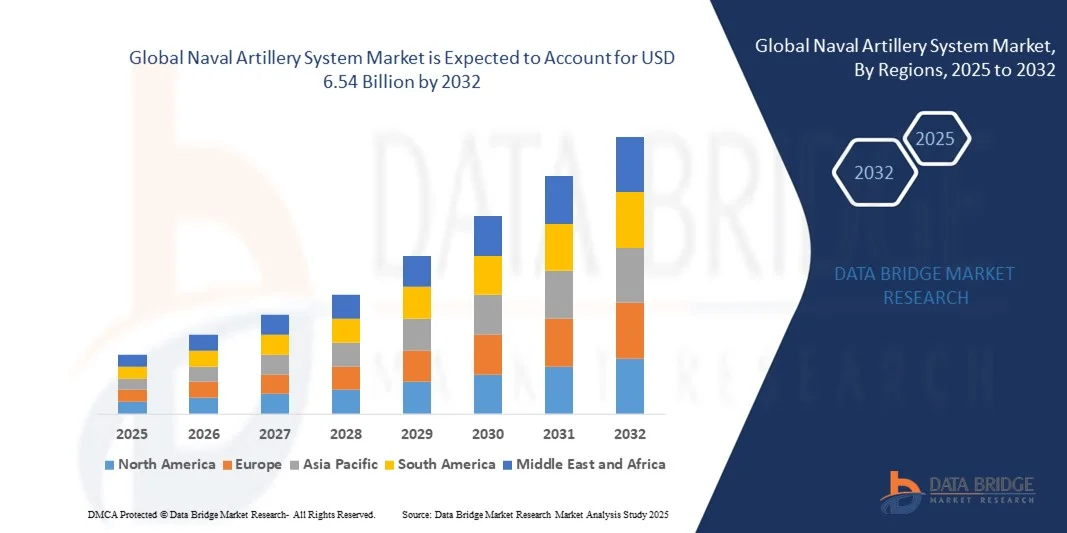
- The global naval artillery system market size was valued at USD 4.78 billion in 2024 and is expected to reach USD 6.54 billion by 2032, at a CAGR of 4.00% during the forecast period
- The naval artillery system market is undergoing essential changes with recent developments in technologies which are positively affecting the growth rate of naval artillery system market over the forecast period. Also, As the adoption of a naval artillery system leads to strengthening the operational capacities of defense systems of various countries thus is also aiding towards the growth of the target market
- The high growth of the naval artillery system depends on the country economy and the amount of investment a nation is doing for upgrading their naval defense system in the global market
What are the Major Takeaways of Naval Artillery System Market?
- Some of the major driving factors for the growth of naval artillery system are rising demand for artillery systems from the military sector, constant effect on target areas and ships, fewer time of reaction and least possible time of handling and meeting of coastal targets against encumber background and in a heavy blocking environment as well as the enduring military modernization programs globally
- In addition, the increasing spending and investment of several countries on their naval defense is anticipated to propel the demand of the naval artillery systems over the forecast period
- North America dominated the naval artillery system market with the largest revenue share of 46.65% in 2024, driven by increasing defense modernization programs, high defense spending, and advanced naval capabilities
- The Asia-Pacific naval artillery system market is poised to grow at the fastest CAGR of 9.24% from 2025 to 2032, driven by increasing naval modernization programs, rising defense budgets, and strategic maritime expansion in countries such as China, Japan, and India
- Deadbolt segment dominated the Naval Artillery System market with a market share of 43.2% in 2024, driven by its established reputation for security and ease of retrofit into existing door setups
Report Scope and Naval Artillery System Market Segmentation
|
Attributes |
Naval Artillery System Key Market Insights |
|
Segments Covered |
|
|
Countries Covered |
North America
Europe
Asia-Pacific
Middle East and Africa
South America
|
|
Key Market Players |
|
|
Market Opportunities |
|
|
Value Added Data Infosets |
In addition to the insights on market scenarios such as market value, growth rate, segmentation, geographical coverage, and major players, the market reports curated by the Data Bridge Market Research also include in-depth expert analysis, pricing analysis, brand share analysis, consumer survey, demography analysis, supply chain analysis, value chain analysis, raw material/consumables overview, vendor selection criteria, PESTLE Analysis, Porter Analysis, and regulatory framework. |
What is the Key Trend in the Naval Artillery System Market?
AI-Driven Precision and Automation in Naval Firepower
- A key trend in the global naval artillery system market is the integration of advanced artificial intelligence (AI), automated targeting, and network-centric warfare capabilities, significantly enhancing operational precision and situational awareness
- Modern naval artillery platforms increasingly incorporate AI-powered fire control systems, enabling real-time threat assessment, automated targeting, and predictive engagement strategies for enhanced combat efficiency. For instance, Rheinmetall’s state-of-the-art systems utilize AI algorithms to optimize firing solutions under dynamic sea conditions
- Integration with broader naval combat networks allows seamless coordination with radar, sonar, and missile defense systems, providing a unified operational interface for fleet commanders
- Autonomous and semi-autonomous features in naval artillery systems enable rapid response against evolving threats while minimizing human intervention, improving both accuracy and crew safety
- Companies such as Lockheed Martin and BAE Systems are advancing AI-enabled naval artillery platforms with smart ammunition handling, automated tracking, and precision targeting capabilities
- The growing demand for intelligent, networked, and automated artillery solutions is reshaping naval warfare expectations, driving adoption across modern fleets worldwide
What are the Key Drivers of Naval Artillery System Market?
- The increasing emphasis on maritime security, rising geopolitical tensions, and naval modernization programs are key drivers for the demand for advanced Naval Artillery Systems
- For instance, in 2024, the U.S. Navy commissioned upgrades to its guided artillery platforms to integrate AI-based targeting systems, reflecting the broader trend toward precision-guided naval firepower
- Growing naval expansion in Asia-Pacific and the Middle East is fueling investments in next-generation artillery systems capable of long-range precision engagement and networked operations
- The need for automation, enhanced accuracy, and reduced operational risk is driving the integration of AI and automated fire control into modern artillery platforms
- Furthermore, governments and defense contractors are increasingly focused on modular, multi-role systems that support interoperability with other naval and joint forces, encouraging the adoption of flexible, high-performance artillery solutions
Which Factor is Challenging the Growth of the Naval Artillery System Market?
- High development and procurement costs, along with complex integration requirements with existing naval platforms, pose challenges to widespread adoption of advanced Naval Artillery Systems
- For instance, integrating AI-driven targeting with legacy fleet systems often requires significant investments in software, hardware, and training
- In addition, concerns over cybersecurity, data integrity, and the potential for electronic warfare interference can hinder deployment, as these systems rely heavily on networked sensors and automated control mechanisms
- Defense budgets in developing nations and regions with fiscal constraints may limit procurement of cutting-edge artillery systems, slowing market expansion
- Addressing these challenges through cost-efficient modular designs, standardized integration protocols, and robust cybersecurity measures will be essential for sustained market growth and broader adoption of advanced naval artillery solutions
How is the Naval Artillery System Market Segmented?
The market is segmented on the basis of type, communication protocol, unlocking mechanism, and application.
- By Product Type
On the basis of product type, the naval artillery system market is segmented into Naval Artillery, Coastal Artillery, and Submarine Artillery. The Naval Artillery segment dominated the market with the largest revenue share of 45.3% in 2024, driven by its widespread deployment across modern warships for multi-role combat capabilities. Naval Artillery systems are favored due to their versatility, precision targeting, and integration with advanced fire control and surveillance systems. The segment’s growth is further supported by continuous modernization programs in developed navies, focusing on upgrading existing ships with AI-assisted, networked artillery solutions.
The Submarine Artillery segment is anticipated to witness the fastest CAGR of 22.1% from 2025 to 2032, fueled by rising investments in underwater defense capabilities, stealth operations, and the growing need for long-range strike options in submarines. Submarine artillery provides covert offensive capabilities while enhancing underwater deterrence strategies.
- By Range
On the basis of range, the naval artillery system market is segmented into Short Range, Medium Range, and Long Range. The Long Range segment dominated the market with a market revenue share of 48.5% in 2024, owing to the increasing demand for precision strike capabilities from beyond-visual-range targets, both at sea and on coastal installations. Long-range artillery systems are increasingly integrated with advanced targeting sensors, AI-guided fire control, and networked combat platforms to enhance operational accuracy and effectiveness.
The Medium Range segment is expected to witness the fastest CAGR of 21.8% from 2025 to 2032, driven by its adaptability across various ship classes and coastal defense platforms. Medium-range systems offer an optimal balance between mobility, firepower, and tactical flexibility, making them a preferred choice for navies expanding their multi-role fleet capabilities in emerging markets.
- By Artillery Type
On the basis of artillery type, the market is segmented into Howitzer, Mortar, Anti-air, Rocket, and Others. The Howitzer segment dominated the Naval Artillery System market with the largest revenue share of 46.2% in 2024, attributed to its high firepower, extended range, and integration with modern fire control systems for naval combat operations. Howitzers are widely used for both offensive and defensive applications, providing flexible engagement against surface, coastal, and airborne threats.
The Anti-air artillery segment is expected to witness the fastest CAGR of 23% from 2025 to 2032, propelled by the increasing need for robust aerial defense systems to counter drones, fighter jets, and missile threats. Anti-air systems are increasingly integrated with radar-guided targeting and automated fire control to enhance accuracy and responsiveness, particularly in high-threat maritime environments.
Which Region Holds the Largest Share of the Naval Artillery System Market?
- North America dominated the naval artillery system market with the largest revenue share of 46.65% in 2024, driven by increasing defense modernization programs, high defense spending, and advanced naval capabilities
- Navies in the region prioritize technologically advanced artillery systems for precision targeting, multi-role deployment, and integration with radar and missile defense networks
- This dominance is further supported by strong industrial infrastructure, a technologically skilled workforce, and substantial government investments in naval modernization, establishing North America as a key market for both naval and coastal artillery systems
U.S. Naval Artillery System Market Insight
The U.S. naval artillery system market captured the largest revenue share of 69.41% in 2024 within North America, fueled by ongoing naval fleet modernization programs and strategic investments in advanced artillery systems. Programs such as the Zumwalt-class destroyer modernization and integration of AI-assisted targeting systems are driving demand. The U.S. Navy’s focus on long-range precision artillery and networked fire control systems further propels market expansion. In addition, collaborations between defense contractors and technology providers accelerate development of next-generation naval artillery capabilities, ensuring sustained growth.
Europe Naval Artillery System Market Insight
The Europe naval artillery system market is projected to expand at a substantial CAGR during the forecast period, driven by defense modernization programs in countries such as Germany, France, and Italy. The emphasis on upgrading naval fleets with precision artillery systems and multi-role capabilities, coupled with stringent defense regulations, is fueling adoption. European navies are also increasingly integrating artillery systems with automated fire control and surveillance technologies. Investments in coastal defense infrastructure and participation in NATO missions further support demand across both new deployments and upgrades of existing vessels.
U.K. Naval Artillery System Market Insight
The U.K. naval artillery system market is expected to grow at a noteworthy CAGR during the forecast period, driven by strategic modernization of the Royal Navy’s fleet and enhanced coastal defense initiatives. Investments in AI-enabled artillery systems, integration with missile defense networks, and multi-role deployment capabilities are major growth drivers. The U.K.’s focus on improving operational readiness, coupled with defense export opportunities and government support for indigenous manufacturing, ensures continued demand for advanced naval artillery solutions.
Germany Naval Artillery System Market Insight
The Germany naval artillery system market is anticipated to expand at a considerable CAGR throughout the forecast period, fueled by investments in fleet modernization and the replacement of legacy systems. Germany’s strong defense manufacturing sector, emphasis on precision engineering, and integration of artillery systems with advanced sensor and targeting technologies promote adoption. Coastal defense and multi-role naval programs further encourage deployment of both naval and submarine artillery systems, aligning with the country’s strategic defense priorities.
Which Region is the Fastest Growing Region in the Naval Artillery System Market?
The Asia-Pacific naval artillery system market is poised to grow at the fastest CAGR of 9.24% from 2025 to 2032, driven by increasing naval modernization programs, rising defense budgets, and strategic maritime expansion in countries such as China, Japan, and India. The region’s growing focus on coastal defense, submarine capabilities, and fleet upgrades is boosting artillery adoption. In addition, domestic manufacturing capabilities and government initiatives promoting defense technology enhance affordability and accessibility, enabling wider deployment across emerging APAC navies.
Japan Naval Artillery System Market Insight
The Japan naval artillery system market is gaining momentum due to the nation’s focus on maritime security, fleet modernization, and advanced defense technologies. AI-assisted targeting, integration with missile defense systems, and coastal protection initiatives are driving demand. Japan’s strategic emphasis on enhancing naval capabilities and supporting indigenous defense manufacturers further contributes to market expansion.
China Naval Artillery System Market Insight
The China naval artillery system market accounted for the largest revenue share in Asia-Pacific in 2024, driven by rapid naval fleet expansion, modernization programs, and investments in long-range and multi-role artillery systems. The push for smart naval platforms, including integration with AI and networked fire control, along with domestic defense manufacturing capabilities, supports robust growth across both naval and coastal artillery segments.
Which are the Top Companies in Naval Artillery System Market?
The naval artillery system industry is primarily led by well-established companies, including:
- General Dynamics Corporation (U.S.)
- Lockheed Martin Corporation (U.S.)
- Rheinmetall AG (Germany)
- BAE Systems (U.K.)
- Elbit Systems Ltd. (Israel)
- Nexter Group KNDS (France)
- Mandus Group (U.K.)
- Avibras Indústria Aeroespacial S/A (Brazil)
- China Ordnance Industries Group Corporation (China)
- Defsys Solutions Pvt. Ltd. (India)
- Denel SOC Ltd (South Africa)
- IMI Systems (Israel)
- AEI Systems Ltd. (U.K.)
- KNDS (France)
- RUAG Group (Switzerland)
- HYUNDAI WIA CORP (South Korea)
- Aubert & Duval (France)
- ST Engineering (Singapore)
- Navantia (Spain)
- Hanwha Group (South Korea)
What are the Recent Developments in Global Naval Artillery System Market?
- In July 2025, Mitsubishi Heavy Industries launched the 11th Mogami-class frigate for the Japan Maritime Self-Defense Force (JMSDF) at its shipyard in Nagasaki, where the Mogami-class frigates are under construction, marking a significant milestone in Japan’s naval modernization program
- In July 2025, KNDS Deutschland, Elbit Systems, and Kongsberg successfully conducted the first live-fire test of the Naval Strike Missile (NSM) from the MARS 3 rocket artillery system, confirming the system’s capability to launch the long-range, sea-skimming NSM widely deployed by NATO naval forces, reinforcing advancements in precision strike capabilities
- In March 2025, the Defence Research & Development Organisation (DRDO) and the Indian Navy successfully flight-tested the indigenously-developed Vertically-Launched Short-Range Surface-to-Air Missile (VLSRSAM) at the Integrated Test Range (ITR), Chandipur, Odisha, marking a major enhancement in India’s defence capabilities

- Interactive Data Analysis Dashboard
- Company Analysis Dashboard for high growth potential opportunities
- Research Analyst Access for customization & queries
- Competitor Analysis with Interactive dashboard
- Latest News, Updates & Trend analysis
- Harness the Power of Benchmark Analysis for Comprehensive Competitor Tracking
Data collection and base year analysis are done using data collection modules with large sample sizes. The stage includes obtaining market information or related data through various sources and strategies. It includes examining and planning all the data acquired from the past in advance. It likewise envelops the examination of information inconsistencies seen across different information sources. The market data is analysed and estimated using market statistical and coherent models. Also, market share analysis and key trend analysis are the major success factors in the market report. To know more, please request an analyst call or drop down your inquiry.
The key research methodology used by DBMR research team is data triangulation which involves data mining, analysis of the impact of data variables on the market and primary (industry expert) validation. Data models include Vendor Positioning Grid, Market Time Line Analysis, Market Overview and Guide, Company Positioning Grid, Patent Analysis, Pricing Analysis, Company Market Share Analysis, Standards of Measurement, Global versus Regional and Vendor Share Analysis. To know more about the research methodology, drop in an inquiry to speak to our industry experts.
Data Bridge Market Research is a leader in advanced formative research. We take pride in servicing our existing and new customers with data and analysis that match and suits their goal. The report can be customized to include price trend analysis of target brands understanding the market for additional countries (ask for the list of countries), clinical trial results data, literature review, refurbished market and product base analysis. Market analysis of target competitors can be analyzed from technology-based analysis to market portfolio strategies. We can add as many competitors that you require data about in the format and data style you are looking for. Our team of analysts can also provide you data in crude raw excel files pivot tables (Fact book) or can assist you in creating presentations from the data sets available in the report.













