


What is the Navigation Systems Market Size and Growth Rate?
As per Data Bridge Market Research Analysis the Navigation Systems Market was valued at USD 2.48 billion in 2025 and is projected to reach USD 5.92 billion by 2033, growing at a CAGR of 11.50% from 2026 to 2033. The market is witnessing steady growth driven by increasing demand for accurate positioning and real-time location-based services, rapid advancements in satellite navigation technologies, and expanding applications across automotive, aerospace, marine, defense, and consumer electronics sectors.
The growing integration of GNSS-enabled solutions in autonomous vehicles, fleet management, and smart transportation systems, combined with rising investments in next-generation satellite constellations such as GPS modernization, Galileo expansion, and BeiDou enhancements, is significantly accelerating market adoption. Additionally, increasing reliance on precise navigation for defense operations, aviation safety, logistics optimization, and precision agriculture is further strengthening the demand for advanced navigation systems globally.
Key Market Trends & Insights
- North America dominated the Navigation Systems Market with the largest revenue share of 34.12% in 2025, supported by advanced GNSS infrastructure, strong defense adoption, and widespread integration in automotive and aerospace applications.
- The GNSS segment led the market with a 48.62% share in 2025, driven by its extensive deployment across automotive, aviation, marine, agriculture, and defense applications.
- Asia-Pacific is expected to be the fastest-growing region at a CAGR of 8.1% from 2026 to 2033, fueled by rapid smart city development, expanding automotive production, and increasing adoption of BeiDou-based navigation systems.
- Augmentation Systems are the fastest-growing system type, projected to register a CAGR of 8.1%, reflecting the surge in demand for enhanced positioning accuracy and reliability.
- The Hardware segment dominated the component category with a 52.14% revenue share in 2025, led by extensive demand for GNSS receivers, antennas, sensors, navigation processors, and positioning modules.
- Satellite-Based Navigation accounted for 56.83% of the market, preferred by its widespread use across transportation, aviation, marine, defense, and consumer applications.
- The Hybrid Navigation Systems segment is the fastest-growing technology category, with a CAGR of 8.8%, driven by increasing demand for uninterrupted positioning in complex operating environments.
Market Size & Forecast
- Global Market Value (2025): USD 2.48 Billion
- Expected Market Value (2033): USD 5.92 Billion
- Forecast CAGR (2026–2033): 11.50%
- Leading Region in 2025: North America
- Fastest Growing Region: Asia Pacific
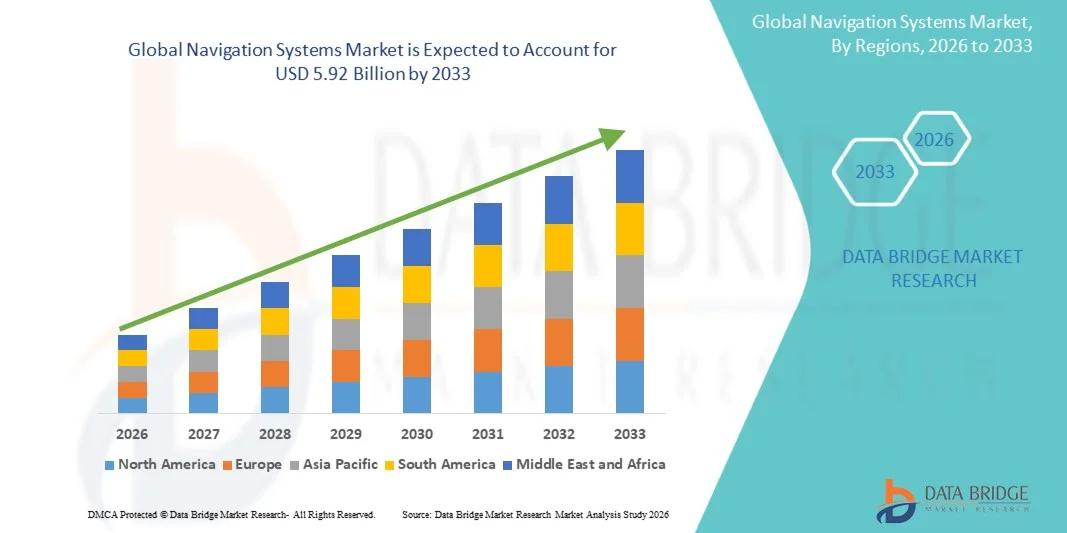
Report Scope and Navigation Systems Market Segmentation
|
Attributes |
Navigation Systems Key Market Insights |
|
Segments Covered |
|
|
Countries Covered |
North America · U.S. · Canada · Mexico Europe · Germany · France · U.K. · Netherlands · Switzerland · Belgium · Russia · Italy · Spain · Turkey · Rest of Europe Asia-Pacific · China · Japan · India · South Korea · Singapore · Malaysia · Australia · Thailand · Indonesia · Philippines · Rest of Asia-Pacific Middle East and Africa · Saudi Arabia · U.A.E. · South Africa · Egypt · Israel · Rest of Middle East and Africa South America · Brazil · Argentina · Rest of South America |
|
Key Market Players |
· Trimble Inc. (U.S.) · Garmin Ltd. (Switzerland) · TomTom N.V. (Netherlands) · HERE Global B.V. (Netherlands) · Topcon Corporation (Japan) · Furuno Electric Co., Ltd. (Japan) · Hexagon AB (Sweden) · JAVAD GNSS, Inc. (U.S.) · Septentrio NV (Belgium) · NovAtel Inc. (Canada) · u-blox AG (Switzerland) · Leica Geosystems AG (Switzerland) · CHC Navigation (China) · NVS Technologies AG (Switzerland) · iMAR Navigation GmbH (Germany) · Oxford Technical Solutions Ltd (U.K.) · Tallysman Wireless Inc. (Canada) · SBG Systems S.A.S. (France) · Advanced Navigation Pty Ltd (Australia) · UrsaNav, Inc. (U.S.) |
|
Market Opportunities |
· Rapid expansion of autonomous vehicles and ADAS systems · Growing deployment of smart city infrastructure and IoT-enabled transport systems · Increasing modernization of defense and aerospace navigation systems |
|
Value Added Data Infosets |
In addition to the insights on market scenarios such as market value, growth rate, segmentation, geographical coverage, and major players, the market reports curated by the Data Bridge Market Research also include in-depth expert analysis, patient epidemiology, pipeline analysis, pricing analysis, and regulatory framework. |
What is the Key Trend in the Navigation Systems Market?
Trend: Growth in Precision Positioning & Connected Mobility Applications
Transportation operators, logistics companies, and mobility service providers are increasingly adopting advanced navigation systems to enhance route efficiency, improve operational visibility, and support real-time decision-making without the limitations of traditional mapping methods. The integration of real-time positioning correction services enables precise analysis of vehicle location, movement patterns, and travel conditions. Fleet operators and smart mobility platforms are similarly leveraging navigation technologies to optimize transportation networks through standardized, data-driven management frameworks, while AI and cloud-based mapping technologies create intelligent environments that closely replicate real-world mobility conditions.
For instance, in January 2025, TomTom expanded its AI-powered mapping capabilities to improve real-time navigation accuracy and connected mobility services across global transportation networks.
Navigation Systems Market Dynamics
Key Market Driver: Growing Adoption of Navigation Technologies in Autonomous Vehicle Development
The rapid development of autonomous vehicles and Advanced Driver Assistance Systems (ADAS) has created substantial demand for high-precision navigation systems that can validate positioning algorithms, sensor fusion models, and vehicle localization accuracy across millions of operational scenarios impossible to replicate through physical testing. Automotive OEMs, Tier-1 suppliers, and technology companies are deploying navigation platforms as a core component of their development pipeline, reducing costs, accelerating innovation cycles, and improving overall transportation safety.
For instance, in April 2024, HERE Technologies strengthened its HD Live Map capabilities to support autonomous driving development and advanced vehicle positioning applications.
Key Restraint/Challenge: High Infrastructure and Deployment Cost of Advanced Navigation Systems
A significant restraint in the Navigation Systems Market is the high upfront investment required for advanced positioning infrastructure. Modern platforms integrate satellite connectivity services, correction networks, high-definition mapping databases, and real-time analytics capabilities, demanding substantial investment in deployment, integration, and ongoing maintenance. The total cost of ownership extends to software subscriptions, periodic updates, and technical support, making adoption difficult for smaller fleet operators, public agencies, and emerging-market organizations.
The October 2024 expansion of advanced GNSS correction service infrastructure by multiple navigation technology providers illustrates the scale of capital commitment required for high-accuracy positioning ecosystems, reflecting the broader challenge of adoption beyond well-funded organizations.
For instance, the deployment of nationwide real-time GNSS correction networks requires significant infrastructure investment and long-term operational expenditure.
Key Market Opportunity: Integration of AI and Intelligent Location-Based Service Platforms
The integration of artificial intelligence in navigation systems presents a significant market opportunity. AI-enabled platforms can generate dynamic, adaptive routing recommendations, provide real-time traffic intelligence, and support large-scale optimization of connected transportation networks. The development of cloud-based mapping ecosystems and location intelligence platforms is further democratizing access to advanced navigation capabilities, opening growth opportunities across cost-sensitive markets in Asia-Pacific, Latin America, and the Middle East.
For instance, in February 2025, Google enhanced AI-driven navigation features within its mapping ecosystem to deliver more predictive routing and real-time travel intelligence.
How is the Navigation Systems Market Segmented?
The navigation systems market is segmented on the basis of system type, component, technology, and end user.
- By System Type
On the basis of system type, the Navigation Systems Market is segmented into GNSS, RNSS, Augmentation Systems, and Inertial Navigation Systems. The GNSS segment dominated the market with a 48.62% share in 2025, owing to its extensive deployment across automotive, aviation, marine, agriculture, and defense applications. GNSS technologies provide accurate positioning, navigation, and timing services on a global scale, making them essential for modern transportation and logistics operations. The widespread availability of satellite constellations and receiver devices has significantly expanded adoption across both commercial and consumer sectors. Increasing demand for location-based services and connected mobility solutions is further supporting market growth. Continuous improvements in positioning accuracy and satellite coverage are strengthening system reliability. The segment continues to benefit from growing investments in smart transportation and digital infrastructure projects worldwide.
The Augmentation Systems segment is projected to register the fastest growth at a CAGR of 8.1% from 2026 to 2033, driven by rising demand for enhanced positioning accuracy and reliability. These systems improve GNSS performance by correcting signal errors and providing real-time integrity information for critical applications. Increasing deployment in aviation navigation, autonomous vehicles, precision agriculture, and surveying activities is accelerating adoption. Governments and infrastructure agencies are investing heavily in satellite-based and ground-based augmentation networks to support next-generation mobility systems. The growing need for centimeter-level positioning accuracy is creating substantial opportunities for market expansion. Continuous advancements in correction technologies and real-time data processing are expected to further boost growth.
- By Component
On the basis of component, the Navigation Systems Market is segmented into hardware, software, and services. The Hardware segment led the market with a 52.14% share in 2025, driven by extensive demand for GNSS receivers, antennas, sensors, navigation processors, and positioning modules. Navigation hardware forms the foundation of positioning systems across automotive, aerospace, defense, marine, and industrial applications. Rising production of connected vehicles and autonomous platforms is increasing the deployment of advanced navigation equipment. Continuous innovation in miniaturization and sensor integration is improving system performance and efficiency. The segment also benefits from growing investments in satellite navigation infrastructure and intelligent transportation systems. Strong demand from both commercial and government sectors continues to support its dominant position.
The Software segment is expected to witness the fastest growth at a CAGR of 8.5% from 2026 to 2033, driven by increasing adoption of digital mapping, route optimization, geospatial analytics, and AI-powered navigation solutions. Software platforms play a critical role in transforming positioning data into actionable intelligence for users and organizations. The growing use of cloud-based navigation services and real-time traffic management systems is accelerating market expansion. Advancements in machine learning and predictive analytics are enhancing route planning and operational efficiency. Increasing integration with connected mobility ecosystems is further driving software demand. The shift toward subscription-based navigation services is also creating long-term growth opportunities.
- By Technology
On the basis of technology, the Navigation Systems Market is segmented into satellite-based navigation, terrestrial navigation, and hybrid navigation systems. The Satellite-Based Navigation segment accounted for the largest market share with 56.38% in 2025, owing to its widespread use across transportation, aviation, marine, defense, and consumer applications. These systems provide global coverage and reliable positioning services through satellite constellations such as GPS, Galileo, GLONASS, and BeiDou. Growing dependence on real-time navigation and location-based services is supporting widespread adoption. Continuous upgrades in satellite infrastructure are improving accuracy, availability, and service reliability. The technology remains a critical component of autonomous mobility and logistics operations. Increasing investments in next-generation satellite systems continue to reinforce market leadership.
The Hybrid Navigation Systems segment is projected to register the fastest growth at a CAGR of 8.8% from 2026 to 2033, driven by increasing demand for uninterrupted positioning in complex operating environments. Hybrid systems combine satellite navigation with inertial sensors, terrestrial networks, and additional positioning technologies to enhance accuracy and reliability. These solutions are particularly valuable in urban canyons, tunnels, underground facilities, and indoor environments where GNSS signals may be degraded. Growing deployment in autonomous vehicles, robotics, drones, and defense applications is accelerating adoption. Technological advancements in sensor fusion and artificial intelligence are significantly improving system performance. Rising demand for resilient navigation capabilities is expected to fuel rapid market growth.
- By End User
On the basis of end user, the Navigation Systems Market is segmented into government & defense, automotive industry, transportation & logistics, aerospace & aviation, marine industry, consumer electronics, agriculture & precision farming, and construction & mining. The Automotive Industry segment dominated the market with a 29.87% share in 2025, driven by increasing integration of navigation systems into passenger vehicles, commercial vehicles, and autonomous driving platforms. Modern vehicles rely heavily on navigation technologies for route guidance, fleet management, ADAS functionality, and connected mobility services. Growing consumer demand for intelligent transportation experiences is supporting widespread adoption. Automotive manufacturers continue to invest heavily in advanced positioning and mapping solutions to improve safety and operational efficiency. The rise of electric and connected vehicles is further strengthening market demand. Continuous innovation in mobility technologies is expected to sustain segment leadership.
The Agriculture & Precision Farming segment is anticipated to witness the fastest growth at a CAGR of 9.2% from 2026 to 2033, driven by increasing adoption of precision agriculture technologies worldwide. Farmers are utilizing advanced navigation systems to improve field mapping, automated steering, crop monitoring, and resource management activities. High-accuracy positioning enables optimized fertilizer application, irrigation management, and planting operations, significantly improving productivity. Growing concerns regarding food security and agricultural efficiency are accelerating technology adoption. Government support for smart farming initiatives is further contributing to market expansion. The increasing availability of affordable precision farming solutions is expected to drive strong long-term growth across both developed and emerging economies.
Which Region Holds the Largest Share of the Navigation Systems Market?
North America dominated the Navigation Systems Market with the largest revenue share of 34.12% in 2025, supported by advanced GNSS infrastructure, strong defense adoption, and widespread integration in automotive and aerospace applications. The region also benefits from widespread adoption of GNSS-enabled solutions, high deployment of connected transportation systems, and growing use of navigation technologies across automotive, defense, aviation, and logistics applications. Increasing focus on autonomous mobility, intelligent transportation networks, and next-generation positioning capabilities continues to strengthen North America’s leadership position in the global market.
U.S. Navigation Systems Market Insight
The U.S. navigation systems market is witnessing strong growth due to rising investments in autonomous mobility technologies, intelligent transportation systems, and advanced positioning infrastructure. The country’s mature aerospace, defense, and automotive ecosystem, along with increasing adoption of AI-powered, GNSS-based, and connected navigation solutions, is driving demand across commercial, government, and industrial applications. In addition, growing emphasis on improving transportation efficiency and enhancing location accuracy standards is accelerating navigation system adoption across fleet operators, technology companies, and public agencies.
Europe Navigation Systems Market Insight
The Europe navigation systems market remains a major contributor to global revenue, driven by strong government support, technological innovation, and high demand for advanced positioning solutions. The widespread use of navigation technologies in automotive, aviation, marine, and logistics applications is supporting market expansion across the region. Increasing investments in satellite navigation infrastructure, coupled with strict transportation regulations and a highly skilled technology workforce, continue to enhance the adoption of navigation systems throughout Europe.
U.K. Navigation Systems Market Insight
The U.K. navigation systems market is experiencing steady growth, supported by rising adoption of positioning technologies in transportation, logistics, and autonomous mobility applications. Increasing investments in advanced navigation infrastructure and growing demand for accurate, reliable location intelligence solutions are contributing to market growth. Furthermore, integration of AI, geospatial analytics, and real-time mapping technologies is improving navigation performance and operational efficiency, positioning the U.K. as a key innovation hub in the navigation systems industry.
Germany Navigation Systems Market Insight
The Germany navigation systems market is expanding steadily due to the country’s strong automotive manufacturing base, advanced engineering capabilities, and increasing adoption of next-generation positioning technologies. Automotive companies, logistics providers, and industrial organizations are increasingly utilizing navigation systems for route optimization, vehicle localization, and operational management activities. Continuous advancements in satellite positioning, sensor integration, and digital mapping technologies, along with strong government focus on transportation modernization and innovation, are further driving market growth in Germany.
Asia-Pacific Navigation Systems Market Insight
The Asia-Pacific navigation systems market is expected to witness rapid growth, driven by increasing urbanization, expanding transportation infrastructure, and rising investments in smart mobility networks across countries such as China, India, and Japan. Growing awareness regarding transportation efficiency, rising adoption of advanced navigation technologies, and increasing demand for scalable and cost-effective positioning solutions are supporting regional market expansion. Additionally, the growing presence of automotive manufacturing centers and logistics activities is accelerating navigation system adoption across commercial and industrial sectors.
Japan Navigation Systems Market Insight
The Japan navigation systems market is witnessing consistent growth due to rising investments in intelligent mobility technologies, transportation innovation, and infrastructure modernization initiatives. Automotive manufacturers, electronics companies, and research institutes are increasingly adopting advanced navigation systems for vehicle positioning, route optimization, and mobility management purposes. Moreover, increasing integration of AI-powered mapping technologies and the country’s focus on efficient and safe transportation solutions are further contributing to market growth.
China Navigation Systems Market Insight
The China navigation systems market is growing rapidly, driven by increasing urbanization, expanding transportation infrastructure, and rising government focus on smart mobility and intelligent transportation development. Growing adoption of AI-enabled and GNSS-based navigation platforms across automotive, logistics, and industrial sectors is significantly boosting market demand. In addition, rising investments in transportation modernization, increasing awareness regarding operational efficiency, and rapid technological advancements are positioning China as one of the fastest-growing markets for navigation systems globally.
Navigation Systems Market Share
The navigation systems industry is primarily led by well-established companies, including:
- Trimble Inc. (U.S.)
- Garmin Ltd. (Switzerland)
- TomTom N.V. (Netherlands)
- HERE Global B.V. (Netherlands)
- Topcon Corporation (Japan)
- Furuno Electric Co., Ltd. (Japan)
- Hexagon AB (Sweden)
- JAVAD GNSS, Inc. (U.S.)
- Septentrio NV (Belgium)
- NovAtel Inc. (Canada)
- u-blox AG (Switzerland)
- Leica Geosystems AG (Switzerland)
- CHC Navigation (China)
- NVS Technologies AG (Switzerland)
- iMAR Navigation GmbH (Germany)
- Oxford Technical Solutions Ltd (U.K.)
- Tallysman Wireless Inc. (Canada)
- SBG Systems S.A.S. (France)
- Advanced Navigation Pty Ltd (Australia)
- UrsaNav, Inc. (U.S.)
What are Latest Developments in Navigation Systems Market?
- In April 2025, Septentrio, a leading provider of high-precision GNSS positioning solutions, announced the launch of its new AsteRx RB3 GNSS receiver and AsteRx RBi3 GNSS/INS receiver. The ultra-rugged navigation systems are designed for machine control, industrial automation, and autonomous applications operating in harsh environments. The products deliver centimeter-level positioning accuracy, enhanced resilience against signal interference, and improved reliability for mission-critical navigation tasks. This launch highlights the growing demand for advanced navigation technologies supporting autonomous and industrial mobility applications
- In January 2025, Hexagon announced the acquisition of Septentrio, a recognized developer of Global Navigation Satellite System (GNSS) technologies. The acquisition strengthens Hexagon’s positioning portfolio by integrating GNSS, sensor fusion, anti-jamming, and correction service capabilities. The combined technologies are expected to accelerate innovation in autonomous systems, robotics, UAVs, and other navigation-intensive applications. This development reflects increasing industry focus on resilient and highly accurate positioning solutions
- In May 2024, CHC Navigation (CHCNAV) introduced the i76 Visual IMU-RTK GNSS Receiver, a compact navigation and surveying solution integrating GNSS, inertial measurement technology, and dual-camera functionality. The device provides centimeter-level positioning accuracy while supporting CAD and augmented reality-based field operations. The launch was aimed at improving efficiency in surveying, mapping, and geospatial data collection applications. This development demonstrates the continued convergence of navigation technologies with digital visualization and intelligent positioning capabilities
- In November 2023, the European Space Agency announced the successful completion of key hardware tests for its Galileo Second Generation (G2) navigation satellites. The new satellite platform incorporates enhanced atomic clocks, digital payloads, electric propulsion systems, and more powerful navigation antennas to improve positioning accuracy and service reliability. The milestone marked significant progress toward the next evolution of Europe’s satellite navigation infrastructure. This development reinforces global investment in advanced navigation satellite systems
- In June 2023, the European Space Agency entered the full development phase of the Galileo Second Generation program, awarding major contracts for system engineering, security monitoring, and ground mission infrastructure. The initiative is designed to deliver more robust, resilient, and innovative navigation services for users worldwide. With substantial investment committed to next-generation satellite navigation capabilities, the project represents one of the most significant developments in the global navigation systems industry

- Interactive Data Analysis Dashboard
- Company Analysis Dashboard for high growth potential opportunities
- Research Analyst Access for customization & queries
- Competitor Analysis with Interactive dashboard
- Latest News, Updates & Trend analysis
- Harness the Power of Benchmark Analysis for Comprehensive Competitor Tracking
Data collection and base year analysis are done using data collection modules with large sample sizes. The stage includes obtaining market information or related data through various sources and strategies. It includes examining and planning all the data acquired from the past in advance. It likewise envelops the examination of information inconsistencies seen across different information sources. The market data is analysed and estimated using market statistical and coherent models. Also, market share analysis and key trend analysis are the major success factors in the market report. To know more, please request an analyst call or drop down your inquiry.
The key research methodology used by DBMR research team is data triangulation which involves data mining, analysis of the impact of data variables on the market and primary (industry expert) validation. Data models include Vendor Positioning Grid, Market Time Line Analysis, Market Overview and Guide, Company Positioning Grid, Patent Analysis, Pricing Analysis, Company Market Share Analysis, Standards of Measurement, Global versus Regional and Vendor Share Analysis. To know more about the research methodology, drop in an inquiry to speak to our industry experts.
Data Bridge Market Research is a leader in advanced formative research. We take pride in servicing our existing and new customers with data and analysis that match and suits their goal. The report can be customized to include price trend analysis of target brands understanding the market for additional countries (ask for the list of countries), clinical trial results data, literature review, refurbished market and product base analysis. Market analysis of target competitors can be analyzed from technology-based analysis to market portfolio strategies. We can add as many competitors that you require data about in the format and data style you are looking for. Our team of analysts can also provide you data in crude raw excel files pivot tables (Fact book) or can assist you in creating presentations from the data sets available in the report.













