


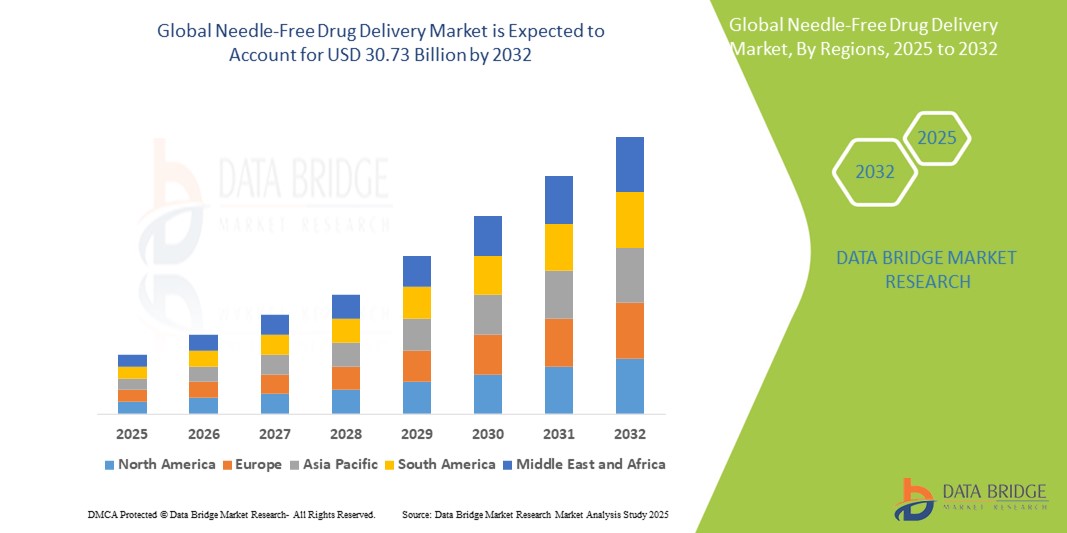
Needle-Free Drug Delivery Market Size
- The global needle-free drug delivery market size was valued at USD 14.39 billion in 2024 and is expected to reach USD 30.73 billion by 2032, at a CAGR of 9.95% during the forecast period
- The market growth is largely fueled by the increasing prevalence of chronic diseases (such as diabetes, autoimmune diseases, cardiovascular diseases, and oncological diseases) that require frequent injections, and significant technological advancements in drug delivery systems, leading to more patient-friendly and efficient administration methods
- Furthermore, rising patient preference for painless drug administration, coupled with the growing demand for self-injection devices and the need to reduce the risk of needlestick injuries and cross-contamination, is establishing needle-free drug delivery solutions as the modern drug administration method of choice. These converging factors are accelerating the uptake of needle-free drug delivery solutions, thereby significantly boosting the industry's growth
Needle-Free Drug Delivery Market Analysis
- Needle-free drug delivery solutions are increasingly vital components of modern healthcare systems in both residential and commercial settings due to their enhanced patient convenience, improved adherence capabilities, and seamless integration with evolving digital health ecosystems
- The escalating demand for needle-free drug delivery is primarily fueled by the widespread adoption of patient-centric care models, growing concerns among consumers regarding traditional injection pain and needle phobia, and a rising preference for comfortable and safe drug administration
- North America dominates the needle-free drug delivery market with the largest revenue share of 42.8% in 2024, characterized by early adoption of advanced medical technologies, high healthcare expenditures, and a strong presence of key pharmaceutical and biotech industry players
- Asia-Pacific is expected to be the fastest growing region in the needle-free drug delivery market during the forecast period, with a projected CAGR of around 9.4%, due to increasing urbanization and rising disposable incomes
- The fillable needle-free injection systems segment dominates the needle-free drug delivery market with a market share of 64.6% in 2024, driven by its versatility in accommodating various drug formulations and the economic benefit for multi-dose applications and clinical settings where customization is key.
Report Scope and Needle-Free Drug Delivery Market Segmentation
|
Attributes |
Needle-Free Drug Delivery Key Market Insights |
|
Segments Covered |
|
|
Countries Covered |
North America
Europe
Asia-Pacific
Middle East and Africa
South America
|
|
Key Market Players |
|
|
Market Opportunities |
|
|
Value Added Data Infosets |
In addition to the insights on market scenarios such as market value, growth rate, segmentation, geographical coverage, and major players, the market reports curated by the Data Bridge Market Research also include in-depth expert analysis, pricing analysis, brand share analysis, consumer survey, demography analysis, supply chain analysis, value chain analysis, raw material/consumables overview, vendor selection criteria, PESTLE Analysis, Porter Analysis, and regulatory framework. |
Needle-Free Drug Delivery Market Trends
“Smart Systems and Patient Empowerment”
- A significant and accelerating trend in the global needle-free drug delivery market is the deepening integration with digital health platforms and smart devices. This fusion of technologies is significantly enhancing patient convenience, adherence, and overall control over their medication management
- For instance, next-generation needle-free drug delivery devices, such as the NovaXS Telosis system, are being developed to seamlessly sync with smartphone applications. This allows users to track treatment progress, view treatment calendars, and receive reminders, empowering them to manage their medication effectively from home
- The integration of smart features in needle-free drug delivery devices enables functionalities such as learning user adherence patterns to personalize medication schedules and providing intelligent alerts based on administration history. For example, some advanced needle-free auto-injectors can improve dose precision and send reminders if a scheduled dose is missed or unusual administration activity is detected, contributing to better patient outcomes
- The seamless integration of needle-free drug delivery devices with broader digital health platforms facilitates centralized control over various aspects of the connected healthcare environment. Through a single interface, users can manage their drug delivery alongside vital sign monitoring, appointment reminders, and other health tracking devices, creating a unified and automated wellness experience
- The demand for needle-free drug delivery solutions that offer seamless digital integration and enhanced user convenience is growing rapidly across both chronic disease management and vaccination sectors, as patients increasingly prioritize ease of use and comprehensive digital health functionality
Needle-Free Drug Delivery Market Dynamics
Driver
“Growing Need Due to Rising Patient Preference and Digital Health Adoption”
- The increasing prevalence of patient preferences for comfortable and convenient medication administration, coupled with the accelerating adoption of digital health ecosystems, is a significant driver for the heightened demand for needle-free drug delivery solutions
- For instance, a leading pharmaceutical company might announce advancements in integrated, self-administered drug delivery systems, looking forward to integrating state-of-the-art monitoring sensors into their needle-free patch solutions. Such strategies by key companies are expected to drive the needle-free drug delivery industry growth in the forecast period
- As patients become more aware of potential discomfort and risks associated with traditional injections and seek enhanced ease of use for their treatments, needle-free drug delivery offers advanced features such as precise dosing, reduced pain, and improved adherence tracking, providing a compelling upgrade over conventional methods
- Furthermore, the growing popularity of digital health devices and the desire for interconnected healthcare experiences are making needle-free drug delivery an integral component of these systems, offering seamless integration with other health monitoring devices and platforms
- The convenience of pain-free administration, remote treatment management for caregivers or healthcare providers, and the ability to track medication history through smartphone applications are key factors propelling the adoption of needle-free drug delivery in both home-care and clinical settings. The trend towards personalized medicine and the increasing availability of user-friendly needle-free drug delivery options further contribute to market growth
Restraint/Challenge
“Concerns Regarding Device Security and High Development Costs”
- Concerns surrounding the security vulnerabilities of connected medical devices, including advanced needle-free drug delivery systems, pose a significant challenge to broader market penetration. As these systems rely on software and potentially network connectivity for monitoring or programming, they are susceptible to hacking attempts and data breaches, raising anxieties among potential consumers and healthcare providers about the integrity of their treatment and personal data
- For instance, reports of vulnerabilities in medical IoT devices have made some patients and healthcare institutions hesitant to adopt certain digitally connected drug delivery solutions
- Addressing these cybersecurity concerns through robust encryption, secure authentication protocols, and regular software updates is crucial for building consumer trust. Companies developing needle-free drug delivery systems emphasize their advanced data protection methods and security features in their marketing to reassure potential users
- In addition, the relatively high initial development and manufacturing cost of some advanced needle-free drug delivery systems compared to traditional syringes can be a barrier to adoption for price-sensitive healthcare systems or patients, particularly in developing regions or for budget-conscious providers. While basic needle-free options are becoming more affordable, premium features such as integrated diagnostics or complex formulation delivery often come with a higher price tag
- While prices are gradually decreasing, the perceived premium for advanced medical technology can still hinder widespread adoption, especially for those who do not see an immediate need for the advanced features offered
Needle-Free Drug Delivery Market Scope
The market is segmented on the basis of product, technology, application, injection method, and source of power.
By Product
On the basis of product, the needle-free drug delivery market is segmented into Prefilled needle-free injection systems and fillable needle-free injection systems. The fillable needle-free injection systems segment held a dominant market revenue share of 64.6%, primarily driven by its versatility in accommodating various drug formulations and the economic benefit for bulk usage in clinical settings. Healthcare providers often prefer fillable systems for their adaptability to different patient needs and drug types. The market also sees strong demand for fillable types due to their reusability and compatibility with diverse drug regimens.
The prefilled needle-free injection systems segment is anticipated to witness rapid growth from 2025 to 2032, fueled by increasing adoption in self-administration scenarios and for specific pre-packaged biologics. Prefilled systems offer superior convenience, reduce preparation errors, and are highly suitable for individuals managing chronic conditions at home, contributing to their growing popularity in modern patient-centric care.
By Technology
On the basis of technology, the needle-free drug delivery market is segmented into inhaler, novel needle-free, jet injector, and transdermal patch. The Jet Injector segment held a largest market revenue share in 2024, driven by its established efficacy for delivering a wide range of liquid medications with precision and speed. Jet injectors often offer rapid onset of action and are widely accepted for mass vaccination programs and insulin delivery.
The novel needle-free technologies segment is expected to witness the fastest growth rate from 2025 to 2032, driven by continuous innovation in areas such as microneedle arrays, ballistic delivery, and other emerging painless methods. These novel technologies are gaining traction due to their potential for targeted drug delivery, improved patient comfort, and applicability for a broader spectrum of therapeutic molecules, especially in specialized treatments.
By Application
On the basis of application, the needle-free drug delivery market is segmented into insulin delivery, vaccination, pediatric injections, and pain management. The insulin delivery segment accounted for the largest market revenue share in 2024, driven by the increasing global prevalence of diabetes and the daily need for insulin administration, making needle-free options highly desirable for patient comfort and adherence. Diabetic patients often prioritize needle-free devices for their ease of use and reduced psychological burden compared to traditional injections.
The vaccination segment is expected to witness robust growth, fueled by global immunization initiatives, the need for painless administration, especially for pediatric populations, and the potential for self-administration during public health crises. Needle-free vaccination offers advantages in terms of reduced discomfort and improved public acceptance, particularly for widespread campaigns.
By Injection Method
On the basis of injection method, the needle-free drug delivery market is segmented into powder injections, liquid injections, and depot or projectile injection. The liquid injections segment accounted for the largest market revenue share in 2024, driven by the prevalent use of liquid formulations for most injectable drugs and the extensive research and development in this area. Liquid injection systems are widely adopted due to their versatility and the ease of delivering a broad spectrum of medications.
The powder injections segment is expected to witness the fastest CAGR from 2025 to 2032, favored for its advantages in drug stability and simplified storage for certain sensitive biologics and vaccines. Powder injection methods are particularly gaining traction for formulations that require reconstitution before use, offering improved shelf life and reducing cold chain requirements.
By Source of Power
On the basis of source of power, the needle-free drug delivery market is segmented into spring load jet injector systems, gas powered jet injector, and battery powered jet injector system. The spring load jet injector systems segment held the largest market revenue share in 2024, driven by its mechanical simplicity, reliability, and cost-effectiveness. Spring-loaded systems are widely favored for their consistent performance and ease of use in various settings, including home care and low-resource environments.
The battery powered jet injector system segment is expected to witness significant growth from 2025 to 2032, driven by advancements in miniaturization, improved portability, and enhanced control over injection parameters. Battery-powered systems offer greater precision and flexibility, making them increasingly popular for advanced home-care devices and specialized clinical applications requiring programmable dosing.
Needle-Free Drug Delivery Market Regional Analysis
- North America dominates the needle-free drug delivery market with a substantial revenue share of 42.8%, driven by a growing demand for patient comfort and adherence, as well as increased awareness of advanced healthcare technology
- Consumers in the region highly value the convenience, improved safety features, and seamless integration offered by needle-free drug delivery systems with other digital health devices such as glucose monitors and health tracking applications
- This widespread adoption is further supported by high healthcare expenditures, a technologically inclined population, and the growing preference for self-administration and remote monitoring of treatment, establishing needle-free drug delivery as a favored solution for both home-care and clinical settings
U.S. Needle-Free Drug Delivery Market Insight
The U.S. needle-free drug delivery market captured largest revenue share of 81.7% 2024 within North America, fueled by the swift uptake of connected medical devices and the expanding trend of home healthcare adoption. Consumers are increasingly prioritizing comfortable and efficient drug administration through innovative, needle-free systems. The growing preference for patient-friendly device setups, combined with robust demand for digital health integration and remote monitoring capabilities, further propels the needle-free drug delivery industry. Moreover, the increasing integration of digital health technologies is significantly contributing to the market's expansion.
Europe Needle-Free Drug Delivery Market Insight
The Europe needle-free drug delivery market is projected to expand at a substantial CAGR throughout the forecast period, primarily driven by stringent healthcare regulations emphasizing patient safety and the escalating need for improved medication adherence in homes and clinics. The increase in urbanization, coupled with the demand for advanced medical devices, is fostering the adoption of needle-free drug delivery. European consumers are also drawn to the convenience and reduced discomfort these devices offer. The region is experiencing significant growth across patient home-care, clinical, and institutional applications, with needle-free solutions being incorporated into both new treatment protocols and existing healthcare practices.
U.K. Needle-Free Drug Delivery Market Insight
The U.K. needle-free drug delivery market is anticipated to grow at a noteworthy CAGR during the forecast period, driven by the escalating trend of home healthcare and a desire for heightened patient comfort and convenience in medication administration. In addition, concerns regarding needle phobia and safety are encouraging both patients and healthcare providers to choose needle-free delivery solutions. The UK’s embrace of digital health devices, alongside its robust healthcare infrastructure, is expected to continue to stimulate market growth.
Germany Needle-Free Drug Delivery Market Insight
The Germany needle-free drug delivery market is expected to expand at a considerable CAGR during the forecast period, fueled by increasing awareness of advanced healthcare technologies and the demand for innovative, patient-centric solutions. Germany’s well-developed healthcare infrastructure, combined with its emphasis on innovation and quality in medical devices, promotes the adoption of needle-free drug delivery, particularly in chronic disease management and vaccination programs. The integration of needle-free systems with digital health platforms is also becoming increasingly prevalent, with a strong preference for secure, privacy-focused solutions aligning with local consumer and regulatory expectations.
Asia-Pacific Needle-Free Drug Delivery Market Insight
The Asia-Pacific needle-free drug delivery market is poised to grow at the fastest CAGR of 9.6% during the forecast period, driven by increasing urbanization, rising disposable incomes, and technological advancements in countries such as China, Japan, and India. The region's growing inclination towards accessible home healthcare solutions, supported by government initiatives promoting digitalization in healthcare, is driving the adoption of needle-free drug delivery. Furthermore, as APAC emerges as a manufacturing hub for needle-free drug delivery components and systems, the affordability and accessibility of these solutions are expanding to a wider patient base.
Japan Needle-Free Drug Delivery Market Insight
The Japan needle-free drug delivery market witnessed the highest CAGR of 11.5%, during the forecast period, due to the country’s high-tech culture, rapid urbanization, and demand for healthcare convenience. The Japanese market places a significant emphasis on patient comfort and safety, and the adoption of needle-free drug delivery is driven by the increasing integration of home healthcare and connected medical devices. The seamless integration of needle-free systems with other digital health devices, such as health monitoring wearables and telemedicine platforms, is fueling growth. Moreover, Japan's aging population is likely to spur demand for easier-to-use, convenient drug administration solutions in both home-care and clinical settings.
China Needle-Free Drug Delivery Market Insight
The China needle-free drug delivery market accounted for the largest market revenue share within Asia Pacific, with 41.4% in 2024, attributed to the country's expanding middle class, rapid urbanization, and high rates of technological adoption in healthcare. China stands as one of the largest markets for digital health devices, and needle-free drug delivery systems are becoming increasingly popular in home-care, clinical, and public health settings. The push towards smart healthcare initiatives and the availability of affordable needle-free drug delivery options, alongside strong domestic manufacturers, are key factors propelling the market in China.
Needle-Free Drug Delivery Market Share
The needle-free drug delivery industry is primarily led by well-established companies, including:
- 3M (U.S.)
- PharmaJet (U.S.)
- UCB S.A. (U.S.)
- INOVIO Pharmaceuticals (U.S.)
- MannKind Corporation (U.S.)
- Akra Dermojet (France)
- Endo, Inc. (U.S.)
- BD (U.S.)
- CROSSJECT (France)
- Medical International Technologies Inc. (Canada)
- AstraZeneca (U.K.)
- Ferring B.V. (Netherlands)
- OptiNose US Inc. (U.S.)
- Pfizer Inc. (U.S.)
- IntegriMedical LLC (U.S.)
- Gerresheimer AG (Germany)
Latest Developments in Global Needle-Free Drug Delivery Market
- In April 2025, PharmaJet presented new partner data at the World Vaccine Congress 2025, demonstrating that its needle-free delivery systems can boost the immune response of DNA and novel therapeutic cancer vaccines. This highlights the company's commitment to advancing vaccine effectiveness through its precision delivery technology and reinforces the potential of needle-free solutions in complex therapeutic areas
- In May 2025, CROSSJECT announced plans to launch a capital increase of approximately EUR 5 million to support the final development and production of ZEPIZURE, an emergency injectable for epilepsy crises, and to finance for other products. This strategic fundraising aims to bolster the company's financial flexibility as it targets Emergency Use Authorization (EUA) filing with the FDA for its needle-free ZENEO platform
- In March 2025, Vaxxas secured a new U.S. patent for its proprietary manufacturing technology related to its high-density microarray patch (HD-MAP) for needle-free vaccination. This patent strengthens the company's intellectual property portfolio, supporting its exclusive claim to manufacture and sell its innovative vaccination platform designed for consistent, high-speed application of dried vaccine formulations
- In May 2023, Boehringer Ingelheim, a Germany-based pharmaceutical company, announced that its Cyltezo Pen, an autoinjector option for Cyltezo (adalimumab-adbm), received approval from the U.S. Food and Drug Administration (FDA). While autoinjectors can be needle-based, this development highlights the continued focus of major pharmaceutical companies on self-administered and user-friendly drug delivery devices, including those with needle-free or minimized-needle designs, aligning with broader market trends
- In February 2025, Micron Biomedical secured over USD 33 million in funding, including a grant from the Coalition for Epidemic Preparedness Innovations (CEPI), to advance its dissolvable microarray technology for needle-free vaccines. This funding supports the development of a next-generation vaccine platform that aims to overcome cold chain challenges and reduce sharps waste, underscoring the potential for innovative needle-free delivery in global health initiatives

- Interactive Data Analysis Dashboard
- Company Analysis Dashboard for high growth potential opportunities
- Research Analyst Access for customization & queries
- Competitor Analysis with Interactive dashboard
- Latest News, Updates & Trend analysis
- Harness the Power of Benchmark Analysis for Comprehensive Competitor Tracking
Data collection and base year analysis are done using data collection modules with large sample sizes. The stage includes obtaining market information or related data through various sources and strategies. It includes examining and planning all the data acquired from the past in advance. It likewise envelops the examination of information inconsistencies seen across different information sources. The market data is analysed and estimated using market statistical and coherent models. Also, market share analysis and key trend analysis are the major success factors in the market report. To know more, please request an analyst call or drop down your inquiry.
The key research methodology used by DBMR research team is data triangulation which involves data mining, analysis of the impact of data variables on the market and primary (industry expert) validation. Data models include Vendor Positioning Grid, Market Time Line Analysis, Market Overview and Guide, Company Positioning Grid, Patent Analysis, Pricing Analysis, Company Market Share Analysis, Standards of Measurement, Global versus Regional and Vendor Share Analysis. To know more about the research methodology, drop in an inquiry to speak to our industry experts.
Data Bridge Market Research is a leader in advanced formative research. We take pride in servicing our existing and new customers with data and analysis that match and suits their goal. The report can be customized to include price trend analysis of target brands understanding the market for additional countries (ask for the list of countries), clinical trial results data, literature review, refurbished market and product base analysis. Market analysis of target competitors can be analyzed from technology-based analysis to market portfolio strategies. We can add as many competitors that you require data about in the format and data style you are looking for. Our team of analysts can also provide you data in crude raw excel files pivot tables (Fact book) or can assist you in creating presentations from the data sets available in the report.













