


Needle-Free Peptide Delivery Market Size
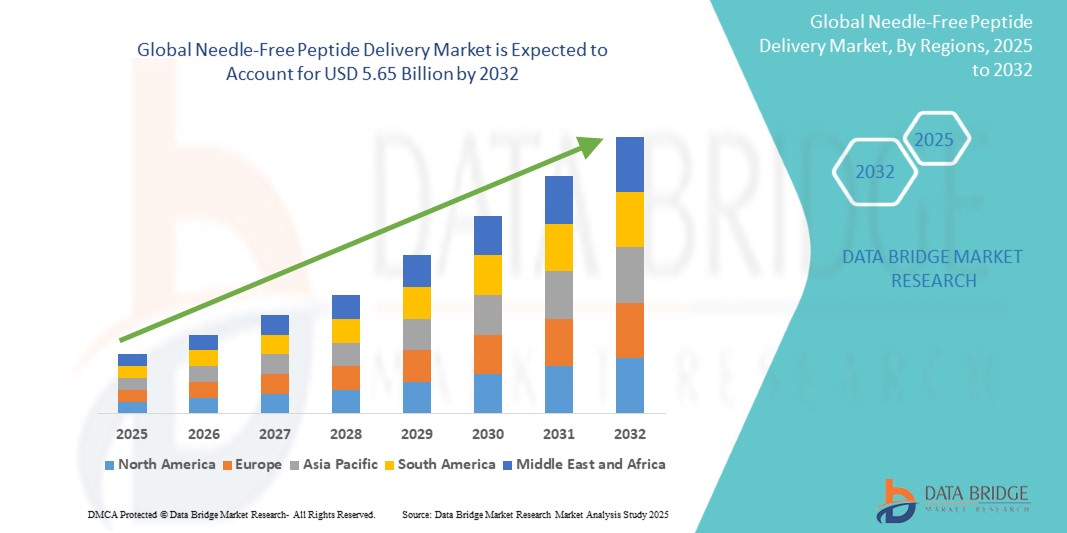
- The global needle-free peptide delivery market size was valued at USD 2.96 billion in 2024 and is expected to reach USD 5.65 billion by 2032, at a CAGR of 8.40% during the forecast period
- The market growth is largely fueled by rising demand for painless, self-administered drug delivery systems and the increasing prevalence of chronic diseases such as diabetes, cancer, and hormonal disorders, where peptide-based therapies are widely used
- Furthermore, ongoing advancements in needle-free delivery technologies such as jet injectors, transdermal systems, and inhalable formulations are improving patient compliance and therapeutic efficacy, thereby accelerating the adoption of these systems and driving substantial industry expansion
Needle-Free Peptide Delivery Market Analysis
- Needle-free peptide delivery systems, designed to administer therapeutic peptides without the use of traditional needles, are becoming increasingly crucial in modern drug delivery due to their ability to enhance patient comfort, eliminate needle-associated risks, and enable self-administration across both clinical and home care settings
- The growing demand for these systems is primarily driven by the rising prevalence of chronic conditions such as diabetes and cancer, increased focus on patient-centric treatment methods, and expanding use of peptide-based drugs across various therapeutic areas
- North America dominated the needle-free peptide delivery market with the largest revenue share of 42.2% in 2024, supported by advanced healthcare infrastructure, high adoption of innovative drug delivery technologies, and strong presence of leading biopharmaceutical companies investing in non-invasive solutions for peptide therapeutics
- Asia-Pacific is expected to be the fastest growing region in the needle-free peptide delivery market during the forecast period due to expanding healthcare access, rising chronic disease burden, and increasing awareness of advanced, pain-free treatment alternatives
- Jet injector segment dominated the needle-free peptide delivery market with a market share of 47% in 2024, owing to its proven efficacy in delivering accurate dosages of peptide formulations and its wide applicability across insulin, vaccine, and hormone therapies
Report Scope and Needle-Free Peptide Delivery Market Segmentation
|
Attributes |
Needle-Free Peptide Delivery Key Market Insights |
|
Segments Covered |
|
|
Countries Covered |
North America
Europe
Asia-Pacific
Middle East and Africa
South America
|
|
Key Market Players |
|
|
Market Opportunities |
|
|
Value Added Data Infosets |
In addition to the insights on market scenarios such as market value, growth rate, segmentation, geographical coverage, and major players, the market reports curated by the Data Bridge Market Research also include in-depth expert analysis, pricing analysis, brand share analysis, consumer survey, demography analysis, supply chain analysis, value chain analysis, raw material/consumables overview, vendor selection criteria, PESTLE Analysis, Porter Analysis, and regulatory framework. |
Needle-Free Peptide Delivery Market Trends
“Advancement of Painless, Self-Administered Delivery Technologies”
- A significant and accelerating trend in the global needle-free peptide delivery market is the advancement and adoption of technologies that enable painless, non-invasive, and self-administered drug delivery particularly in the context of chronic and peptide-based therapies such as insulin, vaccines, and growth hormones
- For instance, companies such as PharmaJet have developed jet injector systems that deliver peptide-based drugs intramuscularly or subcutaneously without needles, significantly improving patient compliance and eliminating the fear and discomfort associated with traditional injections
- Next-generation devices are integrating digital health features such as dose tracking, feedback monitoring, and smartphone connectivity, enabling users and healthcare providers to better manage treatment regimens and adherence. Zogenix and Portal Instruments, for instance, are advancing needle-free devices that pair with mobile apps to track usage data and ensure accurate peptide dosing
- The growing demand for remote care and self-treatment is further fueling the development of compact, user-friendly delivery systems that do not require healthcare professionals for administration. This trend is particularly impactful in managing chronic diseases where frequent dosing is required
- As regulatory agencies increasingly support innovative delivery formats that improve patient experience and compliance, manufacturers are accelerating R&D investments into systems that cater to pediatric, geriatric, and needle-phobic populations
- This trend toward digitalized, patient-centric, and pain-free drug delivery is redefining expectations for how peptide therapeutics are administered. Companies such as Crossject are leading this transition by launching needle-free systems specifically tailored to peptide-based emergency and maintenance therapies
- The demand for safe, self-administered, needle-free peptide delivery systems is growing rapidly across both developed and emerging markets, driven by the combined factors of therapeutic innovation, healthcare decentralization, and enhanced patient convenience
Needle-Free Peptide Delivery Market Dynamics
Driver
“Rising Chronic Disease Burden and Demand for Non-Invasive Drug Delivery”
- The global rise in chronic diseases such as diabetes, osteoporosis, and cancer many of which require long-term or frequent administration of peptide-based drugs is a key driver fueling the demand for needle-free delivery solutions
- For instance, the increasing use of peptide therapeutics such as insulin, GLP-1 analogs, and hormonal treatments is pushing healthcare systems to adopt non-invasive and user-friendly delivery technologies that improve adherence and reduce the risk of needle-stick injuries and infections
- As the healthcare industry shifts toward patient-centric models and remote treatment, needle-free systems offer an attractive alternative by facilitating safe, effective, and self-managed administration. In this context, jet injectors and transdermal systems are becoming valuable tools, particularly for home care and pediatric patients
- In addition, growing public and private investments in the development of novel peptide formulations suitable for needle-free delivery and favorable regulatory pathways are accelerating product commercialization
- The ability of these systems to reduce healthcare costs by minimizing clinic visits and enabling self-administration positions them as a critical component of future drug delivery strategies across both developed and resource-limited regions
Restraint/Challenge
“High Development Costs and Device-Specific Regulatory Barriers”
- Despite their benefits, needle-free peptide delivery systems face notable challenges, including high development and manufacturing costs, which can limit affordability and accessibility in price-sensitive markets
- For instance, the complexity of designing precise delivery mechanisms that maintain peptide stability and bioavailability while ensuring ease of use—adds to R&D expenditure and device pricing
- In addition, obtaining regulatory approval for combination products (device + drug) can be a lengthy and rigorous process, as these systems must meet standards for both medical devices and pharmaceutical formulations. This dual-pathway regulatory framework poses significant hurdles for startups and smaller firms
- Moreover, there are technical limitations regarding the compatibility of certain peptide drugs with needle-free methods, such as molecular weight constraints and degradation risks during administration
- Educating healthcare professionals and patients about proper use, device handling, and the safety benefits of needle-free solutions is also essential for market acceptance. Without widespread understanding, some users may remain skeptical of their efficacy compared to traditional injections
- Overcoming these challenges will require continued technological refinement, cost-optimization strategies, clearer regulatory guidance, and broader awareness campaigns to drive adoption in both clinical and home care settings
Needle-Free Peptide Delivery Market Scope
The market is segmented on the basis of technology, form, delivery site, application, and end user.
- By Technology
On the basis of technology, the needle-free peptide delivery market is segmented into jet injectors, inhaler technology, transdermal patch technology, electroporation, laser-powered systems, and microporation. The jet injectors segment dominated the market with the largest market revenue share of 47% in 2024, owing to their ability to deliver accurate doses of peptide-based therapeutics such as insulin and vaccines without the need for needles. These devices are well-suited for mass immunizations and chronic disease management, enhancing patient compliance and safety. Jet injectors are also favored in clinical and home care settings due to their ease of use and fast drug administration.
The microporation segment is anticipated to witness the fastest growth rate from 2025 to 2032, driven by increasing adoption of minimally invasive transdermal technologies that enhance skin permeability for peptide delivery. Microporation enables localized and pain-free administration, making it ideal for aesthetic peptide therapies and chronic treatments that require regular self-application.
- By Form
On the basis of form, the needle-free peptide delivery market is segmented into liquid-based injectors, powder-based injectors, and depot-based injectors. The liquid-based injectors segment held the largest market revenue share in 2024, supported by the widespread use of liquid peptide formulations and their compatibility with existing jet injector devices. Liquid injectors are widely adopted in diabetes care and hormone therapies due to their ease of handling, faster absorption, and minimal discomfort during administration.
The powder-based injectors segment is expected to witness the fastest CAGR from 2025 to 2032, fueled by the growing interest in dry-form peptide drugs that offer better stability, longer shelf life, and reduced cold-chain dependency. These injectors are particularly effective for vaccine delivery and in low-resource settings where storage and transport of liquid drugs are challenging. Their increasing role in public health immunization programs contributes to their high growth potential.
- By Delivery Site
On the basis of delivery site, the needle-free peptide delivery market is segmented into subcutaneous, intramuscular, and intradermal. The subcutaneous segment dominated the market with the largest revenue share in 2024, driven by its common use for chronic peptide therapies, particularly in insulin and GLP-1 administration. Subcutaneous delivery offers a balance of absorption efficiency and patient comfort, making it the preferred route for both clinical and at-home use.
The intradermal segment is anticipated to witness the fastest growth from 2025 to 2032, due to its emerging role in targeted therapies, vaccine administration, and cosmetic procedures. The rising demand for precise, low-dose peptide applications and improved immune responses from intradermal vaccines is enhancing the appeal of this delivery site in both developed and developing markets.
- By Application
On the basis of application, the needle-free peptide delivery market is segmented into insulin delivery, vaccine delivery, pain management, pediatric injections, oncology therapies, and others. The insulin delivery segment dominated the market with the largest market revenue share in 2024, driven by the global rise in diabetes prevalence and the need for safe, repeatable, and needle-free daily injections. Patient preference for painless and convenient delivery options has made needle-free insulin systems increasingly popular, particularly among pediatric and elderly populations.
The oncology therapies segment is expected to witness the fastest growth rate from 2025 to 2032, fueled by the increasing development of peptide-based cancer drugs and the growing need for non-invasive drug administration methods. Needle-free systems are gaining traction in cancer care for their ability to deliver potent therapeutics while improving patient comfort and reducing clinic visits.
- By End User
On the basis of end user, the needle-free peptide delivery market is segmented into hospitals & clinics, home care settings, research laboratories, pharmaceutical & biotech companies, and others. The hospitals & clinics segment accounted for the largest market revenue share in 2024, supported by their widespread use of needle-free systems for routine vaccinations, chronic care, and post-operative therapies. These healthcare settings benefit from the safety, speed, and compliance advantages offered by needle-free delivery technologies.
The home care settings segment is anticipated to witness the fastest growth rate from 2025 to 2032, driven by the rise in self-administration trends and the growing shift toward decentralized healthcare models. Increasing availability of user-friendly, portable needle-free devices is enabling patients to manage chronic conditions from home, reducing dependency on healthcare facilities and improving treatment adherence.
Needle-Free Peptide Delivery Market Regional Analysis
- North America dominated the needle-free peptide delivery market with the largest revenue share of 42.2% in 2024, supported by advanced healthcare infrastructure, high adoption of innovative drug delivery technologies, and strong presence of leading biopharmaceutical companies investing in non-invasive solutions for peptide therapeutics
- Consumers and healthcare providers in the region place high importance on non-invasive treatment methods that improve adherence and reduce discomfort, particularly for long-term therapies involving peptide-based medications
- This widespread adoption is further supported by advanced healthcare infrastructure, robust R&D investments, favorable regulatory support, and a growing shift toward home-based care, positioning needle-free delivery systems as a preferred option across clinical, home, and specialty care settings
U.S. Needle-Free Peptide Delivery Market Insight
The U.S. needle-free peptide delivery market captured the largest revenue share of 82.4% in 2024 within North America, fueled by the high prevalence of chronic diseases such as diabetes and cancer, and strong demand for self-administered, patient-friendly drug delivery systems. The U.S. healthcare system increasingly favors non-invasive therapeutic options that enhance patient compliance, especially in outpatient and home care settings. Furthermore, the presence of leading pharmaceutical and medtech innovators, along with favorable regulatory frameworks supporting device-drug combination approvals, continues to drive market expansion.
Europe Needle-Free Peptide Delivery Market Insight
The Europe needle-free peptide delivery market is projected to expand at a substantial CAGR throughout the forecast period, primarily driven by the region’s focus on healthcare innovation and safety in drug administration. The rising burden of chronic conditions, coupled with strong public health infrastructure, is supporting the adoption of needle-free systems across both hospitals and home settings. European consumers are increasingly embracing these technologies for their convenience and lower infection risk, with widespread integration occurring in diabetes care, vaccine delivery, and oncology applications.
U.K. Needle-Free Peptide Delivery Market Insight
The U.K. needle-free peptide delivery market is anticipated to grow at a noteworthy CAGR during the forecast period, driven by increasing healthcare modernization efforts and demand for non-invasive, cost-effective drug administration solutions. The country’s National Health Service (NHS) is promoting self-managed care models, enhancing the appeal of needle-free technologies. In addition, rising public awareness of advanced delivery methods, alongside government support for chronic disease prevention and outpatient treatment, is contributing to market momentum.
Germany Needle-Free Peptide Delivery Market Insight
The Germany needle-free peptide delivery market is expected to expand at a considerable CAGR during the forecast period, fueled by the country’s commitment to digital health innovation and pharmaceutical excellence. Germany’s healthcare system prioritizes safe, efficient drug delivery methods, with increasing adoption of needle-free injectors and transdermal systems across both clinical and at-home care. The market benefits from strong regulatory support, domestic manufacturing capabilities, and growing emphasis on minimizing healthcare-associated infections and improving patient adherence.
Asia-Pacific Needle-Free Peptide Delivery Market Insight
The Asia-Pacific needle-free peptide delivery market is poised to grow at the fastest CAGR of 25.6% during the forecast period of 2025 to 2032, driven by rising healthcare awareness, urbanization, and increasing prevalence of chronic diseases in countries such as China, Japan, and India. The region's focus on expanding access to care, supported by government-led health programs and increasing affordability of drug delivery technologies, is accelerating market adoption. Furthermore, APAC’s role as a manufacturing hub for medical devices is helping lower production costs and increase the accessibility of needle-free systems across diverse patient populations.
Japan Needle-Free Peptide Delivery Market Insight
The Japan needle-free peptide delivery market is gaining momentum due to the country’s advanced healthcare infrastructure, tech-savvy population, and preference for pain-free, user-friendly drug delivery systems. Japan’s aging demographic is a major driver, with growing demand for home-based therapies that reduce dependence on clinical visits. The integration of smart health technologies with needle-free devices and an increasing focus on patient-centric treatment approaches are further contributing to sustained growth in this market.
India Needle-Free Peptide Delivery Market Insight
The India needle-free peptide delivery market accounted for the largest market revenue share in Asia Pacific in 2024, attributed to the country's rising burden of chronic diseases, rapidly expanding healthcare access, and a growing middle-class population. India is experiencing strong demand for affordable, easy-to-use delivery solutions for insulin, vaccines, and hormone therapies. Government initiatives promoting healthcare digitization and increased local manufacturing of medical devices are further propelling the adoption of needle-free systems across both urban and rural areas.
Needle-Free Peptide Delivery Market Share
The needle-free peptide delivery industry is primarily led by well-established companies, including:
- Zynerba Pharmaceuticals, Inc. (U.S.)
- Portal Instruments, Inc. (U.S.)
- Crossject Société Anonyme (France)
- 3M (U.S.)
- Antares Pharma, Inc. (U.S.)
- Zogenix, Inc. (U.S.)
- PharmaJet, Inc. (U.S.)
- Inovio Pharmaceuticals, Inc. (U.S.)
- Bioject Medical Technologies Inc. (U.S.)
- Valeritas, Inc. (U.S.)
- Takeda Pharmaceutical Company Limited (Japan)
- Medical International Technology, Inc. (Canada)
- Endo International plc (Ireland)
- Akra Dermojet S.A.S. (France)
- TheraJect, Inc. (U.S.)
- TARI Labs, Inc. (U.S.)
- InsuJet (Netherlands)
- Gerresheimer AG (Germany)
- Mitsubishi Tanabe Pharma Corporation (Japan)
- Novartis AG (Switzerland)
What are the Recent Developments in Global Needle-Free Peptide Delivery Market?
- In April 2023, Zynerba Pharmaceuticals, Inc., a leader in transdermal cannabinoid therapies, announced promising Phase 2 trial results for its needle-free peptide-based gel designed for Fragile X Syndrome. The topical gel demonstrated significant improvement in behavioral symptoms without the need for injection-based delivery, marking a critical step forward in patient-friendly treatment protocols. This development reinforces Zynerba’s commitment to pioneering non-invasive peptide delivery methods for neuropsychiatric conditions
- In March 2023, Portal Instruments, a Boston-based medical device company, partnered with Takeda Pharmaceutical Company Limited to advance its needle-free, high-pressure injector technology for delivering biologics, including peptides. This collaboration aims to enhance patient compliance and comfort, particularly in chronic disease management. The partnership highlights a growing industry shift toward pain-free, precision-based drug delivery platforms that eliminate the need for conventional needle
- In February 2023, Crossject, a French biotech firm, received EU regulatory clearance for its ZENEO® needle-free auto-injector platform for peptide-based emergency treatments. The technology delivers medications intradermally using a gas-powered system, offering an alternative to traditional syringe-and-needle methods. This milestone underscores Crossject’s role in revolutionizing emergency and chronic care through safe, fast, and needle-free solutions
- In February 2023, Antares Pharma, Inc. expanded its licensing agreement with Teva Pharmaceutical Industries Ltd. to include a needle-free transdermal system for peptide hormone delivery. This strategic move enables Teva to leverage Antares’ advanced drug-device combination platforms, enhancing therapeutic adherence and reducing injection-related anxiety for patients requiring regular peptide therapy
- In January 2023, 3M Drug Delivery Systems announced a new research initiative focused on microneedle and transdermal peptide delivery patches in collaboration with several academic institutions. This initiative aims to optimize controlled-release mechanisms and improve systemic bioavailability for large-molecule drugs. The research highlights 3M’s continued investment in advancing non-invasive drug delivery technologies and meeting evolving patient needs for comfort and convenience

- Interactive Data Analysis Dashboard
- Company Analysis Dashboard for high growth potential opportunities
- Research Analyst Access for customization & queries
- Competitor Analysis with Interactive dashboard
- Latest News, Updates & Trend analysis
- Harness the Power of Benchmark Analysis for Comprehensive Competitor Tracking
Data collection and base year analysis are done using data collection modules with large sample sizes. The stage includes obtaining market information or related data through various sources and strategies. It includes examining and planning all the data acquired from the past in advance. It likewise envelops the examination of information inconsistencies seen across different information sources. The market data is analysed and estimated using market statistical and coherent models. Also, market share analysis and key trend analysis are the major success factors in the market report. To know more, please request an analyst call or drop down your inquiry.
The key research methodology used by DBMR research team is data triangulation which involves data mining, analysis of the impact of data variables on the market and primary (industry expert) validation. Data models include Vendor Positioning Grid, Market Time Line Analysis, Market Overview and Guide, Company Positioning Grid, Patent Analysis, Pricing Analysis, Company Market Share Analysis, Standards of Measurement, Global versus Regional and Vendor Share Analysis. To know more about the research methodology, drop in an inquiry to speak to our industry experts.
Data Bridge Market Research is a leader in advanced formative research. We take pride in servicing our existing and new customers with data and analysis that match and suits their goal. The report can be customized to include price trend analysis of target brands understanding the market for additional countries (ask for the list of countries), clinical trial results data, literature review, refurbished market and product base analysis. Market analysis of target competitors can be analyzed from technology-based analysis to market portfolio strategies. We can add as many competitors that you require data about in the format and data style you are looking for. Our team of analysts can also provide you data in crude raw excel files pivot tables (Fact book) or can assist you in creating presentations from the data sets available in the report.












