What is the Nematicides Market Size and Overview?
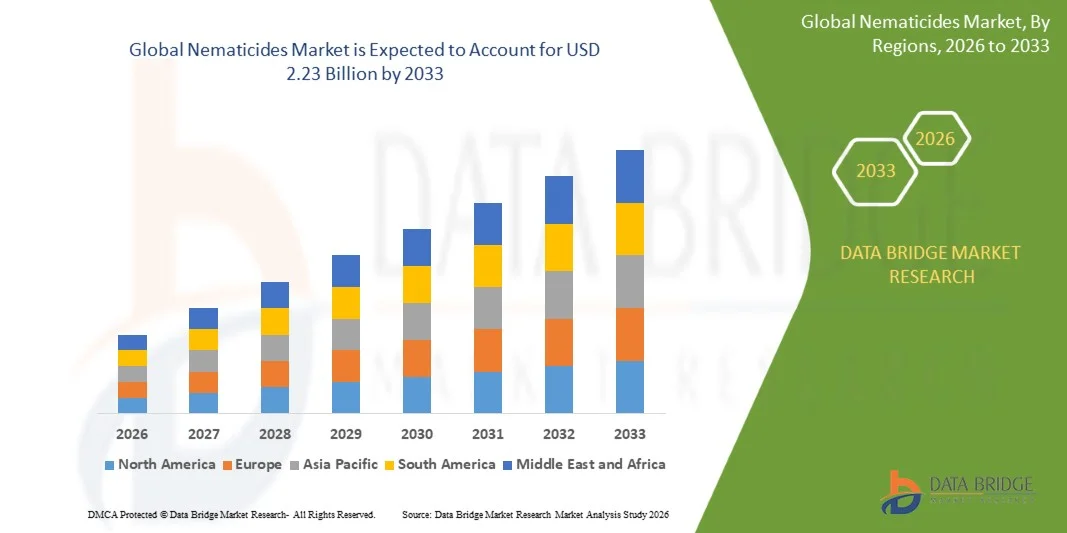
As per Data Bridge Market Research analysis the nematicides market was valued at USD 1.68 billion in 2025 and is projected to reach USD 2.23 billion by 2033, growing at a CAGR of 3.65% from 2026 to 2033. The market is experiencing steady growth driven by the increasing prevalence of plant-parasitic nematodes, rising demand for higher agricultural productivity, and growing adoption of advanced crop protection solutions across both developed and emerging agricultural economies.
The increasing pressure to improve crop yields amid shrinking arable land and rising food demand is encouraging farmers to adopt effective nematode management solutions. Plant-parasitic nematodes continue to cause significant yield losses in high-value crops such as fruits, vegetables, cereals, oilseeds, and plantation crops, prompting greater use of chemical and biological nematicides. Furthermore, advancements in biological nematicides, integrated pest management (IPM) practices, precision agriculture technologies, and supportive government initiatives promoting sustainable crop protection are further contributing to market expansion. Growing awareness among farmers regarding soil health, crop quality, and the economic impact of nematode infestations is also supporting the increasing adoption of nematicides worldwide.
Market Size & Forecast
- Market Value (2025): USD 1.68 Billion
- Expected Market Value (2033): USD 2.23 Billion
- Forecast CAGR (2026–2033): 3.65%
- Leading Region in 2025: North America
- Fastest Growing Region: Asia-Pacific
Key Market Trends & Insights
- North America dominated the nematicides market with the largest revenue share of 36.18% in 2025, supported by the extensive cultivation of soybean, corn, cotton, potatoes, and other high-value crops, rising adoption of advanced crop protection technologies, and the strong presence of leading agrochemical companies. The region also benefits from increasing investments in biological nematicides, precision agriculture, and integrated pest management (IPM) practices, along with continuous product innovation by major industry participants.
- The root-knot nematodes segment dominated the market with an estimated 47.18% share in 2025, owing to the widespread prevalence of root-knot nematodes (Meloidogyne).
- Asia-Pacific is expected to be the fastest-growing region at a CAGR of 7.5% from 2026 to 2033, fueled by expanding agricultural production, increasing cultivation of fruits, vegetables, and commercial crops, growing awareness of crop losses caused by plant-parasitic nematodes, and rising adoption of biological crop protection products. Government initiatives promoting sustainable agriculture, improving farm productivity, and the rapid expansion of commercial farming in China, India, Japan, and Southeast Asia are further accelerating regional market growth.
- The fieldcrops segment dominated the market with an estimated 87% share in 2025, owing to the extensive cultivation of soybean, corn, cotton, sugar beet, and other large-acreage crops that are highly susceptible to plant-parasitic nematodes.
- The fruits and nuts segment is anticipated to witness the fastest CAGR of 1% from 2026 to 2033, driven by increasing cultivation of high-value horticultural crops and growing demand for premium-quality produce in domestic and export markets.
Report Scope and Nematicides Market Segmentation
|
Attributes |
Nematicides Key Market Insights |
|
Segments Covered |
|
|
Countries Covered |
North America
Europe
Asia-Pacific
Middle East and Africa
South America
|
|
Key Market Players |
|
|
Market Opportunities |
|
|
Value Added Data Infosets |
In addition to the insights on market scenarios such as market value, growth rate, segmentation, geographical coverage, and major players, the market reports curated by the Data Bridge Market Research also include in-depth expert analysis, geographically represented company-wise production and capacity, network layouts of distributors and partners, detailed and updated price trend analysis and deficit analysis of supply chain and demand. |
What is the Key Trend in the Nematicides Market?
Trend: Rapid Shift Toward Biological and Next-Generation Nematicides
The nematicides market is increasingly shifting toward biological and next-generation nematicides as growers seek sustainable alternatives to conventional fumigants and organophosphate products. Regulatory pressure on older chemistries, coupled with increasing demand for residue-free food production, has accelerated investments in novel active ingredients and biological technologies. Companies are focusing on products that provide effective nematode control while preserving beneficial soil microorganisms and improving long-term soil health. For instance: In February 2024, Syngenta Korea launched Vaniva, a nematicide based on TYMIRIUM technology, designed to control the complete life cycle of plant-parasitic nematodes while supporting sustainable crop production. This trend reflects the industry's growing emphasis on sustainable crop protection, biological innovation, and environmentally responsible nematode management, which is expected to accelerate the adoption of next-generation nematicides across agricultural markets.
Nematicides Market Dynamics
Key Market Driver: Increasing Innovation in Nematode Control Technologies
Growing crop losses from plant-parasitic nematodes are driving investment in innovative nematode control technologies. Seed traits, biological products, and novel active ingredients are being developed to improve crop productivity while reducing dependence on conventional pesticides. These innovations are expanding treatment options for soybean, vegetables, potatoes, cotton, and other high-value crops. For instance, In June 2024, BASF introduced Nemasphere, the industry's first biotechnology trait for controlling soybean cyst nematodes (SCN). BASF reported that soybean cyst nematodes cause approximately USD1.5 billion in annual soybean yield losses in the United States, and field trials demonstrated an average 8% yield improvement with the technology. This increasing pace of technological innovation is expected to strengthen crop protection efficiency, enhance agricultural productivity, and support sustained growth of the nematicides market.
Key Restraint/Challenge: Stringent Regulatory Approval Requirements for New Nematicides
The development and commercialization of nematicides require extensive efficacy, toxicology, environmental, and residue testing before regulatory approval. These lengthy approval timelines increase R&D costs and delay market entry, particularly for companies developing new active ingredients. The October 2024 launch of the Dresden Driving Simulator (DDS), a world-first sustained acceleration simulator for ADAS and highly automated driving research developed by AMST and Technische University Dresden, illustrates the scale of capital commitment required for cutting-edge simulation infrastructure, reflecting the broader challenge of adoption beyond well-funded organizations. For instance, Corteva Agriscience received regulatory approvals for Reklemel active (fluazaindolizine) before commercializing Salibro in multiple countries, illustrating the extensive regulatory pathway required for introducing a new nematicide active ingredient. These stringent regulatory requirements continue to increase commercialization costs and development timelines, posing a significant challenge for manufacturers seeking to introduce innovative nematicide solutions into the market.
Key Market Opportunity: Commercialization of Novel Biological and Low-Risk Nematicides
The increasing commercialization of biological and reduced-risk nematicides presents a major opportunity for manufacturers. Companies are expanding their biological portfolios to meet sustainability goals while addressing resistance issues associated with traditional chemical nematicides. For instance, Syngenta introduced TYMIRIUM technology as a next-generation crop protection platform designed to provide both nematicidal and fungicidal activity while reducing impacts on beneficial soil organisms. The technology is being deployed across products such as Victrato and Vaniva, supporting sustainable nematode management. The continued expansion of biological and low-risk crop protection technologies is expected to create substantial growth opportunities for manufacturers while supporting sustainable agriculture and long-term soil health worldwide.
How is the Nematicides Market Segmented?
The nematicides market is segmented on the basis of type, nematode type, mode of application, formulation, and crop type.
- By Type
On the basis of type, the nematicides market is segmented into chemical nematicides and biological nematicides. The chemical nematicides segment dominated the market with an estimated 71.84% share in 2025, owing to their proven efficacy in controlling a broad spectrum of plant-parasitic nematodes across commercial agriculture. Chemical products continue to be widely used in vegetables, fruits, field crops, plantation crops, and high-value horticultural production because they provide rapid knockdown activity and consistent field performance. The nematicides market continues benefiting from decades of established product availability, extensive distribution networks, and farmer familiarity with chemical crop protection products. Commercial growers rely on chemical nematicides to minimize yield losses caused by root-knot, cyst, and lesion nematodes while improving crop quality and productivity. Manufacturers continue investing in improved formulations that enhance soil penetration, application efficiency, and environmental safety. Increasing adoption of precision application technologies is further optimizing chemical usage. Strong regulatory registrations across major agricultural economies continue supporting commercial demand. Continuous product innovation and broad crop compatibility are expected to sustain the dominance of chemical nematicides throughout the forecast period.
The biological nematicides segment is anticipated to witness the fastest CAGR of 8.1% from 2026 to 2033, driven by increasing demand for sustainable agriculture and environmentally friendly crop protection solutions. The nematicides market is witnessing rapid commercialization of microbial products derived from beneficial bacteria, fungi, and plant-based extracts that provide effective nematode suppression while preserving soil biodiversity. Growing adoption of organic farming and integrated pest management practices is accelerating product demand worldwide. Governments are encouraging biological alternatives through favorable regulatory frameworks and sustainability initiatives. Leading crop protection companies are expanding biological product portfolios through acquisitions and R&D investments. Improvements in formulation technologies are enhancing shelf life, field consistency, and efficacy. Rising consumer preference for residue-free food products is further supporting adoption. Increasing awareness regarding soil health management continues strengthening market demand. These developments are expected to make biological nematicides the fastest-growing segment during the forecast period.
- By Nematode Type
On the basis of nematode type, the nematicides market is segmented into root-knot nematodes, cyst nematodes, and lesion nematodes. The root-knot nematodes segment dominated the market with an estimated 46.92% share in 2025 owing to the widespread prevalence of Meloidogyne species across vegetables, fruits, plantation crops, and field crops. These nematodes attack plant roots by forming characteristic galls that significantly reduce nutrient and water uptake, resulting in severe yield losses. The nematicides market continues experiencing strong demand for products targeting root-knot nematodes because they affect more than 3,000 plant species worldwide. High infestation rates in greenhouse vegetables, tomatoes, cucumbers, peppers, potatoes, and horticultural crops continue driving product adoption. Manufacturers are introducing advanced chemical and biological formulations specifically targeting root-knot infestations. Increasing awareness regarding integrated pest management practices is supporting effective control strategies. Expansion of protected cultivation systems is further strengthening demand. Continuous investment in innovative nematicidal technologies is expected to maintain the leadership of the root-knot nematodes segment throughout the forecast period.
The cyst nematodes segment is projected to register the fastest CAGR of 7.2% from 2026 to 2033, driven by rising infestations of soybean cyst nematodes and potato cyst nematodes across major agricultural regions. The nematicides market is witnessing increasing investments in advanced seed treatments, resistant crop varieties, and biological technologies targeting cyst nematodes. Expanding soybean cultivation in North America, South America, Europe, and Asia-Pacific is significantly increasing demand for effective nematode management solutions. Continuous research into microbial nematicides and biotechnology traits is improving treatment options. Government-supported extension programs are encouraging early diagnosis and sustainable soil management. Precision agriculture technologies are enabling improved nematode monitoring and targeted applications. Increasing investments from crop protection companies are accelerating commercialization of innovative products. Rising awareness regarding economic losses associated with cyst nematodes is supporting market growth. These factors are expected to position cyst nematodes as the fastest-growing nematode type during the forecast period.
- By Mode of Application
On the basis of mode of application, the nematicides market is segmented into drenching, soil dressing, seed treatment, and fumigation. The fumigation segment dominated the market with an estimated 39.26% share in 2025, owing to its ability to provide broad-spectrum control of plant-parasitic nematodes before crop establishment. Fumigation enables the treatment of the entire soil profile, effectively reducing nematode populations while simultaneously suppressing several soil-borne fungi and pests. The nematicides market continues to witness strong adoption of fumigation across vegetables, potatoes, strawberries, tobacco, and other high-value horticultural crops where severe nematode infestations can significantly reduce productivity. Commercial growers prefer fumigation because it delivers rapid and uniform distribution of active ingredients throughout the root zone. Continuous advancements in precision fumigation equipment and improved application technologies are enhancing treatment efficiency while minimizing environmental impact. Increasing investments in protected cultivation and commercial farming further support product demand. Improved stewardship practices and optimized application methods continue strengthening adoption. These factors are expected to maintain the dominance of the fumigation segment throughout the forecast period.
The seed treatment segment is projected to witness the fastest CAGR of 7.4% from 2026 to 2033, driven by increasing adoption of precision agriculture and integrated pest management practices. The nematicides market is experiencing growing demand for seed-applied nematicides because they provide early-season protection against nematode attacks while requiring significantly lower quantities of active ingredients than conventional soil treatments. Major crop protection companies continue developing innovative biological and chemical seed treatment technologies that combine nematicidal, fungicidal, and insecticidal properties. Rising cultivation of soybean, corn, cotton, cereals, and oilseed crops is accelerating adoption ly. Continuous improvements in seed coating technologies are enhancing treatment durability and field performance. Government initiatives promoting sustainable crop protection are supporting commercialization. Increasing grower awareness regarding cost-effective crop protection is strengthening demand. Expansion of treated seed usage in emerging agricultural economies is further accelerating adoption. These developments are expected to make seed treatment the fastest-growing application segment during the forecast period.
- By Formulation
On the basis of formulation, the nematicides market is segmented into liquid formulations, granular formulations, emulsifiable concentrates, wettable powders, and other formulations. The liquid formulations segment dominated the market with an estimated 45.18% share in 2025 owing to their ease of application, superior soil penetration, and compatibility with modern irrigation and spraying systems. The nematicides market continues benefiting from widespread use of liquid formulations through drip irrigation, chemigation, soil drenching, and precision application systems, enabling efficient delivery of active ingredients directly into the root zone. Commercial growers prefer liquid products because they provide uniform soil coverage, rapid nematode suppression, and improved crop safety. Technological advancements in suspension concentrates and soluble liquid formulations have enhanced product stability and application performance. Increasing adoption of precision agriculture technologies is further supporting segment growth. High demand from vegetables, fruits, plantation crops, and greenhouse cultivation continues reinforcing market leadership. Manufacturers are introducing improved liquid formulations with enhanced environmental profiles and longer shelf life. These factors are expected to sustain the dominance of liquid formulations throughout the forecast period.
The granular formulations segment is anticipated to witness the fastest CAGR of 7.0% from 2026 to 2033, driven by increasing adoption in large-scale farming operations requiring controlled-release nematode management. The nematicides market is witnessing growing demand for granular products because they provide prolonged soil protection, reduced leaching losses, and improved application efficiency. Granular formulations are increasingly utilized across cereals, pulses, oilseeds, plantation crops, and commercial field crops where mechanical application equipment is widely available. Continuous advancements in granule coating technologies and slow-release systems are improving product performance while reducing environmental impact. Growing investment in sustainable agriculture is encouraging adoption of advanced granular technologies. Compatibility with precision planting equipment further enhances operational efficiency. Increasing awareness regarding soil health and integrated pest management practices continues supporting market growth. Manufacturers are expanding product portfolios to address evolving grower requirements. These developments are expected to position granular formulations as the fastest-growing formulation segment during the forecast period.
- By Crop Type
On the basis of crop type, the nematicides market is segmented into fruits & vegetables, field crops, plantation crops, turf & ornamentals, and other crop types. The field crops segment dominated the market with an estimated 36.41% share in 2025 owing to the extensive cultivation of soybean, corn, cotton, wheat, and other large-acreage crops that are highly susceptible to plant-parasitic nematodes. The nematicides market continues experiencing strong demand from commercial field crop producers seeking to reduce yield losses caused by root-knot, cyst, lesion, and reniform nematodes. Rising demand for food, feed, and industrial crops is encouraging greater adoption of chemical and biological nematicides across large farming operations. Precision farming technologies and integrated pest management programs are further supporting product utilization. Leading crop protection companies continue introducing innovative seed treatment technologies and advanced formulations specifically designed for broad-acre agriculture. Increasing investments in sustainable crop production are strengthening long-term market demand. Continuous expansion of mechanized farming is improving product accessibility. These factors are expected to maintain the dominance of the field crops segment throughout the forecast period.
The fruits & vegetables segment is projected to register the fastest CAGR of 7.3% from 2026 to 2033, driven by increasing cultivation of high-value horticultural crops and rising demand for premium-quality produce. The nematicides market is witnessing higher adoption of advanced nematicide solutions in tomatoes, peppers, cucumbers, grapes, citrus fruits, strawberries, bananas, and leafy vegetables because these crops are highly vulnerable to root-knot and lesion nematodes. Growers are increasingly implementing biological nematicides, precision irrigation, and integrated pest management strategies to improve productivity while complying with strict residue regulations. Expansion of greenhouse cultivation and protected agriculture is accelerating demand for specialized crop protection products. Continuous investment in sustainable horticulture and precision farming technologies is strengthening adoption. Manufacturers continue introducing innovative biological and reduced-risk formulations targeting premium fruit and vegetable production. Rising exports of fresh produce are encouraging greater investment in crop protection solutions. These developments are expected to make fruits & vegetables the fastest-growing crop type segment during the forecast period.
Which Region Holds the Largest Share of the Nematicides Market?
North America dominated the nematicides market and accounted for the largest revenue share of 36.18% in 2025, supported by extensive cultivation of soybean, corn, cotton, potatoes, and other high-value crops that are highly susceptible to plant-parasitic nematodes, particularly root-knot nematodes (Meloidogyne spp.), which represented the largest nematode segment ly. The region benefits from the presence of leading agrochemical companies, widespread adoption of advanced crop protection technologies, and increasing use of biological nematicides and integrated pest management (IPM) practices. Strong investments in agricultural R&D, precision farming technologies, and seed treatment innovations continue to improve nematode management efficiency. In addition, supportive regulatory frameworks and growing awareness of soil health are accelerating the adoption of sustainable nematicide solutions across commercial farming operations, reinforcing North America's leading position in the market.
U.S. Nematicides Market Insight
The U.S. nematicides market is witnessing strong growth owing to the country's large-scale production of soybean, corn, cotton, vegetables, and potatoes, where nematode infestations result in significant economic losses. Rising adoption of biological crop protection products, precision agriculture technologies, and integrated pest management strategies is driving demand for advanced nematicides. Continuous product innovation by major companies such as BASF, Corteva Agriscience, FMC Corporation, and Valent BioSciences is further strengthening market growth. Increasing investments in sustainable farming practices and growing adoption of seed treatment technologies are also contributing to the expansion of the U.S. market.
Europe Nematicides Market Insight
The Europe nematicides market remains a significant contributor to revenue, driven by increasing emphasis on sustainable agriculture, stringent pesticide regulations, and growing adoption of biological crop protection products. Farmers across the region are increasingly implementing integrated pest management programs to reduce dependence on conventional chemical pesticides while maintaining crop productivity. Continuous investment in agricultural research, precision farming technologies, and environmentally friendly nematicide formulations is supporting market growth. The expansion of high-value fruit, vegetable, and greenhouse cultivation further contributes to increasing demand for effective nematode management solutions across Europe.
U.K. Nematicides Market Insight
The U.K. nematicides market is experiencing steady growth, supported by increasing adoption of sustainable crop protection practices and rising awareness regarding soil-borne pest management. The country's commercial vegetable, potato, and horticultural sectors continue to invest in biological nematicides and integrated pest management solutions to improve crop productivity while complying with strict environmental regulations. Growing research collaborations between agricultural institutes and crop protection companies are also supporting innovation in biological and low-risk nematicide technologies.
Germany Nematicides Market Insight
The Germany nematicides market is expanding steadily due to strong agricultural research capabilities, increasing adoption of precision farming, and growing demand for environmentally sustainable crop protection products. The country's emphasis on reducing chemical pesticide usage has accelerated the development and adoption of biological nematicides and integrated pest management practices. Increasing cultivation of vegetables, potatoes, sugar beet, and other high-value crops requiring effective nematode management is further supporting market expansion. Continuous innovation by leading agrochemical companies is also contributing to product development across the German market.
Asia-Pacific Nematicides Market Insight
The Asia-Pacific nematicides market is expected to witness the fastest growth at a CAGR of 7.5% from 2026 to 2033, driven by expanding agricultural production, increasing cultivation of fruits, vegetables, commercial crops, and cereals, and rising awareness of crop losses caused by plant-parasitic nematodes, particularly root-knot nematodes. Government initiatives promoting sustainable agriculture, improving farm productivity, and encouraging integrated pest management practices are accelerating product adoption across the region. Furthermore, increasing commercialization of biological nematicides, expanding protected cultivation, and rapid modernization of farming practices in China, India, Japan, and Southeast Asia are expected to create significant growth opportunities for market participants.
Japan Nematicides Market Insight
The Japan nematicides market is witnessing consistent growth owing to increasing adoption of high-value horticultural production, advanced farming technologies, and biological crop protection products. Japanese growers are increasingly implementing precision agriculture and integrated pest management strategies to enhance crop quality while reducing environmental impact. Strong investment in agricultural innovation and sustainable farming practices continues to support demand for next-generation nematicides, particularly in fruit, vegetable, and greenhouse cultivation.
China Nematicides Market Insight
The China nematicides market is growing rapidly due to expanding agricultural production, increasing cultivation of vegetables, fruits, rice, cotton, and commercial crops, and rising awareness regarding the economic impact of plant-parasitic nematodes. Government support for sustainable agriculture, increasing adoption of biological crop protection products, and modernization of farming practices are significantly boosting market demand. In addition, rapid expansion of precision agriculture, protected cultivation, and investments in domestic crop protection research are positioning China as one of the fastest-growing markets for nematicides ly.
Which are the Top Companies in Nematicides Market?
The nematicides industry is primarily led by well-established companies, including:
- BASF (Germany)
- Bayer AG (Germany)
- Corteva Agriscience (U.S.)
- FMC Corporation (U.S.)
- UPL (India)
- Sumitomo Chemical Co., Ltd. (Japan)
- ADAMA (Israel)
- AMVAC Chemical Corporation (U.S.)
- Syngenta (U.S.)
- Koppert (Netherlands)
- Biobest (Belgium)
- BioWorks, Inc (U.S.)
- Gowan Company, L.L.C. (Italy)
- Sipcam Oxon Spa VAT (Italy)
- tstanes.com (India)
- AgBiTech (Australia)
- Novozymes A/S (Denmark)
- Andermatt Group AG. (Switzerland)
- American Vanguard Corporation (U.S.)
What are Latest Developments in Nematicides Market?
- In January 2025, Corteva Agriscience announced the registration and launch of Salibro CA nematicide with Reklemel active in California for orchards, vineyards, and fruiting vegetables. The novel non-fumigant nematicide targets plant-parasitic nematodes while preserving beneficial soil organisms, supporting sustainable soil health and productivity. This followed U.S. EPA registration in 2024 and marked an important commercial expansion of Corteva's nematicide portfolio
- In June 2024, BASF SE introduced Nemasphere, the industry's first biotechnology trait for managing soybean cyst nematodes (SCN). The technology offers a novel mode of action against the leading yield-robbing pest in U.S. soybeans and is designed to be stacked with Enlist E3 soybean technology, providing growers with improved nematode resistance and yield protection
- In March 2024, Syngenta AG highlighted TYMIRIUM technology as one of its next-generation crop protection platforms expected to become a blockbuster innovation. The technology combines nematicidal and fungicidal activity while maintaining a favorable environmental profile by minimizing impacts on beneficial nematodes and supporting long-term soil biodiversity
- In August 2022, Syngenta AG announced that Argentina approved the registration of TYMIRIUM technology, marking the commercial launch of the company's breakthrough nematicide and fungicide technology. Syngenta stated that the technology would be introduced across more than 100 crops in over 60 countries, providing long-lasting protection against plant-parasitic nematodes and soil-borne diseases while promoting soil biodiversity

- Interactive Data Analysis Dashboard
- Company Analysis Dashboard for high growth potential opportunities
- Research Analyst Access for customization & queries
- Competitor Analysis with Interactive dashboard
- Latest News, Updates & Trend analysis
- Harness the Power of Benchmark Analysis for Comprehensive Competitor Tracking
Data collection and base year analysis are done using data collection modules with large sample sizes. The stage includes obtaining market information or related data through various sources and strategies. It includes examining and planning all the data acquired from the past in advance. It likewise envelops the examination of information inconsistencies seen across different information sources. The market data is analysed and estimated using market statistical and coherent models. Also, market share analysis and key trend analysis are the major success factors in the market report. To know more, please request an analyst call or drop down your inquiry.
The key research methodology used by DBMR research team is data triangulation which involves data mining, analysis of the impact of data variables on the market and primary (industry expert) validation. Data models include Vendor Positioning Grid, Market Time Line Analysis, Market Overview and Guide, Company Positioning Grid, Patent Analysis, Pricing Analysis, Company Market Share Analysis, Standards of Measurement, Global versus Regional and Vendor Share Analysis. To know more about the research methodology, drop in an inquiry to speak to our industry experts.
Data Bridge Market Research is a leader in advanced formative research. We take pride in servicing our existing and new customers with data and analysis that match and suits their goal. The report can be customized to include price trend analysis of target brands understanding the market for additional countries (ask for the list of countries), clinical trial results data, literature review, refurbished market and product base analysis. Market analysis of target competitors can be analyzed from technology-based analysis to market portfolio strategies. We can add as many competitors that you require data about in the format and data style you are looking for. Our team of analysts can also provide you data in crude raw excel files pivot tables (Fact book) or can assist you in creating presentations from the data sets available in the report.