


What is the Neo and Challenger Bank Market Size and Growth Rate?
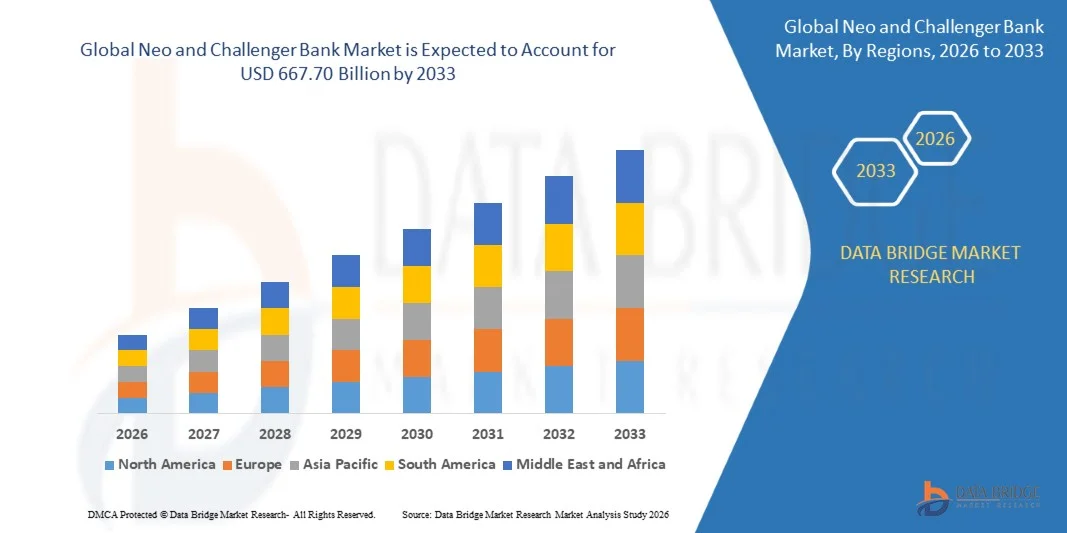
- As per Data Bridge Market Research analysis, the neo and challenger bank market was valued at USD 30.16 billion in 2025 and is projected to reach USD 667.70 billion by 2033, growing at a CAGR of 47.28% from 2026 to 2033.
- The market is experiencing consistent growth driven by rising consumer preference for digital banking services, increasing smartphone penetration, advancements in financial technology, and expanding demand for convenient, low-cost, and personalized banking solutions across individual and business customers
- The increasing adoption of mobile banking applications, open banking APIs, and AI-powered financial services, combined with growing demand for faster digital account opening and real-time payments, is compelling consumers and businesses to adopt neo and challenger banks. Digital-only banking platforms and hybrid banking models are expanding access to payment services, savings, lending, and investment solutions, offering flexible and technology-driven alternatives to traditional banking systems.
Market Size & Forecast
- Global Market Value (2025): USD 30.16 Billion
- Expected Market Value (2033): USD 667.70 Billion
- Forecast CAGR (2026–2033): 47.28%
- Leading Region in 2025: North America
- Fastest Growing Region: Asia Pacific
What are the Major Takeaways of the Neo and Challenger Bank Market?
- North America dominated the neo and challenger bank market with the largest revenue share of 35.4% in 2025, supported by advanced digital banking infrastructure, high fintech adoption, and increasing consumer demand for convenient, technology-driven financial services.
- Asia-Pacific is expected to be the fastest-growing region at a CAGR of 28.4% from 2026 to 2033, fueled by rising smartphone penetration, expanding digital payment ecosystems, financial inclusion initiatives, and increasing adoption of mobile-first banking platforms.
- The neo bank segment led the market with a 60% share in 2025, driven by the growing preference for fully digital banking platforms without physical branches.
- Challenger bank are the fastest-growing type, projected to register a CAGR of 25%, reflecting the surge in competition with traditional financial institutions and growing demand for customer-centric banking services.
- The digital-only segment dominated the business model category with a 65.70% revenue share in 2025, led by its branchless structure and mobile-first customer experience
- Personal accounted for 57.4% of the market share in 2025, preferred by widespread consumer adoption of mobile-first banking and digital financial services
- The mobile banking segment is the fastest-growing services provided category, with a CAGR of 27.84%, driven by increasing smartphone penetration and consumer preference for app-based financial services
Report Scope and Neo and Challenger Bank Market Segmentation
|
Attributes |
Neo and Challenger Bank Key Market Insights |
|
Segments Covered |
|
|
Countries Covered |
North America
Europe
Asia-Pacific
Middle East and Africa
South America
|
|
Key Market Players |
|
|
Market Opportunities |
|
|
Value Added Data Infosets |
In addition to the market insights such as market value, growth rate, market segments, geographical coverage, market players, and market scenario, the market report curated by the Data Bridge Market Research team includes in-depth expert analysis, import/export analysis, pricing analysis, production consumption analysis, and pestle analysis. |
What is the Key Trend in the Neo and Challenger Bank Market?
- Neo and challenger banks are increasingly shifting toward AI-powered hyper-personalization and embedded financial services to deliver customized products, automated financial insights, and seamless banking experiences across digital platforms.
- For instance, in April 2026, Finextra reported that AI-native banking is moving beyond basic chatbots toward real-time financial aggregation, predictive cash-flow management, liquidity optimization, and automated financial decision-making.
- API-based banking infrastructure enables neo and challenger banks to integrate payments, lending, savings, and other financial services directly into digital customer journeys.
- Embedded finance is allowing banking services to become increasingly integrated with e-commerce, telecommunications, and other non-banking platforms, expanding customer access beyond standalone banking applications.
- For instance, in March 2025, PYMNTS reported that partnerships between telecommunications companies and digital banks were expanding mobile financial services, with more than one-quarter of surveyed individuals expressing interest in banking offerings from telecom firms.
- As neo and challenger banks continue investing in artificial intelligence, embedded finance, and API-enabled infrastructure, banking is increasingly evolving from standalone digital applications toward personalized, integrated, and automated financial ecosystems
What are the Key Drivers of the Neo and Challenger Bank Market?
- The rapid expansion of smartphone usage and digital payments has significantly increased demand for mobile-first banking platforms that provide instant account access, real-time transactions, and convenient financial services without physical branches.
- For instance, in March 2025, PYMNTS reported that widespread mobile-phone access was helping digital banks and neobanks expand financial services, while more than one-quarter of surveyed consumers showed interest in banking services offered through telecommunications companies.
- Consumers, freelancers, and small businesses are increasingly adopting digital banking because of faster onboarding, lower fees, personalized services, and convenient access to payments, savings, lending, and international money-transfer solutions.
- For instance, in June 2025, PYMNTS reported that mobile-first banking platform Chime had become the primary bank for 67% of its customers, highlighting the growing adoption of branchless banking experiences among digitally active consumers.
- With financial services increasingly moving toward mobile and real-time digital channels, the continuing expansion of smartphone-based banking, digital payments, and customer-centric financial platforms is expected to support adoption of neo and challenger banks.
Which Factors are Challenging the Growth of the Neo and Challenger Bank Market?
- Neo and challenger banks face significant challenges related to regulatory compliance, cybersecurity, profitability, and customer trust, as they must satisfy stringent financial regulations while maintaining low-cost and highly digital operating models.
- For instance, in June 2025, Finextra reported that neobanks were facing increasing competition and regulatory requirements while also needing to diversify revenue beyond interchange fees and interest income to establish sustainable profitability.
- These requirements can increase compliance expenditure and operational complexity, particularly for newer institutions seeking rapid customer acquisition while developing sustainable revenue streams.
- For instance, in January 2025, the Bank for International Settlements highlighted the importance of liquidity and funding-risk management for banks, emphasizing that mismatches between short-term deposits and longer-term lending can create significant financial vulnerabilities.
- The combination of regulatory obligations, funding and liquidity risks, cybersecurity requirements, and pressure to achieve sustainable profitability can increase operating costs and constrain the ability of neo and challenger banks to scale rapidly across highly regulated markets.
How is the Neo and Challenger Bank Market Segmented?
The neo and challenger bank market is segmented on the basis of type, business model, application, and services provided.
- By Type
On the basis of type, the neo and challenger bank market is segmented into neo bank and challenger bank. The neo bank segment dominated the market with 60% share in 2025, owing to the growing preference for fully digital banking platforms without physical branches. Neo banks provide account management, payments, money transfers, lending, and savings services primarily through mobile applications. Their branchless infrastructure enables lower operating costs and supports competitive fees and digitally focused customer experiences. Increasing smartphone penetration and consumer preference for instant banking access are further strengthening adoption. The ability to introduce personalized financial products through cloud infrastructure and APIs is also supporting segment expansion.
The challenger bank segment is projected to register the fastest growth at a CAGR of 25% from 2026 to 2033, supported by increasing competition with traditional financial institutions and growing demand for customer-centric banking services. Challenger banks can provide broader banking capabilities through digital channels while maintaining more extensive financial-service offerings. Their ability to combine digital convenience with comprehensive financial products is attracting consumers and businesses seeking alternatives to incumbent banks. Increasing investment in mobile banking, payments, lending, and investment capabilities is further supporting expansion. Regulatory developments supporting digital banking are creating opportunities for new challenger-bank entrants.
- By Business Model
On the basis of business model, the neo and challenger bank market is segmented into digital-only and hybrid. The digital-only segment dominated the market with 65.70% share in 2025, supported by its branchless structure and mobile-first customer experience. Digital-only banks can operate with substantially lower physical infrastructure requirements than conventional banks. This enables them to provide competitively priced services while investing in digital features and customer acquisition. Real-time transaction alerts, budgeting tools, automated savings, and personalized financial insights are increasingly incorporated into these platforms. Cloud infrastructure and open banking APIs also enable digital-only banks to scale services rapidly across markets.
The hybrid segment is projected to register the fastest growth at a CAGR of 20% from 2026 to 2033, as customers increasingly seek digital convenience combined with access to human or physical banking support when required. Hybrid models can serve customers through mobile and web applications while retaining selected physical touchpoints or partnerships. This approach can be particularly relevant for SMEs and customers requiring more complex financial services. Hybrid banks can use digital channels for routine transactions while providing personal assistance for lending, advisory, and other higher-value services. Increasing demand for omnichannel financial experiences is encouraging banks to combine digital platforms with traditional service infrastructure.
- By Application
On the basis of application, the neo and challenger bank market is segmented into personal and business. The personal segment dominated the market with a 57.4% share in 2025, driven by widespread consumer adoption of mobile-first banking and digital financial services. Individual customers increasingly use neo and challenger banks for everyday payments, savings, account management, budgeting, and money transfers. Simple digital onboarding and real-time account notifications make these platforms attractive to digitally connected consumers. Lower fees and convenient mobile access also support adoption among younger and cost-conscious users. Digital banking platforms are In addition expanding financial access for consumers who may be underserved by conventional branch-based institutions.
The business segment is projected to register the fastest growth at a CAGR of 26.41% from 2026 to 2033, supported by increasing demand for efficient digital financial management among SMEs and other businesses. Neo and challenger banks provide businesses with digital accounts, payment processing, expense management, and other technology-enabled financial services. API-based integrations can connect banking functions with accounting, payroll, taxation, and business-management platforms. Faster onboarding and automated financial tools can also reduce administrative burdens for smaller companies. Growing adoption of digital payments and expanding embedded financial services are creating additional demand from business customers.
- By Services Provided
On the basis of services provided, the neo and challenger bank market is segmented into checking and savings account, payment and money transfer, loans, mobile banking, investment accounts, retirement savings, and others. The checking and savings account segment dominated the market with 30% share in 2025, as these products represent foundational banking services and are commonly used for customer acquisition. Digital banks provide account opening, balance management, transfers, and savings functions through mobile applications. Automated savings tools and real-time balance notifications further improve customer engagement. Lower operating costs can allow digital banks to provide competitive rates and reduced account fees. These accounts also provide a foundation for cross-selling payments, lending, investment, and other financial products.
The mobile banking segment is projected to register the fastest growth at a CAGR of 27.84% from 2026 to 2033, driven by increasing smartphone penetration and consumer preference for app-based financial services. Mobile banking allows customers to manage accounts, make payments, transfer funds, monitor transactions, and access financial products without visiting branches. Real-time notifications and personalized financial-management tools are further increasing engagement with mobile platforms. Continuous improvements in biometric authentication, AI-powered assistance, and mobile security are strengthening the functionality of banking applications. The expansion of digital payments and growing demand for 24/7 banking access are also supporting rapid adoption.
Which Region Holds the Largest Share of the Neo and Challenger Bank Market?
- North America dominated the neo and challenger bank market with the largest revenue share of 35.4% in 2025, supported by advanced digital banking infrastructure, high fintech adoption, and increasing consumer demand for convenient, technology-driven financial services.
- The region also benefits from a mature fintech ecosystem, widespread adoption of digital payments, strong investment in financial technology, and increasing use of Banking-as-a-Service and embedded finance platforms. Growing consumer preference for convenient digital banking, along with expanding services from neo and challenger banks across payments, savings, lending, and investment, continues to strengthen North America’s position in the global market.
U.S. Neo and Challenger Bank Market Insight
The U.S. neo and challenger bank market is witnessing strong growth due to rising consumer adoption of mobile-first banking, expanding digital payment ecosystems, and increasing demand for convenient and personalized financial services. The country’s mature fintech ecosystem, along with widespread smartphone usage and increasing integration of AI, open banking, and embedded finance technologies, is driving demand across personal and business banking applications. In addition, growing consumer preference for faster account opening, real-time payments, and digitally managed financial services is accelerating adoption across the banking sector.
Asia-Pacific Neo and Challenger Bank Market Insight
The Asia-Pacific neo and challenger bank market is expected to witness rapid growth, driven by increasing smartphone penetration, expanding digital payment infrastructure, and rising demand for accessible banking services across countries such as China, India, Japan, and Southeast Asian economies. Growing financial inclusion initiatives, increasing adoption of mobile banking applications, and expanding fintech ecosystems are supporting regional market expansion. In addition, the growing presence of digital payment platforms, technology-focused financial institutions, and Banking-as-a-Service providers is accelerating adoption across personal and business banking sectors.
Japan Neo and Challenger Bank Market Insight
The Japan neo and challenger bank market is witnessing consistent growth due to rising investments in digital financial services, mobile banking technologies, and financial technology infrastructure. Banks and fintech companies are increasingly adopting digital platforms to provide convenient account management, payments, savings, lending, and investment services. Moreover, increasing integration of AI, cloud technologies, and cashless payment solutions, together with the country’s focus on financial-sector digitalization, is further contributing to market growth.
China Neo and Challenger Bank Market Insight
The China neo and challenger bank market is growing rapidly, driven by widespread smartphone adoption, advanced digital payment infrastructure, and increasing consumer preference for mobile-based financial services. Growing adoption of AI-enabled banking platforms, digital wallets, and integrated financial ecosystems across consumer and business applications is significantly boosting market demand. In addition, rising investments in fintech innovation, expanding digital financial inclusion, and rapid development of technology-enabled banking services are positioning China as one of the major markets for neo and challenger banking in the Asia-Pacific region.
U.K. Neo and Challenger Bank Market Insight
The U.K. neo and challenger bank market is experiencing steady growth, supported by strong adoption of digital banking, open banking technologies, and mobile payment services. Increasing investments in digital banking infrastructure and growing demand for convenient, low-cost, and personalized financial services are contributing to market growth. Furthermore, integration of AI, cloud computing, and API-enabled financial services is improving customer experiences and operational efficiency, positioning the U.K. as a key innovation hub in the neo and challenger banking industry.
Germany Neo and Challenger Bank Market Insight
The Germany neo and challenger bank market is expanding steadily due to the country’s strong digital banking infrastructure, high smartphone adoption, and increasing consumer preference for convenient, mobile-first financial services. Neo and challenger banks are increasingly utilizing digital platforms, cloud technologies,and AI-enabled solutions to provide payments, savings, lending, and personalized banking services. Continuous advancements in mobile banking, digital payments, and open banking, along with growing competition from digital-first financial providers and changing customer expectations, are further driving market growth in Germany.
Which are the Top Companies in Neo and Challenger Bank Market?
The neo and challenger bank industry is primarily led by well-established companies, including:
- Revolut Ltd (U.K.)
- Monzo Bank Limited (U.K.)
- Starling Bank Limited (U.K.)
- N26 Bank SE (Germany)
- bunq B.V. (Netherlands)
- Chime Financial, Inc. (U.S.)
- Social Finance, Inc. (U.S.)
- Varo Money, Inc. (U.S.)
- Current Technologies, Inc. (U.S.)
- Wise Payments Limited (U.K.)
- Atom bank (U.K.)
- Monese Ltd (U.K.)
- Tide Platform Limited (U.K.)
- Block, Inc. (U.S.)
- Dave, Inc. (U.S.)
- Mercury Technologies, Inc. (U.S.)
- Nu Pagamentos S.A. (Brazil)
- Klarna Bank AB (Sweden)
- Open Bank, S.A. (Spain)
- Nubank (U.S.)
What are Latest Developments in Neo and Challenger Bank Market?
- In November 2025, Mashreq introduced Mashreq NEO in Pakistan, launching a fully digital and Shariah-compliant banking platform designed to provide digital account opening, profit-bearing current and savings accounts, digital transactions, and nationwide ATM access. The launch expanded Mashreq’s digital banking presence in Pakistan and targeted both resident and non-resident Pakistani customers.
- In September 2024, Saudi National Bank launched NEO in Saudi Arabia, introducing a mobile-first digital banking and financial ecosystem offering multi-currency debit cards, rewards, cashback, gift cards, and integrated lifestyle services. The launch represented an expansion of digital banking services beyond traditional account and payment functions toward broader digital financial ecosystems.
- In September 2023, Axis Bank launched NEO for Business, a mobile-first transaction banking platform designed specifically for micro, small, and medium-sized enterprises. The platform provides digital onboarding, payments and collections management, and access through mobile, PC, and tablet, expanding digital banking capabilities for India's MSME sector.
- In May 2022, IIFL Finance and Open Financial Technologies announced a joint venture to launch a neobank for MSMEs, combining banking and credit services for India's micro and small enterprises. The proposed venture, IIFL Open Fintech, was established with initial capital of INR 120 crore and a 51:49 ownership structure between IIFL Finance and Open.
- In April 2021, former Google executives launched Fi in India, a digital banking platform targeting millennials and developed in partnership with Federal Bank. Fi enabled customers to open savings accounts digitally in under three minutes, demonstrating the market's increasing focus on rapid onboarding, mobile-first banking, and digitally personalized financial services.

- Interactive Data Analysis Dashboard
- Company Analysis Dashboard for high growth potential opportunities
- Research Analyst Access for customization & queries
- Competitor Analysis with Interactive dashboard
- Latest News, Updates & Trend analysis
- Harness the Power of Benchmark Analysis for Comprehensive Competitor Tracking
Data collection and base year analysis are done using data collection modules with large sample sizes. The stage includes obtaining market information or related data through various sources and strategies. It includes examining and planning all the data acquired from the past in advance. It likewise envelops the examination of information inconsistencies seen across different information sources. The market data is analysed and estimated using market statistical and coherent models. Also, market share analysis and key trend analysis are the major success factors in the market report. To know more, please request an analyst call or drop down your inquiry.
The key research methodology used by DBMR research team is data triangulation which involves data mining, analysis of the impact of data variables on the market and primary (industry expert) validation. Data models include Vendor Positioning Grid, Market Time Line Analysis, Market Overview and Guide, Company Positioning Grid, Patent Analysis, Pricing Analysis, Company Market Share Analysis, Standards of Measurement, Global versus Regional and Vendor Share Analysis. To know more about the research methodology, drop in an inquiry to speak to our industry experts.
Data Bridge Market Research is a leader in advanced formative research. We take pride in servicing our existing and new customers with data and analysis that match and suits their goal. The report can be customized to include price trend analysis of target brands understanding the market for additional countries (ask for the list of countries), clinical trial results data, literature review, refurbished market and product base analysis. Market analysis of target competitors can be analyzed from technology-based analysis to market portfolio strategies. We can add as many competitors that you require data about in the format and data style you are looking for. Our team of analysts can also provide you data in crude raw excel files pivot tables (Fact book) or can assist you in creating presentations from the data sets available in the report.













