


Neonatal Jaundice Treatment Market Overview
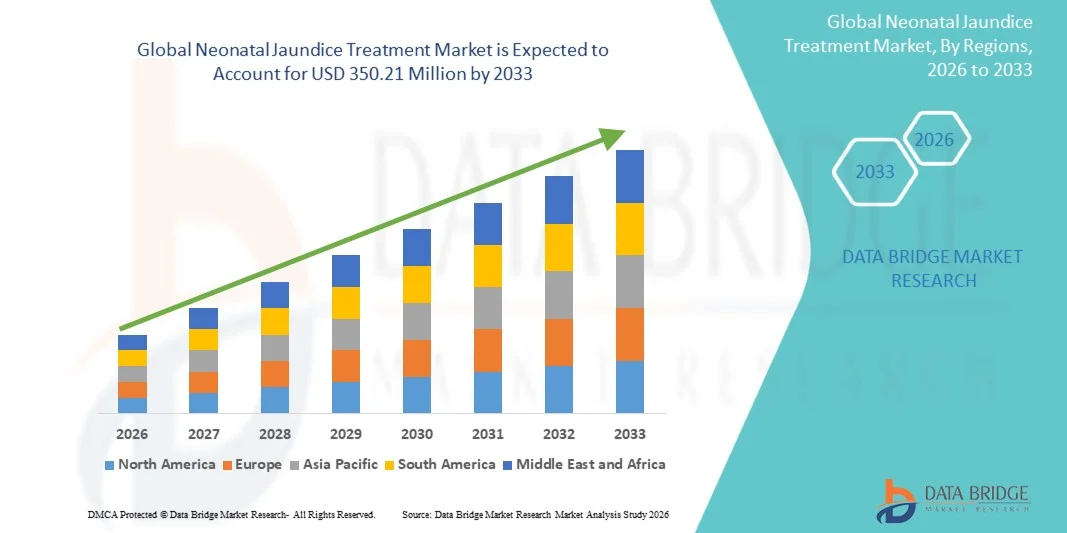
The Neonatal Jaundice Treatment Market was valued at USD 209.24 Million in 2025 and is projected to reach USD 350.21 Million by 2033, growing at a CAGR of 6.65% from 2026 to 2033. The market is experiencing steady growth driven by the rising prevalence of neonatal jaundice, increasing awareness regarding early diagnosis and treatment of hyperbilirubinemia, and continuous advancements in neonatal care technologies. Growing birth rates in developing countries, expanding neonatal intensive care unit (NICU) infrastructure, and improving access to specialized newborn healthcare services are further supporting market expansion.
The increasing incidence of neonatal jaundice worldwide, particularly among preterm and low-birth-weight infants, is encouraging hospitals and healthcare providers to adopt advanced treatment solutions such as phototherapy systems, fiber-optic phototherapy devices, and exchange transfusion therapies. Modern phototherapy technologies are increasingly replacing conventional treatment approaches due to their higher efficacy, improved safety profiles, reduced treatment duration, and enhanced patient comfort. In addition, growing government initiatives aimed at reducing neonatal mortality, rising investments in maternal and child healthcare programs, and increasing adoption of technologically advanced neonatal care equipment are accelerating the demand for neonatal jaundice treatment solutions across both developed and emerging healthcare markets.
Key Market Trends & Insights
- North America dominated the Neonatal Jaundice Treatment Market with the largest revenue share of 39.18% in 2025, supported by advanced neonatal healthcare infrastructure, high adoption of phototherapy technologies, increasing rates of preterm births, and strong availability of neonatal intensive care units (NICUs) across hospitals and specialty healthcare centers.
- The light-based therapy segment dominated the market with a share of 61.47% in 2025 due to its widespread acceptance as the first-line treatment for neonatal jaundice.
- Asia-Pacific is expected to be the fastest-growing region at a CAGR of 8.7% from 2026 to 2033, fueled by rising birth rates, improving access to neonatal healthcare services, expanding NICU infrastructure, and increasing healthcare investments across China, India, Japan, and Southeast Asian countries.
- The Bilirubin Monitoring Systems segment is projected to be the fastest-growing type category, registering a CAGR of 8.9% from 2026 to 2033, reflecting growing demand for early diagnosis, continuous bilirubin assessment, and non-invasive monitoring technologies that support timely treatment decisions.
- The Hospitals segment dominates the end-user category with a 58.64% revenue share in 2025, supported by the high volume of neonatal admissions, availability of advanced phototherapy equipment, specialized neonatal care teams, and comprehensive treatment capabilities for severe jaundice cases.
- Light-Based Therapy accounts for 61.47% of the market in 2025, owing to its proven clinical efficacy, safety profile, cost-effectiveness, and widespread recommendation as the primary treatment approach for neonatal jaundice management globally.
- The Homecare application segment is anticipated to be the fastest-growing application category, with a CAGR of 8.5% from 2026 to 2033, driven by increasing adoption of portable phototherapy devices, growing preference for home-based neonatal care, reduced hospitalization costs, and advancements in remote patient monitoring technologies.
Market Size & Forecast
- Global Market Value (2025): USD 209.24 Million
- Expected Market Value (2033): USD 350.21 Million
- Forecast CAGR (2026–2033): 6.65%
- Leading Region in 2025: North America
- Fastest Growing Region: Asia-Pacific
Report Scope and Neonatal Jaundice Treatment Market Segmentation
|
Attributes |
Neonatal Jaundice Treatment Key Market Insights |
|
Segments Covered |
· By Type: Phototherapy Devices, Medications, Bilirubin Monitoring Systems, and Others · By End-User: Hospitals, Specialty Clinics, Home Healthcare, and Others · By Treatment Mechanism: Light-Based Therapy, Drug-Based Therapy, Exchange Transfusion, and Others · By Application: Neonatal Intensive Care Units (NICUs), General Ward, Homecare, and Others. |
|
Countries Covered |
North America · U.S. · Canada · Mexico Europe · Germany · France · U.K. · Netherlands · Switzerland · Belgium · Russia · Italy · Spain · Turkey · Rest of Europe Asia-Pacific · China · Japan · India · South Korea · Singapore · Malaysia · Australia · Thailand · Indonesia · Philippines · Rest of Asia-Pacific Middle East and Africa · Saudi Arabia · U.A.E. · South Africa · Egypt · Israel · Rest of Middle East and Africa South America · Brazil · Argentina · Rest of South America |
|
Key Market Players |
• GE HealthCare (U.S.) |
|
Market Opportunities |
· Expansion of Home-Based Phototherapy Solutions · Increasing Healthcare Investments in Emerging Economies · Development of Advanced Bilirubin Monitoring Technologies |
|
Value Added Data Infosets |
In addition to the insights on market scenarios such as market value, growth rate, segmentation, geographical coverage, and major players, the market reports curated by the Data Bridge Market Research also include in-depth expert analysis, geographically represented company-wise production and capacity, network layouts of distributors and partners, detailed and updated price trend analysis and deficit analysis of supply chain and demand. |
Neonatal Jaundice Treatment Market Trends
Trend: Increasing Adoption of Advanced LED Phototherapy Systems
One of the key trends shaping the Neonatal Jaundice Treatment Market is the growing adoption of advanced LED-based phototherapy systems. Healthcare providers are increasingly replacing conventional fluorescent phototherapy units with LED technologies due to their higher energy efficiency, longer operating life, lower heat generation, and improved treatment effectiveness. Modern LED phototherapy devices offer uniform light distribution and optimized wavelength delivery, helping reduce bilirubin levels more rapidly while enhancing patient safety. In addition, portable and fiber-optic phototherapy systems are gaining popularity in hospitals and home healthcare settings, enabling flexible treatment options and reducing the need for prolonged hospital stays. The increasing focus on neonatal care quality and technological advancements in phototherapy equipment continues to support market growth.
Neonatal Jaundice Treatment Market Dynamics
Key Market Driver: Rising Incidence of Neonatal Jaundice and Growing Neonatal Care Infrastructure
The increasing prevalence of neonatal jaundice worldwide is a major driver of the Neonatal Jaundice Treatment Market. According to the World Health Organization (WHO), approximately 60% of full-term newborns and nearly 80% of preterm infants develop jaundice during the first week of life. As a result, hospitals and healthcare providers are investing heavily in phototherapy devices, bilirubin monitoring systems, and specialized neonatal care services to ensure early diagnosis and effective treatment. Rising preterm birth rates, increasing awareness regarding neonatal health, and expansion of neonatal intensive care units (NICUs) across both developed and developing countries are further accelerating market demand. Government initiatives focused on reducing neonatal mortality and improving maternal-child healthcare outcomes are also contributing to widespread adoption of neonatal jaundice treatment solutions.
Key Restraint/Challenge: Limited Access to Advanced Neonatal Care in Low-Resource Settings
A significant challenge facing the Neonatal Jaundice Treatment Market is the limited availability of advanced neonatal care infrastructure in many low- and middle-income countries. Effective treatment often requires access to specialized phototherapy equipment, bilirubin monitoring systems, trained healthcare professionals, and NICU facilities, which may not be readily available in underserved regions. The costs associated with acquiring and maintaining advanced neonatal care equipment can create financial barriers for smaller hospitals and rural healthcare centers. In addition, delayed diagnosis, inadequate screening programs, and shortages of skilled neonatal specialists can increase the risk of severe hyperbilirubinemia and related complications.
For instance, according to global health studies, severe neonatal jaundice remains a significant contributor to preventable neonatal morbidity in several developing regions where access to timely diagnosis and phototherapy treatment remains limited. These healthcare disparities continue to challenge market penetration and treatment accessibility.
Key Market Opportunity: Expansion of Home-Based Phototherapy and Digital Neonatal Monitoring
The growing adoption of home-based neonatal care solutions presents a significant opportunity for the Neonatal Jaundice Treatment Market. Portable phototherapy devices, wearable bilirubin monitoring technologies, and remote patient monitoring platforms are enabling healthcare providers to manage mild-to-moderate neonatal jaundice outside traditional hospital settings. These innovations help reduce healthcare costs, improve treatment convenience for families, and optimize hospital resource utilization.
For instance, several healthcare providers and medical device manufacturers are expanding the availability of portable LED phototherapy systems designed specifically for home use. In addition, the integration of digital health technologies and telemedicine platforms allows clinicians to remotely monitor bilirubin levels and treatment progress, supporting safer and more efficient neonatal care. The increasing emphasis on patient-centered healthcare delivery, coupled with expanding neonatal healthcare infrastructure in emerging markets, is expected to create substantial growth opportunities for market participants throughout the forecast period.
Neonatal Jaundice Treatment Market Scope
The Neonatal Jaundice Treatment market is segmented on the basis of type, end-user, treatment mechanism, and application.
- By Type
On the basis of type, the Neonatal Jaundice Treatment Market is segmented into phototherapy devices, medications, bilirubin monitoring systems, and others. The phototherapy devices segment dominated the market with a share of 46.72% in 2025 due to its position as the standard treatment option for neonatal hyperbilirubinemia across hospitals and neonatal intensive care units worldwide. High adoption is driven by the proven clinical effectiveness of LED phototherapy systems in reducing bilirubin levels safely and non-invasively. The increasing prevalence of neonatal jaundice, growing number of preterm births, and expanding neonatal care infrastructure are further supporting segment growth. In addition, technological advancements such as fiber-optic phototherapy, portable phototherapy units, and energy-efficient LED devices are improving treatment outcomes and operational efficiency. The widespread availability of phototherapy equipment across developed and emerging healthcare markets continues to reinforce the dominance of this segment.
The bilirubin monitoring systems segment is expected to witness the fastest CAGR of 8.9% from 2026 to 2033, driven by the growing emphasis on early diagnosis and continuous monitoring of neonatal jaundice. Healthcare providers are increasingly adopting non-invasive transcutaneous bilirubin monitoring devices to reduce blood sampling requirements and improve patient comfort. Rising awareness regarding the importance of early bilirubin assessment, coupled with advancements in digital monitoring technologies, is accelerating adoption. In addition, integration of monitoring systems with hospital information platforms and neonatal care workflows is enhancing clinical decision-making. The increasing demand for accurate, real-time bilirubin measurement and preventive neonatal care is expected to further drive segment expansion during the forecast period.
- By End-User
On the basis of end-user, the Neonatal Jaundice Treatment Market is segmented into hospitals, specialty clinics, home healthcare, and others. The hospitals segment dominated the market with a share of 58.64% in 2025 due to the high volume of neonatal admissions and the widespread availability of advanced treatment infrastructure. Hospitals serve as the primary care setting for newborns requiring jaundice diagnosis, monitoring, and treatment. The presence of specialized neonatal intensive care units (NICUs), trained healthcare professionals, and advanced phototherapy equipment supports strong adoption within this segment. In addition, increasing healthcare expenditure, rising preterm birth rates, and growing investments in neonatal healthcare facilities continue to strengthen hospital-based treatment demand. The ability to manage severe hyperbilirubinemia cases and provide comprehensive neonatal care further reinforces the segment's leading position globally.
The home healthcare segment is expected to witness the fastest CAGR of 8.6% from 2026 to 2033, driven by the growing availability of portable phototherapy devices and remote patient monitoring technologies. Parents and healthcare providers are increasingly favoring home-based treatment options for mild-to-moderate neonatal jaundice due to reduced hospitalization costs and improved patient convenience. Advances in compact LED phototherapy systems and telehealth services are enabling safe and effective treatment outside traditional hospital settings. In addition, increasing focus on family-centered neonatal care and expanding healthcare access in developing regions are contributing to segment growth. The shift toward home-based healthcare delivery models is expected to create significant opportunities for this segment.
- By Treatment Mechanism
On the basis of treatment mechanism, the Neonatal Jaundice Treatment Market is segmented into light-based therapy, drug-based therapy, exchange transfusion, and others. The light-based therapy segment dominated the market with a share of 61.47% in 2025 due to its widespread acceptance as the first-line treatment for neonatal jaundice. Phototherapy remains the most commonly prescribed treatment because of its safety, effectiveness, and non-invasive nature. Hospitals and NICUs extensively utilize LED and fiber-optic phototherapy systems to rapidly reduce bilirubin levels and prevent complications such as kernicterus. In addition, continuous technological innovations have improved treatment efficiency while minimizing side effects. Growing awareness among healthcare professionals regarding early intervention and evidence-based treatment protocols continues to support the segment’s dominance. The increasing availability of advanced phototherapy equipment across healthcare settings further strengthens market growth.
The drug-based therapy segment is expected to witness the fastest CAGR of 8.2% from 2026 to 2033, driven by increasing research activities focused on adjunctive pharmacological treatments for neonatal hyperbilirubinemia. Growing interest in medications that enhance bilirubin metabolism and reduce treatment duration is contributing to market expansion. Pharmaceutical companies are investing in innovative neonatal therapeutics and supportive treatment options to complement conventional phototherapy. In addition, rising demand for personalized treatment approaches and improved neonatal outcomes is accelerating adoption. Expanding clinical research and growing awareness of combination treatment strategies are expected to further support the growth of this segment over the forecast period.
- By Application
On the basis of application, the Neonatal Jaundice Treatment Market is segmented into neonatal intensive care units (NICUs), general ward, homecare, and others. The neonatal intensive care units (NICUs) segment dominated the market with a share of 52.38% in 2025 due to the high concentration of critically ill and preterm newborns requiring specialized monitoring and treatment. NICUs are equipped with advanced phototherapy systems, bilirubin monitoring devices, and trained neonatal specialists capable of managing severe jaundice cases. Increasing rates of premature births and neonatal complications worldwide are driving demand for NICU-based treatment services. In addition, expanding investments in neonatal healthcare infrastructure and technological advancements in critical care equipment are supporting segment growth. The need for continuous monitoring and immediate clinical intervention reinforces the dominant role of NICUs within the market.
The homecare segment is expected to witness the fastest CAGR of 8.5% from 2026 to 2033, driven by the increasing adoption of portable phototherapy technologies and remote healthcare solutions. Homecare treatment provides a cost-effective alternative to prolonged hospitalization while maintaining effective jaundice management. Growing awareness among parents, improving access to portable treatment devices, and expanding telemedicine capabilities are supporting segment growth. In addition, healthcare systems are increasingly promoting home-based care models to reduce hospital burden and optimize healthcare resources. The rising preference for convenient, patient-centered treatment options is expected to significantly accelerate adoption of neonatal jaundice treatment solutions in homecare settings throughout the forecast period.
Neonatal Jaundice Treatment Market Regional Analysis
North America dominated the Neonatal Jaundice Treatment Market and accounted for the largest revenue share of 39.18% in 2025, supported by advanced neonatal healthcare infrastructure, widespread availability of neonatal intensive care units (NICUs), and high adoption of phototherapy-based treatment systems. The region benefits from strong healthcare spending, comprehensive newborn screening programs, and increasing awareness regarding early diagnosis and management of neonatal hyperbilirubinemia. In addition, the growing prevalence of preterm births, favorable reimbursement frameworks, and continuous technological advancements in bilirubin monitoring and treatment devices are strengthening market growth. The presence of leading medical device manufacturers and specialized pediatric healthcare providers further reinforces North America's leading position in the global market.
U.S. Neonatal Jaundice Treatment Market Insight
The U.S. Neonatal Jaundice Treatment market is witnessing significant growth due to increasing neonatal healthcare expenditure, rising incidence of premature births, and strong adoption of advanced phototherapy technologies. Hospitals and NICUs across the country are increasingly utilizing LED phototherapy systems, transcutaneous bilirubin monitoring devices, and integrated neonatal care solutions to improve treatment outcomes. In addition, growing awareness regarding early jaundice detection, expanding pediatric healthcare services, and ongoing investments in neonatal care infrastructure are supporting market expansion. The presence of major healthcare institutions and continuous innovation in newborn care technologies further contribute to market growth in the United States.
Europe Neonatal Jaundice Treatment Market Insight
The Europe Neonatal Jaundice Treatment market remains a major contributor to global revenue, driven by well-established healthcare systems, favorable government healthcare policies, and increasing focus on neonatal health outcomes. The region has witnessed growing adoption of advanced phototherapy equipment, non-invasive bilirubin monitoring technologies, and evidence-based treatment protocols for neonatal jaundice management. Rising investments in maternal and child healthcare programs, coupled with increasing awareness regarding newborn complications, continue to support market expansion. Furthermore, the presence of specialized pediatric hospitals and research institutions is facilitating the adoption of innovative neonatal treatment solutions throughout Europe.
U.K. Neonatal Jaundice Treatment Market Insight
The U.K. Neonatal Jaundice Treatment market is experiencing steady growth, supported by strong public healthcare infrastructure and increasing emphasis on early diagnosis and treatment of neonatal jaundice. Hospitals and neonatal care centers are increasingly adopting advanced LED phototherapy devices and bilirubin screening technologies to improve patient outcomes and reduce hospitalization duration. In addition, ongoing investments by the healthcare sector in neonatal intensive care services and growing awareness among healthcare professionals regarding jaundice-related complications are contributing to market growth. The country's focus on improving neonatal survival rates and quality of care further supports market development.
Germany Neonatal Jaundice Treatment Market Insight
The Germany Neonatal Jaundice Treatment market is expanding steadily due to the country's advanced healthcare infrastructure, strong neonatal care standards, and increasing adoption of innovative medical technologies. Healthcare providers are utilizing advanced phototherapy systems and bilirubin monitoring devices to improve diagnosis accuracy and treatment effectiveness. Rising healthcare expenditure, growing focus on newborn health management, and continuous technological advancements in neonatal care equipment are supporting market growth. Furthermore, Germany's strong medical research ecosystem and commitment to improving pediatric healthcare outcomes continue to drive adoption of neonatal jaundice treatment solutions.
Asia-Pacific Neonatal Jaundice Treatment Market Insight
The Asia-Pacific Neonatal Jaundice Treatment market is expected to witness the fastest growth and is projected to expand at a CAGR of 8.7% from 2026 to 2033. Growth is driven by rising birth rates, increasing prevalence of neonatal jaundice, expanding healthcare infrastructure, and growing investments in maternal and child healthcare services across emerging economies. Governments throughout the region are investing significantly in neonatal intensive care units (NICUs), newborn screening programs, and hospital modernization initiatives. Increasing awareness regarding early jaundice diagnosis, improving access to healthcare services, and rising adoption of cost-effective phototherapy technologies are further supporting market expansion across Asia-Pacific.
Japan Neonatal Jaundice Treatment Market Insight
The Japan Neonatal Jaundice Treatment market is witnessing consistent growth due to the country's advanced healthcare system, high standards of neonatal care, and strong adoption of technologically advanced treatment devices. Hospitals and specialty neonatal centers are increasingly implementing modern phototherapy systems and non-invasive bilirubin monitoring solutions to enhance treatment accuracy and patient safety. In addition, growing investments in pediatric healthcare, increasing focus on reducing neonatal complications, and ongoing research activities in neonatal medicine are contributing to market growth. Japan's commitment to healthcare innovation continues to support the adoption of advanced neonatal treatment technologies.
China Neonatal Jaundice Treatment Market Insight
The China Neonatal Jaundice Treatment market is growing rapidly, driven by a large newborn population, increasing healthcare investments, and ongoing expansion of neonatal care infrastructure. Government initiatives aimed at improving maternal and infant healthcare services have significantly increased access to NICUs and advanced neonatal treatment technologies. The growing adoption of phototherapy devices, bilirubin monitoring systems, and standardized newborn screening protocols is enhancing treatment effectiveness across hospitals and healthcare facilities. In addition, rising awareness regarding neonatal health, increasing healthcare expenditure, and continuous modernization of healthcare infrastructure are positioning China as one of the fastest-growing markets for Neonatal Jaundice Treatment globally.
Neonatal Jaundice Treatment Market Share
The Neonatal Jaundice Treatment industry is primarily led by well-established companies, including:
- GE HealthCare (U.S.)
- Drägerwerk AG & Co. KGaA (Germany)
- Natus Medical Incorporated (U.S.)
- Atom Medical Corporation (Japan)
- Phoenix Medical Systems Pvt. Ltd. (India)
- Fanem Ltda. (Brazil)
- Medela AG (Switzerland)
- Inspiration Healthcare Group plc (U.K.)
- Neotech Medical Systems Pvt. Ltd. (India)
- Novos Medical Systems (Turkey)
- Bistos Co., Ltd. (South Korea)
- Weyer GmbH (Germany)
- AVI Healthcare Pvt. Ltd. (India)
- Nice Neotech Medical Systems Pvt. Ltd. (India)
- Beijing Julongsanyou Technology Co., Ltd. (China)
- Ningbo David Medical Device Co., Ltd. (China)
- Shenzhen Comen Medical Instruments Co., Ltd. (China)
- Ibis Medical Equipment & Systems Pvt. Ltd. (India)
- Olidef cz Indústria e Comércio de Aparelhos Hospitalares Ltda. (Brazil)
- Ginevri S.r.l. (Italy)
Latest Developments in Neonatal Jaundice Treatment Market
- In June 2022, researchers from the University College London (UCL) and the University of Ghana announced successful results from the first major clinical trial of the neoSCB smartphone application for neonatal jaundice screening. The app uses smartphone imaging of the sclera (white of the eye) to identify newborn jaundice and was evaluated on more than 300 newborns in Ghana. The development demonstrated the potential of low-cost digital screening tools to improve early diagnosis and treatment access in resource-limited settings
- In November 2022, the World Health Organization (WHO) released updated guidelines for the care of preterm and low-birth-weight infants, reinforcing the importance of improving neonatal care infrastructure worldwide. The guidance has encouraged broader investments in neonatal monitoring and treatment technologies, including phototherapy systems used for managing neonatal jaundice, particularly in developing healthcare markets
- In February 2023, IIT Hyderabad-based health technology startup HeaMac showcased its AI-enabled “nLite 360” neonatal phototherapy device at BioAsia 2023. The system was designed to provide more efficient jaundice treatment by combining advanced phototherapy with intelligent monitoring capabilities, potentially reducing treatment duration while minimizing mother-infant separation during therapy
- In February 2023, researchers published the development and validation of a certified smartphone-based neonatal jaundice assessment system in JMIR Pediatrics and Parenting. The technology demonstrated how mobile health platforms can support bilirubin assessment and remote monitoring, highlighting the growing integration of digital health solutions into neonatal jaundice management
- In September 2023, E3A Healthcare introduced the Bilimonitor BJM-30, a smart wearable neonatal jaundice monitoring device recognized through the Good Design Awards program. The wearable system enables continuous, non-invasive bilirubin monitoring and was developed to improve early detection and ongoing management of neonatal jaundice while reducing reliance on repeated blood sampling
- In November 2023, the Centre for Health Entrepreneurship (CfHE) presented an innovative neonatal jaundice management technology at Global Bio-India 2023. The solution focused on advanced phototherapy approaches aimed at improving treatment accessibility and efficiency for newborns suffering from hyperbilirubinemia, particularly in emerging healthcare settings

- Interactive Data Analysis Dashboard
- Company Analysis Dashboard for high growth potential opportunities
- Research Analyst Access for customization & queries
- Competitor Analysis with Interactive dashboard
- Latest News, Updates & Trend analysis
- Harness the Power of Benchmark Analysis for Comprehensive Competitor Tracking
Data collection and base year analysis are done using data collection modules with large sample sizes. The stage includes obtaining market information or related data through various sources and strategies. It includes examining and planning all the data acquired from the past in advance. It likewise envelops the examination of information inconsistencies seen across different information sources. The market data is analysed and estimated using market statistical and coherent models. Also, market share analysis and key trend analysis are the major success factors in the market report. To know more, please request an analyst call or drop down your inquiry.
The key research methodology used by DBMR research team is data triangulation which involves data mining, analysis of the impact of data variables on the market and primary (industry expert) validation. Data models include Vendor Positioning Grid, Market Time Line Analysis, Market Overview and Guide, Company Positioning Grid, Patent Analysis, Pricing Analysis, Company Market Share Analysis, Standards of Measurement, Global versus Regional and Vendor Share Analysis. To know more about the research methodology, drop in an inquiry to speak to our industry experts.
Data Bridge Market Research is a leader in advanced formative research. We take pride in servicing our existing and new customers with data and analysis that match and suits their goal. The report can be customized to include price trend analysis of target brands understanding the market for additional countries (ask for the list of countries), clinical trial results data, literature review, refurbished market and product base analysis. Market analysis of target competitors can be analyzed from technology-based analysis to market portfolio strategies. We can add as many competitors that you require data about in the format and data style you are looking for. Our team of analysts can also provide you data in crude raw excel files pivot tables (Fact book) or can assist you in creating presentations from the data sets available in the report.












