


Neonatal Phototherapy Market Size
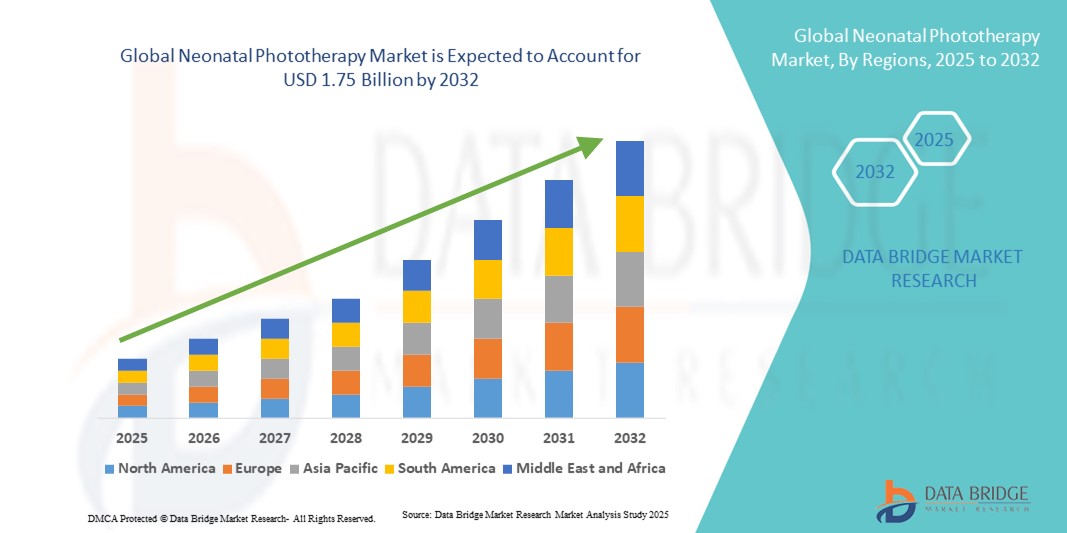
- The global neonatal phototherapy market size was valued at USD 1.15 billion in 2024 and is expected to reach USD 1.75 billion by 2032, at a CAGR of 5.40% during the forecast period
- The market growth is largely fueled by the increasing prevalence of neonatal jaundice and heightened awareness among healthcare providers and parents regarding timely intervention
- Furthermore, rising demand for safe, efficient, and non-invasive treatment options for hyperbilirubinemia in newborns is establishing phototherapy as the standard care for neonatal jaundice. These converging factors are accelerating the adoption of advanced Neonatal Phototherapy systems, including LED-based and fiber-optic solutions, thereby significantly boosting the industry's growth
Neonatal Phototherapy Market Analysis
- Neonatal Phototherapy is increasingly recognized as a critical treatment for managing hyperbilirubinemia in newborns, helping prevent severe jaundice and associated complications. The rising prevalence of neonatal jaundice, coupled with advancements in phototherapy devices, is driving the global demand for effective and safe treatment solutions
- The escalating demand for neonatal phototherapy is primarily fueled by increasing awareness among healthcare providers and parents about early intervention, rising birth rates in developing regions, and the adoption of advanced, energy-efficient phototherapy units in hospitals and neonatal care centers
- North America dominated the neonatal phototherapy market with the largest revenue share of 42.10% in 2024, supported by advanced neonatal care infrastructure, widespread adoption of innovative phototherapy devices, and a strong presence of key medical device manufacturers. The U.S. witnessed substantial growth in installations across hospitals and neonatal intensive care units, driven by ongoing clinical research, government initiatives, and healthcare collaborations
- Asia-Pacific is expected to be the fastest-growing region in the neonatal phototherapy market during the forecast period, due to increasing healthcare investments, rising birth rates, expanding hospital networks, and growing adoption of advanced neonatal care solutions in countries such as China, India, and Japan
- The neonatal jaundice management segment dominated the neonatal phototherapy market with the largest market revenue share of 68.9% in 2024, fueled by the high prevalence of hyperbilirubinemia in newborns globally
Report Scope and Neonatal Phototherapy Market Segmentation
|
Attributes |
Neonatal Phototherapy Key Market Insights |
|
Segments Covered |
|
|
Countries Covered |
North America
Europe
Asia-Pacific
Middle East and Africa
South America
|
|
Key Market Players |
|
|
Market Opportunities |
|
|
Value Added Data Infosets |
In addition to the insights on market scenarios such as market value, growth rate, segmentation, geographical coverage, and major players, the market reports curated by the Data Bridge Market Research also include in-depth expert analysis, pricing analysis, brand share analysis, consumer survey, demography analysis, supply chain analysis, value chain analysis, raw material/consumables overview, vendor selection criteria, PESTLE Analysis, Porter Analysis, and regulatory framework. |
Neonatal Phototherapy Market Trends
Advancements Driving Efficiency and Safety in Neonatal Care
- A significant and accelerating trend in the global neonatal phototherapy market is the development and adoption of advanced, energy-efficient phototherapy devices designed to enhance treatment outcomes for newborns with hyperbilirubinemia. These innovations are improving treatment efficacy, reducing side effects, and enabling easier monitoring of neonatal patients
- For instance, modern LED-based phototherapy units allow for uniform light distribution, adjustable intensity, and lower heat generation, providing a safer and more comfortable environment for infants. Hospitals and neonatal care centers are increasingly integrating these devices into standard care protocols for early intervention and optimal treatment results
- Recent developments in portable and compact phototherapy systems are enabling their use in both hospital and homecare settings, increasing accessibility and convenience for parents and healthcare providers. These devices support continuous monitoring and can be tailored to individual treatment requirements
- Furthermore, innovations such as filtered light therapy and wavelength-optimized devices are enhancing the efficiency of bilirubin reduction, minimizing the risk of overexposure, and improving overall clinical outcomes
- The trend towards more effective, safe, and accessible phototherapy systems is fundamentally reshaping neonatal care practices. Consequently, companies are investing in R&D to develop solutions that combine high efficacy with ease of use, energy efficiency, and scalability for large-scale neonatal care programs
- The demand for modern Neonatal Phototherapy devices is growing rapidly across hospitals, neonatal intensive care units (NICUs), and homecare settings, as healthcare providers and parents increasingly prioritize early intervention, safety, and enhanced treatment outcomes for newborns
Neonatal Phototherapy Market Dynamics
Driver
Growing Need Due to Rising Incidence of Neonatal Jaundice and Awareness
- The increasing prevalence of neonatal jaundice, coupled with rising awareness among healthcare providers and parents about early diagnosis and treatment, is a significant driver for the heightened demand for Neonatal Phototherapy systems
- For instance, in April 2024, a leading medical device company announced the launch of an advanced LED-based phototherapy unit, designed to provide uniform light distribution and reduced heat exposure. Such innovations by key players are expected to drive the Neonatal Phototherapy industry growth in the forecast period
- As hospitals and neonatal care centers focus on improving treatment outcomes, modern phototherapy devices offer advanced features such as adjustable intensity, filtered light options, and portability, providing a safer and more efficient alternative to conventional phototherapy lamps
- Furthermore, the growing adoption of hospital-based NICU programs, combined with increasing interest in homecare phototherapy solutions, is making Neonatal Phototherapy systems integral to comprehensive neonatal care
- The ease of use, energy efficiency, ability to reduce bilirubin levels effectively, and enhanced safety for newborns are key factors propelling the adoption of Neonatal Phototherapy devices in both hospital and homecare settings. The trend towards compact, portable, and easy-to-monitor systems further contributes to market growth
Restraint/Challenge
Concerns Regarding High Initial Costs and Limited Awareness in Emerging Regions
- The relatively high initial cost of advanced neonatal phototherapy systems, compared to traditional phototherapy lamps, poses a challenge to broader market adoption, particularly in developing regions or small-scale healthcare facilities
- In some areas, limited awareness about the benefits of early intervention and phototherapy treatment protocols has restrained adoption rates, highlighting the need for educational initiatives targeting both healthcare professionals and parents
- Addressing these challenges through cost-effective solutions, increased training for medical staff, and government or NGO-backed awareness campaigns is crucial for driving market growth
- In addition, companies are focusing on developing portable, low-maintenance units to make the technology accessible to remote and resource-limited areas
- While prices are gradually decreasing due to technological advancements and increased competition, the perception of higher upfront investment can still hinder adoption, especially among budget-conscious healthcare providers
- Overcoming these challenges through the development of affordable, safe, and efficient Neonatal Phototherapy solutions, alongside greater awareness campaigns, will be vital for sustained market growth in the coming years
Neonatal Phototherapy Market Scope
The market is segmented on the basis of type, product type, and application.
- By Type
On the basis of type, the neonatal phototherapy market is segmented into convectional phototherapy equipment, LED phototherapy equipment, and fiber optic phototherapy equipment. The LED Phototherapy Equipment segment dominated the largest market revenue share of 45.3% in 2024, driven by its superior energy efficiency, longer operational lifespan, and minimal heat emission compared to conventional systems. Hospitals and neonatal care centers prefer LED-based devices for their enhanced efficacy in reducing bilirubin levels and safer, non-invasive treatment. In addition, LED phototherapy systems offer customizable wavelengths, uniform light distribution, and lower maintenance costs, further supporting widespread adoption. Increasing investments in neonatal care infrastructure and rising awareness of jaundice management are key factors boosting segment growth.
The fiber optic phototherapy equipment segment is expected to witness the fastest CAGR of 18.1% from 2025 to 2032, fueled by the increasing adoption of flexible, wearable, and home-use phototherapy devices. Fiber optic systems allow targeted light delivery, enabling safe treatment of neonates in incubators or during parental care. Their portability, ease of use, and ability to minimize disruption to routine neonatal care are driving adoption in both hospitals and homecare settings. Growing interest in personalized and non-invasive neonatal treatments, along with technological innovations in fiber optic phototherapy, is accelerating segment growth globally.
- By Product Type
On the basis of product type, the neonatal phototherapy market is segmented into traditional phototherapy lamps, phototherapy beds, and flexible phototherapy lamps. The Phototherapy Beds segment dominated the largest market revenue share of 52.7% in 2024, owing to their integrated design that combines controlled light delivery with patient monitoring systems. Hospitals and NICUs prefer phototherapy beds for continuous, safe, and effective treatment of neonatal jaundice, especially in high-risk newborns. Features such as adjustable intensity, built-in safety alarms, and ease of maintenance contribute to their dominance.
Flexible phototherapy lamps are expected to witness the fastest CAGR of 17.5% from 2025 to 2032, driven by their unmatched convenience, portability, and adaptability for homecare applications. These innovative lamps enable precise, targeted phototherapy treatment, allowing newborns to receive effective care while remaining in a familiar and comfortable home environment, reducing the need for prolonged hospital stays. Their lightweight design and ease of use empower parents and caregivers to actively participate in the treatment process, improving adherence and overall neonatal outcomes. The growing awareness among parents and healthcare professionals about the importance of early jaundice management is further accelerating adoption.
- By Application
On the basis of application, the neonatal phototherapy market is segmented into skin diseases treatment and neonatal jaundice management. The neonatal jaundice management segment dominated the largest market revenue share of 68.9% in 2024, fueled by the high prevalence of hyperbilirubinemia in newborns globally. Hospitals and neonatal care centers prioritize phototherapy as the standard non-invasive treatment, supported by clinical guidelines and increasing parental awareness. Advancements in phototherapy technology, such as LED and fiber optic systems, enhance efficacy and patient safety, reinforcing its dominance.
The skin diseases treatment segment is expected to witness the fastest CAGR of 15.8% from 2025 to 2032, driven by the increasing utilization of phototherapy for managing various neonatal skin conditions, including eczema, psoriasis, and rashes. The segment benefits from significant technological advancements in targeted light therapy devices, which ensure precise treatment while minimizing side effects, making them safer for delicate neonatal skin. Growing recommendations from dermatologists and pediatricians for non-invasive and effective treatment options are further encouraging adoption across hospitals, specialized clinics, and outpatient care settings. In addition, rising awareness among parents about the importance of early intervention for skin disorders is contributing to segment growth.
Neonatal Phototherapy Market Regional Analysis
- North America dominated the neonatal phototherapy market with the largest revenue share of 42.10% in 2024, supported by advanced neonatal care infrastructure, widespread adoption of innovative phototherapy devices, and a strong presence of key medical device manufacturers
- The region’s hospitals and neonatal intensive care units (NICUs) are increasingly equipping themselves with high-performance phototherapy systems to manage neonatal jaundice efficiently
- Rising awareness about early intervention and continuous clinical research further drives adoption, while government healthcare initiatives and collaborations among medical institutions facilitate the deployment of advanced treatment solutions
U.S. Neonatal Phototherapy Market Insight
The U.S. neonatal phototherapy market captured the largest revenue share within North America in 2024, driven by the rapid expansion of NICU facilities and the integration of state-of-the-art phototherapy devices. Hospitals and specialty clinics are increasingly adopting LED and fiber-optic phototherapy systems to enhance treatment efficacy and minimize side effects. Ongoing clinical trials, technological innovations, and healthcare collaborations contribute significantly to market growth, ensuring better neonatal outcomes and improving access to advanced treatment solutions across the country.
Europe Neonatal Phototherapy Market Insight
The Europe neonatal phototherapy market is projected to expand at a substantial CAGR throughout the forecast period, primarily driven by increasing healthcare expenditure, rising awareness of neonatal jaundice, and stringent clinical care guidelines. Countries across the region are upgrading neonatal care infrastructure and integrating advanced phototherapy technologies into hospitals and specialty clinics. Growing urbanization, government support, and a focus on improving neonatal health outcomes are further fostering market growth, with notable adoption across both new healthcare facilities and renovation projects in existing hospitals.
U.K. Neonatal Phototherapy Market Insight
The U.K. neonatal phototherapy market is expected to grow at a noteworthy CAGR during the forecast period, fueled by increased investments in neonatal care units and rising demand for safer and more effective phototherapy solutions. The focus on early diagnosis of neonatal jaundice, coupled with government-led awareness programs, supports market expansion. Hospitals and specialized clinics are adopting modern phototherapy systems to reduce bilirubin levels efficiently, while the trend of enhancing neonatal treatment protocols contributes to widespread adoption across the country.
Germany Neonatal Phototherapy Market Insight
The Germany neonatal phototherapy market is anticipated to expand at a significant CAGR during the forecast period, driven by advanced healthcare infrastructure, high-quality clinical standards, and increasing adoption of modern phototherapy devices. Hospitals and NICUs are increasingly equipped with LED-based and fiber-optic phototherapy systems that provide improved treatment outcomes for newborns. Government initiatives supporting neonatal health, coupled with growing awareness among healthcare professionals and parents, further propel market growth in Germany.
Asia-Pacific Neonatal Phototherapy Market Insight
The Asia-Pacific neonatal phototherapy market is poised to grow at the fastest CAGR of 24% during the forecast period of 2025 to 2032, driven by increasing healthcare investments, rising birth rates, and expanding hospital networks in countries such as China, India, and Japan. Growing awareness of neonatal jaundice, coupled with the adoption of advanced phototherapy solutions and rising accessibility to modern healthcare facilities, supports rapid market expansion. Additionally, the region’s emphasis on improving neonatal health outcomes and government initiatives promoting maternal and child health are key growth drivers.
Japan Neonatal Phototherapy Market Insight
The Japan neonatal phototherapy market is gaining momentum due to increasing healthcare investments, high-tech medical infrastructure, and rising awareness of early neonatal care. Hospitals and NICUs are adopting advanced phototherapy systems that ensure effective bilirubin reduction and safer treatment outcomes. Growing emphasis on quality neonatal care and integration of innovative treatment solutions further drives adoption, while government healthcare programs and training for medical staff support market expansion across the country.
China Neonatal Phototherapy Market Insight
The China neonatal phototherapy market accounted for the largest market revenue share in Asia-Pacific in 2024, attributed to the country’s rapid expansion of hospital networks, significant healthcare investments, and increasing awareness of early HIE diagnosis and treatment. The adoption of advanced phototherapy systems in NICUs and pediatric units is supported by government initiatives and strong domestic medical device manufacturing capabilities. Rising birth rates, urbanization, and expanding healthcare access are key factors propelling the market in China, making it a leading contributor to the growth of the Asia-Pacific Neonatal Phototherapy sector.
Neonatal Phototherapy Market Share
The Neonatal Phototherapy industry is primarily led by well-established companies, including:
- Natus Medical Incorporated (U.S.)
- Novos Medical Systems (Turkey)
- Tom Medical Supplies Co. (Japan)
- Dragerwerk AG & Co. KGaA (Germany)
- Phoenix Medical Systems Pvt. Ltd (India)
- Medela (Switzerland)
- Koninklijke Philips N.V (Netherlands)
- General Electric Company (U.S.)
- Toshiba Corporation (Japan)
- Atom Medical Corp (Japan)
- Weyer GmbH (Japan)
- Ibis Medical (India)
Latest Developments in Global Neonatal Phototherapy Market
- In March 2025, Drägerwerk AG & Co. KGaA expanded its neonatal care portfolio by introducing the BiliPredics software solution. This innovative digital application utilizes a proprietary algorithm to predict bilirubin levels up to 60 hours in advance, aiding healthcare professionals in early intervention and care for neonatal jaundice
- In June 2023, Phoenix Medical Systems unveiled the Brilliance Pro, an advanced phototherapy device designed for use in the NICU. The Brilliance Pro features an integrated light meter and is compatible with other critical medical equipment such as infant warmers and incubators, providing comprehensive care for infants
- In September 2024, Natus Medical Incorporated launched the neoBLUE® nova LED phototherapy system. This versatile 3-in-1 system combines blue and white light, reducing glare and making the lighting effect easier on the eyes compared to traditional systems, enhancing comfort for both newborns and caregivers during phototherapy sessions
- In November 2024, Novos Medical Systems introduced the Bililed Mini+, an overhead phototherapy system designed with a space-saving ergonomic mobile stand. The Bililed Mini+ can be used in combination with infant incubators, warmers, and baby cots in NICUs, offering flexibility and ease of use in neonatal care settings

- Interactive Data Analysis Dashboard
- Company Analysis Dashboard for high growth potential opportunities
- Research Analyst Access for customization & queries
- Competitor Analysis with Interactive dashboard
- Latest News, Updates & Trend analysis
- Harness the Power of Benchmark Analysis for Comprehensive Competitor Tracking
Data collection and base year analysis are done using data collection modules with large sample sizes. The stage includes obtaining market information or related data through various sources and strategies. It includes examining and planning all the data acquired from the past in advance. It likewise envelops the examination of information inconsistencies seen across different information sources. The market data is analysed and estimated using market statistical and coherent models. Also, market share analysis and key trend analysis are the major success factors in the market report. To know more, please request an analyst call or drop down your inquiry.
The key research methodology used by DBMR research team is data triangulation which involves data mining, analysis of the impact of data variables on the market and primary (industry expert) validation. Data models include Vendor Positioning Grid, Market Time Line Analysis, Market Overview and Guide, Company Positioning Grid, Patent Analysis, Pricing Analysis, Company Market Share Analysis, Standards of Measurement, Global versus Regional and Vendor Share Analysis. To know more about the research methodology, drop in an inquiry to speak to our industry experts.
Data Bridge Market Research is a leader in advanced formative research. We take pride in servicing our existing and new customers with data and analysis that match and suits their goal. The report can be customized to include price trend analysis of target brands understanding the market for additional countries (ask for the list of countries), clinical trial results data, literature review, refurbished market and product base analysis. Market analysis of target competitors can be analyzed from technology-based analysis to market portfolio strategies. We can add as many competitors that you require data about in the format and data style you are looking for. Our team of analysts can also provide you data in crude raw excel files pivot tables (Fact book) or can assist you in creating presentations from the data sets available in the report.













