


Neonatal Ventilators Market Size
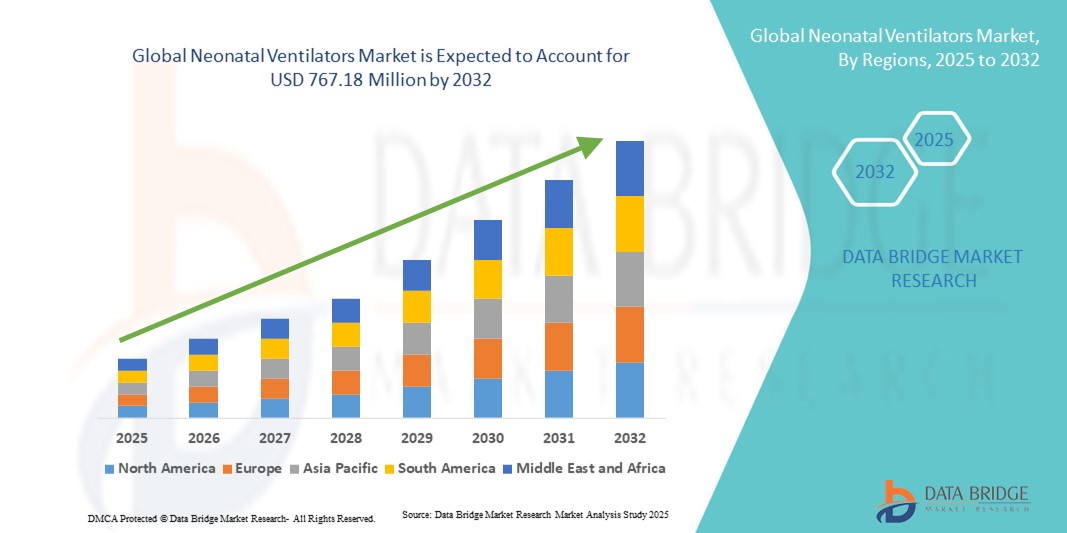
- The global neonatal ventilators market size was valued at USD 454.94 million in 2024 and is expected to reach USD 767.18 million by 2032, at a CAGR of 6.75% during the forecast period
- The market growth is largely fueled by the increasing prevalence of premature births, respiratory distress syndrome (RDS), and other neonatal respiratory complications, which drive the demand for advanced ventilatory support
- Furthermore, rising investments in neonatal intensive care units (NICUs), technological advancements in ventilator design, and increasing awareness of improved neonatal outcomes are significantly boosting the adoption of neonatal ventilators solutions, thereby accelerating the overall market growth
Neonatal Ventilators Market Analysis
- Neonatal ventilators, offering advanced respiratory support and monitoring for newborns, are increasingly vital components of neonatal intensive care units (NICUs) due to their precision, reliability, and role in improving survival outcomes for preterm and critically ill infants
- The escalating demand for neonatal ventilators is primarily fueled by rising neonatal mortality rates, increasing prevalence of respiratory disorders in newborns, and growing investments in advanced neonatal care infrastructure
- North America dominated the neonatal ventilators market with the largest revenue share of 39% in 2024, supported by advanced neonatal care infrastructure, widespread adoption of innovative ventilator technologies, and a strong presence of key medical device manufacturers. The U.S. witnessed substantial growth in installations across hospitals and neonatal intensive care units, driven by ongoing clinical research, government initiatives, and healthcare collaborations
- Asia-Pacific is expected to be the fastest-growing region in the neonatal ventilators market during the forecast period, driven by increasing healthcare investments, rising birth rates, expansion of hospital networks, and growing adoption of advanced neonatal care solutions in countries such as China, India, and Japan
- The intensive care ventilators segment dominated the neonatal ventilators market with a revenue share of 51.2% in 2024. This segment’s dominance is attributed to its indispensable role in NICUs, offering advanced monitoring capabilities, multiple ventilation modes, and seamless integration with other critical care equipment
Report Scope and Neonatal Ventilators Market Segmentation
|
Attributes |
Neonatal Ventilators Key Market Insights |
|
Segments Covered |
|
|
Countries Covered |
North America
Europe
Asia-Pacific
Middle East and Africa
South America
|
|
Key Market Players |
|
|
Market Opportunities |
|
|
Value Added Data Infosets |
In addition to the insights on market scenarios such as market value, growth rate, segmentation, geographical coverage, and major players, the market reports curated by the Data Bridge Market Research also include in-depth expert analysis, pricing analysis, brand share analysis, consumer survey, demography analysis, supply chain analysis, value chain analysis, raw material/consumables overview, vendor selection criteria, PESTLE Analysis, Porter Analysis, and regulatory framework. |
Neonatal Ventilators Market Trends
Growing Adoption of Advanced Ventilator Technologies
- A significant trend in the global neonatal ventilators market is the increasing adoption of advanced ventilator technologies that improve clinical outcomes for preterm and critically ill newborns. Hospitals and neonatal intensive care units are integrating high-precision ventilators capable of providing controlled respiratory support tailored to neonatal physiology
- Modern neonatal ventilators offer features such as synchronized ventilation, non-invasive modes, and real-time monitoring of vital parameters, which enhance patient safety and treatment effectiveness. These capabilities are driving demand across developed and emerging markets
- For instance, hospitals in North America and Europe are increasingly procuring ventilators with integrated monitoring systems to reduce complications associated with respiratory distress and ensure optimal care for neonates in intensive care units
- The market is also witnessing a rise in portable and compact ventilator systems suitable for use in smaller hospitals, transport situations, and emergency neonatal care, enhancing accessibility to critical respiratory support
- Manufacturers are focusing on innovations that improve energy efficiency, reduce device footprint, and offer user-friendly interfaces, supporting widespread adoption in both urban and resource-limited settings
- The emphasis on evidence-based clinical outcomes, reduced neonatal morbidity, and improved survival rates is further encouraging healthcare providers to invest in state-of-the-art ventilators
- Overall, the growing awareness of neonatal respiratory care, coupled with continuous technological enhancements and increasing healthcare infrastructure, is driving robust growth in the Neonatal Ventilators market across key regions worldwide
Neonatal Ventilators Market Dynamics
Driver
Growing Need Due to Rising Incidence of Neonatal Respiratory Disorders
- The increasing prevalence of neonatal respiratory complications, including respiratory distress syndrome and other critical breathing disorders, is a significant driver for the heightened demand for neonatal ventilators. Early and effective intervention is crucial to improve survival rates and reduce long-term complications among preterm and critically ill newborns
- For instance, in April 2024, leading medical device companies announced the launch of advanced neonatal ventilators with improved monitoring capabilities, precise ventilation modes, and enhanced safety features. Such developments are expected to drive the Neonatal Ventilators industry growth in the forecast period
- Healthcare providers are increasingly prioritizing ventilators that offer synchronized ventilation, non-invasive options, and real-time vital monitoring, providing critical support for neonatal intensive care units (NICUs) and specialized hospitals
- Furthermore, the rising adoption of portable and compact ventilator systems allows for flexibility in emergency care, inter-hospital transfers, and homecare settings for chronic neonatal respiratory conditions
- The trend towards technologically advanced devices that provide precise respiratory support, reduce complications, and enhance patient outcomes is propelling the adoption of neonatal ventilators across both developed and emerging markets
- Continuous training programs, increasing awareness about neonatal care, and government initiatives supporting NICU expansions further contribute to market growth, as hospitals seek reliable and effective solutions for critical care
Restraint/Challenge
High Equipment Costs and Skilled Workforce Requirement
- The high cost of advanced neonatal ventilators, particularly models with sophisticated monitoring and control systems, poses a significant challenge to widespread adoption in budget-constrained hospitals and healthcare facilities, especially in developing regions
- In addition, the operation of high-end ventilators requires trained personnel and skilled neonatal care specialists, which can limit adoption in areas with workforce shortages or limited clinical expertise
- Maintenance and calibration of complex ventilator systems also demand specialized technical support, which may not be readily available in smaller hospitals or remote regions, increasing downtime and operational costs
- Energy consumption and the need for stable power supply can be a constraint in resource-limited settings, especially in rural or underdeveloped regions where consistent electricity may be a challenge
- Compatibility issues with other medical equipment, such as patient monitoring systems or NICU setups, may further complicate integration and reduce operational efficiency
- While prices of certain ventilator models are gradually decreasing, the perceived premium for technologically advanced devices can still hinder adoption, particularly in small clinics or low-resource healthcare centers
- Infection control and proper sterilization of reusable ventilator components require strict protocols, which may be challenging to implement in overstretched healthcare facilities, potentially affecting patient safety
- Overcoming these barriers through increased awareness, workforce training, government support, and development of user-friendly, affordable, and energy-efficient ventilator systems will be vital for sustaining robust growth in the Neonatal Ventilators market over the forecast period
Neonatal Ventilators Market Scope
The market is segmented on the basis of product, mobility, technology, and end use.
- By Product
On the basis of product, the neonatal ventilators market is segmented into invasive ventilation, non-invasive ventilation, and hybrid ventilation. The invasive ventilation segment dominated the market with the largest revenue share of 46.3% in 2024. This dominance is due to its critical role in managing severely ill neonates in NICUs, offering precise control over ventilation parameters and oxygen delivery. Hospitals and specialty clinics rely on invasive ventilators for conditions such as respiratory distress syndrome, apnea of prematurity, and other critical neonatal respiratory disorders. The segment benefits from continuous technological innovations, integration with bedside monitoring systems, and strong adoption across leading hospitals. Clinicians prioritize invasive ventilators for their reliability, adaptability to complex cases, and ability to provide consistent, life-saving support. Additionally, ongoing government initiatives and investments in neonatal care infrastructure further bolster this segment’s market share.
The non-invasive ventilation segment is expected to witness the fastest CAGR of 23.5% from 2025 to 2032. Growth in this segment is driven by the increasing preference for respiratory support methods that minimize complications such as ventilator-associated pneumonia and airway trauma. Non-invasive ventilators are widely adopted in NICUs and homecare settings for neonates with moderate respiratory distress. Their user-friendly design, portability, and ability to provide high-quality respiratory support without intubation contribute to rapid adoption. Clinicians value non-invasive solutions for reducing long-term complications and supporting step-down care after intensive treatment. The segment also benefits from increasing awareness of safer respiratory management practices and technological improvements enhancing patient comfort and monitoring.
- By Mobility
On the basis of mobility, the neonatal ventilators market is segmented into intensive care ventilators and portable/transportable ventilators. The intensive care ventilators segment dominated the market with a revenue share of 51.2% in 2024. This segment’s dominance is attributed to its indispensable role in NICUs, offering advanced monitoring capabilities, multiple ventilation modes, and seamless integration with other critical care equipment. Hospitals rely on intensive care ventilators for critically ill neonates who require precise and continuous respiratory support. Their reliability, high accuracy, and adaptability to complex patient needs make them a preferred choice in specialized neonatal units. Moreover, intensive care ventilators support a range of clinical procedures and allow real-time adjustments based on patient response, enhancing treatment outcomes. Continuous technological upgrades and strong adoption by leading hospitals further reinforce their dominant position in the market.
Portable/transportable ventilators are expected to witness the fastest CAGR of 22.8% from 2025 to 2032. This growth is driven by the increasing need for neonatal patient transfers between hospitals and specialized care centers, as well as demand for flexible ventilatory solutions in emergency and homecare settings. Portable ventilators ensure uninterrupted respiratory support during transfers and provide adaptability in multiple clinical environments. Their compact design, ease of operation, and integration with monitoring systems make them highly desirable in both urban and semi-urban healthcare settings. Increasing focus on neonatal transport safety and homecare ventilation solutions also supports this segment’s rapid growth.
- By Technology
On the basis of technology, the neonatal ventilators market is segmented into mechanical ventilators, high-frequency ventilators, volume-targeted ventilators, and hybrid ventilators. The mechanical ventilators segment held the largest revenue share of 48.7% in 2024. These ventilators are widely used due to their reliability, multiple ventilation modes, and precise control over tidal volumes and pressures, ensuring optimal outcomes for critically ill neonates. Hospitals rely heavily on mechanical ventilators for both short-term and long-term respiratory support, making them a standard equipment choice in NICUs. Their integration with bedside monitoring systems, clinical workflow compatibility, and adaptability for diverse patient conditions reinforce their dominant market position. Continuous R&D and technological advancements further strengthen this segment’s relevance in neonatal respiratory care.
The volume-targeted ventilators segment is anticipated to register the fastest CAGR of 24.1% from 2025 to 2032. These ventilators allow clinicians to set specific target tidal volumes, reducing the risk of ventilator-induced lung injuries and ensuring safer respiratory support for neonates with fragile lungs. Increasing clinical focus on improving neonatal outcomes and minimizing long-term complications is driving adoption. Volume-targeted ventilators are rapidly being incorporated into modern NICUs and neonatal care centers, benefiting from technological innovations, clinician training, and growing awareness of safer ventilation practices. Their versatility, precision, and enhanced patient safety features make them a preferred choice for advanced neonatal care.
- By End Use
On the basis of end use, the neonatal ventilators market is segmented into hospitals, nursing homes, clinics, ambulatory surgical centers, and others. The hospitals segment dominated the market with the largest revenue share of 55.4% in 2024. Hospitals, particularly tertiary care centers and specialized NICUs, require advanced ventilatory support systems to manage critically ill neonates. The presence of highly trained medical personnel, comprehensive patient monitoring infrastructure, and ongoing clinical research programs drive the high adoption of neonatal ventilators. Hospitals also benefit from government funding, private investments, and partnerships with medical device manufacturers, reinforcing their dominance. Continuous investment in NICU infrastructure and expansion of neonatal care facilities further support this segment’s leading position.
The ambulatory surgical centers segment is expected to witness the fastest CAGR of 21.9% from 2025 to 2032. Growth is driven by the increasing trend of outpatient procedures, neonatal patient transfers, and the demand for compact, efficient ventilatory solutions for short-term neonatal care outside traditional hospitals. Portable and non-invasive ventilators are increasingly adopted in ambulatory centers to ensure continuity of care. The segment’s growth is further supported by rising healthcare accessibility in semi-urban areas, expansion of specialized neonatal services, and increasing awareness among caregivers and clinicians of portable ventilatory solutions.
Neonatal Ventilators Market Regional Analysis
- North America dominated the neonatal ventilators market with the largest revenue share of 39% in 2024, supported by advanced neonatal care infrastructure, widespread adoption of innovative ventilator technologies, and a strong presence of key medical device manufacturer
- Hospitals and neonatal intensive care units (NICUs) in the region witnessed substantial growth in ventilator installations, driven by ongoing clinical research, government initiatives, and strategic healthcare collaborations
- The demand for technologically advanced ventilators, combined with high healthcare spending and a robust network of specialized care centers, further reinforces North America’s market dominance
U.S. Neonatal Ventilators Market Insight
The U.S. neonatal ventilators market captured the largest revenue share within North America in 2024, fueled by rapid adoption of cutting-edge ventilator technologies in NICUs and pediatric care units. Hospitals and specialized neonatal centers are increasingly integrating high-precision invasive, non-invasive, and hybrid ventilators to improve survival rates and patient outcomes. Government funding programs, research initiatives, and partnerships with medical device manufacturers are accelerating the expansion of neonatal ventilator infrastructure across the country.
Europe Neonatal Ventilators Market Insight
The Europe neonatal ventilators market is projected to grow at a significant CAGR during the forecast period, driven by increasing awareness of neonatal respiratory care, rising investments in pediatric hospitals, and stringent regulatory standards. Germany, the U.K., and France are investing heavily in neonatal intensive care, promoting the adoption of advanced ventilator systems. Hospitals and specialty clinics across Europe are focusing on precision ventilatory support, energy-efficient devices, and integration with digital monitoring systems, facilitating better patient management and improved clinical outcomes.
U.K. Neonatal Ventilators Market Insight
The U.K. neonatal ventilators market is anticipated to expand at a notable CAGR from 2025 to 2032, supported by the country’s well-developed healthcare infrastructure and increasing prevalence of preterm births. NICUs are upgrading to advanced non-invasive and hybrid ventilators to provide safer and more effective respiratory support. Public and private hospital networks, combined with a growing focus on neonatal research and training, are driving the adoption of technologically advanced ventilators across the nation.
Germany Neonatal Ventilators Market Insight
The Germany neonatal ventilators market is expected to grow steadily during the forecast period, fueled by strong healthcare investments, robust neonatal care facilities, and increasing adoption of precision ventilatory technologies. Hospitals and specialized clinics are deploying high-frequency, volume-targeted, and hybrid ventilators to improve outcomes for preterm and critically ill neonates. Government initiatives to upgrade NICU equipment and ongoing clinical trials are further contributing to market growth.
Asia-Pacific Neonatal Ventilators Market Insight
The Asia-Pacific neonatal ventilators market is expected to be the fastest-growing region during the forecast period, driven by increasing healthcare investments, rising birth rates, expansion of hospital networks, and growing adoption of advanced neonatal care solutions in countries such as China, India, and Japan. Government initiatives, rising awareness of neonatal respiratory care, and partnerships with international ventilator manufacturers are boosting adoption across public and private hospitals.
Japan Neonatal Ventilators Market Insight
The Japan neonatal ventilators market is gaining traction due to the country’s focus on high-quality neonatal care, advanced medical infrastructure, and rapid technological adoption. Hospitals and NICUs are increasingly implementing state-of-the-art ventilators, including non-invasive and hybrid systems, to improve neonatal outcomes. The country’s aging healthcare workforce and focus on digital monitoring solutions further enhance the demand for innovative ventilatory support devices.
China Neonatal Ventilators Market Insight
The China neonatal ventilators market accounted for the largest revenue share in Asia-Pacific in 2024, driven by expanding healthcare infrastructure, rising birth rates, and increasing adoption of advanced neonatal care technologies. Hospitals and specialized neonatal units are investing in invasive, non-invasive, and hybrid ventilators to provide timely and precise respiratory support. Strong government initiatives, growing hospital networks, and domestic manufacturing capabilities are key factors propelling market growth in China.
Neonatal Ventilators Market Share
The neonatal ventilators industry is primarily led by well-established companies, including:
- Air Liquide (France)
- Hamilton Medical (Switzerland)
- Breas Medical AB (Sweden)
- Drägerwerk AG & Co. KGaA (Germany)
- General Electric Company (U.S.)
- Koninklijke Philips N.V. (Netherlands)
- Getinge (Sweden)
- ResMed (U.S.)
- Smiths Medical, Inc. (U.S.)
- Fisher & Paykel Healthcare Limited (New Zealand)
- Sechrist Industries (U.S.)
- Allied Healthcare Products, Inc. (U.S.)
- Inspiration Healthcare Group plc. (U.S.)
Latest Developments in Global Neonatal Ventilators Market
- In May 2023, the World Health Organization (WHO) reported that approximately 13.4 million babies were born preterm in 2020, with preterm birth complications being the leading cause of death among children under five years of age. This statistic underscores the critical need for advanced neonatal care, including ventilators, to support premature infants
- In February 2023, Draegerwerk AG & Co. announced the launch of the Evita V500 neonatal ventilator. This high-end ventilator is designed for intensive care units and offers advanced features to support neonatal respiratory care
- In November 2023, Inspiration Healthcare Group plc launched the SLE1500 non-invasive ventilator. This device is designed to provide respiratory support for neonatal and pediatric patients, offering features tailored to their specific needs
- In December 2024, Europlaz, a UK-based medical technology company, introduced a new neonatal innovation aimed at improving neonatal care. This development has the potential to enhance the survival rates of premature or distressed infants
- In July 2024, Inspiration Healthcare Group plc secured a USD 4.3 million contract to supply SLE6000 neonatal ventilators, First Breath Humidification, and associated accessories. This contract underscores the company's commitment to advancing neonatal respiratory care
- In June 2025, Getinge extended its Servo-c ventilator line by introducing a neonatal option. This addition transforms the Servo-c into a universal solution that supports respiratory care for all patient categories, from fragile premature newborns to fully grown adults

- Interactive Data Analysis Dashboard
- Company Analysis Dashboard for high growth potential opportunities
- Research Analyst Access for customization & queries
- Competitor Analysis with Interactive dashboard
- Latest News, Updates & Trend analysis
- Harness the Power of Benchmark Analysis for Comprehensive Competitor Tracking
Data collection and base year analysis are done using data collection modules with large sample sizes. The stage includes obtaining market information or related data through various sources and strategies. It includes examining and planning all the data acquired from the past in advance. It likewise envelops the examination of information inconsistencies seen across different information sources. The market data is analysed and estimated using market statistical and coherent models. Also, market share analysis and key trend analysis are the major success factors in the market report. To know more, please request an analyst call or drop down your inquiry.
The key research methodology used by DBMR research team is data triangulation which involves data mining, analysis of the impact of data variables on the market and primary (industry expert) validation. Data models include Vendor Positioning Grid, Market Time Line Analysis, Market Overview and Guide, Company Positioning Grid, Patent Analysis, Pricing Analysis, Company Market Share Analysis, Standards of Measurement, Global versus Regional and Vendor Share Analysis. To know more about the research methodology, drop in an inquiry to speak to our industry experts.
Data Bridge Market Research is a leader in advanced formative research. We take pride in servicing our existing and new customers with data and analysis that match and suits their goal. The report can be customized to include price trend analysis of target brands understanding the market for additional countries (ask for the list of countries), clinical trial results data, literature review, refurbished market and product base analysis. Market analysis of target competitors can be analyzed from technology-based analysis to market portfolio strategies. We can add as many competitors that you require data about in the format and data style you are looking for. Our team of analysts can also provide you data in crude raw excel files pivot tables (Fact book) or can assist you in creating presentations from the data sets available in the report.













