What is the Network Attached AI Storage System Market Size and Growth Rate?
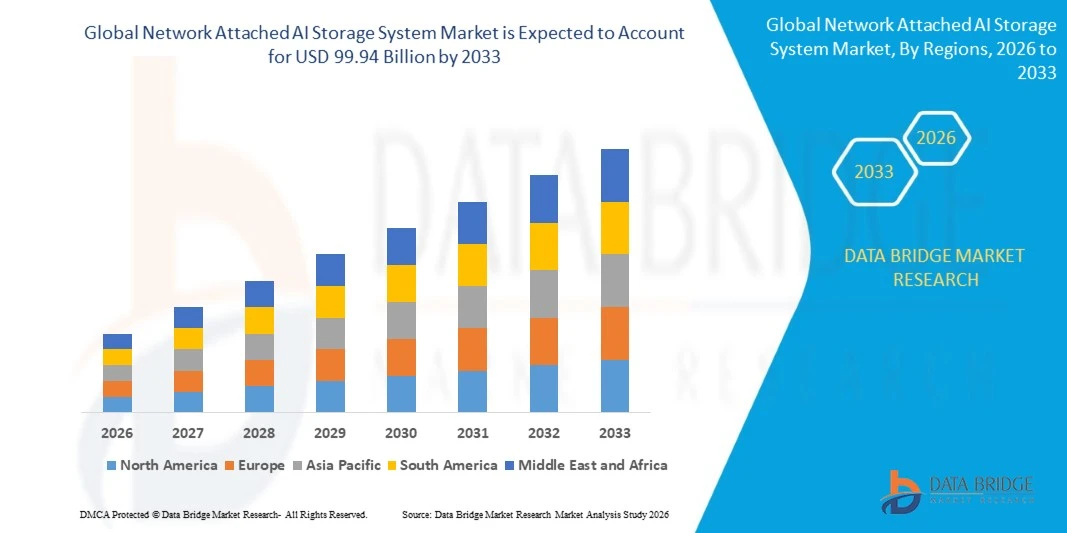
- As per Data Bridge Market Research analysis, the network attached AI storage system market was valued at USD 25.88 billion in 2025 and is projected to reach USD 99.94 billion by 2033, growing at a CAGR of 18.40% from 2026 to 2033.
- The market is experiencing consistent growth driven by rising demand for high-performance data storage, increasing adoption of artificial intelligence and machine learning applications, and expanding requirements for scalable storage infrastructure across data centers, cloud computing, and enterprise IT environments.
- The growing volume of unstructured data generated by AI workloads, combined with increasing demand for real-time data processing and high-speed access, is compelling enterprises, cloud service providers, and research institutions to adopt advanced network-attached AI storage systems. AI-optimized storage solutions are gaining traction by offering scalable capacity, efficient data management, and reliable performance for model training, inference, and analytics workloads.
Market Size & Forecast
- Global Market Value (2025): USD 25.88 Billion
- Expected Market Value (2033): USD 99.94 Billion
- Forecast CAGR (2026–2033): 18.40%
- Leading Region in 2025: North America
- Fastest Growing Region: Asia Pacific
What are the Major Takeaways of the Network Attached AI Storage System Market?
- North America dominated the network attached AI storage system market with the largest revenue share of 35.87% in 2025, supported by advanced data center infrastructure, strong AI investments, and the presence of leading technology companies.
- Asia-Pacific is expected to be the fastest-growing region at a CAGR of 17.91% from 2026 to 2033, fueled by expanding data center capacity, rapid digitalization, and increasing AI adoption across China, India, and Japan.
- The hardware segment led the market with a 62.5% share in 2025, driven by increasing investments in storage servers, high-performance drives, storage controllers, and networking components required to support AI workloads.
- Software are the fastest-growing offering type, projected to register a CAGR of 20.5%, reflecting the surge in demand for intelligent data management and AI-optimized storage operations.
- The hard disk drive segment dominated the storage medium category with a 56.5% revenue share in 2025, led by its cost-effectiveness and ability to provide high-capacity storage for large datasets
- Cloud service providers accounted for 39.5% of the market share in 2025, preferred by expanding hyperscale data centers, increasing cloud adoption, and rising demand for AI computing infrastructure.
- The object-based storage segment is the fastest-growing storage architecture category, with a CAGR of 21.5%, driven by increasing demand for scalable storage of unstructured data and AI training datasets.
Report Scope and Network Attached AI Storage System Market Segmentation
|
Attributes |
Network Attached AI Storage System Key Market Insights |
|
Segments Covered |
|
|
Countries Covered |
North America
Europe
Asia-Pacific
Middle East and Africa
South America
|
|
Key Market Players |
|
|
Market Opportunities |
|
|
Value Added Data Infosets |
In addition to the insights on market scenarios such as market value, growth rate, segmentation, geographical coverage, and major players, the market reports curated by the Data Bridge Market Research also include in-depth expert analysis, geographically represented company-wise production and capacity, network layouts of distributors and partners, detailed and updated price trend analysis and deficit analysis of supply chain and demand. |
What is the Key Trend in the Network Attached AI Storage System Market?
- Enterprises are increasingly adopting AI-optimized network-attached storage systems to accelerate model training, improve data accessibility, and manage growing volumes of unstructured data while supporting scalable AI infrastructure.
- For instance, in March 2025, CoreWeave announced the general availability of its AI Object Storage service, designed to support large-scale AI training and inference through scalable, high-performance storage infrastructure.
- High-throughput storage architectures enable enterprises to reduce data-access bottlenecks and improve the efficiency of GPU-intensive AI workloads.
- Technology providers are integrating intelligent data management, automated storage optimization, and high-performance networking to simplify enterprise AI infrastructure.
- For instance, in June 2025, WEKA introduced its NeuralMesh storage system, featuring an adaptive mesh architecture designed to support enterprise and agentic AI workloads with microsecond-level latency.
- As enterprises prioritize faster AI processing, scalable capacity, and efficient data management, demand for AI-optimized network-attached storage systems is expected to accelerate, reinforcing advanced storage infrastructure as a core component of AI deployment.
What are the Key Drivers of the Network Attached AI Storage System Market?
- The rapid advancement of generative AI and large language models has significantly increased demand for high-performance network-attached storage systems capable of delivering large datasets to GPUs and supporting intensive training and inference workloads.
- For instance, in March 2025, NVIDIA introduced its AI Data Platform reference design, enabling storage providers to develop enterprise infrastructure with AI query agents for faster reasoning and near-real-time insights.
- Enterprises, cloud service providers, and research organizations are integrating scalable storage infrastructure into their AI development environments to improve data availability, reduce processing bottlenecks, and accelerate deployment timelines.
- For instance, in April 2025, Lenovo announced 21 new ThinkSystem and ThinkAgile models designed to improve performance, efficiency, and scalability for enterprise AI, virtualization, and modern data operations.
- With enterprises increasingly relying on data-intensive AI applications to improve productivity and accelerate innovation, network-attached AI storage systems will remain essential for delivering scalable, reliable, and high-performance data infrastructure.
What Factors are Challenging the Growth of the Network Attached AI Storage System Market?
- Advanced network attached AI storage system require significant upfront investment due to the integration of high-fidelity graphics, motion platforms, realistic vehicle dynamics, and immersive visualization systems.
- For instance, in October 2025, Network World reported that AI-driven storage demand was extending hard-drive lead times to more than a year, while enterprise flash storage faced potential shortages and price increases, creating procurement challenges for organizations expanding AI storage infrastructure.
- These high costs limit adoption among smaller driving schools, research institutions, and organizations in emerging economies.
- For instance, in April 2025, McKinsey reported that global data centers could require approximately USD 6.7 trillion in investment by 2030 to meet growing computing demand, highlighting the substantial capital requirements associated with expanding AI infrastructure, including servers, storage, networking, and supporting facilities.
- The high capital investment and recurring operational costs associated with advanced Network Attached AI Storage System continue to restrict adoption, particularly among small and medium-sized organizations, driving schools, and research institutions. This cost barrier slows market penetration in price-sensitive and emerging regions, limiting the widespread deployment of advanced simulation technologies despite growing demand.
How is the Network Attached AI Storage System Market Segmented?
The network attached AI storage system market is segmented on the basis of offering, storage medium, industry vertical, and storage architecture.
- By Offering
On the basis of offering, the network attached AI storage system market is segmented into hardware and software. The hardware segment dominated the market with an estimated 62.5% share in 2025, owing to increasing investments in storage servers, high-performance drives, storage controllers, and networking components required to support AI workloads. Hardware provides the physical infrastructure needed to store, retrieve, and transfer large volumes of structured and unstructured data. Growing adoption of generative AI and machine learning is increasing demand for high-capacity storage systems with faster data throughput. Enterprises and cloud service providers are investing in scalable storage infrastructure to support GPU-intensive computing environments. Continuous advancements in solid-state storage, high-speed connectivity, and storage density are further strengthening hardware adoption.
The software segment is projected to register the fastest growth at an estimated CAGR of 20.5% from 2026 to 2033, driven by increasing demand for intelligent data management and AI-optimized storage operations. Storage software enables automated data placement, monitoring, workload optimization, and efficient utilization of storage resources. Growing AI workloads are encouraging enterprises to adopt software-defined storage platforms that can adapt to changing performance requirements. Integration of predictive analytics and automated tiering is helping organizations improve storage efficiency and reduce operational complexity. Software solutions also support data protection, access control, and management across distributed storage environments.
- By Storage Medium
On the basis of storage medium, the network attached AI storage system market is segmented into hard disk drive and solid state drive. The hard disk drive segment dominated the market with an estimated 56.5% share in 2025, supported by its cost-effectiveness and ability to provide high-capacity storage for large datasets. AI development requires organizations to retain extensive training datasets, archived information, and historical records, creating demand for economical storage solutions. HDDs offer comparatively lower costs per terabyte, making them suitable for bulk data storage in enterprise and hyperscale environments. Cloud service providers and research institutions use high-capacity HDDs to maintain large data repositories. Improvements in recording technology and storage density continue to enhance their suitability for data-intensive applications.
The solid state drive segment is projected to register the fastest growth at an estimated CAGR of 22.0% from 2026 to 2033, driven by increasing demand for high-speed data access and low-latency performance in AI computing environments. SSDs provide faster read and write speeds than conventional hard disk drives, helping reduce data-loading bottlenecks during model training and inference. Growing deployment of generative AI applications is increasing the need for rapid access to large datasets. Advancements in NAND flash technology and enterprise-grade NVMe storage are improving performance and capacity. AI infrastructure operators are increasingly combining SSDs with high-performance networking to accelerate data delivery to GPUs. Although SSDs generally involve higher acquisition costs per terabyte than HDDs, their performance advantages support adoption in latency-sensitive workloads.
- By Industry Vertical
On the basis of industry vertical, the network attached AI storage system market is segmented into BFSI, telecom, media and entertainment, government, cloud service providers, and others. The cloud service providers segment dominated the market with an estimated 39.5% share in 2025, driven by expanding hyperscale data centers, increasing cloud adoption, and rising demand for AI computing infrastructure. Cloud providers require scalable storage platforms to manage extensive datasets used in generative AI, machine learning, and analytics applications. Network-attached storage supports centralized data access and efficient distribution of information across computing environments. Increasing investments in AI infrastructure are encouraging providers to deploy high-capacity storage systems with reliable performance. Growing demand for cloud-based AI services is further increasing storage requirements
The media and entertainment segment is projected to witness strong growth at an estimated CAGR of 19.2% from 2026 to 2033, driven by increasing use of AI in video production, content recommendation, visual effects, and digital asset management. High-resolution video, animation, and immersive media generate large volumes of data that require reliable and scalable storage infrastructure. AI-assisted editing and content generation applications require rapid access to extensive libraries of media assets. Network-attached storage enables collaborative workflows by allowing production teams to access and share files across connected workstations. Growing adoption of high-resolution video production is increasing storage capacity requirements. Streaming platforms are also using AI-driven analytics and personalization to improve content delivery and audience engagement.
- By Storage Architecture
On the basis of storage architecture, the network attached AI storage system market is segmented into file and object-based storage. The file-based storage segment dominated the market with an estimated 58.0% share in 2025, supported by its established use in enterprise file sharing, collaborative workflows, and conventional data management. File-based storage organizes information through files and directories, allowing users and applications to access data through familiar hierarchical structures. Enterprises use these systems to manage documents, application files, research datasets, and shared business information. Compatibility with established network file protocols supports integration with existing IT infrastructure. File storage is also useful for collaborative AI development environments that require shared access to datasets and project files.
The object-based storage segment is projected to register the fastest growth at an estimated CAGR of 21.5% from 2026 to 2033, driven by increasing demand for scalable storage of unstructured data and AI training datasets. Object storage organizes information into discrete objects with associated metadata, supporting efficient management of large and distributed data repositories. Growing adoption of generative AI, machine learning, and data analytics is increasing demand for architectures that can accommodate rapidly expanding datasets. Object-based systems support horizontal scalability, making them suitable for cloud environments and large-scale AI infrastructure. Advanced metadata capabilities also facilitate data classification, retrieval, and lifecycle management. Integration with cloud-native applications and AI data pipelines is further strengthening adoption.
Which Region Holds the Largest Share of the Network Attached AI Storage System Market?
- North America dominated the network attached AI storage system market with the largest revenue share of 35.87% in 2025, supported by advanced data center infrastructure, strong AI investments, and the presence of leading technology companies.
- The region also benefits from widespread adoption of cloud computing, increasing demand for high-performance AI data processing, and growing investments in scalable enterprise storage infrastructure. The strong presence of hyperscale data centers, advanced IT capabilities, and major AI technology developers continues to strengthen North America's leadership position in the global market
U.S. Network Attached AI Storage System Market Insight
The U.S. network attached AI storage system market is witnessing strong growth due to rising investments in artificial intelligence infrastructure, cloud computing, and high-performance data storage technologies. The country’s advanced data center ecosystem, along with increasing adoption of generative AI, machine learning, and enterprise storage solutions, is driving demand across technology, financial, healthcare, and research applications. In addition, growing emphasis on scalable data management, cybersecurity, and real-time processing is accelerating the adoption of AI-optimized storage systems across enterprises and cloud service providers.
Asia-Pacific Network Attached AI Storage System Market Insight
The Asia-Pacific network attached AI storage system market is expected to witness rapid growth, driven by increasing digitalization, expanding data center capacity, and rising investments in AI infrastructure across countries such as China, India, and Japan. Growing demand for cloud computing, enterprise data management, and high-performance storage solutions is supporting regional market expansion. In addition, the increasing adoption of generative AI, expansion of telecommunications networks, and development of hyperscale data centers are accelerating the deployment of network-attached storage systems across commercial and industrial sectors.
Japan Network Attached AI Storage System Market Insight
The Japan network attached AI storage system market is witnessing consistent growth due to rising investments in enterprise digital transformation, advanced computing infrastructure, and artificial intelligence applications. Technology companies, manufacturers, and research institutions are increasingly adopting scalable storage systems for AI development, industrial automation, and data-intensive analytics. Moreover, increasing integration of cloud-based services, high-performance storage technologies, and advanced data management solutions is further contributing to market growth.
China Network Attached AI Storage System Market Insight
The China network attached AI storage system market is growing rapidly, driven by expanding data center infrastructure, increasing AI adoption, and rising demand for enterprise cloud storage solutions. Growing deployment of AI-enabled storage platforms across telecommunications, financial services, manufacturing, and technology sectors is significantly boosting market demand. In addition, rising investments in domestic computing infrastructure, increasing volumes of unstructured data, and rapid advancements in intelligent data management are positioning China as a major growth market for network attached AI storage systems.
U.K. Network Attached AI Storage System Market Insight
The U.K. network attached AI storage system market is experiencing steady growth, supported by rising adoption of cloud computing, enterprise AI applications, and advanced data storage infrastructure. Increasing investments in data center modernization and growing demand for secure, scalable storage solutions are contributing to market growth. Furthermore, integration of AI-driven data management, automated storage optimization, and cybersecurity technologies is improving storage efficiency and operational performance, positioning the U.K. as an important market for advanced AI storage solutions.
Germany Network Attached AI Storage System Market Insight
The Germany network attached AI storage system market is expanding steadily due to the country’s strong industrial base, advanced digital infrastructure, and increasing adoption of artificial intelligence technologies. Manufacturing companies, financial institutions, and research organizations are increasingly utilizing network-attached storage systems for industrial analytics, automation, and enterprise data management. Continuous advancements in high-performance storage, cloud integration, and intelligent data management, along with growing investments in digital transformation and data center infrastructure, are further driving market growth in Germany.
Which are the Top Companies in Network Attached AI Storage System Market?
The network attached AI storage system industry is primarily led by well-established companies, including:
- Dell Inc. (U.S.)
- NetApp, Inc. (U.S.)
- Pure Storage, Inc. (U.S.)
- Hewlett Packard Enterprise Company (U.S.)
- International Business Machines Corporation (U.S.)
- Lenovo Group Limited (China)
- Hitachi Vantara LLC (U.S.)
- DDN (U.S.)
- WEKA.IO (U.S.)
- VAST Data (U.S.)
- Qumulo, Inc. (U.S.)
- Quantum Corporation (U.S.)
- QNAP Systems, Inc. (Taiwan)
- Synology Inc. (Taiwan)
- Seagate Technology LLC (Ireland)
- Western Digital Corporation (U.S.)
- KIOXIA Corporation (Japan)
- Micron Technology, Inc. (U.S.)
- Nutanix, Inc. (U.S.)
- Huawei Technologies Co., Ltd. (China)
What are Latest Developments in Network Attached AI Storage System Market?
- In June 2025, StorONE announced the launch of ONEai, an automated AI storage solution developed in partnership with Phison Electronics. The platform integrates Phison’s aiDAPTIV+ technology to support large language model training, inference, and fine-tuning directly within enterprise storage infrastructure. The solution combines AI memory optimization, intelligent data placement, and simplified deployment to help organizations accelerate AI adoption and improve storage efficiency. This launch highlights the growing integration of AI capabilities into enterprise storage platforms.
- In March 2025, NVIDIA introduced the NVIDIA AI Data Platform, a customizable reference design developed with storage industry leaders to support enterprise AI inference workloads. The platform enables storage providers to integrate AI query agents with NVIDIA accelerated computing, networking, and software to generate insights from enterprise data. It incorporates technologies designed to support advanced reasoning and near-real-time responses to complex queries. This development demonstrates the increasing convergence of AI computing and enterprise storage infrastructure.
- In October 2023, IBM introduced the Storage Scale System 6000, a high-performance storage appliance designed to manage unstructured data and support demanding AI and data-intensive workloads. The platform combines a cloud-scale global data architecture with a high-performance parallel file system to support large datasets and complex computing environments. Its capabilities are intended to help organizations improve data access and manage increasingly demanding AI applications. This launch reflects the growing importance of scalable storage infrastructure for enterprise AI development.
- In September 2022, Mercury Systems announced its Rugged Data Storage (RDS) system, an all-flash network-attached storage solution developed for mission-critical aerospace, defense, and commercial edge applications. Developed in collaboration with VAST Data Federal, the system was designed to deliver low-latency data access, scalability, and security for AI and machine learning workloads in demanding operating environments. Its architecture supports high-performance storage while reducing bottlenecks associated with traditional storage tiering. This development highlights the expansion of specialized AI storage systems beyond conventional data centers.
- In November 2021, DDN announced the AI400X2, an addition to its A³I AI storage solutions portfolio, designed to deliver twice the performance of the previous-generation appliance within the same footprint. The system incorporated enhancements such as Hot Node integration and an improved user interface to simplify enterprise IT operations and accelerate AI workloads. Designed to support NVIDIA DGX systems, the platform targeted data-intensive applications across financial services, life sciences, healthcare, and autonomous vehicle development. This launch demonstrated continued innovation in high-performance storage systems for enterprise AI applications.
- Interactive Data Analysis Dashboard
- Company Analysis Dashboard for high growth potential opportunities
- Research Analyst Access for customization & queries
- Competitor Analysis with Interactive dashboard
- Latest News, Updates & Trend analysis
- Harness the Power of Benchmark Analysis for Comprehensive Competitor Tracking
Global Network Attached Ai Storage System Market, Supply Chain Analysis and Ecosystem Framework
To support market growth and help clients navigate the impact of geopolitical shifts, DBMR has integrated in-depth supply chain analysis into its Global Network Attached Ai Storage System Market research reports. This addition empowers clients to respond effectively to global changes affecting their industries. The supply chain analysis section includes detailed insights such as Global Network Attached Ai Storage System Market consumption and production by country, price trend analysis, the impact of tariffs and geopolitical developments, and import and export trends by country and HSN code. It also highlights major suppliers with data on production capacity and company profiles, as well as key importers and exporters. In addition to research, DBMR offers specialized supply chain consulting services backed by over a decade of experience, providing solutions like supplier discovery, supplier risk assessment, price trend analysis, impact evaluation of inflation and trade route changes, and comprehensive market trend analysis.
Data collection and base year analysis are done using data collection modules with large sample sizes. The stage includes obtaining market information or related data through various sources and strategies. It includes examining and planning all the data acquired from the past in advance. It likewise envelops the examination of information inconsistencies seen across different information sources. The market data is analysed and estimated using market statistical and coherent models. Also, market share analysis and key trend analysis are the major success factors in the market report. To know more, please request an analyst call or drop down your inquiry.
The key research methodology used by DBMR research team is data triangulation which involves data mining, analysis of the impact of data variables on the market and primary (industry expert) validation. Data models include Vendor Positioning Grid, Market Time Line Analysis, Market Overview and Guide, Company Positioning Grid, Patent Analysis, Pricing Analysis, Company Market Share Analysis, Standards of Measurement, Global versus Regional and Vendor Share Analysis. To know more about the research methodology, drop in an inquiry to speak to our industry experts.
Data Bridge Market Research is a leader in advanced formative research. We take pride in servicing our existing and new customers with data and analysis that match and suits their goal. The report can be customized to include price trend analysis of target brands understanding the market for additional countries (ask for the list of countries), clinical trial results data, literature review, refurbished market and product base analysis. Market analysis of target competitors can be analyzed from technology-based analysis to market portfolio strategies. We can add as many competitors that you require data about in the format and data style you are looking for. Our team of analysts can also provide you data in crude raw excel files pivot tables (Fact book) or can assist you in creating presentations from the data sets available in the report.