What is the Network Copyright Market Size and Growth Rate?
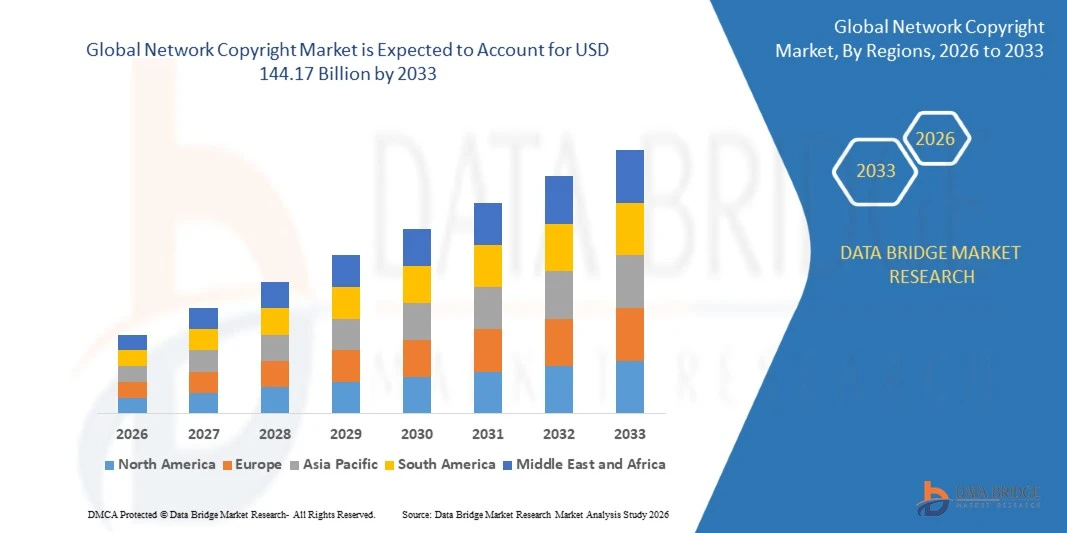
- As per Data Bridge Market Research analysis, the Network Copyright market was valued at USD 48.80 billion in 2025 and is projected to reach USD 144.17 billion by 2033, growing at a CAGR of 14.50% from 2026 to 2033.
- The market is experiencing consistent growth driven by rising demand for digital copyright protection, increasing online content creation, and the rapid expansion of digital media, publishing, software, entertainment, and e-commerce platforms.
- The increasing shift toward digital content distribution, cloud-based platforms, social media publishing, and online intellectual property management, combined with growing concerns regarding unauthorized copying, content piracy, and copyright infringement across interconnected networks, is supporting market adoption. Network copyright solutions are being applied across digital publishing, media and entertainment, software, education, e-commerce, and enterprise environments, offering organizations greater capabilities to monitor, protect, manage, and enforce copyright ownership of digital content across networked platforms.
Market Size & Forecast
- Global Market Value (2025): USD 48.80 Billion
- Expected Market Value (2033): USD 144.17 Billion
- Forecast CAGR (2026–2033): 14.50%
- Leading Region in 2025: North America
- Fastest Growing Region: Asia Pacific
What are the Major Takeaways of the Network Copyright Market?
- North America dominated the network copyright market with the largest revenue share of 35.72% in 2025, supported by high adoption of digital content platforms, established copyright-management infrastructure, strong media and entertainment industries, and widespread use of online video and telecommunications services.
- Asia-Pacific is expected to be the fastest-growing region at a CAGR of 16.18% from 2026 to 2033, fueled by rapid growth in digital content consumption, expanding video streaming platforms, increasing online education and e-commerce activity, and rising adoption of copyright protection and digital rights management solutions.
- The long video segment led the market with a 28.64% share in 2025, driven by the extensive production and distribution of movies, television programs, premium streaming content, corporate videos, and other long-form digital media requiring licensing and copyright protection.
- Short video is the fastest-growing video type, projected to register a CAGR of 18.72%, reflecting the rapid expansion of short-form video platforms, creator-generated content, social media consumption, and increasing requirements for automated copyright identification and claims management.
- The digital rights management (DRM)/encryption/access control segment dominated the solution category with a 30.86% revenue share in 2025, supported by growing demand for secure digital content distribution, access authorization, encryption, piracy prevention, and protection of copyrighted video, music, software, and educational content.
- Copyright for business accounted for 62.18% of the market share in 2025, supported by increasing requirements among publishers, broadcasters, streaming platforms, software providers, telecommunications companies, and other enterprises to manage licensing, royalties, content ownership, and copyright compliance.
- Live streaming and self-media creators are the fastest-growing end-user category, with a CAGR of 18.95%, driven by the rapid expansion of creator economies, user-generated content, live commerce, social media broadcasting, and increasing demand for automated copyright detection and infringement management.
Report Scope and Network Copyright Market Segmentation
|
Attributes |
Network Copyright Key Market Insights |
|
Segments Covered |
|
|
Countries Covered |
North America
Europe
Asia-Pacific
Middle East and Africa
South America
|
|
Key Market Players |
|
|
Market Opportunities |
|
|
Value Added Data Infosets |
In addition to the market insights such as market value, growth rate, market segments, geographical coverage, market players, and market scenario, the market report curated by the Data Bridge Market Research team includes in-depth expert analysis, import/export analysis, pricing analysis, production consumption analysis, and pestle analysis. |
What is the Key Trend in the Network Copyright Market?
- AI-powered copyright identification and content-provenance technologies are increasingly being integrated into digital content platforms, enabling creators and rights holders to identify, authenticate, and manage the use of digital content across networked environments.
- For instance, in September 2024, YouTube announced new synthetic-singing identification technology within Content ID to help eligible partners automatically detect and manage AI-generated content that simulates their singing voices, demonstrating the expansion of automated rights-management capabilities into AI-generated media.
- Digital content provenance is becoming increasingly important alongside conventional copyright-management tools, with technologies such as secure metadata, digital fingerprints, invisible watermarks, and Content Credentials being used to maintain information about content origin and attribution.
- For instance, in October 2024, Adobe introduced its Adobe Content Authenticity web application, allowing creators to attach Content Credentials to digital works and use secure metadata, invisible watermarks, and digital fingerprinting to help maintain attribution as content is shared online.
- Real-time and automated monitoring is also expanding across creator and streaming ecosystems as platforms seek to manage copyright, synthetic media, and unauthorized reuse at large scale.
- For instance, in May 2026, YouTube began rolling out internal signals to automatically identify certain photorealistic AI-generated or altered content when creators have not provided the relevant disclosure, adding automated detection capabilities to its existing content-transparency systems.
- As AI-based content matching, digital fingerprinting, provenance technologies, automated copyright monitoring, and rights-management systems continue to advance, network copyright solutions are expected to expand across video streaming platforms, music platforms, live-streaming services, online education, e-commerce video, gaming, and creator ecosystems.
What are the Key Drivers of the Network Copyright Market?
- The rapid expansion of digital video, music, live streaming, creator-generated content, online education, and other digitally distributed media is increasing the volume of copyrighted material that requires identification, attribution, licensing, and protection across networked platforms.
- For instance, in September 2024, YouTube stated that its Content ID system had processed billions of claims annually and introduced new tools aimed at helping creators and rights holders manage AI-generated content, illustrating the increasing scale of automated rights-management requirements.
- Streaming platforms, media companies, music providers, publishers, and creators are increasingly adopting technologies that combine content matching, digital fingerprints, metadata, licensing information, and automated claims processes to manage the use of copyrighted material.
- For instance, in February 2024, Adobe announced that Google had joined the Coalition for Content Provenance and Authenticity (C2PA) and highlighted the expansion of Content Credentials across digital platforms, software, cameras, and other technologies to improve transparency around the origin and history of digital content.
- The growing use of generative AI is creating additional requirements for identifying synthetic content, establishing content provenance, protecting creator attribution, and managing how copyrighted works are used in digital environments.
- For instance, in November 2025, YouTube expanded its creator-focused AI tools and introduced broader likeness-detection capabilities designed to help creators monitor where their facial likeness appears on the platform and request removal of unauthorized AI-altered videos.
- With digital content increasingly distributed through interconnected platforms and AI-generated media becoming more prevalent, automated copyright identification, licensing administration, content provenance, and infringement-management technologies are supporting demand for network copyright solutions.
What Factors Are Challenging the Growth of the Network Copyright Market?
- Network copyright systems require sophisticated content-matching algorithms, large reference databases, rights metadata, continuous monitoring infrastructure, and integration with multiple digital platforms, increasing implementation and operational complexity.
- For instance, in September 2024, YouTube stated that its new synthetic-singing identification technology was being refined with partners before broader deployment, illustrating the ongoing technical development required to reliably identify AI-generated content within large-scale content libraries.
- These requirements can create challenges related to false matches, ownership verification, rights metadata, territorial licensing, content provenance, dispute management, and maintaining accurate copyright information across large volumes of digital content.
- The increasing use of generative AI also makes it more difficult to establish content origin and distinguish original works from altered, remixed, or synthetically generated material, increasing the need for interoperable identification and provenance standards.
- For instance, in October 2024, Adobe stated that its Content Credentials technology uses secure metadata, invisible watermarks, and digital fingerprinting to help credentials remain connected to content even when metadata is removed or a screenshot is created, highlighting the technical challenges involved in maintaining content provenance across different forms of digital reuse.
- The combination of complex technology requirements, large-scale content processing, ownership verification, potential false matches, fragmented rights information, and evolving AI-generated content formats can constrain the efficiency and scalability of automated network copyright-management systems, particularly for platforms handling diverse digital content across multiple jurisdictions.
How is the Network Copyright Market Segmented?
The network copyright market is segmented on the basis of video type, solution, application, industry, and end user.
- By Video Type
On the basis of video type, the network copyright market is segmented into long video, short video, live streaming, music and gaming content, online education, e-commerce video, and others. The long video segment dominated the market with 28.6% share in 2025, supported by the extensive distribution of films, television programs, documentaries, and other long-form copyrighted content across digital platforms. Long-form content requires comprehensive rights management covering licensing, territorial distribution, content identification, and unauthorized redistribution. Streaming services and digital publishers increasingly use automated content-recognition and rights-management systems to monitor large libraries. The growing movement of traditional media content toward digital distribution is further increasing the requirement for copyright protection and licensing administration.
The short video segment is projected to register the fastest growth at a CAGR of 17.2% from 2026 to 2033, driven by the rapid expansion of creator-generated videos and short-form content across social and entertainment platforms. High volumes of short videos create continuous requirements for automated fingerprinting, matching, claims management, and infringement detection. Increasing use of music, clips, images, and other third-party copyrighted material in short-form videos is also strengthening demand for automated rights-management systems. In September 2024, YouTube announced synthetic-singing identification technology within Content ID to help partners detect and manage AI-generated content that simulates singing voices, demonstrating the expansion of automated identification capabilities across creator content.
- By Solution
On the basis of solution, the network copyright market is segmented into licensing/royalty administration, collective management, digital rights management (DRM)/encryption/access control, fingerprinting/matching/claims management, and notice-and-takedown/compliance/dispute handling. The digital rights management (DRM)/encryption/access control segment dominated the market with 29.8% share in 2025, supported by increasing requirements to control access to copyrighted digital content across streaming, publishing, education, gaming, and enterprise environments. DRM solutions help rights holders control how digital content is accessed, distributed, copied, and consumed. Encryption and access-control technologies are increasingly integrated with streaming and cloud-based content delivery systems. The growing distribution of premium digital video, music, software, and educational content is further strengthening demand for rights-based access controls.
The fingerprinting/matching/claims management segment is projected to register the fastest growth at a CAGR of 16.8% from 2026 to 2033, driven by increasing volumes of digital content requiring automated identification and rights enforcement. Digital fingerprinting enables platforms to compare uploaded material against reference content and identify potential matches at scale. Automated claims management can support monetization, blocking, tracking, and rights-holder notification workflows. In October 2024, Adobe introduced Adobe Content Authenticity with Content Credentials supported by digital fingerprinting, invisible watermarking, and cryptographically signed metadata to maintain attribution and content provenance across digital environments
- By Application
On the basis of application, the network copyright market is segmented into copyright for individual and copyright for business. The copyright for business segment dominated the market with 64.7% share in 2025, supported by the extensive volume of copyrighted material managed by publishers, broadcasters, streaming platforms, music companies, software providers, and other commercial organizations. Businesses require copyright solutions for licensing, content distribution, rights verification, infringement monitoring, royalty administration, and dispute handling. The increasing value of digital content and its distribution across multiple platforms is encouraging organizations to adopt automated copyright-management systems. Integration with enterprise content repositories and digital asset-management platforms is further supporting business adoption.
The copyright for individual segment is projected to register the fastest growth at a CAGR of 16.1% from 2026 to 2033, driven by the rapid expansion of independent creators, musicians, photographers, video producers, and other individual content owners. Individual creators increasingly require accessible technologies for attribution, content identification, unauthorized-use monitoring, and protection against digital copying. Creator-focused tools are also making copyright and content-provenance capabilities available without requiring large enterprise infrastructure. In October 2024, Adobe introduced its Content Authenticity web application to allow individual creators to attach Content Credentials to images, audio, and video and provide attribution information about their work.
- By Industry
On the basis of industry, the network copyright market is segmented into newspapers, broadcasting, motion pictures, radio and TV, sound recordings, software publishers, satellite, wired telecommunications, and wireless telecommunications. The broadcasting segment dominated the market with 18.9% share in 2025, supported by the large-scale distribution of television programs, news, sports, entertainment, and other copyrighted audiovisual content across traditional and digital channels. Broadcasters require systems for content identification, licensing, rights tracking, monitoring, and unauthorized-use management. The transition toward digital broadcasting and online distribution has increased the number of channels through which copyrighted programming can be accessed and redistributed. Increasing integration of broadcasting operations with streaming and connected media platforms is further expanding copyright-management requirements.
The sound recordings segment is projected to register the fastest growth at a CAGR of 17.5% from 2026 to 2033, driven by the rapid expansion of music streaming, short-form video, gaming, podcasts, and creator-generated media. Music rights involve multiple ownership and licensing relationships, increasing the importance of automated identification, royalty administration, and claims management. Digital platforms are increasingly required to identify music usage across large volumes of user-generated content. In September 2024, YouTube announced the expansion of Content ID capabilities through synthetic-singing identification technology designed to detect AI-generated content that simulates artists' singing voices, reflecting growing requirements for automated management of music-related rights.
- By End User
On the basis of end user, the network copyright market is segmented into video streaming platforms, live streaming and self-media creators, music platforms and gaming services, online education providers, e-commerce platforms, and others. The video streaming platforms segment dominated the market with 31.4% share in 2025, supported by the extensive volume of licensed and user-generated video content distributed through streaming services. Streaming platforms require copyright-management technologies for content identification, licensing, access control, territorial restrictions, claims management, and unauthorized redistribution monitoring. The expansion of subscription-based and ad-supported streaming services is increasing the volume of digital content requiring continuous rights administration. Automated content matching and DRM technologies are increasingly integrated into streaming workflows to support large-scale content distribution.
The live streaming and self-media creators segment is projected to register the fastest growth at a CAGR of 18.1% from 2026 to 2033, driven by the rapid expansion of creator-led broadcasting, gaming streams, social video, and real-time digital content. Live environments create additional copyright-management requirements because music, video clips, images, and other third-party content can be incorporated into broadcasts in real time. Automated detection and claims-management technologies can help platforms identify potentially unauthorized content during or after live broadcasts. In May 2026, YouTube began rolling out internal signals to automatically identify certain photorealistic AI-generated content, expanding automated content-identification capabilities alongside its existing creator disclosure systems.
Which Region Holds the Largest Share of the Network Copyright Market?
- North America dominated the Network Copyright market with the largest revenue share of 35.72% in 2025, supported by a mature digital content ecosystem, widespread adoption of streaming and online platforms, established copyright-management infrastructure, and strong demand for digital rights protection across media, software, telecommunications, and creator-driven content.
- The region also benefits from established copyright frameworks, advanced content-identification technologies, and increasing requirements for managing AI-generated and digitally distributed content. In the U.S., the Copyright Office has been actively examining copyright issues related to generative AI, digital replicas, and AI training, further highlighting the growing importance of digital copyright management.
U.S. Network Copyright Market Insight
The U.S. network copyright market is witnessing strong growth due to the expanding use of video streaming, music platforms, social media, software, online education, and other digitally distributed content. The country's mature technology ecosystem and established copyright infrastructure are supporting demand for content identification, licensing, digital rights management, infringement monitoring, and notice-and-takedown solutions. In addition, increasing use of generative AI is creating new requirements for copyright protection, digital replicas, content ownership, and content provenance. In January 2025, the U.S. Copyright Office released Part 2 of its Artificial Intelligence Report addressing the copyrightability of generative AI outputs, highlighting the evolving copyright-management requirements associated with AI-generated content.
Asia-Pacific Network Copyright Market Insight
The Asia-Pacific network copyright market is expected to witness rapid growth, driven by expanding digital content consumption, increasing internet penetration, rising use of video and music streaming platforms, and rapid growth of creator-generated content across countries such as China, India, and Japan. Increasing digital distribution of films, television programs, music, games, short videos, and online educational content is creating greater requirements for copyright monitoring, licensing, content matching, and infringement management.
Japan Network Copyright Market Insight
The Japan network copyright market is witnessing consistent growth due to the country's large digital entertainment industry, advanced technology ecosystem, and increasing international distribution of Japanese films, animation, music, publishing, and gaming content. Growing online consumption and cross-border distribution are increasing the need for digital copyright monitoring, content identification, licensing management, and anti-piracy solutions.
China Network Copyright Market Insight
The China network copyright market is growing rapidly, driven by expanding online video, short-video, gaming, music, publishing, and digital entertainment ecosystems. Increasing volumes of digitally distributed content are strengthening demand for copyright monitoring, content identification, licensing, and infringement-removal solutions. In May 2025, China's National Copyright Administration and other government authorities launched the Jianwang 2025 campaign, focusing on online copyright infringement involving films, television programs, web series, short videos, animation, and games, while requiring relevant network service providers to strengthen protection and respond to infringement notice.
U.K. Network Copyright Market Insight
The U.K. network copyright market is experiencing steady growth, supported by extensive use of online video, music, publishing, broadcasting, software, and digital platforms. Increasing consumption of digitally distributed content is strengthening requirements for copyright protection, online infringement monitoring, and rights management. In June 2025, the U.K. Intellectual Property Office published its 13th Online Copyright Infringement Tracker Survey, examining online copyright infringement, digital behaviors, and attitudes among people aged 12 and above, demonstrating continued regulatory and monitoring attention toward digital copyright use.
Germany Network Copyright Market Insight
The Germany network copyright market is expanding steadily due to increasing digitization of media, online commerce, publishing, broadcasting, and other digital services. The country's strong technology ecosystem and participation in the European digital regulatory framework are supporting requirements for managing legally distributed digital content and addressing unlawful online material. In May 2025, the German Federal Government highlighted that digital service providers operating under the Digital Services Act are required to address unlawful content, strengthening the broader regulatory environment for digital platforms and online content management.
Which are the Top Companies in Network Copyright Market?
The network copyright industry is primarily led by well-established companies, including:
- Adobe Inc. (U.S.)
- Google LLC (U.S.)
- Microsoft Corporation (U.S.)
- Apple Inc. (U.S.)
- Oracle Corporation (U.S.)
- International Business Machines Corporation (U.S.)
- Amazon Web Services, Inc. (U.S.)
- Irdeto B.V. (Netherlands)
- Verimatrix, Inc. (U.S.)
- Intertrust Technologies Corporation (U.S.)
- OpenText Corporation (Canada)
- Seclore Technology Pvt. Ltd. (India)
- Fasoo, Inc. (South Korea)
- Vitrium Systems Inc. (Canada)
- Locklizard Limited (U.K.)
- BuyDRM, Inc. (U.S.)
- EZDRM, Inc. (U.S.)
- Bitmovin Inc. (Austria)
- Kudelski Group (Switzerland)
- Red Points Solutions, S.L. (Spain)
What are Latest Developments in Network Copyright Market?
- In September 2024, YouTube introduced new synthetic-singing identification technology within its Content ID system, designed to help eligible partners automatically detect and manage AI-generated content that simulates their singing voices. The company also announced development of technology to help creators, actors, musicians, and athletes detect and manage AI-generated content depicting their faces, expanding automated rights-management capabilities across digital media.
- In October 2024, Adobe introduced Adobe Content Authenticity, a free web application that enables creators to attach Content Credentials to digital works and establish attribution. The solution combines secure metadata, invisible watermarks, and digital fingerprinting to help keep content credentials connected to digital works even when metadata is removed or content is captured through screenshots, supporting digital content protection and provenance management.
- In April 2025, Adobe launched the public beta of Adobe Content Authenticity, allowing creators to apply Content Credentials to digital work and share information about authorship and attribution. The application also provides creators with an option to signal that their content should not be used to train or be used by generative AI models, strengthening creator-oriented content protection and rights-management capabilities.
- In March 2026, Meta announced enhancements to its Facebook content protection tools to help creators detect potential impersonation across its platforms and submit reports more easily. The company also stated that it was updating its original-content guidelines and expanding measures intended to reduce the distribution of copied or unoriginal creator content, demonstrating the increasing use of automated protection and enforcement tools across social media platforms.
- In October 2025, Spotify announced a collaboration with Sony Music Group, Universal Music Group, Warner Music Group, Merlin, and Believe to develop artist-focused AI music products. Spotify stated that the collaboration would develop products through agreements with record labels, distributors, and music publishers, with an emphasis on rights, consent, and compensation, highlighting the growing integration of licensing and rights-management frameworks into AI-enabled music platforms.

- Interactive Data Analysis Dashboard
- Company Analysis Dashboard for high growth potential opportunities
- Research Analyst Access for customization & queries
- Competitor Analysis with Interactive dashboard
- Latest News, Updates & Trend analysis
- Harness the Power of Benchmark Analysis for Comprehensive Competitor Tracking
Data collection and base year analysis are done using data collection modules with large sample sizes. The stage includes obtaining market information or related data through various sources and strategies. It includes examining and planning all the data acquired from the past in advance. It likewise envelops the examination of information inconsistencies seen across different information sources. The market data is analysed and estimated using market statistical and coherent models. Also, market share analysis and key trend analysis are the major success factors in the market report. To know more, please request an analyst call or drop down your inquiry.
The key research methodology used by DBMR research team is data triangulation which involves data mining, analysis of the impact of data variables on the market and primary (industry expert) validation. Data models include Vendor Positioning Grid, Market Time Line Analysis, Market Overview and Guide, Company Positioning Grid, Patent Analysis, Pricing Analysis, Company Market Share Analysis, Standards of Measurement, Global versus Regional and Vendor Share Analysis. To know more about the research methodology, drop in an inquiry to speak to our industry experts.
Data Bridge Market Research is a leader in advanced formative research. We take pride in servicing our existing and new customers with data and analysis that match and suits their goal. The report can be customized to include price trend analysis of target brands understanding the market for additional countries (ask for the list of countries), clinical trial results data, literature review, refurbished market and product base analysis. Market analysis of target competitors can be analyzed from technology-based analysis to market portfolio strategies. We can add as many competitors that you require data about in the format and data style you are looking for. Our team of analysts can also provide you data in crude raw excel files pivot tables (Fact book) or can assist you in creating presentations from the data sets available in the report.