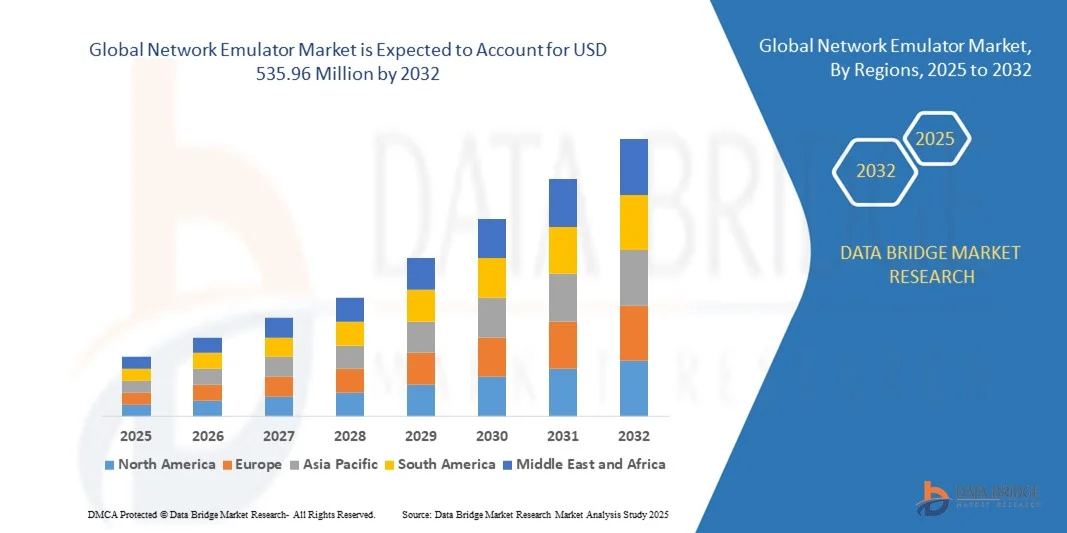
Network Emulator Market Size
- The global network emulator market size was valued at USD 288.50 million in 2024 and is expected to reach USD 535.96 million by 2032, at a CAGR of 8.5% during the forecast period
- The market growth is largely fueled by the increasing deployment of advanced network technologies, including 5G, IoT, and cloud-based infrastructures, which demand sophisticated testing and validation environments for optimal performance
- Furthermore, rising adoption of network emulators by enterprises and service providers to simulate complex network conditions, ensure reliable connectivity, and reduce operational costs is driving significant growth in the network emulator market
Network Emulator Market Analysis
- Network emulators are software or hardware solutions that replicate real-world network conditions, enabling testing of applications, devices, and services under controlled and repeatable scenarios. They support a wide range of protocols, network topologies, and traffic patterns to validate performance, scalability, and reliability
- The growing demand for network emulators is primarily fueled by the need for efficient network testing, accelerated 5G deployment, and the increasing complexity of enterprise and telecom networks requiring precise performance assessment
- North America dominated the network emulator market with a share of 37.5% in 2024, due to rising demand for network testing, performance optimization, and secure connectivity solutions across enterprises and telecom providers.
- Asia-Pacific is expected to be the fastest growing region in the network emulator market during the forecast period due to increasing digitalization, 5G adoption, and cloud and IoT deployments across countries such as China, Japan, and India
- SD-WAN segment dominated the market with a market share of 42% in 2024, due to enterprises’ growing need for optimized, secure, and cost-effective wide-area network management. SD-WAN solutions allow organizations to centrally manage traffic, ensure high-quality application performance, and enhance network reliability, which makes them particularly attractive for large-scale enterprise deployments. Furthermore, the integration of SD-WAN with network emulators enables IT teams to simulate complex network scenarios, test configurations, and validate performance before deployment, reducing operational risks. The segment’s dominance is also supported by the increasing adoption of hybrid work models, which require seamless and resilient connectivity across multiple locations
Report Scope and Network Emulator Market Segmentation
|
Attributes |
Network Emulator Key Market Insights |
|
Segments Covered |
|
|
Countries Covered |
North America
Europe
Asia-Pacific
Middle East and Africa
South America
|
|
Key Market Players |
|
|
Market Opportunities |
|
|
Value Added Data Infosets |
In addition to the market insights such as market value, growth rate, market segments, geographical coverage, market players, and market scenario, the market report curated by the Data Bridge Market Research team includes in-depth expert analysis, import/export analysis, pricing analysis, production consumption analysis, and pestle analysis. |
Network Emulator Market Trends
Adoption of 5G and IoT-Driven Network Testing
- The network emulator market is experiencing rapid adoption fueled by the expansion of 5G networks and IoT ecosystems, both of which demand highly reliable, scalable, and latency-sensitive testing environments. Emulators are vital for replicating real-world conditions, ensuring performance reliability before deployment in mission-critical networks
- For instance, Spirent Communications has developed advanced 5G network emulation tools for real-time validation of mobile devices and IoT systems, while Keysight Technologies offers IoT-focused emulation platforms that replicate complex multi-device environments. These solutions are helping enterprises accelerate innovation in next-generation network deployments
- With 5G enabling ultra-low latency and massive connectivity, network emulators are ensuring quality of service for applications such as autonomous vehicles, AR/VR, and smart factories. Simulation of these environments helps developers identify failures early and carry out proactive optimization before large-scale rollout
- In addition, the growth of IoT devices is creating diverse network conditions across industries such as healthcare, manufacturing, and logistics. Emulators capable of replicating heterogeneous environments enable seamless integration and ensure device-to-device communication under real-world stress scenarios
- The ability to test interoperability, security, and performance across multiple protocols makes network emulation solutions fundamental in accelerating 5G and IoT innovation. Emulation ensures reduced risks, faster deployment, and minimized operational disruptions for enterprises adopting these advanced networks
- The adoption of 5G and IoT-driven testing through advanced emulators signals a critical evolution in telecom and enterprise R&D. The growing role of emulators highlights their strategic importance in ensuring robust connectivity, seamless integration, and long-term scalability of next-generation communication systems
Network Emulator Market Dynamics
Driver
Rising Need for Efficient and Cost-Effective Network Validation
- The increasing demand for efficient and cost-effective validation of networks is a primary driver fueling the network emulator market. Enterprises and telecom operators rely on emulators to reduce risks, lower testing costs, and streamline deployments for complex networks without physically replicating the entire infrastructure
- For instance, VIAVI Solutions provides cost-optimized emulation platforms that reduce the need for expensive real-world infrastructure testing, helping operators accelerate 5G rollout with accurate validation at lower costs. Such solutions offer enterprises agility and reliability in testing environments while cutting operational expenses
- Network emulators help organizations avoid costly delays by detecting vulnerabilities and bottlenecks during pre-deployment testing. This ensures better scalability and faster delivery of services for industries undergoing digital transformation
- In addition, the cost-effectiveness of emulators supports enterprise adoption across varied industries. They allow simulations of thousands of virtual endpoints or traffic conditions without the need for extensive physical hardware setups, providing both flexibility and efficiency
- The rising demand for cost-effective network validation reflects the growing need for efficient solutions that combine performance assurance with cost savings. This driver strongly supports global adoption of emulation platforms as businesses demand more agile, scalable, and reliable network solutions
Restraint/Challenge
High Complexity and Cost of Advanced Network Emulation Solutions
- The complexity and high cost of advanced network emulation solutions pose significant challenges to market adoption. Sophisticated platforms require skilled professionals, high investment in infrastructure, and advanced technical expertise, limiting adoption in smaller firms or price-sensitive industries
- For instance, Keysight Technologies’ advanced emulation platforms offer exceptional accuracy for 5G and hyperscale networks but involve substantial capital investment and integration costs, making them less accessible to enterprises with limited budgets. This disparity creates adoption gaps across regions and sectors
- Integrating high-capacity emulators into complex enterprise systems often demands significant customization and technical expertise. This complexity results in prolonged deployment times and higher training costs for organizations, restraining immediate benefits
- In addition, the ongoing advancements in 5G and IoT introduce constant updates in emulation technology, which drives continuous capital investments for organizations. Small-to-medium businesses often lack the financial resources to keep up with these evolving requirements
- Addressing these challenges requires the development of more affordable, flexible, and user-friendly emulation systems. Reducing complexity while ensuring accuracy will be critical for enabling broader adoption and unlocking the full potential of network emulators across industries
Network Emulator Market Scope
The market is segmented on the basis of application type and vertical.
- By Application Type
On the basis of application type, the network emulator market is segmented into SD-WAN, Cloud, IoT, and Others. The SD-WAN segment dominated the largest market revenue share of 42% in 2024, driven by enterprises’ growing need for optimized, secure, and cost-effective wide-area network management. SD-WAN solutions allow organizations to centrally manage traffic, ensure high-quality application performance, and enhance network reliability, which makes them particularly attractive for large-scale enterprise deployments. Furthermore, the integration of SD-WAN with network emulators enables IT teams to simulate complex network scenarios, test configurations, and validate performance before deployment, reducing operational risks. The segment’s dominance is also supported by the increasing adoption of hybrid work models, which require seamless and resilient connectivity across multiple locations.
The Cloud segment is anticipated to witness the fastest growth rate from 2025 to 2032, fueled by the rising adoption of cloud-native applications and services across enterprises. Cloud-based network emulators provide scalable, flexible, and cost-efficient testing environments without the need for extensive on-premises infrastructure. Organizations leverage cloud emulators to simulate diverse network conditions, troubleshoot performance issues, and ensure smooth service delivery for distributed applications. The growing trend of multi-cloud strategies, combined with the need for rapid deployment and testing of network configurations, further accelerates the adoption of cloud-based network emulators.
- By Vertical
On the basis of vertical, the network emulator market is segmented into Telecommunications, BFSI, Government and Defense, and Others. The Telecommunications segment held the largest market revenue share in 2024, driven by telecom operators’ demand for robust network planning, optimization, and quality assurance. Network emulators enable telecom providers to simulate traffic loads, latency conditions, and packet loss scenarios, allowing efficient deployment of 5G, LTE, and broadband services. The segment benefits from continuous network modernization initiatives and the need to reduce downtime while ensuring superior customer experience. Telecom companies also use emulators to validate network configurations, manage capacity planning, and mitigate risks associated with service interruptions, reinforcing the segment’s leading position in the market.
The BFSI vertical is expected to witness the fastest CAGR from 2025 to 2032, fueled by financial institutions’ increasing reliance on secure, low-latency networks for digital banking, online transactions, and real-time trading platforms. Network emulators allow BFSI organizations to test mission-critical applications under simulated network conditions, ensuring uninterrupted service and regulatory compliance. The rising adoption of cloud banking, mobile banking applications, and AI-driven transaction systems further drives the demand for network emulators in this sector. In addition, stringent requirements for cybersecurity, latency monitoring, and high network reliability contribute to the accelerated growth of this vertical.
Network Emulator Market Regional Analysis
- North America dominated the network emulator market with the largest revenue share of 37.5% in 2024, driven by rising demand for network testing, performance optimization, and secure connectivity solutions across enterprises and telecom providers
- Organizations in the region highly value the ability to simulate complex network conditions, validate configurations, and ensure reliability before deployment, particularly for SD-WAN, cloud, and IoT networks
- The widespread adoption is further supported by a technologically advanced IT infrastructure, high cloud and SD-WAN penetration, and strong enterprise investment in network performance management, establishing network emulators as essential tools across telecommunications, BFSI, and government sectors
U.S. Network Emulator Market Insight
The U.S. network emulator market captured the largest revenue share in 2024 within North America, fueled by the rapid adoption of SD-WAN, cloud services, and IoT networks. Enterprises and telecom operators prioritize testing and optimizing network performance, latency, and reliability. Growing investments in 5G deployment, virtualization, and cloud-native applications are driving demand for advanced network emulation solutions. Moreover, the increasing need for secure, low-latency connectivity for mission-critical applications further propels market growth, with businesses leveraging emulators to simulate and troubleshoot network scenarios before real-world deployment.
Europe Network Emulator Market Insight
The Europe network emulator market is projected to expand at a substantial CAGR during the forecast period, driven by digital transformation initiatives, stringent network performance standards, and the need for secure, resilient IT infrastructure. Enterprises and telecom operators are adopting network emulators to optimize cloud, SD-WAN, and IoT networks, ensuring seamless service delivery and compliance with regulatory requirements. Increasing urbanization, adoption of connected devices, and investments in next-generation networks are also fostering market growth across the region.
U.K. Network Emulator Market Insight
The U.K. network emulator market is expected to grow at a noteworthy CAGR during the forecast period, supported by the increasing adoption of cloud services, SD-WAN networks, and IoT deployments across enterprises. The demand for secure, reliable, and high-performance network infrastructure is encouraging organizations to leverage network emulation solutions. In addition, the U.K.’s robust IT infrastructure, advanced telecom network, and thriving technology ecosystem are driving growth, enabling organizations to test and validate networks effectively before deployment.
Germany Network Emulator Market Insight
The Germany network emulator market is anticipated to expand at a considerable CAGR during the forecast period, driven by a focus on network optimization, secure connectivity, and digital transformation in both enterprises and government institutions. The country’s advanced IT infrastructure, combined with investments in cloud computing, SD-WAN, and next-generation networks, promotes the adoption of network emulators. Emphasis on cybersecurity, compliance, and reliable network performance further accelerates market demand, particularly among telecommunications and BFSI sectors.
Asia-Pacific Network Emulator Market Insight
The Asia-Pacific network emulator market is poised to grow at the fastest CAGR during the forecast period of 2025 to 2032, fueled by increasing digitalization, 5G adoption, and cloud and IoT deployments across countries such as China, Japan, and India. Enterprises and telecom operators are investing in network emulation to simulate network conditions, optimize performance, and ensure reliable service delivery. The growing demand for secure, low-latency networks in BFSI, manufacturing, and government sectors, coupled with government initiatives supporting smart cities and technological advancement, is driving the adoption of network emulators across the region.
Japan Network Emulator Market Insight
The Japan network emulator market is gaining momentum due to rapid technological adoption, high demand for secure and efficient network operations, and the proliferation of SD-WAN, cloud, and IoT networks. Japanese enterprises and telecom providers are leveraging emulators to simulate network conditions, test configurations, and ensure reliable connectivity. The country’s emphasis on innovation, digital transformation, and high-quality service delivery is fueling market growth, particularly in telecommunications and BFSI verticals.
China Network Emulator Market Insight
The China network emulator market accounted for the largest market revenue share in Asia-Pacific in 2024, driven by rapid urbanization, increasing enterprise digitalization, and extensive adoption of cloud, SD-WAN, and IoT networks. China’s growing demand for secure, high-performance networks in BFSI, government, and telecom sectors, combined with investments in 5G and smart city projects, is propelling the market. Domestic vendors and increasing availability of cost-effective network emulation solutions are further accelerating market adoption.
Network Emulator Market Share
The network emulator industry is primarily led by well-established companies, including:
- Spirent Communications (U.K.)
- Keysight Technologies (U.S.)
- InterWorking Labs, Inc. dba IWL (U.S.)
- VMware, Inc (U.S.)
- Qosmotec Software Solutions GmbH (Germany)
- Apposite Technologies (U.S.)
- Itrinegy (U.K)
- Polaris Networks (U.S.)
- PACKETSTORM COMMUNICATIONS, INC. (U.S.)
- Aukua Systems Inc. (U.S.)
- Calnex Solutions Limited (U.K.)
- SolarWinds Worldwide, LLC (U.S.)
- GigaNet Systems Inc. (U.S.)
- SCALABLE Network Technologies, Inc. (U.S.)
- Valid8.com Inc. (U.S.)
- W2BI INCORPORATED (U.S.)
Latest Developments in Global Network Emulator Market
- In June 2025, Calnex Solutions announced the SNE-X with 400GbE interfaces, marking the first network emulator of its kind. This launch significantly enhances the market by enabling enterprises and research institutions to test AI infrastructure and other high-performance computing networks under complex conditions. The SNE-X 400G allows organizations to validate large-scale, high-speed network deployments more efficiently, positioning Calnex as a key innovator in high-capacity network emulation solutions and driving market growth for advanced testing tools
- In April 2025, Spirent Communications released the Octobox STA Automation Package, the industry’s first solution to fully automate performance testing and validation of client stations and devices on Wi-Fi 6/6E and Wi-Fi 7 networks. By replacing time-consuming, inconsistent, and resource-intensive manual testing with structured, repeatable, and scalable automated workflows, this development is expected to accelerate adoption of network emulation solutions across enterprises and service providers, reinforcing the market’s shift toward automation and efficiency in wireless network testing
- In April 2025, Turn/River Capital acquired SolarWinds to expand capabilities in providing simple, secure, and powerful solutions for hybrid and multi-cloud environments. This acquisition strengthens the network emulator market by integrating advanced monitoring, emulation, and testing tools into cloud-native infrastructures, enabling organizations to simulate complex network conditions across hybrid setups and increasing the demand for versatile and scalable network emulation solutions
- In February 2025, Spirent Communications collaborated with the Centre of Excellence in Wireless Technology (CEWiT) to support the Indian government’s “Bharat 6G Vision,” positioning India as a global leader in 6G technology. Spirent’s network emulation technology is being leveraged to test and emulate 5G core network functionalities, paving the way for next-generation 6G innovation. This initiative highlights the strategic role of network emulators in national technology development and is expected to accelerate market adoption in India and other emerging markets pursuing advanced wireless networks
- In March 2023, Spirent Communications launched the Landslide Network Emulator, providing advanced emulation capabilities for testing and validation of 5G networks. This launch strengthened the market by enabling service providers and enterprises to simulate real-world 5G network conditions, optimize network performance, and ensure reliability prior to deployment, thereby reinforcing Spirent’s position in the rapidly growing 5G network emulation segment

- Interactive Data Analysis Dashboard
- Company Analysis Dashboard for high growth potential opportunities
- Research Analyst Access for customization & queries
- Competitor Analysis with Interactive dashboard
- Latest News, Updates & Trend analysis
- Harness the Power of Benchmark Analysis for Comprehensive Competitor Tracking
Data collection and base year analysis are done using data collection modules with large sample sizes. The stage includes obtaining market information or related data through various sources and strategies. It includes examining and planning all the data acquired from the past in advance. It likewise envelops the examination of information inconsistencies seen across different information sources. The market data is analysed and estimated using market statistical and coherent models. Also, market share analysis and key trend analysis are the major success factors in the market report. To know more, please request an analyst call or drop down your inquiry.
The key research methodology used by DBMR research team is data triangulation which involves data mining, analysis of the impact of data variables on the market and primary (industry expert) validation. Data models include Vendor Positioning Grid, Market Time Line Analysis, Market Overview and Guide, Company Positioning Grid, Patent Analysis, Pricing Analysis, Company Market Share Analysis, Standards of Measurement, Global versus Regional and Vendor Share Analysis. To know more about the research methodology, drop in an inquiry to speak to our industry experts.
Data Bridge Market Research is a leader in advanced formative research. We take pride in servicing our existing and new customers with data and analysis that match and suits their goal. The report can be customized to include price trend analysis of target brands understanding the market for additional countries (ask for the list of countries), clinical trial results data, literature review, refurbished market and product base analysis. Market analysis of target competitors can be analyzed from technology-based analysis to market portfolio strategies. We can add as many competitors that you require data about in the format and data style you are looking for. Our team of analysts can also provide you data in crude raw excel files pivot tables (Fact book) or can assist you in creating presentations from the data sets available in the report.