


Network Infrastructure Market Size
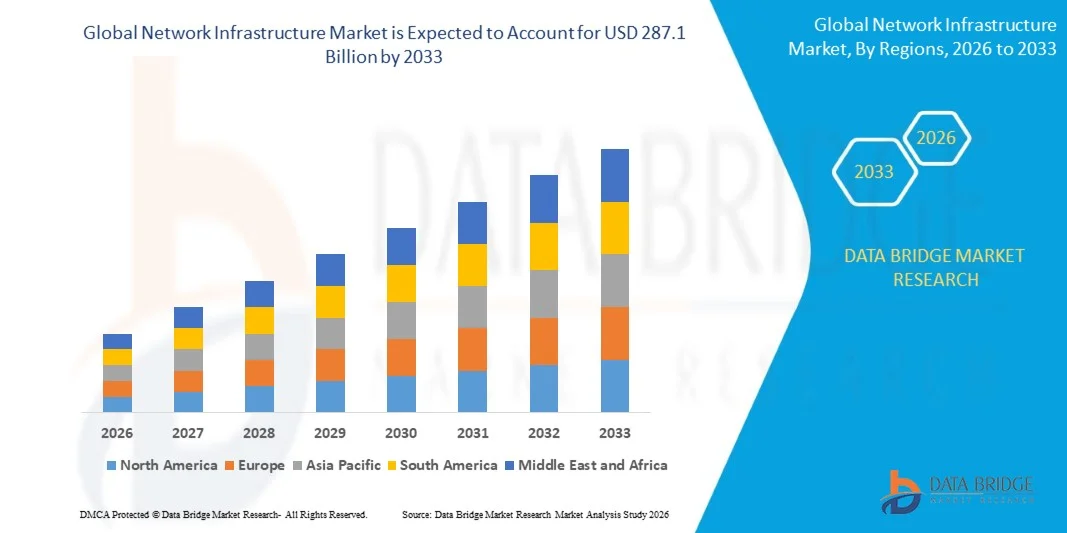
- The global Network Infrastructure market size was valued at USD 98 billion in 2025and is expected to reach USD 287.1 billion by 2033, at a CAGR of 7.5% during the forecast period
- The market growth is primarily driven by the exponential increase in data traffic, rapid adoption of cloud computing, and the global rollout of 5G networks, along with rising demand for high-speed connectivity across enterprises and telecom sectors
- In addition, increasing digital transformation initiatives, growing adoption of IoT and edge computing, and continuous advancements in software-defined networking (SDN) and network virtualization are positioning network infrastructure as a critical backbone of modern digital ecosystems, thereby significantly accelerating overall market growth
Network Infrastructure Market Analysis
- Network infrastructure, which enables seamless data transmission, communication, and connectivity across enterprises, telecom networks, and data centers, serves as a critical backbone of modern digital ecosystems due to its ability to support high-speed data flow, scalability, and real-time operations
- The escalating demand for network infrastructure is primarily driven by the exponential growth in data traffic, increasing adoption of cloud computing, expansion of IoT devices, and rapid deployment of 5G networks, along with rising digital transformation initiatives across industries
- North America dominated the Network Infrastructure market in 2025, accounting for approximately 38.9% of the global market share, supported by advanced IT and telecom infrastructure, a strong presence of key technology providers, and high adoption of cloud computing, artificial intelligence (AI), and data center solutions. The United States remains a major hub for innovation, hyperscale data centers, and large-scale network deployments.
- Asia-Pacific accounted for and is expected to be the fastest-growing region, registering a CAGR of around 12.7% during the forecast period, driven by rapid urbanization, expanding internet penetration, increasing government investments in digital infrastructure, and growing adoption of 5G networks, smart city initiatives, cloud services, and enterprise digital transformation across countries such as China, India, Indonesia, and Vietnam.
- The Hardware segment (including routers, switches, gateways, and networking equipment) dominated the Network Infrastructure market in 2025, capturing approximately 57.4% of total market revenue, owing to its critical role in ensuring network connectivity, traffic management, and data transmission. Increasing enterprise demand for high-performance networking equipment, continuous upgrades to support bandwidth-intensive applications, and expansion of data center and telecom infrastructure are further strengthening the segment's leadership.
Report Scope and Network Infrastructure Market Segmentation
|
Attributes |
Network Infrastructure Key Market Insights |
|
Segments Covered |
|
|
Countries Covered |
North America · U.S. · Canada · Mexico Europe · Germany · France · U.K. · Netherlands · Switzerland · Belgium · Russia · Italy · Spain · Turkey · Rest of Europe Asia-Pacific · China · Japan · India · South Korea · Singapore · Malaysia · Australia · Thailand · Indonesia · Philippines · Rest of Asia-Pacific Middle East and Africa · Saudi Arabia · U.A.E. · South Africa · Egypt · Israel · Rest of Middle East and Africa South America · Brazil · Argentina · Rest of South America |
|
Key Market Players |
|
|
Market Opportunities |
· Rapid expansion of edge computing and IoT ecosystems. · Growing investments in digital transformation and broadband expansion in emerging economies |
|
Value Added Data Infosets |
In addition to the insights on market scenarios such as market value, growth rate, segmentation, geographical coverage, and major players, the market reports curated by the Data Bridge Market Research also include in-depth expert analysis, geographically represented company-wise production and capacity, network layouts of distributors and partners, detailed and updated price trend analysis and deficit analysis of supply chain and demand.. |
Network Infrastructure Market Trends
“Rapid growth in data traffic & internet usage”
- A significant and accelerating driver in the global network infrastructure market is the rapid growth in data traffic and internet usage, driven by increasing digitalization, widespread smartphone adoption, and the proliferation of connected devices across both developed and emerging economies
- For instance, companies such as Cisco Systems and Huawei Technologies have reported exponential growth in global IP traffic, fueled by high-bandwidth applications such as video streaming, online gaming, and cloud-based enterprise operations
- The surge in data consumption has necessitated continuous upgrades in network capacity, including the deployment of high-performance routers, switches, and fiber-optic infrastructure to ensure seamless connectivity and low latency
- Increasing usage of bandwidth-intensive applications such as 4K/8K video streaming, virtual reality (VR), and remote collaboration tools is placing immense pressure on existing network systems, thereby accelerating demand for advanced infrastructure solutions. The expansion of cloud computing and data center ecosystems further contributes to rising data traffic, as enterprises increasingly rely on real-time data processing, storage, and multi-cloud environments for business continuity and scalability. This surge in internet usage is also driven by the growing adoption of IoT devices, smart homes, and industrial automation, all of which require robust and reliable network infrastructure to support continuous data exchange
- The increasing need for high-speed, low-latency, and scalable network solutions is pushing telecom operators and enterprises to invest heavily in next-generation infrastructure, including 5G networks, edge computing, and software-defined networking (SDN). As a result, the rapid growth in data traffic and internet usage is acting as a fundamental driver, reshaping network architecture and accelerating innovation in intelligent, high-capacity, and future-ready network infrastructure systems
Network Infrastructure Market Dynamics
Driver
“Adoption of Software-Defined Networking (SDN) & Network Virtualization”
- The global network infrastructure market is the increasing adoption of Software-Defined Networking (SDN) and network virtualization, which is transforming traditional hardware-centric networks into more agile, software-driven environments. SDN enables centralized network control by separating the control plane from the data plane, allowing organizations to dynamically manage, configure, and optimize network resources in real time
- For instance, companies such as Cisco Systems and VMware offer SDN-based solutions that allow enterprises to automate network provisioning, reduce manual intervention, and improve operational efficiency. Network virtualization allows multiple virtual networks to run on a shared physical infrastructure, significantly reducing hardware dependency and enabling better resource utilization across data centers and cloud environments
- The integration of SDN with cloud computing and edge technologies supports seamless scalability, allowing enterprises to quickly adapt to changing workloads and traffic demands without significant infrastructure upgrades. These technologies enhance cost efficiency by minimizing capital expenditure on physical equipment while lowering operational costs through automation and simplified network management
- The growing demand for flexible, scalable, and programmable network architectures across enterprises, telecom operators, and data centers is accelerating the shift toward SDN and virtualization-driven infrastructure
- This transition toward software-defined and virtualized networking is fundamentally reshaping how modern networks are designed, deployed, and managed, supporting digital transformation initiatives across industries
Restraint/Challenge
“High initial investment & deployment costs”
- The global network infrastructure market is the high initial investment required for deploying advanced networking systems, which can limit adoption, particularly among small and medium-sized enterprises
- For instance, establishing modern network infrastructure such as fiber-optic networks, high-performance routers, switches, and data centers involves substantial capital expenditure, along with costs related to installation, licensing, and maintenance
- The deployment of next-generation technologies, including 5G networks and software-defined infrastructure, further increases upfront costs due to the need for specialized equipment, skilled workforce, and continuous upgrades
- High infrastructure costs also extend to energy consumption, cooling systems, and physical space requirements in data centers, adding to the overall financial burden for organizations
- These financial constraints can delay or restrict digital transformation initiatives, especially in developing regions where budget limitations and return-on-investment concerns are more pronounced
- Additionally, ongoing operational expenses, including system upgrades, cybersecurity measures, and network management, further increase the total cost of ownership over time
- As a result, despite strong demand for high-speed and reliable connectivity, the high cost barrier remains a significant challenge, slowing down widespread adoption and scalability of advanced network infrastructure solutions
Network Infrastructure Market Scope
The market is segmented on the basis of Component, Infrastructure Type, End User Industry.
- By Component
On the basis of component, the global network infrastructure market is segmented into Hardware, Software, and Services. Hardware dominated the global Network Infrastructure market in 2025, accounting for approximately 57.4% of total market revenue, driven by its fundamental role in enabling physical network connectivity across enterprises, telecom networks, and data centers. Hardware components such as routers, switches, firewalls, and servers are widely adopted due to their critical importance in managing high-speed data transmission, ensuring network reliability, and supporting bandwidth-intensive applications. Enterprises and service providers continue to invest heavily in upgrading networking equipment to accommodate growing data traffic, cloud computing, and 5G deployment.
Software accounted and is expected to witness the fastest CAGR of around 13.8% during the forecast period, fueled by the increasing adoption of software-defined networking (SDN), network function virtualization (NFV), cloud-based network management solutions, and AI-driven network analytics.
- By Infrastructure Type
On the basis of infrastructure type, the global network infrastructure market is segmented into Access Network Infrastructure, Core Network Infrastructure, and Edge Network Infrastructure. Core Network Infrastructure dominated the Network Infrastructure market in 2025, capturing approximately 46.8% of total market revenue, driven by its critical role in managing, routing, and processing large volumes of data across telecom and enterprise networks. Increasing deployment of 5G networks, rising internet traffic, and growing demand for high-speed connectivity continue to support segment growth.
The edge network infrastructure segment is expected to witness the fastest growth during the forecast period, fueled by the rapid expansion of IoT devices, real-time applications, and the need for low-latency data processing. Edge Network Infrastructure accounted and is projected to witness the fastest CAGR of approximately 14.5% during the forecast period, fueled by rapid growth in IoT deployments, edge computing, autonomous systems, smart cities, industrial automation, and real-time analytics applications requiring low-latency data processing.
- By End User Industry
On the basis of end-user industry, the global network infrastructure market is segmented into IT & Telecommunications, BFSI, Healthcare, Retail & E-commerce, Manufacturing, and Government & Defense. IT & Telecommunications dominated the global Network Infrastructure market in 2025, representing approximately 41.9% of total market revenue, driven by large-scale deployment of network infrastructure to support cloud computing, data centers, enterprise networking, and 5G connectivity. Telecom operators and IT service providers continue to invest heavily in advanced networking technologies to meet increasing bandwidth and connectivity demands.
Healthcare accounted and is expected to witness the fastest CAGR of around 14.2% during the forecast period, driven by increasing adoption of telemedicine, connected healthcare devices, electronic health records (EHRs), AI-enabled healthcare systems, and secure healthcare data exchange platforms. Rising healthcare digitization and cybersecurity requirements are further accelerating infrastructure investments in this sector.
Network Infrastructure Market Regional Analysis
- North America dominated the network infrastructure market with the largest revenue share, supported by advanced IT and telecom ecosystems, high adoption of cloud computing and data center technologies, and a strong presence of leading technology companies and network solution providers
- Enterprises and service providers in the region place significant emphasis on high-speed connectivity, data security, and scalable network solutions, leading to widespread adoption of advanced infrastructure such as 5G networks, fiber-optic systems, and software-defined networking across industries
- This strong market position is further supported by high digital investment, rapid technological innovation, and increasing demand for AI-driven and cloud-native networking solutions, establishing network infrastructure as a critical backbone for digital transformation across enterprise and telecom environments.
U.S. Network Infrastructure Market Insight
The U.S. network infrastructure market is highly advanced, driven by strong demand for high-speed connectivity, widespread cloud adoption, and continuous investments in 5G and data center expansion. The presence of leading technology companies and telecom operators supports rapid innovation and large-scale deployment of next-generation networking solutions. Additionally, increasing adoption of AI, IoT, and edge computing is accelerating infrastructure upgrades, while growing focus on cybersecurity and network optimization further strengthens market growth across enterprise and service provider segments.
Europe Network Infrastructure Market Insight
The Europe network infrastructure market is witnessing steady growth, driven by increasing investments in 5G deployment, fiber-optic expansion, and cloud-based services across key economies such as Germany, the UK, and France. Strong regulatory support for digital transformation, along with rising demand for secure and high-speed connectivity, is encouraging enterprises to upgrade their networking systems. Additionally, the growing focus on data privacy, edge computing, and smart city initiatives is further strengthening the region’s network infrastructure landscape.
U.K. Network Infrastructure Market Insight
The U.K. network infrastructure market is experiencing steady growth, driven by increasing investments in 5G deployment, full-fiber broadband expansion, and rising adoption of cloud-based services across enterprises. Strong government initiatives supporting digital transformation and nationwide connectivity are accelerating infrastructure upgrades. Additionally, growing demand for secure, high-speed networks across sectors such as finance, healthcare, and retail is boosting adoption. The presence of advanced telecom operators and continuous innovation in software-defined networking further strengthens the market outlook in the U.K.
Germany Network Infrastructure Market Insight
Germany’s network infrastructure market is experiencing steady growth, driven by strong government support for digital transformation and increasing investments in fiber-optic and 5G network expansion. The country’s advanced industrial base and focus on Industry 4.0 are accelerating demand for high-speed, reliable connectivity across manufacturing and enterprise sectors. Additionally, rising adoption of cloud computing, data centers, and IoT solutions is strengthening infrastructure development, while regulatory initiatives and public-private partnerships continue to enhance nationwide broadband coverage and network modernization.
Asia-Pacific Network Infrastructure Market Insight
The Asia-Pacific network infrastructure market is witnessing rapid growth, driven by increasing internet penetration, large-scale 5G deployments, and rising investments in digital transformation across emerging economies such as China and India. Expanding data center infrastructure, growth in cloud adoption, and government-led smart city initiatives are further accelerating demand. Additionally, the surge in IoT devices and mobile data traffic is pushing telecom operators and enterprises to upgrade network capabilities, positioning the region as the fastest-growing market globally.
Japan Network Infrastructure Market Insight
Japan’s network infrastructure market is characterized by advanced technological adoption and strong government support for digital transformation. The country is a global leader in 5G deployment, high-speed fiber-optic networks, and smart city initiatives, driving continuous demand for robust and scalable network solutions. Increasing data consumption, expansion of cloud services, and integration of IoT across industries further accelerate growth. Additionally, Japan’s focus on automation, Industry 4.0, and secure digital ecosystems strengthens the need for reliable and high-performance network infrastructure.
India Network Infrastructure Market Insight
India’s network infrastructure market is witnessing strong growth, driven by rapid digitalization, expanding internet penetration, and large-scale deployment of 4G and 5G networks. Increasing adoption of cloud computing, data centers, and IoT solutions across enterprises is fueling demand for advanced networking systems. Government initiatives such as Digital India and rising investments in fiber-optic infrastructure further support market expansion. Additionally, growing demand for high-speed connectivity in urban and rural areas is strengthening India’s position as a key emerging market.
Network Infrastructure Market Share
The Network Infrastructure industry is primarily led by well-established companies, including:
- Cisco Systems, Inc. (U.S)
- Huawei Technologies Co., Ltd. (China)
- Nokia Corporation (Finland)
- Juniper Networks, Inc. (U.S)
- ZTE Corporation (China)
- Broadcom Inc. (U.S)
- Hewlett Packard Enterprise (U.S)
- Aruba Networks (U.S)
- Avaya Inc. (U.S)
- ALE International (France)
- Ericsson (Sweden)
- NEC Corporation (Japan)
- Fujitsu Limited (Japan)
- IBM Corporation (U.S)
- Dell Technologies (U.S)
What are the Recent Developments in Global network infrastructure market?
- In April 2026, América Móvil’s Claro acquired a majority stake in Desktop in 2026 to enhance its broadband and fiber network footprint. This move reflects a broader industry trend toward consolidation, enabling companies to improve service coverage, boost connectivity offerings, and remain competitive in a rapidly evolving digital landscape.
- In April 2026, Cisco Systems, Inc. expanded its sovereign network infrastructure portfolio across Europe to address growing concerns around data privacy and regulatory compliance. The initiative focuses on delivering secure, locally managed, and on-premise infrastructure solutions, enabling organizations to maintain greater control over sensitive data while aligning with regional data sovereignty requirements and strengthening trust in digital operations.
- In March 2026, Ericsson securing major deployment agreements with telecom operators like Virgin Media O2. These collaborations highlight the increasing investments in next-generation mobile networks, aimed at enhancing connectivity, expanding coverage, and supporting high-speed, low-latency communication services.
- In February 2026, NVIDIA collaborated with major telecom players such as Cisco, Nokia, and Ericsson to develop AI-driven 6G network platforms. This partnership focuses on integrating artificial intelligence into next-generation networks to enhance automation, efficiency, and performance, while laying the foundation for ultra-fast, low-latency communication and more intelligent network operations.
- In March 2026, Claro, a subsidiary of América Móvil, actively pursued strategic acquisitions to expand its broadband and fiber infrastructure presence. These initiatives are aimed at enhancing network coverage, improving service quality, and strengthening its competitive position in the telecom market, particularly by accelerating high-speed connectivity and supporting growing data consumption demands.

- Interactive Data Analysis Dashboard
- Company Analysis Dashboard for high growth potential opportunities
- Research Analyst Access for customization & queries
- Competitor Analysis with Interactive dashboard
- Latest News, Updates & Trend analysis
- Harness the Power of Benchmark Analysis for Comprehensive Competitor Tracking
Global Network Infrastructure Market, Supply Chain Analysis and Ecosystem Framework
To support market growth and help clients navigate the impact of geopolitical shifts, DBMR has integrated in-depth supply chain analysis into its Global Network Infrastructure Market research reports. This addition empowers clients to respond effectively to global changes affecting their industries. The supply chain analysis section includes detailed insights such as Global Network Infrastructure Market consumption and production by country, price trend analysis, the impact of tariffs and geopolitical developments, and import and export trends by country and HSN code. It also highlights major suppliers with data on production capacity and company profiles, as well as key importers and exporters. In addition to research, DBMR offers specialized supply chain consulting services backed by over a decade of experience, providing solutions like supplier discovery, supplier risk assessment, price trend analysis, impact evaluation of inflation and trade route changes, and comprehensive market trend analysis.
Data collection and base year analysis are done using data collection modules with large sample sizes. The stage includes obtaining market information or related data through various sources and strategies. It includes examining and planning all the data acquired from the past in advance. It likewise envelops the examination of information inconsistencies seen across different information sources. The market data is analysed and estimated using market statistical and coherent models. Also, market share analysis and key trend analysis are the major success factors in the market report. To know more, please request an analyst call or drop down your inquiry.
The key research methodology used by DBMR research team is data triangulation which involves data mining, analysis of the impact of data variables on the market and primary (industry expert) validation. Data models include Vendor Positioning Grid, Market Time Line Analysis, Market Overview and Guide, Company Positioning Grid, Patent Analysis, Pricing Analysis, Company Market Share Analysis, Standards of Measurement, Global versus Regional and Vendor Share Analysis. To know more about the research methodology, drop in an inquiry to speak to our industry experts.
Data Bridge Market Research is a leader in advanced formative research. We take pride in servicing our existing and new customers with data and analysis that match and suits their goal. The report can be customized to include price trend analysis of target brands understanding the market for additional countries (ask for the list of countries), clinical trial results data, literature review, refurbished market and product base analysis. Market analysis of target competitors can be analyzed from technology-based analysis to market portfolio strategies. We can add as many competitors that you require data about in the format and data style you are looking for. Our team of analysts can also provide you data in crude raw excel files pivot tables (Fact book) or can assist you in creating presentations from the data sets available in the report.













