


Network Probe Market Size
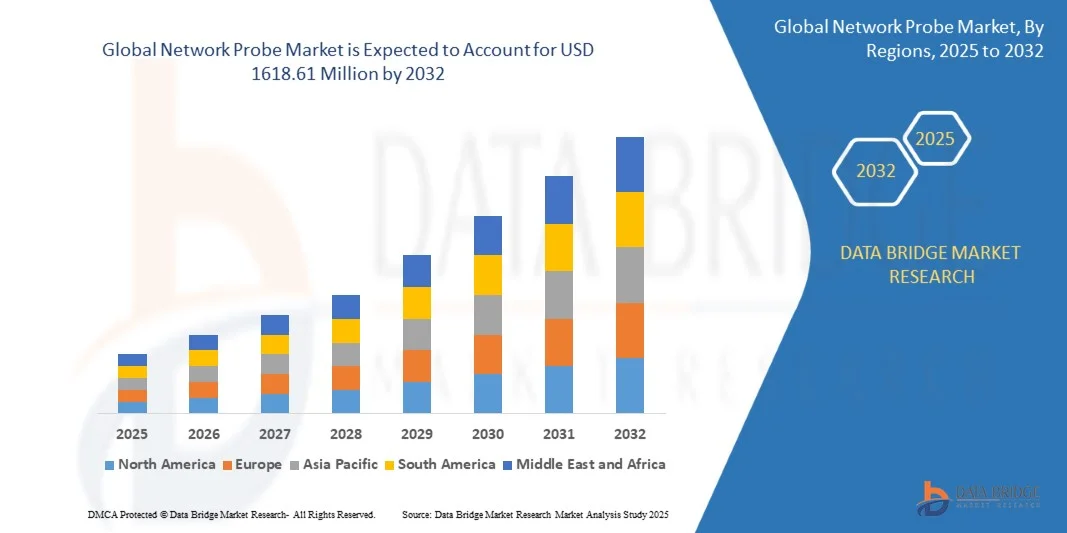
- The global network probe market size was valued at USD 710 million in 2024 and is expected to reach USD 1618.61 million by 2032, at a CAGR of 10.85% during the forecast period
- The network probe market growth is largely fueled by the increasing adoption of advanced network monitoring solutions and rising demand for real-time visibility into network traffic, performance, and security across enterprises and service providers
- Furthermore, the growing need to detect anomalies, prevent cyber threats, and optimize network performance is establishing network probes as essential tools for IT operations and network management. These factors are accelerating the deployment of network probe solutions, thereby significantly boosting the market's expansion
Network Probe Market Analysis
- Network probes, providing in-depth monitoring and analysis of network traffic, are becoming critical for ensuring reliable performance, security, and compliance across enterprise, telecom, and cloud environments. They enable proactive detection of network issues and support efficient troubleshooting
- The rising demand for network probes is primarily driven by the rapid digital transformation of organizations, the expansion of cloud services, increasing data traffic, and heightened cybersecurity concerns, which collectively reinforce the adoption of sophisticated network monitoring and analytics solutions
- North America dominated the network probe market with a share of 29.5% in 2024, due to the growing need for advanced network visibility, cybersecurity, and real-time monitoring across large enterprise networks.
- Asia-Pacific is expected to be the fastest growing region in the network probe market during the forecast period due to rapid digitalization, increasing internet penetration, and the rise of data-intensive industries in China, Japan, and India
- Solution segment dominated the market with a market share of 56.6% in 2024, due to the increasing adoption of advanced network monitoring tools for real-time traffic analysis, security assurance, and performance optimization. Enterprises are heavily investing in network probe solutions to manage complex and hybrid network infrastructures efficiently. The growing need to detect anomalies, prevent data breaches, and ensure uninterrupted network availability continues to strengthen the demand for network probe solutions across various industries
Report Scope and Network Probe Market Segmentation
|
Attributes |
Network Probe Key Market Insights |
|
Segments Covered |
|
|
Countries Covered |
North America
Europe
Asia-Pacific
Middle East and Africa
South America
|
|
Key Market Players |
|
|
Market Opportunities |
|
|
Value Added Data Infosets |
In addition to the market insights such as market value, growth rate, market segments, geographical coverage, market players, and market scenario, the market report curated by the Data Bridge Market Research team includes in-depth expert analysis, import/export analysis, pricing analysis, production consumption analysis, and pestle analysis. |
Network Probe Market Trends
“Adoption of AI-Enabled Network Probes for Real-Time Monitoring”
- The network probe market is evolving rapidly as organizations increasingly deploy AI-driven tools to capture, analyze, and optimize network data in real time. The integration of artificial intelligence and machine learning is enhancing visibility into complex hybrid infrastructures, helping companies prevent outages and respond to traffic anomalies with greater precision
- For instance, Cisco Systems has introduced AI-based network analytics integrated into its Secure Network Analytics (Stealthwatch) platform to ensure proactive identification of performance bottlenecks and security threats. These intelligent probes analyze traffic behavior and continuously adapt to emerging patterns, improving operational responsiveness in large enterprise networks
- AI-enabled network probes support automated detection of unusual packet flows, latency variations, and potential cyber threats, allowing network administrators to maintain optimal performance without manual monitoring. This shift toward predictive analytics transforms traditional network management by emphasizing intelligence-driven decision-making
- In addition, cloud-based network architectures and the expansion of IoT and 5G devices are driving demand for scalable probe solutions capable of monitoring high data volumes across distributed environments. AI integration provides the agility and automation required for dynamic network scaling and fault isolation
- Companies are adopting AI-powered solutions to enable correlation between application performance and network health, facilitating end-to-end visibility across physical, virtual, and cloud domains. These capabilities are becoming critical for digital enterprises striving to maintain user experience in complex, rapidly changing infrastructures
- Overall, the growing use of AI-enabled network probes indicates a transition toward intelligent, self-optimizing infrastructures that enhance visibility, security, and reliability. This trend is central to the next generation of network management solutions built around automation and data-driven agility
Network Probe Market Dynamics
Driver
“Rising Demand for Enhanced Network Security and Performance”
- Increasing digitalization across enterprises is accelerating the demand for network probes that provide real-time monitoring and protection against evolving cyber threats. Businesses are prioritizing technologies that enhance visibility, detect anomalies quickly, and safeguard mission-critical data flows to ensure seamless operations
- For instance, Juniper Networks has launched adaptive network monitoring solutions using deep packet inspection capabilities to detect irregularities and performance degradation before they affect service delivery. These advanced probes help enterprises achieve stronger network resilience and compliance with stringent data protection standards
- Modern network infrastructures supporting cloud computing, IoT devices, and virtualized environments require continuous performance optimization. Network probes allow administrators to monitor dynamic traffic conditions, reduce downtime, and maintain quality of service even during peak loads
- In addition, the escalating frequency of cyberattacks and data breaches is compelling organizations to adopt more sophisticated probe technologies capable of correlating network telemetry with security analytics. This proactive approach strengthens defensive frameworks and mitigates operational risks
- As network ecosystems continue to expand in scale and complexity, the combined demand for real-time visibility and data integrity will sustain the growth of advanced network probes. These tools are becoming foundational to reliable network performance across enterprise, telecom, and cloud environments
Restraint/Challenge
“High Deployment and Integration Costs”
- The widespread implementation of advanced network probes faces challenges due to high initial capital investment and integration complexity. Enterprises must allocate significant resources for software licensing, hardware provisioning, and system customization to align probe functionalities with existing network architectures
- For instance, large-scale telecom operators deploying solutions from vendors such as Netscout Systems often face elevated expenses due to the need for continuous upgrades, analytic module integration, and compatibility with multi-vendor ecosystems. These requirements can lengthen deployment timelines and escalate total cost of ownership
- Complexities in configuring network probes across hybrid and cloud environments increase reliance on skilled IT personnel, leading to added operational costs. Enterprises must ensure that probes integrate seamlessly with centralized management systems and analytics dashboards to deliver actionable insights
- In addition, maintenance of high-performance probe infrastructure demands ongoing expenditure on storage, bandwidth, and analytical computation to process vast data flows efficiently. These recurring costs can deter smaller organizations from adopting comprehensive monitoring frameworks
- To mitigate these financial and integration barriers, vendors are focusing on modular software-defined probes, cloud-based deployment models, and pay-as-you-go services. Adopting scalable and cost-efficient solutions will be key to promoting broader market adoption and overcoming budgetary and technical limitations in network probe deployment
Network Probe Market Scope
The market is segmented on the basis of component, deployment type, enterprise size, and end-use.
• By Component
On the basis of component, the network probe market is segmented into solution and services. The solution segment dominated the market with the largest revenue share of 56.6% in 2024, attributed to the increasing adoption of advanced network monitoring tools for real-time traffic analysis, security assurance, and performance optimization. Enterprises are heavily investing in network probe solutions to manage complex and hybrid network infrastructures efficiently. The growing need to detect anomalies, prevent data breaches, and ensure uninterrupted network availability continues to strengthen the demand for network probe solutions across various industries.
The services segment is anticipated to witness the fastest growth rate from 2025 to 2032, driven by rising demand for managed and professional services that support deployment, integration, and maintenance of network probe systems. Organizations are increasingly outsourcing network management functions to focus on core operations while ensuring optimal network performance. The shift toward subscription-based service models and growing reliance on continuous network health assessments are expected to accelerate the adoption of network probe services.
• By Deployment Type
On the basis of deployment type, the network probe market is segmented into on-premises and cloud. The on-premises segment dominated the market in 2024, primarily due to its robust data control, customization, and compliance advantages in highly regulated industries such as banking, defense, and healthcare. Enterprises with stringent security policies prefer on-premises network probe solutions to ensure sensitive data remains within their infrastructure. This segment’s strength also stems from organizations with legacy systems that require tailored monitoring tools for efficient network visibility.
The cloud segment is projected to witness the fastest CAGR from 2025 to 2032, fueled by the increasing adoption of cloud-based IT infrastructure and remote operations. Cloud-based network probes offer scalability, flexibility, and cost efficiency, making them ideal for dynamic and distributed enterprise networks. The rise in hybrid and multi-cloud environments, coupled with advancements in AI-driven monitoring capabilities, is expected to propel the demand for cloud deployment in the coming years.
• By Enterprise Size
On the basis of enterprise size, the network probe market is segmented into small & medium enterprises (SMEs) and large enterprises. The large enterprises segment dominated the market in 2024 due to their extensive network infrastructures that demand continuous traffic monitoring and security management. Large enterprises increasingly rely on network probes to handle high data volumes and complex multi-site network structures. Their focus on maintaining uptime, detecting threats in real-time, and complying with data protection regulations has significantly driven solution deployment across this segment.
The SMEs segment is anticipated to register the fastest growth rate from 2025 to 2032, driven by the rising awareness of network visibility and cost-effective probe solutions tailored for smaller IT environments. SMEs are adopting lightweight and cloud-based probes to improve operational efficiency, minimize downtime, and safeguard against cyber threats. Government digitalization initiatives and affordable SaaS-based solutions are further encouraging small and medium businesses to integrate network probe technologies.
• By End-Use
On the basis of end-use, the network probe market is segmented into service providers, enterprises, and others. The service providers segment held the largest market share in 2024, driven by the escalating demand for high network performance and uptime among telecom operators and internet service providers. Network probes play a crucial role in ensuring QoS (Quality of Service), managing bandwidth, and proactively identifying faults. The surge in data traffic from 5G rollout and IoT deployments has reinforced the use of probes for monitoring and optimizing network operations.
The enterprise segment is expected to witness the fastest CAGR from 2025 to 2032, supported by the increasing digital transformation and growing dependence on real-time network analytics. Enterprises across BFSI, healthcare, and IT sectors are integrating network probes to gain deeper visibility into their network traffic, prevent downtime, and enhance cybersecurity resilience. The rise in cloud-based enterprise networks and the push toward AI-enabled monitoring are expected to accelerate growth within this segment.
Network Probe Market Regional Analysis
- North America dominated the network probe market with the largest revenue share of 29.5% in 2024, driven by the growing need for advanced network visibility, cybersecurity, and real-time monitoring across large enterprise networks
- The region’s strong presence of cloud service providers and widespread 5G deployment further enhance demand for network probe solutions
- Organizations in North America are increasingly adopting AI-driven analytics to identify anomalies, optimize performance, and ensure seamless connectivity across distributed systems. The rapid digital transformation across industries such as BFSI, healthcare, and telecom continues to strengthen market growth
U.S. Network Probe Market Insight
The U.S. network probe market captured the largest revenue share in 2024 within North America, propelled by rapid cloud adoption and increasing network complexity across enterprises. Rising cybersecurity threats and the need for continuous monitoring to maintain regulatory compliance are driving adoption. Enterprises are focusing on integrating network probes with SIEM (Security Information and Event Management) systems to achieve unified visibility. The robust presence of major technology players and ongoing innovation in data analytics and automation are further accelerating market expansion in the country.
Europe Network Probe Market Insight
The Europe network probe market is projected to grow at a substantial CAGR during the forecast period, supported by stringent data protection regulations such as GDPR and a rising focus on secure data management. Growing digitization across financial services, manufacturing, and government sectors is driving adoption of network probes to ensure operational efficiency and data privacy. European enterprises are emphasizing proactive network management to prevent downtime and enhance user experience. The demand for scalable monitoring tools is rising as organizations expand their digital infrastructure across multiple regions.
U.K. Network Probe Market Insight
The U.K. network probe market is expected to witness notable growth during the forecast period, driven by increasing enterprise network traffic and heightened cybersecurity awareness. Businesses are adopting advanced probe solutions to monitor data flow, mitigate threats, and meet compliance standards. The expansion of data centers and government-led digital transformation initiatives further contribute to growth. In addition, the increasing penetration of hybrid work environments is fueling demand for network visibility and remote management solutions.
Germany Network Probe Market Insight
The Germany network probe market is poised for significant expansion, supported by the country’s focus on Industry 4.0, automation, and high data security standards. German enterprises are deploying network probes to ensure reliable communication between connected devices and operational systems. The growing adoption of IoT and cloud computing in manufacturing and automotive sectors drives the need for continuous network analysis. Moreover, increasing investment in IT infrastructure and a preference for precision-engineered monitoring systems underpin market growth.
Asia-Pacific Network Probe Market Insight
The Asia-Pacific network probe market is anticipated to grow at the fastest CAGR from 2025 to 2032, fueled by rapid digitalization, increasing internet penetration, and the rise of data-intensive industries in China, Japan, and India. The expansion of telecom networks and growing adoption of cloud services are creating strong demand for network visibility and performance management tools. Enterprises in the region are prioritizing AI-integrated probes for predictive analysis and real-time traffic optimization. Government initiatives promoting digital ecosystems and 5G rollout further support the market’s rapid expansion.
China Network Probe Market Insight
China dominated the Asia-Pacific market in 2024, driven by extensive investments in IT infrastructure, smart city projects, and large-scale data centers. The rapid growth of the telecommunications and cloud computing sectors is fueling the deployment of network probes for traffic monitoring and threat detection. Local vendors are offering cost-effective and scalable solutions tailored for high-traffic enterprise environments. In addition, the government’s focus on cybersecurity and technological self-reliance continues to strengthen domestic adoption.
India Network Probe Market Insight
India is projected to register the fastest growth rate in the Asia-Pacific network probe market during the forecast period. The country’s surge in internet users, expansion of 5G networks, and growing digital economy are key drivers. Enterprises across BFSI, IT, and e-commerce sectors are deploying probes to enhance security and optimize bandwidth usage. The government’s “Digital India” initiative and increasing cloud adoption among SMEs are accelerating demand. Furthermore, the growing focus on real-time network monitoring in data-driven industries is expected to sustain long-term market growth.
Network Probe Market Share
The network probe industry is primarily led by well-established companies, including:
- SolarWinds (U.S.)
- NETSCOUT (U.S.)
- Broadcom Inc. (U.S.)
- IBM Corporation (U.S.)
- Cisco Systems, Inc. (U.S.)
- Nokia Corporation (Finland)
- NEC Corporation (Japan)
- AppNeta (U.S.)
- Catchpoint Systems, Inc. (U.S.)
- Accedian Networks Inc. (Canada)
- Paessler AG (Germany)
- ManageEngine (India)
- Progress Software Corporation (U.S.)
- Nagios Enterprises, LLC (U.S.)
- Dynatrace LLC (U.S.)
- HelpSystems (U.S.)
- Riverbed Technology, Inc. (U.S.)
- ExtraHop Networks, Inc. (U.S.)
- Micro Focus International plc (U.K.)
- Cubro Network Visibility (Austria)
- Plixer LLC (U.S.)
- Kentik (U.S.)
- ObjectPlanet, Inc. (Norway)
- Flowmon Networks (Czech Republic)
- Qosmos (France)
Latest Developments in Network Probe Market
- In July 2025, NETSCOUT expanded its network probe ecosystem by integrating its Omnis AI Insights into the TM Forum NeuroNOC self-healing network initiative. This integration enabled probes to supply curated, real-time telemetry to AI agents that autonomously identified and resolved network issues. The outcome—an estimated 80% reduction in manual troubleshooting—demonstrates how probes are evolving from monitoring tools to automation enablers in service provider networks, boosting their strategic importance
- In March 2025, Keysight enhanced its Vision series network packet brokers with built-in AI capabilities and enabled third-party applications to run directly within the broker through its AppFusion integration. This development transforms probe devices from passive traffic collectors into intelligent edge platforms capable of hosting analytics and security workloads with lower latency. It reduces data transport overhead and accelerates insight generation, increasing the competitive differentiation of probe vendors in the visibility market
- In February 2025, NEC Corporation developed a vRAN solution compatible with the interface and component specifications of the O-RAN Alliance. By aligning with O-RAN standards, NEC enhances the security, performance, and scalability of open vRAN deployments. Since probes in mobile networks often rely on these interfaces for traffic and performance monitoring, this compatibility strengthens the deployment scope of network probes in disaggregated RAN environments
- In December 2024, Rohde & Schwarz expanded its portfolio by launching a network monitoring probe designed for mobile operators, private enterprises, and mission-critical networks. This launch reinforces its presence in telecom-grade visibility solutions. The availability of purpose-built probes for mission-critical and private networks intensifies competition and accelerates adoption in sectors requiring high security and performance reliability
- In May 2021, Catchpoint integrated with Google Cloud, enabling IT teams to access user-focused performance insights for applications and infrastructure hosted on the platform. This collaboration allowed probe-based monitoring to deliver visibility via the cloud marketplace, simplifying deployment and billing. It also expanded accessibility for cloud-native organizations, establishing probes as essential tools within modern observability frameworks

- Interactive Data Analysis Dashboard
- Company Analysis Dashboard for high growth potential opportunities
- Research Analyst Access for customization & queries
- Competitor Analysis with Interactive dashboard
- Latest News, Updates & Trend analysis
- Harness the Power of Benchmark Analysis for Comprehensive Competitor Tracking
Data collection and base year analysis are done using data collection modules with large sample sizes. The stage includes obtaining market information or related data through various sources and strategies. It includes examining and planning all the data acquired from the past in advance. It likewise envelops the examination of information inconsistencies seen across different information sources. The market data is analysed and estimated using market statistical and coherent models. Also, market share analysis and key trend analysis are the major success factors in the market report. To know more, please request an analyst call or drop down your inquiry.
The key research methodology used by DBMR research team is data triangulation which involves data mining, analysis of the impact of data variables on the market and primary (industry expert) validation. Data models include Vendor Positioning Grid, Market Time Line Analysis, Market Overview and Guide, Company Positioning Grid, Patent Analysis, Pricing Analysis, Company Market Share Analysis, Standards of Measurement, Global versus Regional and Vendor Share Analysis. To know more about the research methodology, drop in an inquiry to speak to our industry experts.
Data Bridge Market Research is a leader in advanced formative research. We take pride in servicing our existing and new customers with data and analysis that match and suits their goal. The report can be customized to include price trend analysis of target brands understanding the market for additional countries (ask for the list of countries), clinical trial results data, literature review, refurbished market and product base analysis. Market analysis of target competitors can be analyzed from technology-based analysis to market portfolio strategies. We can add as many competitors that you require data about in the format and data style you are looking for. Our team of analysts can also provide you data in crude raw excel files pivot tables (Fact book) or can assist you in creating presentations from the data sets available in the report.













