


What is the Network Slice as a Service Market Size and Growth Rate?
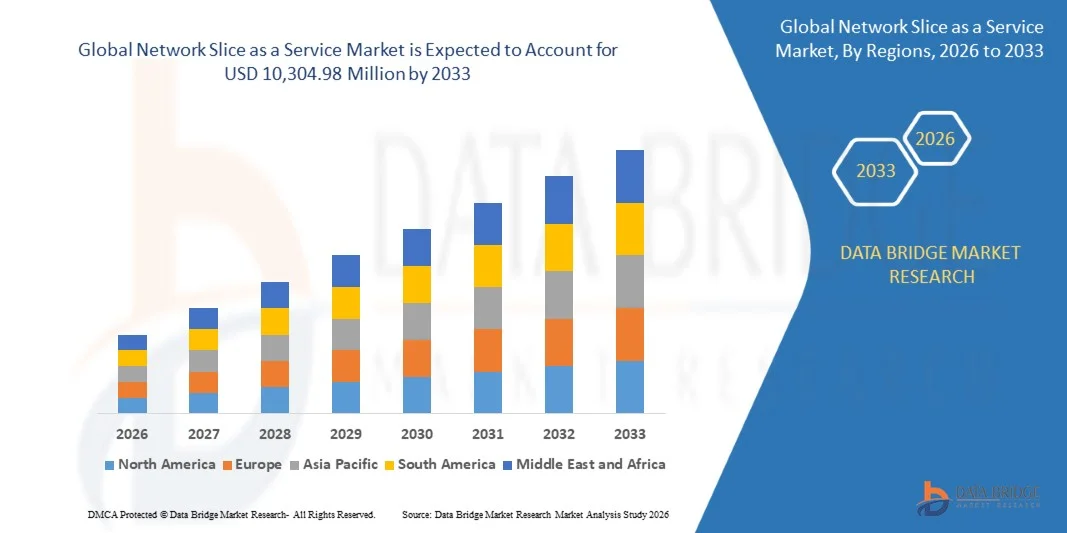
- As per Data Bridge Market Research analysis, the network slice as a service market was valued at USD 648.50 million in 2025 and is projected to reach USD 10,304.98 million by 2033, growing at a CAGR of 41.30% from 2026 to 2033.
- The market is experiencing rapid growth driven by the rapid deployment of standalone 5G networks, increasing demand for customized network connectivity, and the growing adoption of cloud-native network architectures across enterprises. Network slice as a service enables dedicated virtual network environments optimized for specific applications, providing improved network performance, enhanced security, ultra-low latency, and guaranteed quality of service.
- The increasing adoption of Industry 4.0, connected devices, autonomous systems, and mission-critical applications, combined with growing enterprise digital transformation, is compelling organizations across manufacturing, healthcare, transportation, media, and public safety to adopt network slicing technologies. Network slicing enables multiple virtual networks to operate independently on common physical infrastructure, while eMBB, URLLC, and mMTC support high-bandwidth, ultra-reliable low-latency, and massive machine-type communication requirements
Market Size & Forecast
- Global Market Value (2025): USD 648.50 Million
- Expected Market Value (2033): USD 10,304.98 Million
- Forecast CAGR (2026–2033): 41.30%
- Leading Region in 2025: North America
- Fastest Growing Region: Asia Pacific
What are the Major Takeaways of the Network Slice as a Service Market?
- North America dominated the network slice as a service market with the largest revenue share of 34.0% in 2025, supported by early commercialization of standalone 5G networks, strong investments in telecommunications infrastructure, and widespread adoption of cloud-native networking technologies.
- Asia-Pacific is expected to be the fastest-growing region at a CAGR of 34.2% from 2026 to 2033, fueled by rapid 5G commercialization, expanding digital economies, increasing smart city investments, and strong government support for advanced communication infrastructure
- The eMBB (enhanced mobile broadband) slice as a service segment led the market with a 45.1% share in 2025, driven by increasing demand for high-bandwidth applications including ultra-high-definition video streaming, cloud gaming, augmented reality, virtual reality, and enterprise collaboration platform
- URLLC (ultra-reliable low-latency communication) slice as a service are the fastest-growing service type, projected to register a CAGR of 43.2%, reflecting the surge in adoption of autonomous vehicles, industrial automation, remote healthcare, robotics, and mission-critical communications
- The public network slice segment dominated the category deployment mode with a 55% revenue share in 2025, led by scalability, lower deployment costs, simplified management, and broad geographic coverage.
- Smart manufacturing accounted for 30% of the market share in 2025, preferred by increasing adoption of industrial automation, connected machinery, predictive maintenance, collaborative robotics, autonomous production systems, and Industrial Internet of Things deployments.
- The autonomous vehicles segment is the fastest-growing application category, with a CAGR of 44%, driven by the increasing adoption of connected and autonomous mobility technologies.
Report Scope and Network Slice as a Service Market Segmentation
|
Attributes |
Network Slice as a Service Key Market Insights |
|
Segments Covered |
|
|
Countries Covered |
North America
Europe
Asia-Pacific
Middle East and Africa
South America
|
|
Key Market Players |
|
|
Market Opportunities |
|
|
Value Added Data Infosets |
In addition to the market insights such as market value, growth rate, market segments, geographical coverage, market players, and market scenario, the market report curated by the Data Bridge Market Research team includes in-depth expert analysis, import/export analysis, pricing analysis, production consumption analysis, and pestle analysis. |
What is the Key Trend in the Network Slice as a Service Market?
- Automation and intent-based network slicing is emerging as a key trend, enabling communication service providers to dynamically create, manage, and optimize dedicated network slices according to application-specific performance, security, latency, and reliability requirements.
- For instance, in December 2025, Nokia and du implemented an autonomous 5G Advanced network slicing solution that continuously measures slice performance and autonomously adjusts 5G Radio Access Network policies to deliver guaranteed service levels.
- Enterprise demand for scalability, security, throughput, and reliability is increasing as organizations seek predictable and differentiated connectivity for digital applications.
- Enterprises are increasingly prioritizing network slicing capabilities that provide scalable, secure, reliable, and high-throughput connectivity tailored to the specific requirements of different applications and industries.
- For instance, in June 2025, Orange Group selected Ericsson to automate the creation of advanced 5G services for enterprises and subscribers across its European affiliates, with progressive deployment beginning in 2025.
- As 5G Standalone, automation, and enterprise-specific connectivity continue to develop, Network Slice as a Service is expected to become increasingly important for differentiated connectivity, enabling operators to monetize network investments through SLA-driven services and customized network experiences.
What are the Key Drivers of the Network Slice as a Service Market?
- The rapid deployment of 5G Standalone networks is significantly increasing demand for Network Slice as a Service because 5G SA provides the cloud-native core, dynamic resource allocation, and software-defined capabilities required to deliver customized network slices.
- For instance, in April 2025, Ericsson reported that 5G Standalone architecture is the foundation for network slicing, enabling communication service providers to create multiple virtual networks optimized for specific applications, devices, locations, enterprises, and industry verticals.
- Enterprises are integrating network slicing into manufacturing, healthcare, transportation, public safety, and other mission-critical applications to obtain predictable performance, enhanced security, scalability, and application-specific connectivity.
- Enterprises are increasingly adopting network slicing to achieve more flexible, secure, reliable, and application-specific connectivity, supporting digital transformation across manufacturing, healthcare, transportation, public safety, and other industries.
- For instance, in January 2025, Nokia reported commercial network-slicing services from operators including T-Mobile US, Reliance Jio, Singtel, SFR, Deutsche Telekom, Telia, and Elisa, covering enterprise, industrial, fixed wireless access, applications, and event use cases.
- The increasing need for customized connectivity with guaranteed quality of service is encouraging operators to commercialize differentiated network services, enabling multiple logical networks to operate independently over shared physical infrastructure.
Which Factors are Challenging the Growth of the Network Slice as a Service Market?
- Complex end-to-end orchestration and multi-domain integration remain major challenges because network slices must coordinate resources across Radio Access Network, transport, core, cloud, and other heterogeneous network domains
- For instance, in February 2026, a study published in the Journal of Cybersecurity and Privacy identified cross-slice interference, data leakage, and cascading service disruption as potential consequences of inadequate slice isolation, highlighting security risks in multi-tenant 5G network slicing.
- Security and cross-slice isolation risks remain a major challenge because multiple tenants share common physical infrastructure, creating potential exposure to data leakage, cross-slice interference, and service disruption.
- These risks are amplified by SDN/NFV vulnerabilities, management API weaknesses, virtualization risks, and multi-tenancy, increasing the need for robust access controls, continuous monitoring, and security mechanisms across the slicing architecture.
- These complexities can increase provisioning time, operational requirements, and management costs, particularly when multiple network domains, vendors, technologies, and isolated slices must be coordinated through a common orchestration framework.
- For instance, in November 2022, a study published in Computer Communications found that dynamic resource allocation in multi-tenant network slicing has exceptionally high optimization complexity, as resources available to lower-priority tenants can change dynamically because of high-priority tenant preemption.
- The complexity of multi-domain orchestration, interoperability, security, and lifecycle management continues to challenge widespread network slice as a service deployment.
How is the Network Slice as a Service Market Segmented?
The network slice as a service market is segmented on the basis of service, deployment mode, application, and enterprise size.
- By Service
On the basis of service, the network slice as a service market is segmented into eMBB (enhanced mobile broadband) slice as a service, URLLC (ultra-reliable low-latency communication) slice as a service, mMTC (massive machine-type communications) slice as a service, and customized network slice as a service. The eMBB slice as a service segment dominated the market with a 45.1% share in 2025, owing to increasing demand for high-bandwidth applications including ultra-high-definition video streaming, cloud gaming, augmented reality, virtual reality, and enterprise collaboration platforms. Telecommunications operators are increasingly deploying eMBB network slices to provide guaranteed bandwidth, improved user experience, and enhanced network capacity. The rapid expansion of 5G mobile broadband services and increasing consumption of data-intensive applications continue to strengthen the segment. The segment is benefiting from increasing requirements for differentiated connectivity across consumer and enterprise applications. Its ability to support bandwidth-intensive services continues to make it the leading service segment
The URLLC slice as a service segment is projected to register the fastest CAGR of 43.2% from 2026 to 2033, driven by growing adoption of autonomous vehicles, industrial automation, remote healthcare, robotics, and mission-critical communications. These applications require ultra-low latency and highly reliable network connectivity for real-time operations. Enterprises increasingly require URLLC network slices to support applications where minimal latency and uninterrupted connectivity are essential. The growing deployment of Industry 4.0 technologies and smart infrastructure is further accelerating demand for these services. Increasing adoption of connected and autonomous systems is expected to strengthen segment growth throughout the forecast period. The requirement for reliable real-time communications makes URLLC particularly important for latency-sensitive applications.
- By Deployment Mode
On the basis of deployment mode, the network slice as a service market is segmented into public network slice, private network slice, and hybrid network slice. The public network slice segment dominated the market in 2025 with the largest market share, estimated at 55%, supported by scalability, lower deployment costs, simplified management, and broad geographic coverage. Public network slices enable communication service providers to deliver customized connectivity services to multiple enterprise customers over shared 5G infrastructure. Their shared infrastructure model reduces the requirement for customers to deploy separate physical networks. Increasing commercialization of standalone 5G networks is further supporting adoption. The flexibility of public network slicing makes it particularly suitable for enterprises seeking cost-effective differentiated connectivity.
The hybrid network slice segment is projected to register the fastest growth at a CAGR of 42% during 2026 to 2033, driven by increasing demand for flexible connectivity that combines public and private network resources. Hybrid network slicing enables enterprises to connect secure private environments with public 5G infrastructure, supporting distributed operations and multi-site deployments. This deployment model is particularly relevant for organizations operating across enterprise campuses, remote facilities, cloud environments, and edge locations. It can provide greater flexibility while maintaining the security and control required for sensitive applications. Growing adoption of cloud-edge architectures and enterprise digital transformation is creating additional demand for hybrid connectivity.
- By Application
On the basis of application, the network slice as a service market is segmented into smart manufacturing, autonomous vehicles, smart cities, industrial IoT, AR/VR, and others. The smart manufacturing segment dominated the market in 2025 with the largest market share, estimated at 30% in 2025, driven by increasing adoption of industrial automation, connected machinery, predictive maintenance, collaborative robotics, autonomous production systems, and Industrial Internet of Things deployments. Network slicing provides reliable and ultra-low-latency connectivity for real-time manufacturing operations. Manufacturers are increasingly adopting 5G technologies to improve production efficiency and support digital transformation. Dedicated network resources can be optimized according to specific production requirements. Growing Industry 4.0 adoption is further strengthening demand for network slicing in manufacturing.
The autonomous vehicles segment is projected to register the fastest growth at a CAGR of 44% during 2026 to 2033, driven by increasing adoption of connected and autonomous mobility technologies. Autonomous driving systems require reliable, low-latency, and high-bandwidth communication to support vehicle-to-everything (V2X) connectivity, real-time navigation, collision avoidance, and intelligent transportation infrastructure. Network Slice as a Service can provide dedicated network resources capable of meeting these demanding performance requirements. Growing investments in autonomous transportation and connected mobility are further supporting segment growth. The increasing deployment of intelligent transportation infrastructure is creating additional demand for customized network connectivity.
- By Enterprise Size
On the basis of enterprise size, the network slice as a service market is segmented into large enterprises, medium enterprises, and small enterprises. The large enterprises segment dominated the market in 2025 with the largest market share, estimated at 57%, supported by substantial investments in digital transformation, private 5G networks, cloud computing, edge computing, and mission-critical enterprise applications. Large organizations are increasingly adopting network slicing to obtain dedicated network resources with guaranteed bandwidth, enhanced security, and application-specific performance. Industries including manufacturing, healthcare, transportation, telecommunications, and energy are contributing to adoption. Large enterprises generally have greater financial and technical capabilities to deploy advanced networking infrastructure. Their extensive digital infrastructure requirements continue to support the segment's dominance.
The small enterprises segment is projected to register the fastest CAGR of 43% from 2026 to 2033, supported by increasing availability of managed network slice as a service offerings, cloud-based deployment models, and subscription-based pricing. These models reduce the infrastructure investment and technical expertise required to access advanced 5G connectivity. Small businesses are increasingly adopting cloud applications, connected devices, and digital operations requiring reliable network performance. Managed services can simplify network deployment and reduce operational complexity. Growing digital transformation among smaller organizations is further supporting demand. Increasing availability of flexible and cost-effective network slice as a service offerings is expected to accelerate segment growth.
Which Region Holds the Largest Share of the Network Slice as a Service Market?
- North America dominated the network slice as a service market with the largest revenue share of 34.0% in 2025, supported by early commercialization of standalone 5G networks, strong investments in telecommunications infrastructure, and widespread adoption of cloud-native networking technologies.
- The region also benefits from increasing deployment of edge computing, artificial intelligence, and private 5G networks, while communication service providers and enterprises across manufacturing, healthcare, transportation, financial services, and public safety are increasingly deploying network-slicing solutions to deliver application-specific connectivity with guaranteed performance, security, and reliability
U.S. Network Slice as a Service Market Insight
The U.S. network slice as a service market is witnessing strong growth due to the early commercialization of standalone 5G networks, investments in advanced telecommunications infrastructure, and increasing adoption of network slicing for enterprise and mission-critical applications. The country’s mature telecom ecosystem and expanding use of cloud-native networking, edge computing, and private 5G infrastructure are supporting demand for customized connectivity. In addition, communication service providers are increasingly commercializing dedicated network slices for public safety and other applications requiring guaranteed performance and reliability. In June 2025, Verizon expanded its Frontline Network Slice nationwide to 50 major U.S. markets, providing dedicated 5G Ultra Wideband capacity for first responders.
Asia-Pacific Network Slice as a Service Market Insight
The Asia-Pacific network slice as a service market is expected to witness rapid growth, supported by rapid 5G deployment, expanding standalone 5G infrastructure, and increasing adoption of customized connectivity across industrial and enterprise applications. China, Japan, South Korea, and other markets are advancing network slicing for manufacturing, transportation, broadcasting, cloud gaming, and Industrial IoT applications. Growing investment in 5G infrastructure and increasing digital transformation are further supporting regional market expansion. In addition, the region's large mobile subscriber base and increasing deployment of 5G standalone networks are creating favorable conditions for network slicing adoption. GSMA reported in 2025 that China had more than 4.25 million 5G base stations and over 1 billion 5G connections, highlighting the scale of the region's 5G ecosystem.
Japan Network Slice as a Service Market Insight
The Japan network slice as a service market is witnessing consistent growth due to increasing investments in 5G standalone technologies, advanced telecommunications infrastructure, and application-specific connectivity. Telecommunications operators and technology companies are increasingly exploring network slicing for broadcasting, industrial applications, mobility, and other services requiring reliable connectivity. The country's advanced digital infrastructure and strong technology ecosystem are supporting the development of customized 5G services. Moreover, increasing integration of 5G standalone networks with edge and cloud technologies is creating additional opportunities for network slicing. In June 2025, NTT Communications and TBS Television successfully demonstrated network slicing over 5G SA combined with Starlink, achieving stable communications for television broadcasting under congested and emergency conditions.
China Network Slice as a Service Market Insight
The China network slice as a service market is growing rapidly, driven by extensive 5G infrastructure deployment, increasing industrial digitalization, and strong adoption of network slicing across enterprise applications. China has developed large-scale 5G standalone infrastructure supporting customized private networks and differentiated connectivity services. Growing adoption across manufacturing, logistics, transportation, gaming, smart grids, and other industries is significantly supporting market demand. In addition, cooperation among major telecommunications operators is accelerating the development of shared and customized 5G network architectures. China Telecom and China Unicom have built a large-scale 5G SA shared network supporting multiple customized private networks, demonstrating the country's advanced deployment of 5G infrastructure and network-slicing-related technologies
U.K. Network Slice as a Service Market Insight
The U.K. network slice as a service market is experiencing steady growth, supported by increasing deployment of 5G standalone infrastructure and growing adoption of network slicing for enterprise, public safety, events, and other specialized applications. The country's wireless infrastructure strategy recognizes network slicing as a key capability of 5G standalone networks for delivering bespoke connectivity and supporting applications such as self-driving vehicles and remote healthcare. Increasing investment in standalone 5G and enterprise connectivity is further contributing to market development. In February 2025, Vodafone completed a U.K.-first trial of multiple 5G SA network slices at Principality Stadium, providing dedicated connectivity for fans and guaranteed upload performance for the stadium's official photographers.
Germany Network Slice as a Service Market Insight
The Germany network slice as a service market is expanding steadily due to the country's strong industrial base, advanced telecommunications infrastructure, and increasing adoption of 5G standalone technologies. Network slicing is being integrated into industrial, research, public safety, and consumer applications requiring differentiated performance and reliable connectivity. Germany's strong manufacturing ecosystem and increasing deployment of 5G campus networks are creating additional demand for customized network services. Moreover, Deutsche Telekom has made network slicing available for business customers and has expanded its use across industrial and consumer applications. Deutsche Telekom reported that by August 2025, 5G coverage had reached approximately 99% of Germany's population, while 5G standalone with network slicing was available through dedicated consumer plans and business applications.
Which are the Top Companies in Network Slice as a Service Market?
The network slice as a service industry is primarily led by well-established companies, including:
- Ericsson AB (Sweden)
- Nokia Corporation (Finland)
- Huawei Technologies Co., Ltd. (China)
- ZTE Corporation (China)
- Cisco Systems, Inc (U.S.)
- SAMSUNG ELECTRONICS (South Korea)
- NEC Corporation (Japan)
- Orange SA (France)
- Vodafone Group (U.K.)
- Deutsche Telekom AG (Germany)
- Telefónica (Spain)
- Verizon (U.S.)
- AT&T Intellectual Property (U.S.)
- NTT INC. (Japan)
- SK Telecom (South Korea)
- Singtel (Singapore)
- Amdocs (U.S.)
- Netcracker Technology Corporation (U.S.)
- Accenture (Ireland)
What are Latest Developments in Network Slice as a Service Market?
- In December 2025, Nokia and du announced the first implementation of a 5G Advanced autonomous network slicing solution, enabling du to deliver intent-based services for enterprises, industries, and consumers across business-critical operations, live events, broadcasting, gaming, XR, and AI applications. The solution continuously measures slice performance and autonomously adjusts 5G RAN policies to maintain guaranteed service levels, highlighting the industry's shift toward self-optimizing and automated network slicing.
- In June 2025, Orange Group selected Ericsson to automate the creation of advanced 5G services across its European affiliates, with the solution progressively deployed from 2025. The service orchestration and assurance capabilities support end-to-end automation of 5G network slices, enabling Orange to develop differentiated services for enterprises and subscribers and strengthening the commercialization of network slicing across Europe
- In February 2025, Chunghwa Telecom and Ericsson successfully deployed an on-demand network slicing solution on a live 5G Standalone network, allowing enterprises to activate network slices tailored to their specific requirements. The solution provides real-time and flexible network resource allocation for business-critical applications and was planned for commercialization in 2025, supporting new enterprise business models and industrial digitalization.
- In March 2023, Nokia announced the enhancement of NTT DOCOMO’s nationwide IP core backbone with transport network slicing for new 5G mobile services. DOCOMO deployed Nokia’s Network Services Platform to automate the creation, assurance, and optimization of transport network slices, enabling granular service-level agreements, greater network agility, and improved resource efficiency. The development demonstrated the expansion of network slicing beyond the radio and core domains into the transport network.
- In September 2022, Nokia and Telia Finland launched the world’s first commercial 5G Standalone network with network slicing for Fixed Wireless Access services. The deployment enabled Telia to offer broadband services with guaranteed service levels and dynamically allocate network capacity between Fixed Wireless Access and mobile users. The launch represented an important step toward commercializing network slicing and creating differentiated 5G services for customers.

- Interactive Data Analysis Dashboard
- Company Analysis Dashboard for high growth potential opportunities
- Research Analyst Access for customization & queries
- Competitor Analysis with Interactive dashboard
- Latest News, Updates & Trend analysis
- Harness the Power of Benchmark Analysis for Comprehensive Competitor Tracking
Data collection and base year analysis are done using data collection modules with large sample sizes. The stage includes obtaining market information or related data through various sources and strategies. It includes examining and planning all the data acquired from the past in advance. It likewise envelops the examination of information inconsistencies seen across different information sources. The market data is analysed and estimated using market statistical and coherent models. Also, market share analysis and key trend analysis are the major success factors in the market report. To know more, please request an analyst call or drop down your inquiry.
The key research methodology used by DBMR research team is data triangulation which involves data mining, analysis of the impact of data variables on the market and primary (industry expert) validation. Data models include Vendor Positioning Grid, Market Time Line Analysis, Market Overview and Guide, Company Positioning Grid, Patent Analysis, Pricing Analysis, Company Market Share Analysis, Standards of Measurement, Global versus Regional and Vendor Share Analysis. To know more about the research methodology, drop in an inquiry to speak to our industry experts.
Data Bridge Market Research is a leader in advanced formative research. We take pride in servicing our existing and new customers with data and analysis that match and suits their goal. The report can be customized to include price trend analysis of target brands understanding the market for additional countries (ask for the list of countries), clinical trial results data, literature review, refurbished market and product base analysis. Market analysis of target competitors can be analyzed from technology-based analysis to market portfolio strategies. We can add as many competitors that you require data about in the format and data style you are looking for. Our team of analysts can also provide you data in crude raw excel files pivot tables (Fact book) or can assist you in creating presentations from the data sets available in the report.













