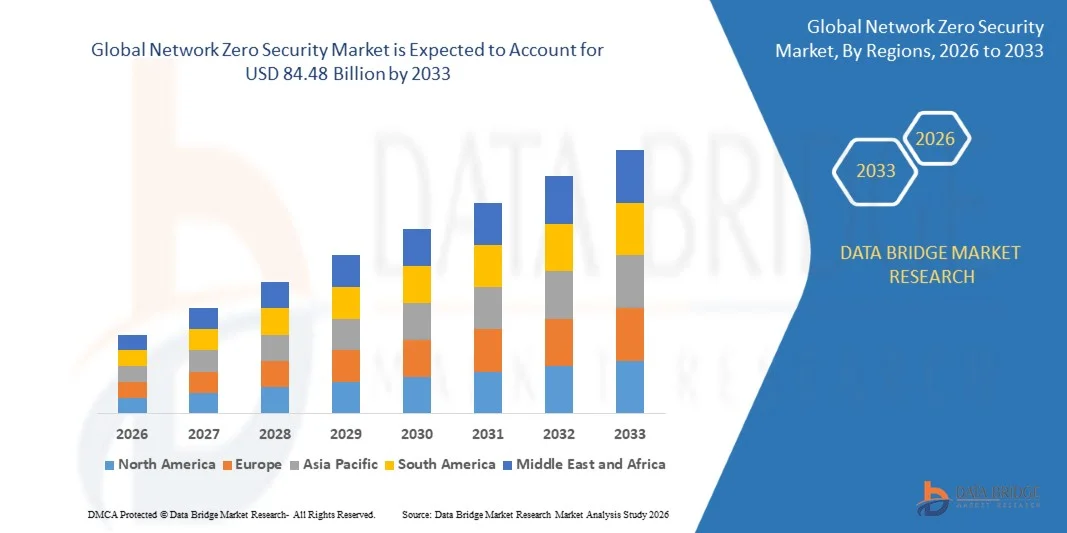
Network Zero Security Market Size
- The global network zero security market size was valued at USD 29.61 billion in 2025 and is expected to reach USD 84.48 billion by 2033, at a CAGR of 14.0% during the forecast period
- The market growth is largely fueled by the increasing adoption of cloud computing, remote work, and hybrid IT environments, which are driving organizations to implement robust zero-trust security frameworks to protect critical applications, data, and endpoints
- Furthermore, rising enterprise demand for secure, identity-based, and automated access control solutions is establishing network zero security as a key strategy for mitigating cyber threats, ensuring regulatory compliance, and enhancing operational efficiency. These converging factors are accelerating the adoption of zero-trust architectures, thereby significantly boosting the industry’s growth
Network Zero Security Market Analysis
- Network zero security, providing identity- and context-based access control for networks, cloud services, and endpoints, is becoming an essential component of enterprise cybersecurity strategies due to its ability to reduce lateral threat movement, enhance monitoring, and enforce continuous authentication across hybrid environments
- The escalating demand for network zero security is primarily driven by the rise in sophisticated cyberattacks, growing regulatory and compliance requirements, and the increasing adoption of cloud services, remote work models, and digital transformation initiatives across enterprises globally
- North America dominated the network zero security market with a share of 37.9% in 2025, due to growing investments in cybersecurity infrastructure and increasing awareness of zero-trust frameworks
- Asia-Pacific is expected to be the fastest growing region in the network zero security market during the forecast period due to rapid digitalization, growing cloud adoption, and increasing cyber threats in countries such as China, Japan, and India
- Multi-factor authentication segment dominated the market with a market share of 62.5% in 2025, due to its superior security measures that combine two or more verification methods, reducing the risk of unauthorized access. Enterprises increasingly prioritize multi-factor authentication for protecting sensitive data and critical infrastructure against evolving cyber threats. The rising adoption of identity and access management (IAM) frameworks and regulatory compliance requirements also bolster demand for multi-factor solutions. Multi-factor authentication systems offer flexibility across devices and applications, supporting both cloud and on-premises setups, making them a preferred choice for organizations aiming to enhance overall network security
Report Scope and Network Zero Security Market Segmentation
|
Attributes |
Network Zero Security Key Market Insights |
|
Segments Covered |
|
|
Countries Covered |
North America
Europe
Asia-Pacific
Middle East and Africa
South America
|
|
Key Market Players |
|
|
Market Opportunities |
|
|
Value Added Data Infosets |
In addition to the market insights such as market value, growth rate, market segments, geographical coverage, market players, and market scenario, the market report curated by the Data Bridge Market Research team includes in-depth expert analysis, import/export analysis, pricing analysis, production consumption analysis, and pestle analysis. |
Network Zero Security Market Trends
“Rising Adoption of Zero Trust Architectures Across Enterprises”
- A significant trend in the Network Zero Security market is the increasing deployment of zero-trust frameworks across enterprises, driven by the growing need to secure cloud applications, remote work environments, and hybrid IT infrastructures. Zero trust is becoming a standard approach to prevent lateral threat movement, enforce identity-based access, and continuously monitor user behavior across networks
- For instance, companies such as Zscaler and Palo Alto Networks offer cloud-native zero-trust platforms that enable secure connectivity and policy enforcement across distributed enterprise environments. These solutions enhance organizational resilience against sophisticated cyber threats and data breaches
- The adoption of zero-trust models is expanding rapidly in sectors such as BFSI, IT and telecommunications, and healthcare, where protecting sensitive information and complying with stringent regulations are critical. Enterprises are increasingly replacing traditional perimeter-based security with continuous authentication and microsegmentation strategies
- Organizations are prioritizing identity-centric security and automated access control systems that reduce dependency on legacy VPNs and firewalls. This approach positions network zero security as an essential measure for digital transformation initiatives and operational continuity
- The rise of cloud adoption and hybrid work models is driving enterprises to deploy scalable, centralized zero-trust solutions capable of securing both on-premises and cloud resources. This trend strengthens the market by addressing growing security demands while simplifying access management
- The market is witnessing strong momentum from regulatory compliance requirements such as GDPR, CCPA, and industry-specific cybersecurity mandates, which encourage the adoption of zero-trust architectures. This growing emphasis on security governance is reinforcing the critical role of network zero security in enterprise cybersecurity strategies
Network Zero Security Market Dynamics
Driver
“Growing Need for Secure Remote Access and Cloud Protection”
- The increasing reliance on remote work, cloud computing, and hybrid IT environments is driving demand for network zero security solutions that ensure secure access to applications and data. These solutions mitigate risks from unauthorized access, insider threats, and advanced persistent threats, while supporting compliance with data protection regulations
- For instance, Okta and Microsoft provide identity- and access-management solutions integrated with zero-trust frameworks to enable secure, seamless connectivity for employees and contractors across multiple devices and networks. This capability is critical for organizations managing distributed workforces
- Enterprises are adopting automated monitoring and policy enforcement tools that reduce administrative overhead and enhance operational efficiency while maintaining high security standards
- The growing complexity of IT environments, including multi-cloud deployments and SaaS applications, requires robust zero-trust solutions that unify access control and threat monitoring across the enterprise
- The expanding digital economy and increasing cyberattack sophistication are creating strong incentives for organizations to implement proactive, scalable security solutions. This sustained demand positions network zero security as a key driver of cybersecurity transformation
Restraint/Challenge
“High Implementation Costs and Complexity of Integration”
- The Network Zero Security market faces challenges due to the high costs and technical complexity associated with implementing zero-trust architectures across large, heterogeneous IT environments. Organizations often require significant investment in identity management, microsegmentation, and continuous monitoring technologies
- For instance, enterprises deploying solutions from Cisco or Illumio encounter integration hurdles with legacy systems and multi-cloud infrastructures, increasing deployment timelines and operational expenses
- Ensuring seamless interoperability among diverse security tools, applications, and devices adds further complexity and requires skilled personnel
- The demand for customized policy frameworks, continuous authentication, and detailed auditing increases the time and cost of adoption, particularly for large organizations with distributed networks
- Scaling zero-trust architectures while maintaining performance, usability, and cost-effectiveness continues to be a key restraint, compelling enterprises to carefully plan implementation and invest in training and professional services
Network Zero Security Market Scope
The market is segmented on the basis of authentication system, organization size, deployment, and vertical.
• By Authentication System
On the basis of authentication system, the Network Zero Security market is segmented into single-factor authentication and multi-factor authentication. The multi-factor authentication segment dominated the market with the largest market revenue share of 62.5% in 2025, driven by its superior security measures that combine two or more verification methods, reducing the risk of unauthorized access. Enterprises increasingly prioritize multi-factor authentication for protecting sensitive data and critical infrastructure against evolving cyber threats. The rising adoption of identity and access management (IAM) frameworks and regulatory compliance requirements also bolster demand for multi-factor solutions. Multi-factor authentication systems offer flexibility across devices and applications, supporting both cloud and on-premises setups, making them a preferred choice for organizations aiming to enhance overall network security.
The single-factor authentication segment is anticipated to witness the fastest growth rate from 2026 to 2033, fueled by its simplicity, low implementation costs, and ease of integration into existing IT environments. For instance, companies such as Okta provide streamlined single-factor solutions for small teams requiring rapid deployment. Organizations with limited budgets or less critical data assets often adopt single-factor authentication as a first step toward zero-trust security frameworks. The convenience and minimal user training required also contribute to its growing adoption, especially in SMEs and sector-specific applications where advanced authentication may not be immediately necessary.
• By Organization Size
On the basis of organization size, the Network Zero Security market is segmented into small and medium-sized enterprises (SMEs) and large enterprises. The large enterprises segment dominated the market in 2025, driven by the need to secure complex IT infrastructures and high-value digital assets. Large organizations often implement comprehensive zero-trust policies incorporating advanced monitoring, continuous authentication, and access controls across multiple geographies and departments. For instance, Microsoft and IBM offer enterprise-grade Network Zero Security solutions that cater to large-scale deployments requiring robust threat mitigation and regulatory compliance. The scale of operations and higher exposure to cyber threats make large enterprises the primary consumers of network zero-security systems, supporting continuous growth in this segment.
The SME segment is expected to witness the fastest growth rate from 2026 to 2033, fueled by the increasing digitalization of small businesses and the rising awareness of cyber vulnerabilities. SMEs are gradually adopting scalable, cost-effective Network Zero Security solutions that provide enterprise-level protection without heavy infrastructure investments. Cloud-based offerings and subscription models allow SMEs to implement zero-trust frameworks efficiently while maintaining operational flexibility. The growing emphasis on protecting customer data and ensuring business continuity drives the adoption of these solutions among smaller organizations.
• By Deployment
On the basis of deployment, the Network Zero Security market is segmented into cloud and on-premises. The cloud segment dominated the market in 2025, driven by the flexibility and scalability offered by cloud-based zero-trust solutions. Cloud deployment allows organizations to manage authentication, access control, and threat monitoring centrally while enabling seamless integration with remote workforces and hybrid IT environments. For instance, companies such as Palo Alto Networks and Zscaler provide cloud-native zero-trust platforms that simplify management, reduce operational overhead, and support rapid updates. The ability to leverage cloud infrastructure for continuous security enforcement and analytics contributes to the strong market share of this segment.
The on-premises segment is expected to witness the fastest growth rate from 2026 to 2033, fueled by organizations with strict data residency, compliance, or regulatory requirements. On-premises Network Zero Security solutions provide direct control over sensitive data and internal networks while allowing customized deployment configurations. Industries handling critical infrastructure or classified information, such as government and defense, often prefer on-premises setups. The rising adoption of hybrid deployment strategies also drives growth in this segment, as enterprises seek a combination of cloud flexibility and on-premises control.
• By Vertical
On the basis of vertical, the Network Zero Security market is segmented into BFSI, IT and telecommunications, government and defense, retail and e-commerce, healthcare, energy and power, and others. The BFSI segment dominated the market in 2025, driven by the need to protect sensitive financial data, comply with stringent regulatory frameworks, and secure online banking and payment channels. For instance, JPMorgan Chase and Citibank have deployed advanced zero-trust architectures to safeguard customer information and ensure continuous monitoring for cyber threats. The increasing reliance on digital banking platforms and online transactions makes BFSI a critical adopter of network zero-security solutions. Continuous innovations in authentication, access control, and threat intelligence further strengthen the segment’s leadership.
The IT and telecommunications segment is expected to witness the fastest growth rate from 2026 to 2033, fueled by rapid digital transformation, expansion of cloud services, and the rising need for secure network infrastructures. IT and telecom companies are increasingly implementing zero-trust security frameworks to manage employee access, safeguard client data, and ensure service continuity. For instance, Cisco and Ericsson offer tailored zero-trust solutions that enable secure connectivity for distributed networks and remote teams. The adoption of IoT, 5G, and software-defined networking further accelerates the demand for Network Zero Security in this vertical.
Network Zero Security Market Regional Analysis
- North America dominated the network zero security market with the largest revenue share of 37.9% in 2025, driven by growing investments in cybersecurity infrastructure and increasing awareness of zero-trust frameworks
- Organizations in the region prioritize securing critical data, cloud applications, and remote access endpoints, fueling demand for network zero-security solutions
- This adoption is further supported by advanced IT infrastructure, high digital maturity, and regulatory compliance requirements such as CCPA and NIST guidelines, establishing zero-trust security as a critical measure across enterprises
U.S. Network Zero Security Market Insight
The U.S. Network Zero Security market captured the largest revenue share in 2025 within North America, fueled by rapid digital transformation and the expansion of remote and hybrid work environments. Enterprises are increasingly adopting zero-trust architectures to prevent unauthorized access and safeguard sensitive data across networks and cloud services. The growing preference for identity-based access controls, continuous monitoring, and integration with existing security tools is further propelling market growth. Moreover, initiatives by cybersecurity vendors such as Palo Alto Networks and Zscaler to provide scalable cloud-native solutions are significantly contributing to the market’s expansion.
Europe Network Zero Security Market Insight
The Europe Network Zero Security market is projected to expand at a substantial CAGR throughout the forecast period, driven by stringent data protection regulations such as GDPR and increasing cybersecurity investments across enterprises. The region is witnessing rising adoption of cloud and hybrid IT environments, fostering the deployment of zero-trust security frameworks. European organizations are emphasizing risk mitigation, secure remote access, and compliance, which is promoting growth across BFSI, government, and IT sectors. In addition, technological advancements and increasing awareness about cyber threats are contributing to the adoption of network zero-security solutions.
U.K. Network Zero Security Market Insight
The U.K. Network Zero Security market is anticipated to grow at a noteworthy CAGR during the forecast period, fueled by the rising trend of digital transformation and heightened concerns regarding data breaches. Enterprises and government organizations are increasingly implementing zero-trust security to protect sensitive information and comply with data privacy regulations. The robust IT and telecom infrastructure, combined with widespread cloud adoption and remote working practices, is driving the deployment of network zero-security solutions. Furthermore, growing collaboration between cybersecurity vendors and local enterprises is accelerating market growth.
Germany Network Zero Security Market Insight
The Germany Network Zero Security market is expected to expand at a considerable CAGR during the forecast period, driven by increasing awareness of cybersecurity threats and regulatory compliance mandates. German enterprises are adopting advanced zero-trust architectures to secure critical business applications, cloud environments, and IT infrastructure. The focus on innovation, digitalization, and industrial security, especially in manufacturing and energy sectors, is supporting the adoption of network zero-security solutions. Integration with identity and access management (IAM) platforms and continuous threat monitoring is becoming increasingly prevalent across organizations.
Asia-Pacific Network Zero Security Market Insight
The Asia-Pacific Network Zero Security market is poised to grow at the fastest CAGR during the forecast period of 2026 to 2033, driven by rapid digitalization, growing cloud adoption, and increasing cyber threats in countries such as China, Japan, and India. Enterprises in the region are increasingly adopting zero-trust frameworks to secure distributed networks, cloud applications, and remote workforces. Government initiatives promoting cybersecurity and data protection, alongside rising IT infrastructure investments, are further accelerating adoption. Moreover, the growing focus on securing critical sectors such as BFSI, IT, and energy is expanding the demand for network zero-security solutions.
Japan Network Zero Security Market Insight
The Japan Network Zero Security market is gaining momentum due to the country’s high digital adoption, advanced IT infrastructure, and increasing cyber threat landscape. Enterprises and government agencies are prioritizing zero-trust security to protect sensitive data and critical infrastructure. Integration with cloud services, IoT devices, and enterprise applications is fueling adoption. Moreover, Japan’s focus on secure remote access and continuous monitoring solutions is expected to further drive market growth across both commercial and government sectors.
China Network Zero Security Market Insight
The China Network Zero Security market accounted for the largest market revenue share in Asia-Pacific in 2025, driven by rapid digital transformation, the growth of cloud computing, and increasing cyberattacks. Enterprises in BFSI, IT, and government sectors are increasingly deploying zero-trust security frameworks to safeguard critical applications and sensitive data. The strong domestic cybersecurity ecosystem, coupled with government initiatives to enhance digital security standards, is boosting market penetration. Availability of cost-effective solutions from local vendors is further expanding adoption across small, medium, and large enterprises.
Network Zero Security Market Share
The network zero security industry is primarily led by well-established companies, including:
- Cisco Systems, Inc. (U.S.)
- Akamai Technologies, Inc. (U.S.)
- Palo Alto Networks, Inc. (U.S.)
- Broadcom Inc. (U.S.)
- Okta, Inc. (U.S.)
- Forcepoint LLC (U.S.)
- Centrify Corporation (U.S.)
- Cyxtera Technologies, Inc. (U.S.)
- Illumio, Inc. (U.S.)
- Sophos Ltd. (U.K.)
- Google LLC (U.S.)
- Microsoft Corporation (U.S.)
- VMware, Inc. (U.S.)
- Trend Micro Incorporated (Japan)
- Cloudflare, Inc. (U.S.)
- IBM Corporation (U.S.)
- Fortinet, Inc. (U.S.)
- Check Point Software Technologies Ltd. (Israel)
- Pulse Secure, LLC (U.S.)
- ON2IT (Netherlands)
Latest Developments in Global Network Zero Security Market
- In November 2025, Zscaler completed the acquisition of AI security specialist SPLX, enhancing its Zero Trust Exchange platform with advanced capabilities for AI asset discovery, automated red‑teaming, and governance. This acquisition strengthens Zscaler’s position in securing the entire AI security lifecycle from development to deployment and supports enterprises in managing rising risks tied to AI adoption, driving broader zero trust adoption and reinforcing Zscaler’s competitive leadership in integrated security offerings
- In October 2025, HCLTech expanded its strategic partnership with Zscaler to deliver AI‑powered network transformation and enhanced zero‑trust security services globally. By integrating Zscaler’s cloud‑native Zero Trust Exchange with HCLTech’s cybersecurity fusion and AI capabilities, the collaboration empowers enterprises to modernize securely while improving threat detection and automated response, facilitating accelerated zero trust deployments at scale across multiple industries
- In August 2025, Cloudflare launched new zero trust security tools for secure AI adoption at scale within its Cloudflare One platform. These features give organizations the ability to monitor and control generative AI usage, protect sensitive data from misuse, and manage Shadow AI risks under a unified zero trust framework. This development helps enterprises balance innovation with security, expanding Cloudflare’s position as a key zero trust provider for modern AI‑enabled environments
- In December 2025, Orca Security expanded its strategic partnership with Zscaler, unifying cloud workload visibility with identity‑based access controls to strengthen zero trust postures across hybrid environments. This integration reduces blind spots between cloud risk insights and secure access, enabling faster, smarter threat prioritization for cloud operations teams. The enhanced combined offering accelerates enterprise zero trust adoption by delivering end‑to‑end visibility and operational efficiency
- In October 2025, Zero Networks partnered with ViewQwest to deliver automated microsegmentation solutions across key Asian markets. This partnership enables enterprises in Southeast Asia to rapidly implement microsegmentation, isolating network segments to contain lateral threat movement and enhance cyber resilience. By expanding distribution and local support, the collaboration boosts Zero Networks’ presence in high‑growth APAC markets and accelerates zero trust implementation among regional organizations

- Interactive Data Analysis Dashboard
- Company Analysis Dashboard for high growth potential opportunities
- Research Analyst Access for customization & queries
- Competitor Analysis with Interactive dashboard
- Latest News, Updates & Trend analysis
- Harness the Power of Benchmark Analysis for Comprehensive Competitor Tracking
Data collection and base year analysis are done using data collection modules with large sample sizes. The stage includes obtaining market information or related data through various sources and strategies. It includes examining and planning all the data acquired from the past in advance. It likewise envelops the examination of information inconsistencies seen across different information sources. The market data is analysed and estimated using market statistical and coherent models. Also, market share analysis and key trend analysis are the major success factors in the market report. To know more, please request an analyst call or drop down your inquiry.
The key research methodology used by DBMR research team is data triangulation which involves data mining, analysis of the impact of data variables on the market and primary (industry expert) validation. Data models include Vendor Positioning Grid, Market Time Line Analysis, Market Overview and Guide, Company Positioning Grid, Patent Analysis, Pricing Analysis, Company Market Share Analysis, Standards of Measurement, Global versus Regional and Vendor Share Analysis. To know more about the research methodology, drop in an inquiry to speak to our industry experts.
Data Bridge Market Research is a leader in advanced formative research. We take pride in servicing our existing and new customers with data and analysis that match and suits their goal. The report can be customized to include price trend analysis of target brands understanding the market for additional countries (ask for the list of countries), clinical trial results data, literature review, refurbished market and product base analysis. Market analysis of target competitors can be analyzed from technology-based analysis to market portfolio strategies. We can add as many competitors that you require data about in the format and data style you are looking for. Our team of analysts can also provide you data in crude raw excel files pivot tables (Fact book) or can assist you in creating presentations from the data sets available in the report.