


Neuroendocrine Tumors Market Size
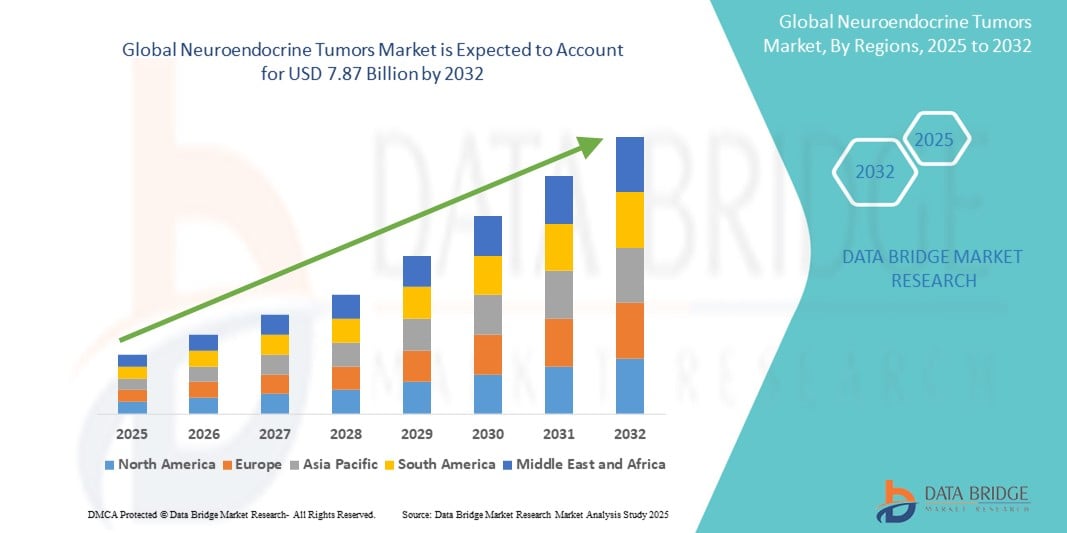
- The global neuroendocrine tumors market size was valued at USD 3.56 billion in 2024 and is expected to reach USD 7.87 billion by 2032, at a CAGR of 10.4% during the forecast period
- The market growth is largely fueled by the increasing incidence and prevalence of neuroendocrine tumors, coupled with significant advancements in diagnostic techniques leading to earlier and more accurate detection
- Furthermore, rising research and development activities, particularly in targeted therapies and novel treatment modalities such as peptide receptor radionuclide therapy (PRRT) and immunotherapies, are expanding treatment options and driving the adoption of these solutions, thereby significantly boosting the industry's growth
Neuroendocrine Tumors Market Analysis
- Neuroendocrine tumors (NETs), a diverse group of cancers originating from neuroendocrine cells, are increasingly recognized as a critical area in oncology. Their varied presentation and often slow growth necessitate advanced diagnostic and treatment modalities across both functional and non-functional types
- The escalating demand for neuroendocrine tumor treatments is primarily fueled by the increasing incidence and prevalence of these tumors globally, significant advancements in diagnostic techniques leading to earlier and more accurate detection, and a rising focus on research and development for novel and targeted therapies
- North America dominates the neuroendocrine tumors market with the largest revenue share of 42.5% in 2024, characterized by a robust healthcare infrastructure, high healthcare expenditure, the presence of key pharmaceutical and biotechnology companies, and a higher awareness and diagnosis rate of NETs. The U.S. specifically drives substantial growth due to extensive research initiatives and patient access to cutting-edge therapies
- Asia-Pacific is expected to be the fastest growing region in the neuroendocrine tumors market during the forecast period due to improving healthcare infrastructure, increasing awareness about NETs, rising disposable incomes, and a growing patient population seeking advanced treatment options
- Non-Functional NET segment dominates the neuroendocrine tumors market with a market share of 52.1% in 2024, driven by its asymptomatic nature leading to later diagnosis at more advanced stages, and increased incidental detection due to the widespread use of advanced imaging techniques
Report Scope and Neuroendocrine Tumors Market Segmentation
|
Attributes |
Neuroendocrine Tumors Key Market Insights |
|
Segments Covered |
|
|
Countries Covered |
North America
Europe
Asia-Pacific
Middle East and Africa
South America
|
|
Key Market Players |
|
|
Market Opportunities |
|
|
Value Added Data Infosets |
In addition to the insights on market scenarios such as market value, growth rate, segmentation, geographical coverage, and major players, the market reports curated by the Data Bridge Market Research also include in-depth expert analysis, pricing analysis, brand share analysis, consumer survey, demography analysis, supply chain analysis, value chain analysis, raw material/consumables overview, vendor selection criteria, PESTLE Analysis, Porter Analysis, and regulatory framework. |
Neuroendocrine Tumors Market Trends
“Advancements in Targeted Therapies and Precision Medicine”
- A significant and accelerating trend in the global neuroendocrine tumors (NETs) market is the continuous development and adoption of highly targeted therapies and precision medicine approaches. This involves understanding the specific molecular characteristics of individual tumors to tailor treatments, moving beyond traditional chemotherapy
- For instance, targeted drugs such as Everolimus and Sunitinib have been approved for pancreatic NETs, demonstrating improved progression-free survival. Similarly, Peptide Receptor Radionuclide Therapy (PRRT), such as with Lutathera has revolutionized the treatment of somatostatin receptor-positive NETs by delivering targeted radiation directly to tumor cells, offering a more precise and effective option for advanced cases
- The complex and heterogeneous nature of NETs is fostering a trend towards multidisciplinary team approaches and the establishment of specialized neuroendocrine tumor centers. These centers bring together endocrinologists, oncologists, surgeons, radiologists, and pathologists to provide comprehensive, individualized patient care, leading to optimized treatment strategies and improved outcomes. This coordinated approach is essential for managing the diverse clinical presentations and treatment pathways associated with NETs
- There is a robust trend of increasing research and development investment in the NET field, exploring new therapeutic avenues beyond existing options. This includes investigations into novel targeted therapies, immunotherapies, and combination regimens to overcome resistance and improve response rates. The focus is on identifying new molecular targets and developing drugs that can specifically interfere with the growth and spread of NET cells, aiming to provide more effective and durable treatment options for patients
- This trend towards more intelligent, precise, and integrated diagnostic and treatment approaches is fundamentally reshaping the landscape of neuroendocrine tumor management
Neuroendocrine Tumors Market Dynamics
Driver
“Increasing Incidence and Advancements in Diagnosis and Treatment”
- The increasing incidence and prevalence of neuroendocrine tumors (NETs) globally, coupled with significant advancements in diagnostic techniques and the continuous development of novel therapeutic options, are major drivers for the heightened demand in the neuroendocrine tumors market
- For instance, the global incidence of NETs has been rising steadily, with improved diagnostic methods such as Gallium-68 DOTATATE PET/CT scans allowing for earlier and more accurate detection. Companies are actively investing in R&D, with new targeted therapies and radioligand treatments expanding treatment landscapes and improving patient outcomes
- As healthcare providers become more adept at identifying NETs and as research yields more effective and targeted treatments, there is a compelling push for comprehensive management strategies. This is further supported by a growing understanding of the disease's complexity and the benefits of multidisciplinary care.
- Furthermore, increased awareness among both the medical community and the public regarding NETs is leading to more patients seeking timely diagnosis and treatment. The development of personalized medicine approaches, tailored to individual tumor characteristics, is also propelling the market by offering more effective and less toxic treatment options
- The rising number of clinical trials for innovative therapies, coupled with increasing investments from pharmaceutical and biotechnology companies in this therapeutic area, are key factors propelling the growth of the neuroendocrine tumors market. The focus on addressing unmet needs and improving the quality of life for NET patients further contributes to market expansion
Restraint/Challenge
“High Cost of Diagnosis and Treatment, and Diagnostic Complexities”
- Concerns surrounding the substantial financial burden of diagnosing and treating neuroendocrine tumors (NETs) pose a significant challenge to broader market penetration and patient access. The high costs associated with advanced diagnostic imaging, specialized pathology, and innovative therapies can be prohibitive for many patients and strain healthcare budgets globally
- For instance, treatments such as Peptide Receptor Radionuclide Therapy, while highly effective, come with a significant price tag. Similarly, sophisticated diagnostic tools such as Gallium-68 DOTATATE PET/CT scans, though crucial for accurate staging, represent a considerable expense. These high costs can lead to treatment delays or non-adherence, particularly in healthcare systems with limited reimbursement policies or in developing regions
- Addressing these financial barriers through robust reimbursement frameworks, patient assistance programs, and the development of more cost-effective generic or biosimilar options for some treatments is crucial for improving patient access
- In addition, the inherent complexities in diagnosing NETs present another major hurdle. Their rarity, diverse clinical presentations, and often non-specific symptoms can lead to prolonged diagnostic journeys and misdiagnoses
- The lack of universally accepted and easily accessible early diagnostic biomarkers contributes to this complexity. This diagnostic challenge can delay appropriate treatment initiation, potentially leading to disease progression and poorer outcomes
Neuroendocrine Tumors Market Scope
The market is segmented on the basis of classification, site, grade, type, product, end user, and distribution channel.
- By Classification
On the basis of classification, the neuroendocrine tumors market is segmented into functional NET and non-functional NET. The non-functional NET segment dominates the market with a market share of 52.1% in 2024, driven by its asymptomatic nature leading to later diagnosis at more advanced stages, and increased incidental detection due to the widespread use of advanced imaging techniques. These tumors often remain undetected until they cause symptoms due to their mass effect rather than hormone secretion.
The non-functional NET segment is also projected to be the fastest-growing segment, driven by continued improvements in diagnostic imaging leading to higher detection rates of previously undiscovered asymptomatic tumors
- By Site
On the basis of site, the neuroendocrine tumors market is segmented into lung, pancreas, gastrointestinal tract (GI), and appendicular. The gastrointestinal tract (GI) segment held the largest market revenue share in 2024. This dominance is attributed to the fact that Gastroenteropancreatic NETs collectively represent the most common subtype, comprising 55–70% of all NETs, making the GI tract the most frequent primary location.
The gastrointestinal tract (GI) segment is also expected to witness the fastest compound annual growth rate (CAGR) from 2025 to 2032 in the global neuroendocrine tumors (NETs) market, driven by the increasing prevalence of gastric cancer and the presence of a strong product pipeline. This segment's growth is further supported by advancements in diagnostic techniques and the development of novel therapeutic options.
- By Grade
On the basis of grade, the neuroendocrine tumors market is segmented into grade 1, grade 2, and grade 3. The grade 2 segment is expected to hold a significant market share in 2024, as many diagnosed NETs fall into this intermediate proliferative category, requiring ongoing monitoring and therapeutic interventions
The grade 3 segment is anticipated to witness the fastest growth rate, fueled by the aggressive nature of these high-grade tumors which necessitate immediate and intensive systemic treatment regimens, including novel and high-cost therapies, driving demand for these solutions.
- By Type
On the basis of type, the neuroendocrine tumors market is segmented into diagnosis and treatment. The treatment segment held the largest market revenue share in 2024, driven by the continuous and long-term need for therapeutic interventions once NETs are diagnosed, encompassing various treatment modalities from medical to surgical options
The diagnosis segment is expected to witness the fastest growth rate, fueled by continuous advancements in imaging technologies and the discovery of novel biomarkers that facilitate earlier and more precise detection of NETs, thereby increasing the patient pool entering the treatment pathway
- By Product
On the basis of product, the neuroendocrine tumors market is segmented into somatostatin analogs, targeted therapy, and chemotherapy. The somatostatin analogs segment dominates the neuroendocrine tumors market with the largest revenue share of 74% in 2024. This is driven by their established efficacy in both controlling symptoms and inhibiting tumor growth in a large proportion of somatostatin receptor-positive NETs, positioning them as a first-line and long-term treatment option
The targeted therapy segment is anticipated to witness the fastest CAGR during the forecast period, fueled by ongoing research and development efforts leading to the approval of new, highly specific drugs that offer improved efficacy and a more favorable side-effect profile for various NET subtypes
- By End User
On the basis of end user, the neuroendocrine tumors market is segmented into hospitals, specialty clinics, radiation centers, home healthcare, and others. The Hospitals segment held the largest market revenue share in 2024, driven by their comprehensive infrastructure, access to multidisciplinary teams, advanced diagnostic capabilities, and the capacity to administer complex, often inpatient, treatments such as PRRT and specialized surgeries.
The specialty clinics segment is anticipated to grow at the highest CAGR during the forecast period, which can be attributed to patients' increasing preference for outpatient care models and specialized expertise offered by these centers, leading to greater patient traffic
- By Distribution Channel
On the basis of end user, the neuroendocrine tumors market is segmented into Direct Tender, Hospital Pharmacies, Retail Pharmacies, Online Pharmacies, and Other. The retail pharmacies segment accounted for the largest market revenue share in 2024, driven by their widespread accessibility, established consumer trust, and the ability to offer a broad range of products, from over-the-counter medications to prescription drugs. Retail pharmacies are often the first point of contact for individuals seeking medications, making them a crucial part of the healthcare system.
The direct tender segment is expected to witness the fastest compound annual growth rate (CAGR) from 2025 to 2032 in the global neuroendocrine tumors market, driven by the increasing focus on cost-effective procurement strategies by healthcare providers and the growing presence of suppliers in the market. This segment's growth is further supported by the expansion of healthcare infrastructure and the rising demand for specialized treatments for neuroendocrine tumors
Neuroendocrine Tumors Market Regional Analysis
- North America dominates the neuroendocrine tumors market with the largest revenue share of 42.5% in 2024, driven by characterized by a robust healthcare infrastructure, high healthcare expenditure, the presence of key pharmaceutical and biotechnology companies, and a higher awareness and diagnosis rate of NETs
- Consumers and healthcare providers in North America highly value access to advanced diagnostic techniques and cutting-edge targeted therapies, alongside robust reimbursement policies that facilitate the adoption of new treatments
- This widespread adoption is further supported by high healthcare expenditure, a technologically advanced medical infrastructure, and the growing preference for personalized medicine approaches, establishing North America as a key innovation hub for NET management
U.S. Neuroendocrine Tumors Market Insight
The U.S. neuroendocrine tumor market captured the largest revenue share of 74% within North America in 2024, fueled by the swift uptake of advanced diagnostic modalities and the expanding availability of novel therapeutic options. Healthcare providers are increasingly prioritizing the enhancement of NET management through precise diagnostic tools and effective treatment regimens. The growing preference for specialized care centers, combined with robust demand for targeted therapies and personalized medicine approaches, further propels the NET industry. Moreover, the increasing integration of clinical research and development, supported by strong governmental funding and pharmaceutical investments, is significantly contributing to the market's expansion
Europe Neuroendocrine Tumors Market Insight
The Europe neuroendocrine tumor market is projected to expand at a substantial CAGR throughout the forecast period, primarily driven by increasing R&D spending, favorable health reimbursement policies, and strategic collaborations among key players. The increase in NET incidence, coupled with a growing focus on early diagnosis and multidisciplinary management, is fostering the adoption of advanced NET treatments. European healthcare systems are also drawn to the benefits of established treatment protocols and increasing awareness campaigns by patient advocacy groups. The region is experiencing significant growth across various treatment modalities, with new therapies being incorporated into clinical practice and national guidelines
U.K. Neuroendocrine Tumors Market Insight
The U.K. neuroendocrine tumor market is anticipated to grow at a noteworthy CAGR during the forecast period, driven by the escalating focus on improving cancer outcomes and a desire for heightened access to innovative therapies. In addition, concerns regarding the often late diagnosis of NETs are encouraging both healthcare providers and patients to seek advanced diagnostic and treatment solutions. The UK’s robust healthcare system, alongside its increasing investment in cancer research and clinical trials, is expected to continue to stimulate market growth
Germany Neuroendocrine Tumors Market Insight
The Germany neuroendocrine tumor market is expected to expand at a considerable CAGR during the forecast period, fueled by increasing awareness of rare cancers and the demand for technologically advanced, high-quality healthcare solutions. Germany’s well-developed infrastructure, combined with its emphasis on innovation and robust reimbursement policies, promotes the adoption of advanced NET diagnostics and therapies, particularly in specialized oncology centers. The integration of precision medicine approaches and a strong preference for research-backed solutions align with local consumer and medical expectations, further driving market expansion
Asia-Pacific Neuroendocrine Tumors Market Insight
The Asia-Pacific neuroendocrine tumor market is poised to grow at the fastest CAGR during the forecast period, driven by increasing incidence of NETs, rising healthcare expenditure, and technological advancements in countries such as China, Japan, and India. The region's growing inclination towards improving cancer care, supported by government initiatives promoting healthcare infrastructure development, is driving the adoption of advanced NET treatments. Furthermore, as APAC witnesses a greater focus on early diagnosis and access to innovative therapies, the affordability and accessibility of NET management are expanding to a wider patient base
Japan Neuroendocrine Tumors Market Insight
The Japan neuroendocrine tumor market is gaining momentum due to the country’s advanced healthcare infrastructure, focus on precision medicine, and demand for high-quality specialized care. The Japanese market places a significant emphasis on diagnostic accuracy and treatment efficacy, and the adoption of advanced NET therapies is driven by the increasing number of diagnosed cases and clinical research. The integration of multidisciplinary care approaches with other advanced medical technologies, such as sophisticated imaging, is fueling growth. Moreover, Japan's aging population is such asly to spur demand for effective and comprehensive NET management solutions.
India Neuroendocrine Tumors Market Insight
The India neuroendocrine tumor market accounted for the largest market revenue share in Asia Pacific in 2024, attributed to the country's expanding middle class, rapid urbanization, and improving access to specialized medical facilities. India stands as a rapidly growing market for cancer care, and advanced NET diagnostics and treatments are becoming increasingly popular in major metropolitan areas. The push towards improving cancer screening programs and the increasing availability of specialized oncology services, alongside growing domestic pharmaceutical capabilities, are key factors propelling the market in India
Neuroendocrine Tumors Market Share
The neuroendocrine tumors industry is primarily led by well-established companies, including:
- F. Hoffmann-La Roche Ltd (Switzerland)
- Bristol-Myers Squibb (U.S.)
- Viatris Inc. (U.S.)
- Thermo Fisher Scientific Inc. (U.S.)
- Novartis AG (Switzerland)
- Regeneron Pharmaceuticals, Inc. (U.S.)
- Sun Pharmaceutical Industries Ltd. (India)
- Teva Pharmaceutical Industries Ltd. (Israel)
- Lilly (U.S.)
- Lupin (India)
- Exact Sciences Corporation (U.S.)
- Pfizer Inc. (U.S.)
- Ipsen Pharma (France)
- Advanced Accelerator Applications SA (France)
- BioSynthema Inc. (U.S.)
- Bionano Genomics, Inc. (U.S.)
- Illumina, Inc. (U.S.)
- GSK plc (U.K.)
- HUTCHMED (China)
Latest Developments in Global Neuroendocrine Tumors Market
- In April 2025, A new Phase 1 clinical trial has opened for enrollment at Sylvester Comprehensive Cancer Center, University of Miami Miller School of Medicine, for patients with high-grade neuroendocrine tumors. This trial will test a novel combination of immunotherapy drugs (nivolumab and ipilimumab) paired with an oncolytic (tumor-busting) virus, SVV-001 (Seneca Valley Virus-001), injected directly into the tumors
- In February 2025, The U.S. Food and Drug Administration (FDA) approved mirdametinib (Gomekli) for the treatment of neurofibromatosis type 1 (NF1) in patients who have symptomatic plexiform neurofibromas not amenable to complete surgical resection. While not directly a neuroendocrine tumor, NF1 is a genetic disorder that can cause various tumors, including some with neuroendocrine features. This approval provides a significant non-surgical option for a challenging tumor type within a related patient population
- In April 2024, Novartis received U.S. Food and Drug Administration (FDA) approval for Lutathera for the treatment of gastroenteropancreatic neuroendocrine tumors in pediatric patients. This approval marks a significant advancement, as Lutathera becomes the first radioligand therapy specifically approved for children with GEP-NETs, offering new hope for young patients and expanding the scope of precision medicine in pediatric oncology
- In March 2024, Crinetics Pharmaceuticals reported positive topline results from its Phase 2 open-label study of paltusotine, an investigational oral somatostatin receptor type 2 (SST2) nonpeptide agonist, in carcinoid syndrome. Paltusotine was shown to result in rapid and sustained reductions in the frequency and severity of flushing episodes and bowel movements associated with neuroendocrine tumors
- In December 2023, Bristol Myers Squibb (BMS) announced the acquisition of RayzeBio for approximately USD 4.1 billion. RayzeBio is a clinical-stage radiopharmaceutical company with a lead asset, RYZ101, targeting somatostatin receptor 2 (SSTR2), which is over-expressed in GEP-NETs and extensive stage small cell lung cancer (ES-SCLC). This acquisition significantly expands BMS's presence in the radiopharmaceutical therapeutics (RPTs) space and aims to strengthen its oncology pipeline

- Interactive Data Analysis Dashboard
- Company Analysis Dashboard for high growth potential opportunities
- Research Analyst Access for customization & queries
- Competitor Analysis with Interactive dashboard
- Latest News, Updates & Trend analysis
- Harness the Power of Benchmark Analysis for Comprehensive Competitor Tracking
Data collection and base year analysis are done using data collection modules with large sample sizes. The stage includes obtaining market information or related data through various sources and strategies. It includes examining and planning all the data acquired from the past in advance. It likewise envelops the examination of information inconsistencies seen across different information sources. The market data is analysed and estimated using market statistical and coherent models. Also, market share analysis and key trend analysis are the major success factors in the market report. To know more, please request an analyst call or drop down your inquiry.
The key research methodology used by DBMR research team is data triangulation which involves data mining, analysis of the impact of data variables on the market and primary (industry expert) validation. Data models include Vendor Positioning Grid, Market Time Line Analysis, Market Overview and Guide, Company Positioning Grid, Patent Analysis, Pricing Analysis, Company Market Share Analysis, Standards of Measurement, Global versus Regional and Vendor Share Analysis. To know more about the research methodology, drop in an inquiry to speak to our industry experts.
Data Bridge Market Research is a leader in advanced formative research. We take pride in servicing our existing and new customers with data and analysis that match and suits their goal. The report can be customized to include price trend analysis of target brands understanding the market for additional countries (ask for the list of countries), clinical trial results data, literature review, refurbished market and product base analysis. Market analysis of target competitors can be analyzed from technology-based analysis to market portfolio strategies. We can add as many competitors that you require data about in the format and data style you are looking for. Our team of analysts can also provide you data in crude raw excel files pivot tables (Fact book) or can assist you in creating presentations from the data sets available in the report.












