


Neuromuscular Blockade Drugs Market Size
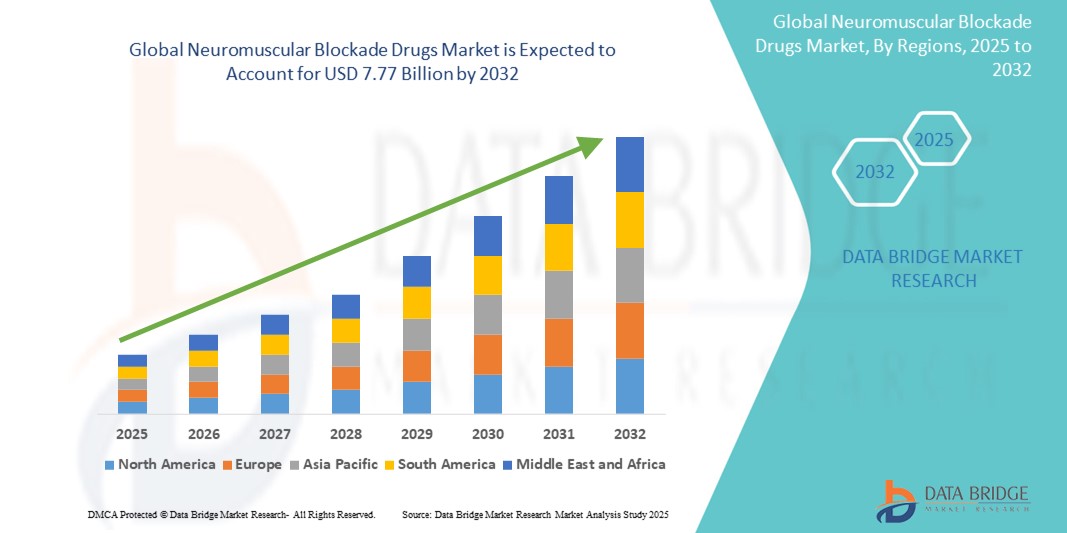
- The global neuromuscular blockade drugs market size was valued at USD 5.46 billion in 2024 and is expected to reach USD 7.77 billion by 2032, at a CAGR of 4.50% during the forecast period
- The market growth is largely fueled by the increasing prevalence of surgeries and critical care procedures, where neuromuscular blockade drugs play an essential role in facilitating endotracheal intubation, mechanical ventilation, and muscle relaxation during operations. Technological advancements in anesthetic delivery systems and monitoring have also contributed to the optimized use of these agents in modern healthcare settings
- Furthermore, rising demand for fast-acting, short-duration neuromuscular blockers and the development of next-generation reversal agents are establishing neuromuscular blockade drugs as indispensable components in surgical and ICU protocols. These converging factors are accelerating the adoption of neuromuscular blockade drug solutions, thereby significantly boosting the industry’s growth
Neuromuscular Blockade Drugs Market Analysis
- Neuromuscular blockade drugs, essential for inducing muscle relaxation during surgical procedures and mechanical ventilation, are becoming increasingly vital in modern operating rooms and intensive care units due to their rapid onset, controllability, and compatibility with advanced anesthesia monitoring systems
- The escalating demand for neuromuscular blockade drugs is primarily fueled by the growing volume of surgeries globally, rising prevalence of chronic diseases requiring intensive care, and technological advancements in perioperative care protocols
- North America dominated the neuromuscular blockade drugs market with the largest revenue share of 38.5% in 2024, characterized by high surgical procedure volumes, robust healthcare infrastructure, and strong presence of major pharmaceutical manufacturers. The U.S. continues to lead with increased utilization of short-acting and intermediate-acting neuromuscular blockers in both elective and emergency surgeries
- Asia-Pacific is expected to be the fastest growing region in the neuromuscular blockade drugs market during the forecast period, projected to grow at a CAGR of 7.9%, driven by rising medical tourism, growing number of hospitals, and expanding access to anesthesia care in developing countries such as India and China
- The non-depolarizing neuromuscular blockers segment dominated the neuromuscular blockade drugs market with the largest revenue share of 67.3% in 2024, owing to their widespread use in long-duration surgeries and critical care settings. These agents offer superior control, prolonged muscle relaxation, and fewer side effects compared to depolarizing drugs, making them the preferred choice among healthcare professionals
Report Scope and Neuromuscular Blockade Drugs Market Segmentation
|
Attributes |
Neuromuscular Blockade Drugs Key Market Insights |
|
Segments Covered |
|
|
Countries Covered |
North America
Europe
Asia-Pacific
Middle East and Africa
South America
|
|
Key Market Players |
|
|
Market Opportunities |
|
|
Value Added Data Infosets |
In addition to the insights on market scenarios such as market value, growth rate, segmentation, geographical coverage, and major players, the market reports curated by the Data Bridge Market Research also include in-depth expert analysis, pricing analysis, brand share analysis, consumer survey, demography analysis, supply chain analysis, value chain analysis, raw material/consumables overview, vendor selection criteria, PESTLE Analysis, Porter Analysis, and regulatory framework. |
Neuromuscular Blockade Drugs Market Trends
“Growing Advancements in Drug Delivery and Monitoring Systems”
- A significant and accelerating trend in the global neuromuscular blockade drugs market is the integration of advanced drug delivery technologies and real-time monitoring systems that enhance precision in dosage and improve patient safety. These developments are transforming traditional anesthetic practices by allowing better control and customization during surgeries and critical care procedures
- For instance, closed-loop systems and target-controlled infusion (TCI) devices are increasingly being employed in modern surgical environments to administer neuromuscular blocking agents with optimal precision. These systems adjust drug infusion rates based on continuous feedback from neuromuscular monitoring, thereby minimizing the risk of residual paralysis and ensuring effective muscle relaxation
- In addition, the incorporation of advanced pharmacokinetic and pharmacodynamic (PK/PD) modeling in anesthesia management platforms allows anesthesiologists to tailor neuromuscular blockade to individual patient needs. This enhances clinical outcomes and reduces the risk of overdose or underdose during high-risk procedures
- The growing adoption of quantitative neuromuscular monitoring (such as acceleromyography and electromyography) in operating rooms and ICUs further facilitates accurate tracking of blockade depth and recovery time. These technologies help determine the appropriate timing for administering reversal agents and extubation, ultimately contributing to faster and safer patient recovery
- This trend toward intelligent, responsive drug administration and monitoring systems is reshaping clinical protocols and improving patient safety standards in perioperative care. Consequently, leading pharmaceutical and med-tech companies are investing in research collaborations and product innovation aimed at integrating their neuromuscular blockade drugs with digital anesthesia and patient monitoring ecosystems
- The demand for such technologically enhanced solutions is growing rapidly across hospitals, ambulatory surgical centers, and critical care units, as healthcare providers increasingly prioritize precision, safety, and operational efficiency in drug administration practices
Neuromuscular Blockade Drugs Market Dynamics
Driver
“Rising Surgical Volume and ICU Demand Fueling Market Growth”
- The global increase in surgical procedures, intensive care admissions, and emergency interventions is a key driver propelling the demand for neuromuscular blockade drugs. These agents are essential in achieving optimal muscle relaxation during surgery, enabling intubation, and facilitating mechanical ventilation in critical care units
- The aging population and the growing burden of chronic diseases such as COPD, cardiovascular conditions, and cancer are contributing to higher hospitalization rates, creating a consistent need for neuromuscular blockade agents
- For instance, hospitals and surgical centers are increasingly utilizing rapid-onset and short-duration neuromuscular blockers to enhance surgical efficiency and improve patient recovery times. The demand for agents such as rocuronium and cisatracurium is steadily increasing in both elective and emergency procedures across developed and emerging healthcare systems
- Furthermore, the increasing prevalence of procedures such as laparoscopic and robotic surgeries, which require precise muscle control, is augmenting the use of neuromuscular blockade drugs in modern operating rooms
Restraint/Challenge
“Adverse Drug Reactions and Reversal Agent Dependency”
- Despite their widespread clinical utility, neuromuscular blockade drugs can be associated with significant side effects, including prolonged paralysis, respiratory complications, and residual neuromuscular blockade post-surgery. This necessitates the use of reversal agents such as sugammadex or neostigmine, which can increase overall treatment cost and complexity
- The dependency on reversal drugs to minimize post-operative complications can pose logistical and financial challenges, particularly in resource-limited settings where access to these agents may be constrained
- In addition, patient variability in drug metabolism and the narrow therapeutic window of some agents such as pancuronium or vecuronium can increase the risk of adverse events, requiring careful monitoring and dosage titration by trained anesthesiologists
- Regulatory concerns regarding safety and potential misuse, particularly in non-hospital settings, further limit broader accessibility and usage of certain neuromuscular blocking agents
- Overcoming these challenges will require continued innovation in drug formulation, improved training protocols for healthcare providers, and greater global availability of reversal agents to ensure safe and effective drug administration
Neuromuscular Blockade Drugs Market Scope
The market is segmented on the basis of type, drugs, end-users, and distribution channel.
• By Type
On the basis of type, the neuromuscular blockade drugs market is segmented into depolarizing, non-depolarizing, and others. The non-depolarizing segment dominated the market with the largest revenue share of 67.3% in 2024, owing to its wide use in long-duration surgeries and critical care. These drugs provide better control and fewer side effects compared to depolarizing agents.
The depolarizing segment is expected to witness the fastest growth with a CAGR of 6.8% from 2025 to 2032, driven by its rapid onset of action, making it ideal for short procedures and emergency intubation.
• By Drugs
On the basis of drugs, the neuromuscular blockade drugs market is segmented into succinylcholine, cisatracurium, mivacurium, doxacurium, rocuronium, atracurium, pancuronium, vecuronium, and others. The rocuronium segment held the largest market share of 22.9% in 2024, supported by its effectiveness, rapid onset, and compatibility with modern anesthesia protocols.
The cisatracurium segment is projected to witness the fastest CAGR of 7.4% from 2025 to 2032, due to its favorable safety profile, organ-independent metabolism, and increased usage in ICU settings.
• By End-Users
On the basis of end-users, the neuromuscular blockade drugs market is segmented into hospitals, homecare, specialty clinics, and others. The hospital segment dominated the market with a revenue share of 54.6% in 2024, driven by the high volume of surgical procedures and continuous demand for anesthesia services in inpatient settings.
The homecare segment is anticipated to register the fastest CAGR of 7.1% from 2025 to 2032, owing to the growing trend of post-surgical care at home and increased availability of portable ventilation and monitoring solutions.
• By Distribution Channel
On the basis of distribution channel, the neuromuscular blockade drugs market is segmented into hospital pharmacy, retail pharmacy, online pharmacies, and others. The hospital pharmacy segment held the largest revenue share of 48.3% in 2024, driven by institutional bulk purchasing and centralized supply chains for surgical centers.
The online pharmacies segment is projected to witness the fastest CAGR of 8.2% from 2025 to 2032, fueled by the increasing adoption of e-prescriptions, digital pharmacy platforms, and home delivery preferences.
Neuromuscular Blockade Drugs Market Regional Analysis
- North America dominated the neuromuscular blockade drugs market with the largest revenue share of 38.5% in 2024, driven by high surgical procedure volumes, well-established healthcare infrastructure
- The presence of key pharmaceutical players such as Merck & Co., Pfizer Inc., and Amgen Inc.
- The region benefits from strong adoption of modern anesthesia practices, favorable reimbursement policies, and continued innovation in critical care settings
U.S. Neuromuscular Blockade Drugs Market Insight
The U.S. neuromuscular blockade drugs market captured the largest revenue share of 78% in 2024 within North America, fueled by the increasing number of surgeries, robust healthcare infrastructure, and expanding ICU capacities. The market is further supported by rapid uptake of short-acting neuromuscular agents and increasing use in outpatient and ambulatory surgery centers.
Europe Neuromuscular Blockade Drugs Market Insight
The Europe neuromuscular blockade drugs market accounted for a 27.6% revenue share in 2024, propelled by a rising number of surgical interventions and improved perioperative care. Stringent regulatory frameworks, increasing adoption of newer agents such as rocuronium and cisatracurium, and the growth in minimally invasive surgeries are key contributors to the region’s market strength.
U.K. Neuromuscular Blockade Drugs Market Insight
The U.K. neuromuscular blockade drugs market is anticipated to grow at a CAGR of 6.8% from 2025 to 2032, driven by increasing surgical volumes and a growing shift toward day-case surgeries. The NHS’s focus on safety and innovation, alongside rising demand for anesthesia in geriatric care, fuels consistent market growth.
Germany Neuromuscular Blockade Drugs Market Insight
The Germany neuromuscular blockade drugs market is expected to expand at a CAGR of 6.5% during the forecast period, supported by a well-developed hospital system, high surgical throughput, and the adoption of advanced anesthetic practices. The country’s strong pharma manufacturing base also contributes to increased drug availability and affordability.
Asia Pacific Neuromuscular Blockade Drugs Market Insight
The Asia-Pacific neuromuscular blockade drugs market is projected to witness the fastest CAGR of 7.9% from 2025 to 2032, driven by increasing healthcare investments, rising surgical volumes, and growing access to anesthesia care across China, India, and Southeast Asia. In 2024, the region accounted for 21.2% of the global market, fueled by rapid urbanization and rising awareness of perioperative safety.
Japan Neuromuscular Blockade Drugs Market Insight
The Japan neuromuscular blockade drugs market held a 6.8% revenue share in 2024, driven by its technologically advanced healthcare infrastructure, aging population, and increasing demand for safe surgical procedures.The integration of neuromuscular blockade agents in enhanced recovery after surgery (ERAS) protocols is further boosting market demand.
China Neuromuscular Blockade Drugs Market Insight
The China neuromuscular blockade drugs market dominated the Asia-Pacific neuromuscular blockade drugs market with a market share of 48.2% within the region in 2024, attributed to its large population base, expanding surgical capacity, and growing local pharmaceutical manufacturing. Supportive government policies and innovation in drug development are accelerating the adoption of both branded and generic neuromuscular blocking agents.
Neuromuscular Blockade Drugs Market Share
The neuromuscular blockade drugs industry is primarily led by well-established companies, including:
- F. Hoffmann-La Roche Ltd. (Switzerland)
- Teva Pharmaceutical Industries Ltd. (Israel)
- Sanofi (France)
- Pfizer Inc. (U.S.)
- GSK plc (U.K.)
- Novartis AG (Switzerland)
- AstraZeneca (U.K.)
- Johnson & Johnson Private Limited (U.S.)
- Sun Pharmaceutical Industries Ltd. (India)
- Merck & Co., Inc. (U.S.)
- Lilly (U.S.)
- Amgen Inc. (U.S.)
- Actelion Pharmaceuticals Ltd (Switzerland)
- Endo International plc (Ireland)
- Intas Pharmaceuticals Ltd. (India)
Latest Developments in Global Neuromuscular Blockade Drugs Market
- In April 2023, Merck & Co., Inc. announced the initiation of a Phase III clinical trial to evaluate a next-generation neuromuscular blockade reversal agent intended to reduce residual paralysis risks post-surgery. This strategic move demonstrates Merck's commitment to expanding its footprint in the perioperative care market and addressing unmet needs in anesthesia recovery
- In March 2023, Pfizer Inc. launched an advanced formulation of Rocuronium Bromide with improved stability and reduced storage requirements, making it ideal for use in low-resource hospital settings. This innovation is aimed at increasing the accessibility and global reach of neuromuscular blocking agents, especially in emerging economies
- In March 2023, Cumberland Pharmaceuticals Inc. received FDA approval for expanded indications of its neuromuscular blockade reversal drug, Caldolor, in intensive care units (ICUs). The approval supports safer and more effective ICU protocols, particularly in patients requiring mechanical ventilation and sedation
- In February 2023, Hikma Pharmaceuticals partnered with a U.S.-based biotech firm to co-develop generic formulations of Vecuronium and Cisatracurium. The initiative is focused on affordability and consistent supply of essential neuromuscular blockers in both domestic and international markets, aligning with global health security goals

- Interactive Data Analysis Dashboard
- Company Analysis Dashboard for high growth potential opportunities
- Research Analyst Access for customization & queries
- Competitor Analysis with Interactive dashboard
- Latest News, Updates & Trend analysis
- Harness the Power of Benchmark Analysis for Comprehensive Competitor Tracking
Data collection and base year analysis are done using data collection modules with large sample sizes. The stage includes obtaining market information or related data through various sources and strategies. It includes examining and planning all the data acquired from the past in advance. It likewise envelops the examination of information inconsistencies seen across different information sources. The market data is analysed and estimated using market statistical and coherent models. Also, market share analysis and key trend analysis are the major success factors in the market report. To know more, please request an analyst call or drop down your inquiry.
The key research methodology used by DBMR research team is data triangulation which involves data mining, analysis of the impact of data variables on the market and primary (industry expert) validation. Data models include Vendor Positioning Grid, Market Time Line Analysis, Market Overview and Guide, Company Positioning Grid, Patent Analysis, Pricing Analysis, Company Market Share Analysis, Standards of Measurement, Global versus Regional and Vendor Share Analysis. To know more about the research methodology, drop in an inquiry to speak to our industry experts.
Data Bridge Market Research is a leader in advanced formative research. We take pride in servicing our existing and new customers with data and analysis that match and suits their goal. The report can be customized to include price trend analysis of target brands understanding the market for additional countries (ask for the list of countries), clinical trial results data, literature review, refurbished market and product base analysis. Market analysis of target competitors can be analyzed from technology-based analysis to market portfolio strategies. We can add as many competitors that you require data about in the format and data style you are looking for. Our team of analysts can also provide you data in crude raw excel files pivot tables (Fact book) or can assist you in creating presentations from the data sets available in the report.












