


Neuroprotective Peptide Therapeutics Market Size
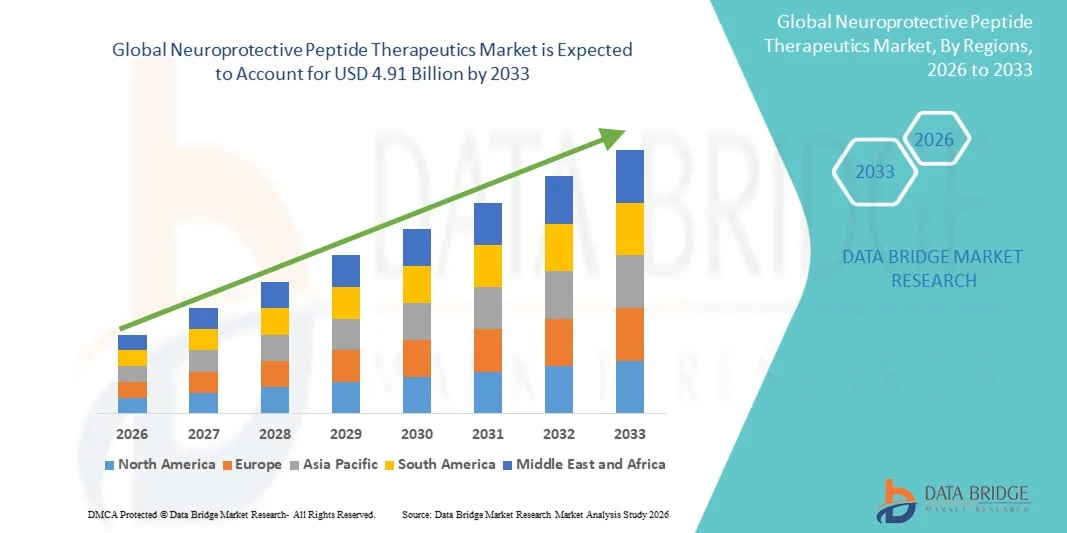
- The global Neuroprotective Peptide Therapeutics market size was valued at USD 1.23 billion in 2025 and is expected to reach USD 4.91 billion by 2033, at a CAGR of 18.90% during the forecast period
- The market growth is largely fueled by increasing prevalence of neurodegenerative disorders, advancements in peptide-based drug discovery, and rising investments in biotechnology and precision medicine, leading to accelerated development of targeted neuroprotective therapies across healthcare and research settings
- Furthermore, growing demand for effective, disease-modifying, and patient-friendly treatment options for conditions such as Alzheimer’s disease, Parkinson’s disease, stroke, and ALS is establishing Neuroprotective Peptide Therapeutics as a promising approach in modern neurology. These converging factors are accelerating the uptake of Neuroprotective Peptide Therapeutics solutions, thereby significantly boosting the industry's growth
Neuroprotective Peptide Therapeutics Market Analysis
- Neuroprotective peptide therapeutics, including neurotrophic peptides, anti-amyloid peptides, mitochondrial protective peptides, and anti-inflammatory peptide agents, are increasingly vital components of modern neurology and precision medicine due to their ability to target disease pathways involved in neurodegeneration and neuronal injury
- The escalating demand for Neuroprotective Peptide Therapeutics is primarily fueled by the rising prevalence of neurodegenerative diseases, growing focus on disease-modifying therapies, increasing investments in biotechnology research, and advancements in peptide engineering and drug delivery systems
- North America dominated the neuroprotective peptide therapeutics market with the largest revenue share of approximately 42.6% in 2025, characterized by strong biotechnology infrastructure, high R&D investments, early adoption of advanced biologics, and a strong presence of key pharmaceutical and biotech companies, with the U.S. witnessing significant growth in clinical trials and peptide-based therapeutic development programs
- Asia-Pacific is expected to be the fastest-growing region in the neuroprotective peptide therapeutics market during the forecast period, projected to register a CAGR of approximately 10.4%, due to increasing healthcare expenditure, rising prevalence of neurological disorders, expanding biotechnology sector, and growing government support for advanced drug development research
- The Alzheimer’s disease segment accounted for the largest market revenue share of 41.8% in 2025, driven by the rapidly increasing global prevalence of dementia-related disorders
Report Scope and Neuroprotective Peptide Therapeutics Market Segmentation
|
Attributes |
Neuroprotective Peptide Therapeutics Key Market Insights |
|
Segments Covered |
|
|
Countries Covered |
North America
Europe
Asia-Pacific
Middle East and Africa
South America
|
|
Key Market Players |
|
|
Market Opportunities |
|
|
Value Added Data Infosets |
In addition to the insights on market scenarios such as market value, growth rate, segmentation, geographical coverage, and major players, the market reports curated by the Data Bridge Market Research also include in-depth expert analysis, patient epidemiology, pipeline analysis, pricing analysis, and regulatory framework. |
Neuroprotective Peptide Therapeutics Market Trends
“Advancements in Targeted Drug Delivery, Precision Medicine, and Neurodegenerative Disease Research”
- A significant and accelerating trend in the global Neuroprotective Peptide Therapeutics market is the growing shift toward highly targeted and mechanism-based therapies aimed at slowing or preventing neuronal damage in conditions such as Alzheimer’s disease, Parkinson’s disease, amyotrophic lateral sclerosis (ALS), and other neurodegenerative disorders. Researchers are increasingly focusing on peptide-based molecules that can cross the blood-brain barrier and act directly on neuronal pathways
- For instance, novel neuroprotective peptides are being engineered to modulate apoptosis, reduce oxidative stress, and regulate inflammatory responses in the central nervous system, offering improved therapeutic specificity compared to conventional small-molecule drugs
- Advances in peptide engineering, including peptide stabilization techniques and nanoformulation-based delivery systems, are improving bioavailability and therapeutic half-life, making these treatments more clinically viable
- Pharmaceutical and biotechnology companies are also investing in biomarker-driven drug development, enabling patient stratification and more personalized treatment approaches based on disease stage and progression rate
- In addition, growing clinical research collaborations and academic-industry partnerships are accelerating pipeline development for next-generation neuroprotective compounds
- This increasing emphasis on precision neurology and disease-modifying therapies is expected to significantly expand opportunities in the Neuroprotective Peptide Therapeutics market
Neuroprotective Peptide Therapeutics Market Dynamics
Driver
“Rising Prevalence of Neurodegenerative Disorders and Increasing Demand for Disease-Modifying Therapies”
- The growing global burden of neurodegenerative diseases is a major driver for the Neuroprotective Peptide Therapeutics market. Aging populations, longer life expectancy, and lifestyle-related neurological risk factors are contributing to a steady rise in conditions such as Alzheimer’s and Parkinson’s disease
- For instance, healthcare systems worldwide are witnessing increased diagnosis rates of cognitive and motor neuron disorders, creating urgent demand for therapies that not only manage symptoms but also slow disease progression
- Current treatment limitations in conventional neuropharmacology are pushing research toward innovative peptide-based therapeutics that can provide neuroprotection and potentially modify disease pathways
- In addition, rising investments from governments and private biotech firms in neuroscience research are accelerating drug discovery efforts and clinical trial activity
- Expanding awareness among clinicians regarding early intervention in neurodegenerative diseases is also improving treatment adoption rates
- These factors collectively are expected to drive sustained growth in the Neuroprotective Peptide Therapeutics market over the forecast period
Restraint/Challenge
“High Development Complexity, Blood-Brain Barrier Delivery Challenges, and Regulatory Hurdles”
- One of the major challenges in the Neuroprotective Peptide Therapeutics market is the difficulty in delivering therapeutic peptides across the blood-brain barrier, which significantly limits drug efficacy and bioavailability
- Peptides often face rapid degradation in the bloodstream, requiring advanced delivery systems or chemical modifications, which increase development complexity and cost.
- In addition, the lengthy and expensive clinical trial process for central nervous system (CNS) drugs creates barriers to rapid commercialization
- Regulatory requirements for neurological therapeutics are stringent due to safety concerns and the complexity of brain-related disorders, often leading to extended approval timelines.
- Limited success rates in late-stage clinical trials for neurodegenerative disease drugs further increase investment risk for pharmaceutical companies
- Overcoming these challenges through advanced delivery technologies, improved peptide stabilization methods, and stronger translational research frameworks will be essential for long-term growth in the Neuroprotective Peptide Therapeutics market
Neuroprotective Peptide Therapeutics Market Scope
The market is segmented on the basis of drug class and application.
• By Drug Class
On the basis of drug class, the Neuroprotective Peptide Therapeutics market is segmented into neurotrophic peptides, amyloid-targeting peptides, anti-inflammatory peptides, mitochondrial protective peptides, and others. The neurotrophic peptides segment dominated the largest market revenue share of 38.6% in 2025, driven by their strong role in promoting neuronal survival, regeneration, and synaptic plasticity. These peptides are widely studied for neurodegenerative conditions such as Alzheimer’s and Parkinson’s disease. Their ability to enhance nerve growth factor activity supports improved cognitive and motor function outcomes. Increasing clinical research and pipeline developments strengthen their adoption. Pharmaceutical companies are heavily investing in neurotrophic peptide-based drug development. Their relatively favorable safety profile compared to small molecules further boosts acceptance. Growing prevalence of neurodegenerative disorders globally supports sustained demand. Advancements in peptide synthesis technologies improve scalability and stability. Rising focus on disease-modifying therapies enhances their clinical importance. Overall, neurotrophic peptides remain the cornerstone of neuroprotective therapeutic strategies.
The mitochondrial protective peptides segment is expected to witness the fastest growth rate of 12.4% CAGR from 2026 to 2033, driven by increasing recognition of mitochondrial dysfunction in neurodegenerative diseases. These peptides help reduce oxidative stress and improve cellular energy metabolism. Rising research into mitochondrial pathways in brain disorders is fueling development. Their potential to slow disease progression is gaining strong clinical interest. Expanding applications in stroke and traumatic brain injury further support growth. Pharmaceutical innovation is accelerating next-generation peptide formulations. Improved delivery systems enhance blood-brain barrier penetration. Growing funding for neuroprotection research supports pipeline expansion. Increasing prevalence of aging-related neurological disorders boosts demand. Overall, mitochondrial protective peptides are emerging as a high-potential therapeutic class.
• By Application
On the basis of application, the market is segmented into Alzheimer’s disease, Parkinson’s disease, stroke, amyotrophic lateral sclerosis (ALS), traumatic brain injury, and others. The Alzheimer’s disease segment accounted for the largest market revenue share of 41.8% in 2025, driven by the rapidly increasing global prevalence of dementia-related disorders. Neuroprotective peptides are being extensively studied to slow amyloid plaque formation and neuronal degeneration. Rising aging population significantly increases patient burden worldwide. Strong research funding and clinical trials in Alzheimer’s therapies support market dominance. Early diagnosis and increased awareness improve treatment uptake. Pharmaceutical companies prioritize Alzheimer’s drug development pipelines. Government initiatives for dementia care enhance treatment accessibility. Growing unmet clinical need further accelerates adoption. Combination therapies involving peptides show promising results. Overall, Alzheimer’s remains the key application driving market growth.
The traumatic brain injury segment is expected to witness the fastest CAGR of 13.1% from 2026 to 2033, driven by increasing incidence of accidents, sports injuries, and military-related trauma. Neuroprotective peptides are gaining attention for their ability to reduce secondary brain injury and inflammation. Rising emergency care advancements improve early intervention rates. Expanding research in acute neuroprotection supports clinical development. Increasing awareness of brain injury consequences drives treatment demand. Military and defense healthcare programs significantly contribute to adoption. Improved diagnostic imaging enhances patient identification. Growing clinical trials for peptide-based interventions support innovation. Rising healthcare expenditure in trauma care boosts accessibility. Overall, traumatic brain injury represents a high-growth application segment.
Neuroprotective Peptide Therapeutics Market Regional Analysis
- North America dominated the neuroprotective peptide therapeutics market with the largest revenue share of approximately 42.6% in 2025, driven by a strong biotechnology infrastructure, high R&D investments, early adoption of advanced biologics, and a well-established presence of leading pharmaceutical and biotechnology companies
- The region also benefits from robust clinical research activity and increasing focus on peptide-based drug development, particularly for neurodegenerative and neurological disorders across the U.S. and Canada
- The market is further supported by advanced research institutions, favorable regulatory frameworks for biologics, and strong funding for neuroscience innovation, making North America the leading hub for Neuroprotective Peptide Therapeutics development and commercialization
U.S. Neuroprotective Peptide Therapeutics Market Insight
The U.S. neuroprotective peptide therapeutics market captured the largest revenue share in 2025 within North America, fueled by significant investments in biotechnology research, a strong pipeline of peptide-based therapeutics, and increasing clinical trials targeting neurodegenerative diseases. The country’s advanced pharmaceutical ecosystem, combined with strong collaboration between biotech firms and academic research centers, is accelerating innovation in neuroprotective peptide development. In addition, rising adoption of biologics and precision medicine approaches continues to strengthen market expansion.
Europe Neuroprotective Peptide Therapeutics Market Insight
The Europe neuroprotective peptide therapeutics market is projected to expand at a substantial CAGR throughout the forecast period, supported by increasing investments in neuroscience research, strong regulatory frameworks for biologics, and growing focus on treatment of neurological disorders. The region benefits from well-established pharmaceutical companies and academic research collaborations. Rising awareness of neurodegenerative diseases and expanding clinical research activities are further driving market growth across major European countries.
U.K. Neuroprotective Peptide Therapeutics Market Insight
The U.K. neuroprotective peptide therapeutics market is anticipated to grow at a noteworthy CAGR during the forecast period, driven by strong biomedical research capabilities and increasing government and private funding for neuroscience innovation. The presence of leading research universities and biotech clusters supports clinical development of peptide-based therapies. In addition, growing participation in global clinical trials is enhancing the country’s role in advanced neurotherapeutic research.
Germany Neuroprotective Peptide Therapeutics Market Insight
The Germany neuroprotective peptide therapeutics market is expected to expand at a considerable CAGR during the forecast period, fueled by advanced pharmaceutical manufacturing capabilities, strong clinical research infrastructure, and increasing focus on neurological disease treatment. Germany’s emphasis on innovation in biologics and precision medicine supports development of peptide-based therapeutics. Collaboration between biotech firms and research institutes further strengthens the market landscape.
Asia-Pacific Neuroprotective Peptide Therapeutics Market Insight
The Asia-Pacific neuroprotective peptide therapeutics market is poised to grow at the fastest CAGR of approximately 10.4% during the forecast period of 2026 to 2033, driven by increasing healthcare expenditure, rising prevalence of neurological disorders, expanding biotechnology sector, and growing government support for advanced drug development research. Rapid improvements in research infrastructure and increasing participation in global biotech innovation are also supporting regional growth.
Japan Neuroprotective Peptide Therapeutics Market Insight
The Japan neuroprotective peptide therapeutics market is gaining momentum due to its advanced healthcare system, strong pharmaceutical research capabilities, and high focus on neurodegenerative disease management. The country’s aging population is a major factor contributing to increasing demand for neuroprotective therapies. In addition, Japan’s strong biotechnology ecosystem supports ongoing innovation in peptide-based drug development.
China Neuroprotective Peptide Therapeutics Market Insight
The China neuroprotective peptide therapeutics market accounted for the largest market revenue share in Asia Pacific in 2025, attributed to rapid expansion of the biotechnology sector, increasing government support for drug innovation, and rising investments in neuroscience research. Growing prevalence of neurological disorders, expanding clinical research infrastructure, and strengthening collaboration between domestic and global pharmaceutical companies are key factors driving market growth in China.
Neuroprotective Peptide Therapeutics Market Share
The Neuroprotective Peptide Therapeutics industry is primarily led by well-established companies, including:
- Amgen Inc. (U.S.)
- Pfizer Inc. (U.S.)
- Novartis AG (Switzerland)
- Roche Holding AG (Switzerland)
- Merck & Co., Inc. (U.S.)
- Johnson & Johnson (U.S.)
- AbbVie Inc. (U.S.)
- Eli Lilly and Company (U.S.)
- Bristol-Myers Squibb Company (U.S.)
- Sanofi S.A. (France)
- Takeda Pharmaceutical Company Limited (Japan)
- AstraZeneca plc (U.K.)
- Teva Pharmaceutical Industries Ltd. (Israel)
- Sun Pharmaceutical Industries Ltd. (India)
- Dr. Reddy’s Laboratories Ltd. (India)
- Cipla Limited (India)
- Lupin Limited (India)
- Aurobindo Pharma Limited (India)
- Biogen Inc. (U.S.)
- Regeneron Pharmaceuticals, Inc. (U.S.)
Latest Developments in Global Neuroprotective Peptide Therapeutics Market
- In April 2021, neuroscience research highlighted increasing development of peptide-based neuroprotective agents targeting neurodegenerative diseases, particularly Alzheimer’s disease and Parkinson’s disease, focusing on neurotrophin-mimetic peptides that enhance neuronal survival and synaptic repair. These peptides were identified as a promising alternative to small-molecule neuroprotective drugs
- In November 2021, clinical neuropharmacology studies reported growing interest in BDNF (Brain-Derived Neurotrophic Factor) mimetic peptides, designed to activate TrkB receptors and promote neuroplasticity. These developments strengthened peptide-based approaches in treating cognitive decline and neurodegeneration
- In June 2022, research publications emphasized advancement in peptide therapeutics targeting mitochondrial dysfunction and oxidative stress pathways, key mechanisms in neurodegenerative diseases such as Alzheimer’s and ALS. This expanded the neuroprotective peptide pipeline beyond traditional neurotrophin pathways
- In January 2023, scientific reviews reported increasing preclinical development of TrkB agonist peptides and NGF-mimetic compounds, which demonstrated improved blood-brain barrier penetration and neuroregenerative effects in animal models of neurodegeneration
- In August 2023, peptide drug development studies showed that more than 200 neuroactive peptide candidates were in clinical or preclinical pipelines globally, with a significant portion focused on neuroprotection, synaptic restoration, and cognitive enhancement therapies
- In February 2024, pharmaceutical research highlighted progress in intranasal delivery systems for neuroprotective peptides, enabling direct central nervous system targeting and bypassing the blood–brain barrier, a major limitation in CNS drug development
- In September 2024, clinical neuroscience literature emphasized expanding use of dual-function neuroprotective peptides, combining anti-inflammatory and neurotrophic effects for treatment of Alzheimer’s disease, ischemic stroke, and traumatic brain injury
- In April 2025, advanced molecular pharmacology studies reported continued development of selective TrkB receptor agonist peptides, which are being investigated for their potential to enhance synaptic repair and cognitive recovery in neurodegenerative conditions

- Interactive Data Analysis Dashboard
- Company Analysis Dashboard for high growth potential opportunities
- Research Analyst Access for customization & queries
- Competitor Analysis with Interactive dashboard
- Latest News, Updates & Trend analysis
- Harness the Power of Benchmark Analysis for Comprehensive Competitor Tracking
Data collection and base year analysis are done using data collection modules with large sample sizes. The stage includes obtaining market information or related data through various sources and strategies. It includes examining and planning all the data acquired from the past in advance. It likewise envelops the examination of information inconsistencies seen across different information sources. The market data is analysed and estimated using market statistical and coherent models. Also, market share analysis and key trend analysis are the major success factors in the market report. To know more, please request an analyst call or drop down your inquiry.
The key research methodology used by DBMR research team is data triangulation which involves data mining, analysis of the impact of data variables on the market and primary (industry expert) validation. Data models include Vendor Positioning Grid, Market Time Line Analysis, Market Overview and Guide, Company Positioning Grid, Patent Analysis, Pricing Analysis, Company Market Share Analysis, Standards of Measurement, Global versus Regional and Vendor Share Analysis. To know more about the research methodology, drop in an inquiry to speak to our industry experts.
Data Bridge Market Research is a leader in advanced formative research. We take pride in servicing our existing and new customers with data and analysis that match and suits their goal. The report can be customized to include price trend analysis of target brands understanding the market for additional countries (ask for the list of countries), clinical trial results data, literature review, refurbished market and product base analysis. Market analysis of target competitors can be analyzed from technology-based analysis to market portfolio strategies. We can add as many competitors that you require data about in the format and data style you are looking for. Our team of analysts can also provide you data in crude raw excel files pivot tables (Fact book) or can assist you in creating presentations from the data sets available in the report.












