


Neurosurgery Surgical Power Tools Market Size
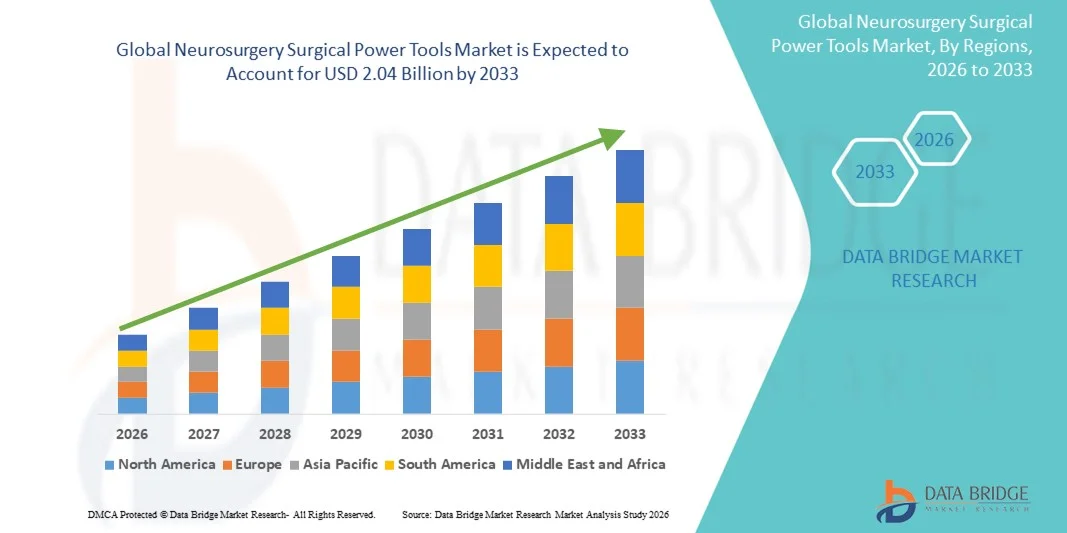
- The global neurosurgery surgical power tools market size was valued at USD 1.42 billion in 2025 and is expected to reach USD 2.04 billion by 2033, at a CAGR of 4.10% during the forecast period
- The market growth is largely fueled by the increasing prevalence of neurological disorders, rising number of neurosurgical procedures, and continuous technological advancements in surgical instruments, leading to enhanced precision, efficiency, and patient safety
- Furthermore, growing demand for minimally invasive surgeries and rising adoption of advanced power tools that offer ergonomic design and improved operational control are establishing neurosurgery surgical power tools as the preferred choice in modern neurosurgical procedures. These converging factors are accelerating the uptake of neurosurgery surgical power tools, thereby significantly boosting the industry's growth
Neurosurgery Surgical Power Tools Market Analysis
- Neurosurgery surgical power tools, comprising high-precision instruments such as drills, saws, and burrs, are increasingly critical in modern neurosurgical procedures due to their ability to enhance surgical accuracy, reduce operation time, and improve patient safety in both hospitals and specialized surgical centers
- The rising demand for neurosurgery surgical power tools is primarily driven by the growing prevalence of neurological disorders, an increasing number of complex neurosurgical procedures, and the continuous integration of advanced technologies such as ergonomically designed, battery-operated, and computer-assisted devices
- North America dominated the neurosurgery surgical power tools market with the largest revenue share of 40.9% in 2025, supported by high healthcare expenditure, the presence of leading medical device manufacturers, and advanced neurosurgical infrastructure, with the U.S. witnessing substantial adoption of minimally invasive and robotic-assisted neurosurgery tools
- Asia-Pacific is expected to be the fastest growing region in the neurosurgery surgical power tools market during the forecast period due to rising healthcare infrastructure investments, increasing number of neurosurgical procedures, and growing awareness of advanced surgical technologies
- Drill segment dominated the neurosurgery surgical power tools market with a market share of 44.4% in 2025, driven by its critical role in cranial and spinal surgeries and continuous technological advancements improving precision and operational efficiency
Report Scope and Neurosurgery Surgical Power Tools Market Segmentation
|
Attributes |
Neurosurgery Surgical Power Tools Key Market Insights |
|
Segments Covered |
|
|
Countries Covered |
North America
Europe
Asia-Pacific
Middle East and Africa
South America
|
|
Key Market Players |
|
|
Market Opportunities |
|
|
Value Added Data Infosets |
In addition to the insights on market scenarios such as market value, growth rate, segmentation, geographical coverage, and major players, the market reports curated by the Data Bridge Market Research also include in-depth expert analysis, patient epidemiology, pipeline analysis, pricing analysis, and regulatory framework |
Neurosurgery Surgical Power Tools Market Trends
Advancements in Minimally Invasive and Robotic-Assisted Surgery
- A significant and accelerating trend in the global neurosurgery surgical power tools market is the increasing integration of minimally invasive and robotic-assisted surgical techniques, enhancing precision and reducing patient recovery time
- For instance, the ROSA ONE robotic system allows neurosurgeons to perform complex cranial and spinal procedures with enhanced accuracy and stability, improving surgical outcomes
- Advanced neurosurgical power tools are increasingly being designed with ergonomics, automation, and real-time feedback, enabling surgeons to operate with reduced fatigue and higher efficiency. For instance, high-speed drills with automated torque control help prevent tissue damage during cranial surgeries
- The integration of navigation systems with power tools facilitates precise targeting in delicate neurosurgical procedures, minimizing errors and improving patient safety. For instance, neuronavigation-compatible burrs allow accurate skull and spinal bone removal with minimal invasiveness
- Adoption of smart, IoT-enabled surgical tools that provide real-time data and analytics is emerging as a key trend. For instance, connected drills can track usage patterns, torque, and speed to optimize performance and maintenance schedules
- Increasing collaboration between medical device companies and AI developers is driving innovation in predictive and adaptive neurosurgical tools. For instance, AI-assisted burrs can adjust drilling speed based on bone density detected during surgery
- This trend towards more precise, intelligent, and ergonomically optimized neurosurgery tools is fundamentally reshaping surgical practices. For instance, companies such as Medtronic and Stryker are developing robotic-assisted drills with real-time monitoring and feedback features
- The demand for advanced neurosurgery surgical power tools is growing rapidly across hospitals and specialized surgical centers, as surgeons increasingly prioritize precision, safety, and efficiency in complex procedures
Neurosurgery Surgical Power Tools Market Dynamics
Driver
Rising Neurological Disorders and Surgical Procedures
- The increasing prevalence of neurological disorders, coupled with the rising number of neurosurgical procedures, is a significant driver for the growing demand for neurosurgery surgical power tools
- For instance, in March 2025, Stryker launched an advanced cranial drill system designed to improve surgical accuracy and reduce operative time for complex brain surgeries. Such innovations by leading manufacturers are expected to drive market growth in the forecast period
- As patient populations with spinal and cranial conditions increase, high-precision power tools provide essential support for safer, faster, and more effective surgeries
- Furthermore, hospitals and specialized surgical centers are increasingly adopting advanced tools that integrate navigation, imaging, and ergonomic features, making them indispensable in modern neurosurgical practices
- Growing investments in healthcare infrastructure and neurosurgery specialty centers are further supporting market expansion. For instance, new centers in Asia-Pacific are equipping operating rooms with state-of-the-art surgical power tools to meet rising patient demand
- Increasing collaboration between hospitals and device manufacturers for customized solutions is creating additional growth opportunities. For instance, hospitals are co-developing procedure-specific drills and burrs to enhance surgical outcomes
- Enhanced operational efficiency, reduced complication rates, and improved patient outcomes are key factors propelling the adoption of neurosurgery surgical power tools across both developed and emerging markets
Restraint/Challenge
High Cost and Regulatory Compliance Challenges
- The high initial cost of advanced neurosurgery surgical power tools poses a significant challenge to broader market penetration, particularly in developing regions with limited healthcare budgets
- For instance, specialized robotic-assisted drills and navigation-integrated burrs can cost several times more than standard surgical instruments, limiting adoption in smaller hospitals or clinics
- Stringent regulatory approvals and compliance requirements for surgical devices can delay product launches and increase development costs, impacting market expansion
- For instance, meeting FDA and CE certification standards for neurosurgical tools involves extensive clinical testing and documentation, adding time and expense for manufacturers
- Maintenance and training requirements for complex neurosurgery power tools can also limit adoption in resource-constrained settings. For instance, hospitals must invest in specialized training programs to ensure safe and effective tool usage
- Supply chain disruptions and dependence on specialized components can impact tool availability, affecting market growth. For instance, delays in high-precision motor or battery components can slow production and delivery timelines
- While technological advancements are rapidly improving tool performance, the high price point and complex regulatory environment can hinder widespread adoption
- Overcoming these challenges through cost optimization, leasing models, and streamlined regulatory processes will be vital for sustained market growth
Neurosurgery Surgical Power Tools Market Scope
The market is segmented on the basis of tool type, power type, and end user.
- By Tool Type
On the basis of tool type, the market is segmented into drill, reamer, saw, and others. The drill segment dominated the market with the largest market revenue share of 44.4% in 2025, driven by its critical role in cranial and spinal surgeries requiring precision bone removal. Neurosurgeons prefer drills for their speed, accuracy, and ability to work in delicate surgical environments with minimal tissue damage. The demand for drills is further supported by continuous technological innovations such as automated torque control, ergonomic design, and integration with navigation systems. Hospitals and specialized neurosurgical centers often prioritize drills due to their versatility across a wide range of neurosurgical procedures. Furthermore, drills compatible with robotic-assisted systems and real-time feedback features are increasingly favored, enhancing surgical outcomes and efficiency. The segment benefits from strong adoption in both developed and emerging regions due to rising neurosurgical procedures and investment in advanced surgical tools.
The saw segment is anticipated to witness the fastest growth rate from 2026 to 2033, fueled by increasing demand for minimally invasive and spinal surgeries requiring precise bone cutting. Saws offer controlled incision and reduced trauma to surrounding tissues, making them ideal for complex neurosurgical procedures. Their adoption is supported by technological advancements such as oscillating and reciprocating saws with improved safety features. Neurosurgical centers and hospitals are increasingly integrating saws with navigation systems for accurate, patient-specific procedures. Growing awareness about patient safety, faster recovery times, and demand for high-precision surgical outcomes further contribute to the segment’s rapid growth. The ability to combine saws with real-time monitoring and robotic assistance enhances their effectiveness, making them a preferred choice in modern neurosurgical practices.
- By Power Type
On the basis of power type, the market is segmented into pneumatic, electric, and battery-powered tools. The electric segment dominated the market in 2025 due to its consistent power output, precision control, and suitability for extended neurosurgical procedures. Electric neurosurgery power tools provide high-speed operation with stable torque, critical for delicate cranial and spinal surgeries. Hospitals prefer electric tools for their reliability, minimal maintenance requirements, and compatibility with surgical navigation systems. The availability of a wide range of electric drills, saws, and reamers enhances their adoption across various neurosurgical procedures. Integration with robotic and computer-assisted systems further strengthens the dominance of electric-powered tools in advanced surgical centers. The segment benefits from strong investments in hospital infrastructure and rising neurosurgical case volumes globally.
Battery-powered tools are expected to witness the fastest growth rate from 2026 to 2033, driven by the demand for portability, ease of use, and flexibility in operating rooms. Battery-powered neurosurgery tools allow surgeons to perform procedures without cable restrictions, improving ergonomics and workflow efficiency. Their adoption is increasing in minimally invasive surgeries and emergency surgical setups where mobility and rapid deployment are critical. Technological advancements such as long-lasting rechargeable batteries and smart power management systems further support growth. Hospitals and specialized surgical centers are increasingly favoring battery-powered tools for hybrid and remote surgical applications. Growing awareness of ergonomic benefits and reduction in OR clutter contributes to the rapid adoption of battery-powered surgical tools.
- By End User
On the basis of end user, the market is segmented into neurosurgical centers and hospitals. The hospital segment dominated the market with the largest revenue share in 2025, driven by the higher volume of neurosurgical procedures and advanced infrastructure available in multi-specialty and tertiary care hospitals. Hospitals often invest in a comprehensive set of neurosurgery surgical power tools, including drills, saws, and reamers, to meet diverse procedural requirements. The presence of trained neurosurgeons and advanced surgical teams in hospitals supports the efficient utilization of high-precision tools. Hospitals in developed regions particularly prioritize the integration of power tools with navigation and robotic systems to improve surgical outcomes. Strong healthcare expenditure, increasing neurological disorder prevalence, and rising demand for minimally invasive surgeries further contribute to the dominance of hospitals as end users.
The neurosurgical centers segment is expected to witness the fastest growth from 2026 to 2033, driven by the rise of specialized surgical centers focused on neurosurgery and minimally invasive procedures. These centers are investing in advanced, high-precision surgical tools to improve patient outcomes, reduce operation time, and attract high patient volumes. Neurosurgical centers often adopt battery-powered, electric, and robotic-assisted tools due to their flexibility and ease of use in specialized setups. The growth is further supported by collaborations with medical device manufacturers for procedure-specific tool development. Increasing patient awareness and preference for specialized care facilities contribute to the rapid expansion of this segment globally.
Neurosurgery Surgical Power Tools Market Regional Analysis
- North America dominated the neurosurgery surgical power tools market with the largest revenue share of 40.9% in 2025, supported by high healthcare expenditure, the presence of leading medical device manufacturers, and advanced neurosurgical infrastructure, with the U.S. witnessing substantial adoption of minimally invasive and robotic-assisted neurosurgery tools
- Hospitals and specialized surgical centers in the region prioritize advanced surgical tools that enhance precision, reduce operation time, and improve patient safety, reflecting strong demand for high-quality neurosurgery power tools
- This widespread adoption is further supported by advanced healthcare infrastructure, high healthcare expenditure, the presence of leading medical device manufacturers, and a skilled neurosurgical workforce, establishing North America as a key market for both hospitals and neurosurgical centers
U.S. Neurosurgery Surgical Power Tools Market Insight
The U.S. neurosurgery surgical power tools market captured the largest revenue share of 42% in 2025 within North America, driven by the high prevalence of neurological disorders and the increasing number of complex neurosurgical procedures. Hospitals and specialized surgical centers are prioritizing the adoption of advanced drills, saws, and reamers to improve surgical precision, reduce operative time, and enhance patient safety. The growing integration of robotic-assisted and minimally invasive surgical systems further propels the market. Moreover, strong healthcare infrastructure, high R&D investments by medical device companies, and a skilled neurosurgical workforce contribute significantly to market expansion.
Europe Neurosurgery Surgical Power Tools Market Insight
The Europe neurosurgery surgical power tools market is projected to expand at a substantial CAGR throughout the forecast period, primarily driven by rising neurological disorder prevalence, stringent medical regulations, and increasing hospital investments in advanced surgical equipment. The growth of minimally invasive neurosurgery and specialized neurosurgical centers in countries such as Germany and France fosters higher adoption of power tools. European hospitals are increasingly implementing integrated systems combining navigation and robotic-assisted drills, enhancing procedural accuracy and patient outcomes. Moreover, the focus on precision, safety, and technological innovation supports robust market growth across residential and clinical neurosurgical setups.
U.K. Neurosurgery Surgical Power Tools Market Insight
The U.K. neurosurgery surgical power tools market is anticipated to grow at a noteworthy CAGR during the forecast period, fueled by increasing demand for advanced neurosurgical procedures and the adoption of cutting-edge surgical technologies. Hospitals and neurosurgical centers in the U.K. are prioritizing tools that offer ergonomic design, reliability, and compatibility with minimally invasive techniques. In addition, government healthcare initiatives and investments in modern neurosurgical infrastructure are encouraging adoption. Growing awareness of patient safety, the efficiency of surgical operations, and the need to reduce postoperative complications are further driving market expansion.
Germany Neurosurgery Surgical Power Tools Market Insight
The Germany neurosurgery surgical power tools market is expected to expand at a considerable CAGR during the forecast period, fueled by increasing investments in high-tech surgical infrastructure and the rising demand for precision surgical tools. Hospitals and neurosurgical centers are adopting technologically advanced drills, saws, and reamers integrated with navigation and robotic systems to improve outcomes. Germany’s emphasis on innovation, quality standards, and patient safety promotes the uptake of advanced surgical tools. Moreover, ongoing research collaborations between medical device companies and hospitals are supporting product development and customized solutions for complex neurosurgical procedures.
Asia-Pacific Neurosurgery Surgical Power Tools Market Insight
The Asia-Pacific neurosurgery surgical power tools market is poised to grow at the fastest CAGR of 25% during the forecast period of 2026 to 2033, driven by rising prevalence of neurological disorders, rapid urbanization, and increasing investments in healthcare infrastructure in countries such as China, Japan, and India. The growing number of neurosurgical procedures and the establishment of specialized surgical centers are supporting higher adoption of advanced drills, saws, and battery-powered tools. Furthermore, government initiatives to improve healthcare access and the increasing presence of global medical device manufacturers are expanding market reach. The affordability of tools manufactured in the region is also facilitating widespread adoption across hospitals and neurosurgical centers.
Japan Neurosurgery Surgical Power Tools Market Insight
The Japan neurosurgery surgical power tools market is gaining momentum due to the country’s technologically advanced healthcare ecosystem, high focus on patient safety, and increasing number of neurosurgical procedures. Hospitals and neurosurgical centers are adopting robotic-assisted and minimally invasive surgical tools to enhance precision and reduce recovery time. Integration of navigation and real-time feedback systems into surgical drills and saws is further driving growth. In addition, Japan’s aging population is increasing demand for neurosurgical interventions, boosting the adoption of advanced surgical power tools. The market benefits from strong local R&D and collaboration between hospitals and device manufacturers for innovative solutions.
India Neurosurgery Surgical Power Tools Market Insight
The India neurosurgery surgical power tools market accounted for the largest revenue share in Asia-Pacific in 2025, attributed to increasing neurological disorder prevalence, rising hospital infrastructure investments, and growing adoption of advanced surgical technologies. Specialized neurosurgical centers and multi-specialty hospitals are increasingly using high-precision drills, saws, and battery-powered tools to improve procedural efficiency and outcomes. Government initiatives promoting healthcare modernization, the rise of minimally invasive surgeries, and increasing medical tourism further support market growth. Moreover, the availability of locally manufactured tools at competitive prices is enhancing accessibility and driving adoption across residential and commercial healthcare facilities.
Neurosurgery Surgical Power Tools Market Share
The Neurosurgery Surgical Power Tools industry is primarily led by well-established companies, including:
- Medtronic (Ireland)
- Stryker (U.S.)
- B. Braun SE (Germany)
- Aesculap (Germany)
- Medical Device Business Services, Inc. (U.S.)
- Zimmer Biomet (U.S.)
- Adeor Medical AG (Germany)
- Bioventus (U.S.)
- Bien Air Surgery (Switzerland)
- NSK Nakanishi (Japan)
- Karl Storz SE & Co. KG (Germany)
- Integra LifeSciences Corporation (U.S.)
- Brainlab AG (Germany)
- Elekta AB (Sweden)
- Boston Scientific Corporation (U.S.)
- Zeta Surgical Inc. (U.S.)
- OsteoMed L.P. (U.S.)
- NICO Corporation (U.S.)
- KLS Martin Group (Germany)
What are the Recent Developments in Global Neurosurgery Surgical Power Tools Market?
- In April 2025, researchers at the University of Toronto and The Hospital for Sick Children (SickKids) unveiled a set of miniature (≈ 3 mm) magnetically actuated robotic surgical tools capable of gripping, cutting, and pulling tissue all controlled by external electromagnetic fields. These tools (gripper, forceps, scalpel) are not driven by motors or cables; instead, the system uses a coil table beneath the patient’s head that generates magnetic fields to actuate the tools
- In March 2025, broader media outlets such as Impact Lab highlighted this University of Toronto development, emphasizing the game‑changing potential of these tiny magnet‑powered tools for minimally invasive brain surgery. The coverage underscores how abandoning traditional motor-driven systems in favour of magnetic control could open up new surgical paradigms, especially for neurosurgery where space is extremely constrained
- In March 2024, Northwestern Medicine reported the first successful clinical use of the Hubly Drill, a battery‑powered cranial drill, in a bedside neurosurgical procedure. Dr. Matthew Potts used it in the ICU to rapidly create a skull opening and relieve intracranial pressure via catheterization the drill’s auto‑stop safety feature, which cuts power the moment it breaks through the skull, was critical in reducing procedural risk
- In March 2023, Stryker introduced its CD NXT System, a power‑tool system that delivers real-time digital depth measurement during drilling. This innovation removes the need for manual depth gauges by providing automatic cortex‑to‑cortex measurement and a digital readout, reducing human error and improving surgical consistency
- In August 2021, ClearPoint Neuro, Inc. struck a strategic and commercial partnership with German surgical‑equipment company adeor medical AG to distribute the Velocity Alpha high‑speed neurosurgical drill in the U.S. and co-develop an MRI‑conditional version

- Interactive Data Analysis Dashboard
- Company Analysis Dashboard for high growth potential opportunities
- Research Analyst Access for customization & queries
- Competitor Analysis with Interactive dashboard
- Latest News, Updates & Trend analysis
- Harness the Power of Benchmark Analysis for Comprehensive Competitor Tracking
Data collection and base year analysis are done using data collection modules with large sample sizes. The stage includes obtaining market information or related data through various sources and strategies. It includes examining and planning all the data acquired from the past in advance. It likewise envelops the examination of information inconsistencies seen across different information sources. The market data is analysed and estimated using market statistical and coherent models. Also, market share analysis and key trend analysis are the major success factors in the market report. To know more, please request an analyst call or drop down your inquiry.
The key research methodology used by DBMR research team is data triangulation which involves data mining, analysis of the impact of data variables on the market and primary (industry expert) validation. Data models include Vendor Positioning Grid, Market Time Line Analysis, Market Overview and Guide, Company Positioning Grid, Patent Analysis, Pricing Analysis, Company Market Share Analysis, Standards of Measurement, Global versus Regional and Vendor Share Analysis. To know more about the research methodology, drop in an inquiry to speak to our industry experts.
Data Bridge Market Research is a leader in advanced formative research. We take pride in servicing our existing and new customers with data and analysis that match and suits their goal. The report can be customized to include price trend analysis of target brands understanding the market for additional countries (ask for the list of countries), clinical trial results data, literature review, refurbished market and product base analysis. Market analysis of target competitors can be analyzed from technology-based analysis to market portfolio strategies. We can add as many competitors that you require data about in the format and data style you are looking for. Our team of analysts can also provide you data in crude raw excel files pivot tables (Fact book) or can assist you in creating presentations from the data sets available in the report.













