


Neurovascular Thrombectomy Devices Market Size
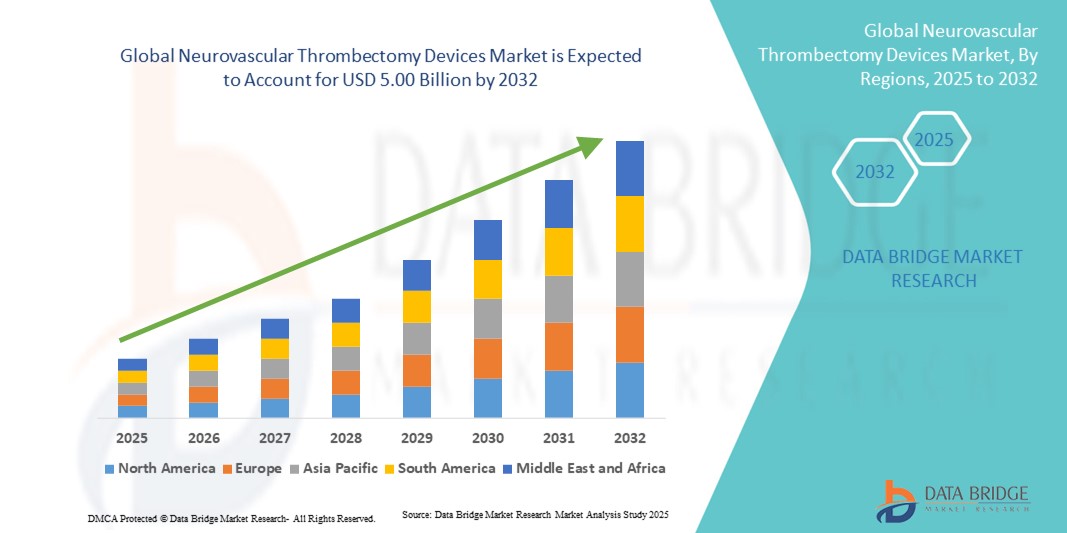
- The global neurovascular thrombectomy devices market size was valued at USD 3.00 billion in 2024 and is expected to reach USD 5.00 billion by 2032, at a CAGR of 6.60% during the forecast period
- The market growth is largely driven by the rising prevalence of acute ischemic stroke, increasing awareness regarding timely stroke intervention, and continuous technological advancements in thrombectomy devices that enhance safety and procedural efficiency
- Furthermore, growing investments in healthcare infrastructure, expansion of stroke centers, and increasing adoption of minimally invasive procedures are positioning neurovascular thrombectomy devices as the preferred solution for acute stroke management. These factors are collectively accelerating the demand for these devices, thereby significantly boosting the industry's growth
Neurovascular Thrombectomy Devices Market Analysis
- Neurovascular thrombectomy devices, designed to mechanically remove blood clots from cerebral arteries, are increasingly essential in acute ischemic stroke management across hospitals and specialized stroke centers due to their minimally invasive nature, procedural efficiency, and potential to significantly improve patient outcomes
- The rising demand for these devices is primarily driven by the increasing prevalence of stroke, growing awareness about the benefits of early intervention, and continuous technological advancements, including improved stent retrievers and aspiration systems that enhance recanalization rates and safety
- North America dominated the neurovascular thrombectomy devices market with the largest revenue share of 39.6% in 2024, supported by a high incidence of stroke, well-established healthcare infrastructure, reimbursement policies favoring advanced stroke treatments, and strong presence of leading device manufacturers, with the U.S. witnessing substantial adoption in comprehensive stroke centers through innovations in device design and procedural techniques
- Asia-Pacific is expected to be the fastest-growing region in the neurovascular thrombectomy devices market during the forecast period, owing to increasing healthcare expenditure, expansion of stroke care centers, and growing awareness regarding stroke treatment options
- Stent retrievers segment dominated the neurovascular thrombectomy devices market with a market share of 46.1% in 2024, driven by their proven efficacy in clot retrieval, ease of use in diverse vascular anatomies, and growing adoption in standard stroke treatment protocols
Report Scope and Neurovascular Thrombectomy Devices Market Segmentation
|
Attributes |
Neurovascular Thrombectomy Devices Key Market Insights |
|
Segments Covered |
|
|
Countries Covered |
North America
Europe
Asia-Pacific
Middle East and Africa
South America
|
|
Key Market Players |
|
|
Market Opportunities |
|
|
Value Added Data Infosets |
In addition to the insights on market scenarios such as market value, growth rate, segmentation, geographical coverage, and major players, the market reports curated by the Data Bridge Market Research also include in-depth expert analysis, pricing analysis, brand share analysis, consumer survey, demography analysis, supply chain analysis, value chain analysis, raw material/consumables overview, vendor selection criteria, PESTLE Analysis, Porter Analysis, and regulatory framework. |
Neurovascular Thrombectomy Devices Market Trends
Advancements Through AI-Assisted and Smart Navigation Systems
- A significant and accelerating trend in the global neurovascular thrombectomy devices market is the integration of artificial intelligence (AI) and smart navigation systems into procedural workflows, enhancing procedural precision and reducing intervention times
- For Instance, The Viz.ai Stroke Platform utilizes AI to automatically detect large vessel occlusions on imaging scans and alert neurointerventional teams in real time, streamlining patient triage and treatment
- AI integration in thrombectomy devices enables predictive procedural planning, real-time device positioning guidance, and improved success rates in clot retrieval, potentially lowering complication risks. Furthermore, smart imaging compatibility allows operators to visualize vascular anatomy and optimize device deployment
- The integration of AI-assisted navigation with imaging platforms allows clinicians to centralize procedural information, monitor multiple patient parameters, and improve decision-making during acute stroke interventions, enhancing treatment efficiency and outcomes
- This trend towards more intelligent, connected, and precise thrombectomy systems is reshaping standards for acute stroke care. Consequently, companies such as Stryker and Medtronic are developing AI-enabled platforms with features such as automated clot detection, device guidance, and outcome prediction
- The demand for thrombectomy devices with AI and smart navigation capabilities is growing rapidly across hospitals and stroke centers, as healthcare providers increasingly prioritize procedural efficiency and patient safety
Neurovascular Thrombectomy Devices Market Dynamics
Driver
Rising Incidence of Stroke and Expanding Stroke Care Infrastructure
- The increasing prevalence of acute ischemic stroke globally, combined with expansion of stroke care centers and specialized neurointerventional programs, is a significant driver for the growing demand for thrombectomy devices
- For Instance, In 2024, Medtronic introduced advanced stent retriever systems optimized for rapid clot removal, supporting hospitals in enhancing stroke treatment capabilities and reducing door-to-reperfusion times
- As awareness of the benefits of timely mechanical thrombectomy grows, clinicians are increasingly adopting these devices to improve patient outcomes and reduce long-term disability
- Furthermore, growing investments in healthcare infrastructure, including dedicated neurointerventional suites and mobile stroke units, are making thrombectomy devices more accessible and integrated into standard care pathways
- The increasing focus on minimally invasive stroke treatments, combined with training programs and procedural standardization, is further propelling adoption of neurovascular thrombectomy devices in both developed and emerging regions
Restraint/Challenge
High Procedural Costs and Regulatory Barriers
- Concerns regarding high procedural costs, reimbursement limitations, and stringent regulatory requirements pose significant challenges to broader market adoption of neurovascular thrombectomy devices
- For Instance, Reports of limited coverage by insurance providers in certain regions have made hospitals cautious about investing in high-end thrombectomy systems, despite their clinical benefits
- Addressing cost barriers through favorable reimbursement policies and bundled stroke care programs is essential for increasing device accessibility, particularly in emerging markets. In addition, regulatory compliance involving device safety, clinical validation, and post-market surveillance can slow market entry for new products
- Furthermore, the need for highly trained neurointerventional specialists and advanced hospital infrastructure limits widespread adoption in resource-constrained regions, even as demand for acute stroke interventions rises
- Overcoming these challenges through cost optimization, regulatory support, and clinical training initiatives will be vital for sustained growth of the neurovascular thrombectomy devices market
Neurovascular Thrombectomy Devices Market Scope
The market is segmented on the basis of product type, application, and end user.
- By Product Type
On the basis of product type, the neurovascular thrombectomy devices market is segmented into stent retrievers and aspiration catheters. The stent retriever segment dominated the market with the largest revenue share of 46.1% in 2024, driven by its proven efficacy in mechanically removing clots, ease of use in diverse vascular anatomies, and widespread adoption in standard stroke treatment protocols. Hospitals and neurointerventional centers often prioritize stent retrievers due to high recanalization rates and improved clinical outcomes. The segment’s dominance is further supported by continuous technological innovations, including designs that reduce vessel trauma and facilitate faster deployment. Stent retrievers also benefit from extensive clinical validation and strong physician familiarity, boosting confidence in their use for acute ischemic stroke management.
The aspiration catheter segment is anticipated to witness the fastest growth rate of 22.4% from 2025 to 2032, fueled by increasing adoption in complex clot scenarios and combined thrombectomy procedures. Aspiration catheters provide effective clot removal with minimal manipulation, making them suitable for patients with tortuous or fragile vessels. Growing awareness of their complementary use alongside stent retrievers and rising procedural success rates are driving demand. In addition, advancements in catheter flexibility, suction power, and trackability are enhancing their applicability in challenging vascular anatomies, particularly in emerging markets. Their minimally invasive nature and ability to reduce procedure time further support rapid adoption.
- By Application
On the basis of application, the market is segmented into ischemic stroke, cerebral aneurysm, and others. The ischemic stroke segment dominated the market in 2024, attributed to the high global prevalence of acute ischemic strokes and the critical role of mechanical thrombectomy in restoring cerebral blood flow. Hospitals and specialized neurointerventional centers prioritize devices for ischemic stroke due to well-established clinical guidelines and robust reimbursement coverage in developed regions. The segment’s dominance is reinforced by increasing awareness of time-sensitive intervention benefits, ongoing training programs for neurointerventionalists, and technological innovations improving procedural outcomes.
The cerebral aneurysm segment is expected to witness the fastest CAGR from 2025 to 2032, driven by rising detection rates of aneurysms through advanced imaging techniques and increased adoption of minimally invasive treatments. Aspiration and stent-assisted thrombectomy devices are increasingly used in adjunctive aneurysm management procedures, expanding their application beyond standard stroke care. Furthermore, growing investments in neurovascular research and early intervention programs are accelerating procedural adoption in both developed and emerging markets. The segment benefits from innovations in device design, enabling safer navigation and precise clot or aneurysm removal.
- By End User
On the basis of end user, the market is segmented into hospitals, neuro-catheterization labs, and specialized neurosurgery centers. The hospitals segment dominated the market in 2024, reflecting the widespread availability of comprehensive stroke care facilities, advanced imaging infrastructure, and trained neurointerventional teams. Hospitals remain the primary point of care for acute ischemic stroke treatment, supporting high volumes of thrombectomy procedures. Their dominance is further supported by increasing investments in stroke units, procedural standardization, and integration of AI-assisted decision-making tools to enhance clinical outcomes.
The specialized neurosurgery centers segment is expected to witness the fastest growth rate from 2025 to 2032, driven by the rising number of dedicated stroke centers and neurointerventional programs in emerging markets. These centers focus on high-complexity procedures and leverage advanced thrombectomy devices for challenging cases. Expansion of specialized stroke care units, growing awareness among patients and healthcare providers, and the availability of cutting-edge procedural technologies are key factors fueling rapid adoption. The segment also benefits from collaborations with device manufacturers for training and early access to new device innovations.
Neurovascular Thrombectomy Devices Market Regional Analysis
- North America dominated the neurovascular thrombectomy devices market with the largest revenue share of 39.6% in 2024, supported by a high incidence of stroke, well-established healthcare infrastructure, reimbursement policies favoring advanced stroke treatments, and strong presence of leading device manufacturers
- Healthcare providers in the region highly value the clinical efficacy, improved patient outcomes, and procedural efficiency offered by thrombectomy devices, supported by well-established stroke treatment guidelines and reimbursement frameworks
- This widespread adoption is further strengthened by the presence of leading device manufacturers, continuous technological innovations, and a growing number of comprehensive stroke centers, positioning neurovascular thrombectomy devices as the preferred solution for acute stroke management in both hospitals and specialized neurointerventional centers
U.S. Neurovascular Thrombectomy Devices Market Insight
The U.S. neurovascular thrombectomy devices market captured the largest revenue share of 79% in 2024 within North America, fueled by a high prevalence of acute ischemic stroke and advanced hospital infrastructure. Healthcare providers are increasingly prioritizing rapid and minimally invasive stroke interventions to improve patient outcomes. The growing adoption of AI-assisted and smart navigation thrombectomy devices, combined with strong reimbursement policies and well-established stroke care programs, is further propelling market growth. Moreover, the presence of leading device manufacturers and a large number of comprehensive stroke centers contributes significantly to market expansion.
Europe Neurovascular Thrombectomy Devices Market Insight
The Europe neurovascular thrombectomy devices market is projected to expand at a substantial CAGR throughout the forecast period, driven by rising stroke incidence, increasing awareness of timely intervention, and growing investments in neurointerventional infrastructure. The demand for advanced thrombectomy devices is increasing across hospitals and specialized neurovascular centers. European healthcare providers are also adopting minimally invasive procedures to reduce patient recovery time and improve clinical outcomes. The focus on improving procedural efficiency and clinical success rates is fostering market adoption across both residential and hospital settings.
U.K. Neurovascular Thrombectomy Devices Market Insight
The U.K. neurovascular thrombectomy devices market is anticipated to grow at a noteworthy CAGR during the forecast period, driven by increasing stroke prevalence and rising awareness regarding early mechanical intervention. Government initiatives supporting stroke care programs and improved access to specialized neurointerventional centers are boosting adoption. Hospitals and stroke centers are prioritizing advanced thrombectomy devices that enhance procedural success and reduce long-term disability. Furthermore, technological innovations and AI-enabled systems are encouraging adoption among healthcare providers across the country.
Germany Neurovascular Thrombectomy Devices Market Insight
The Germany neurovascular thrombectomy devices market is expected to expand at a considerable CAGR during the forecast period, fueled by growing awareness of stroke treatment options and an emphasis on minimally invasive procedures. Germany’s well-developed healthcare infrastructure, combined with technological advancements in thrombectomy devices, supports widespread adoption in hospitals and specialized centers. Integration with AI-assisted imaging and procedural navigation systems is increasing procedural accuracy, while government support for stroke management programs further promotes market growth.
Asia-Pacific Neurovascular Thrombectomy Devices Market Insight
The Asia-Pacific neurovascular thrombectomy devices market is poised to grow at the fastest CAGR of 23% during the forecast period of 2025 to 2032, driven by increasing stroke incidence, improving healthcare infrastructure, and rising awareness of acute stroke management. Countries such as China, Japan, and India are expanding stroke care facilities and neurointerventional programs. The adoption of minimally invasive thrombectomy procedures is being accelerated by technological advancements, government initiatives promoting advanced healthcare, and growing investments in specialized stroke centers.
Japan Neurovascular Thrombectomy Devices Market Insight
The Japan neurovascular thrombectomy devices market is gaining momentum due to high stroke prevalence, advanced healthcare systems, and a focus on rapid intervention. The market growth is supported by an increasing number of specialized stroke centers and the adoption of AI-assisted thrombectomy technologies. Integration of devices with advanced imaging and procedural planning tools is improving patient outcomes. Furthermore, Japan’s aging population and rising awareness of stroke prevention and treatment are driving demand for efficient, minimally invasive neurovascular solutions.
India Neurovascular Thrombectomy Devices Market Insight
The India neurovascular thrombectomy devices market accounted for the largest market revenue share in Asia-Pacific in 2024, attributed to increasing stroke cases, expanding healthcare infrastructure, and rising awareness of advanced stroke interventions. The country is witnessing growth in the number of hospitals and specialized neurointerventional centers adopting thrombectomy procedures. Government initiatives supporting stroke care and increasing affordability of advanced devices are key factors propelling market growth. In addition, technological adoption and training programs for neurointerventional specialists are accelerating the uptake of these devices in India.
Neurovascular Thrombectomy Devices Market Share
The Neurovascular Thrombectomy Devices industry is primarily led by well-established companies, including:
- Penumbra, Inc. (U.S.)
- Medtronic (U.S.)
- Stryker (U.S.)
- Johnson & Johnson Services, Inc. (U.S.)
- Terumo Corporation (Japan)
- Abbott U.S.)
- MicroVention, Inc. (U.S.)
- Cerenovus (U.S.)
- Balt USA (U.S.)
- Rapid Medical (Israel)
- NeuroVasc Technologies, Inc. (U.S.)
- Acandis GmbH & Co. KG (Germany)
- Vesalio (U.S.)
- KANEKA CORPORATION (Japan)
- Inari Medical (U.S.)
- Phenox GmbH (Germany)
- Wallaby Medical (U.S.)
- Anaconda Biomed (Spain)
What are the Recent Developments in Global Neurovascular Thrombectomy Devices Market?
- In July 2025, Q'Apel Medical announced U.S. FDA clearance for its Zebra Neurovascular Access System, preparing for a full U.S. launch. This system is designed to enhance access during neurovascular procedures, facilitating more efficient and effective treatments
- In March 2025, Inari Medical, now part of Stryker, introduced the Artix™ Thrombectomy System. This system is designed to address a broad spectrum of arterial thrombus cases, enhancing the efficiency and effectiveness of thrombectomy procedures. The launch underscores a commitment to advancing vascular care through innovative solutions
- In February 2025, Penumbra launched the ACCESS25™ Delivery Microcatheter, specifically designed for aneurysm access and delivery of elevated clinical benefits. This advancement aims to improve the precision and outcomes of neurovascular procedures, particularly in treating aneurysms
- In May 2024, Penumbra, Inc. announced that it had received CE Mark approval for three of its neurovascular reperfusion catheters—Red 43, Red 72 with SENDit technology, and Red 78. These devices are designed for the treatment of acute ischemic stroke and optimize science-based aspiration thrombectomy (S-BAT). They are engineered with the latest technology in trackability and aspiration to address a wide range of large vessel occlusions
- In July 2022, Rapid Medical announced FDA 510(k) clearance for its Tigertriever 13 thrombectomy device, designed for large vessel occlusions. This device offers a small revascularization solution tailored to remove thrombus from delicate brain blood vessels during ischemic stroke, providing a more atraumatic approach to treatment
- https://www.stryker.com/us/en/about/news/2025/inari-medical-stryker-launches-artix-thrombectomy-system.html
- https://www.penumbrainc.com/penumbra-launches-access25tm-delivery-microcatheter-designed-for-aneurysm-access-and-delivery-of-elevated-clinical-benefits
- https://qapelmedical.com/qapel-medical-announces-u-s-fda-clearance-for-the-zebra-neurovascular-access-system-and-prepares-for-full-u-s-launch/
- https://evtoday.com/news/rapid-medical-tigertrievers-13-thrombectomy-device-gains-fda-clearance
- https://evtoday.com/news/penumbra-neurovascular-reperfusion-devices-launched-in-europe

- Interactive Data Analysis Dashboard
- Company Analysis Dashboard for high growth potential opportunities
- Research Analyst Access for customization & queries
- Competitor Analysis with Interactive dashboard
- Latest News, Updates & Trend analysis
- Harness the Power of Benchmark Analysis for Comprehensive Competitor Tracking
Data collection and base year analysis are done using data collection modules with large sample sizes. The stage includes obtaining market information or related data through various sources and strategies. It includes examining and planning all the data acquired from the past in advance. It likewise envelops the examination of information inconsistencies seen across different information sources. The market data is analysed and estimated using market statistical and coherent models. Also, market share analysis and key trend analysis are the major success factors in the market report. To know more, please request an analyst call or drop down your inquiry.
The key research methodology used by DBMR research team is data triangulation which involves data mining, analysis of the impact of data variables on the market and primary (industry expert) validation. Data models include Vendor Positioning Grid, Market Time Line Analysis, Market Overview and Guide, Company Positioning Grid, Patent Analysis, Pricing Analysis, Company Market Share Analysis, Standards of Measurement, Global versus Regional and Vendor Share Analysis. To know more about the research methodology, drop in an inquiry to speak to our industry experts.
Data Bridge Market Research is a leader in advanced formative research. We take pride in servicing our existing and new customers with data and analysis that match and suits their goal. The report can be customized to include price trend analysis of target brands understanding the market for additional countries (ask for the list of countries), clinical trial results data, literature review, refurbished market and product base analysis. Market analysis of target competitors can be analyzed from technology-based analysis to market portfolio strategies. We can add as many competitors that you require data about in the format and data style you are looking for. Our team of analysts can also provide you data in crude raw excel files pivot tables (Fact book) or can assist you in creating presentations from the data sets available in the report.













