


Next Generation Bio-therapeutics Market Size
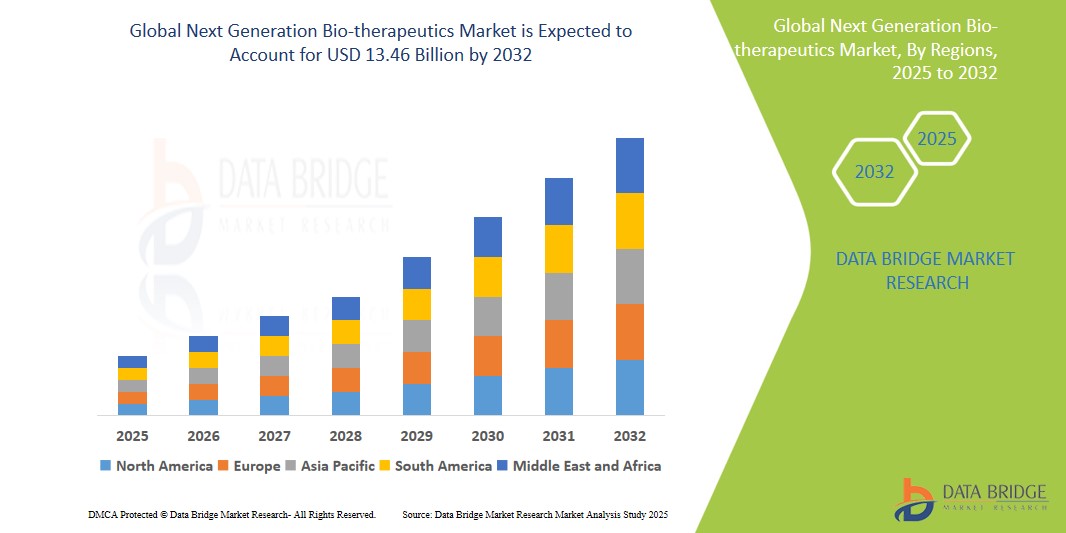
- The Global Next Generation Bio-therapeutics Market size was valued at USD 5.41 billion in 2024 and is expected to reach USD 13.46 billion by 2032, at a CAGR of 12.07% during the forecast period
- This robust growth is driven by the rising demand for targeted therapies, advancements in antibody engineering technologies, and the increasing prevalence of chronic diseases such as cancer and autoimmune disorders.
Next Generation Bio-therapeutics Market Analysis
- Next generation bio-therapeutics include innovative antibody-based therapies such as antibody-drug conjugates (ADCs), bispecific antibodies, and Fc-engineered antibodies, which offer enhanced specificity, potency, and safety compared to traditional biologics
- The market is witnessing strong momentum due to the growing pipeline of advanced biologics, increasing approvals of next-gen antibody drugs, and rising investments in biologic R&D
- Oncology remains the dominant therapeutic application segment, driven by the high global burden of cancer and the increasing adoption of targeted next-gen therapies
- North America leads the global market owing to a strong biotechnology sector, well-established healthcare infrastructure, and growing approvals of innovative biologics by regulatory bodies like the FDA
- Asia-Pacific is expected to be the fastest-growing region during the forecast period, fueled by expanding biopharma investments, increasing access to advanced therapies, and rising awareness about biologic treatments
- Antibody-drug conjugates (ADCs) are projected to dominate the market’s technology segment with 42.6% share, due to their precision in delivering cytotoxic drugs directly to tumor cells, minimizing systemic side effects and enhancing treatment outcomes
Report Scope and Next Generation Bio-therapeutics Market Segmentation
|
Attributes |
Next Generation Bio-therapeutics Key Market Insights |
|
Segments Covered |
|
|
Countries Covered |
North America
Europe
Asia-Pacific
Middle East and Africa
South America
|
|
Key Market Players |
|
|
Market Opportunities |
|
|
Value Added Data Infosets |
In addition to the insights on market scenarios such as market value, growth rate, segmentation, geographical coverage, and major players, the market reports curated by the Data Bridge Market Research also include import export analysis, production capacity overview, production consumption analysis, price trend analysis, climate change scenario, supply chain analysis, value chain analysis, raw material/consumables overview, vendor selection criteria, PESTLE Analysis, Porter Analysis, and regulatory framework. |
Next Generation Bio-therapeutics Market Trends
“Advancements in Antibody-Drug Conjugates (ADCs) and Bispecific Antibodies”
- One prominent trend in next-generation bio-therapeutics is the increasing development of antibody-drug conjugates (ADCs) and bispecific antibodies, which provide targeted, potent treatments with reduced systemic toxicity
- These therapies combine the specificity of monoclonal antibodies with the potency of cytotoxic drugs, improving treatment efficacy in cancers and autoimmune diseases
- For instance, ADCs like Brentuximab Vedotin have shown high response rates in treating cancers such as Hodgkin lymphoma, transforming the landscape of cancer therapy with highly targeted treatments
- These advancements are driving the demand for novel therapies in oncology, autoimmune diseases, and other therapeutic areas, with new molecules entering clinical trials and approval pipelines
Next Generation Bio-therapeutics Market Dynamics
Driver
“Growing Demand for Targeted Therapies in Cancer and Autoimmune Diseases”
- The rising global prevalence of cancer, autoimmune diseases, and other chronic conditions is significantly driving the demand for next-generation bio-therapeutics.
- Cancer treatments are a key focus, with antibody-drug conjugates (ADCs) and bispecific antibodies offering highly targeted and effective solutions for cancers that were previously difficult to treat.
- The shift toward precision medicine is also contributing to this growth, as biologic therapies provide more personalized treatments with fewer side effects
- For instance, In 2023, the global cancer burden continued to rise, with the World Health Organization (WHO) reporting an estimated 19.3 million new cancer cases worldwide. The need for advanced therapies to treat such a vast and growing number of cancer patients is fueling the demand for next-generation bio-therapeutics
- The increasing focus on autoimmune diseases such as rheumatoid arthritis and multiple sclerosis is also contributing to the growth of this market, as biologic treatments offer promising solutions for these chronic conditions
Opportunity
“Integration of Artificial Intelligence (AI) in Drug Discovery and Development”
- AI-driven drug discovery is poised to significantly transform the development of next-generation bio-therapeutics by optimizing the identification of therapeutic targets and accelerating the design of biologic drugs
- AI algorithms are used to predict how molecules will interact in the body, enabling more efficient identification of promising therapeutic candidates and reducing the time to market for new drugs
- Additionally, AI can help optimize clinical trial design by identifying suitable patient populations and predicting treatment responses
- For instance, In January 2024, according to an article published in Nature Biotechnology, AI models were used to predict the effectiveness of ADCs and bispecific antibodies for various cancer types, reducing the trial and error traditionally involved in drug development. These advances are expected to streamline the drug discovery process, resulting in faster and more cost-effective development of novel therapeutics.
- The integration of AI in the design and development of next-generation bio-therapeutics can also improve the overall quality and success rates of clinical trials, further accelerating the commercialization of these advanced treatments
Restraint/Challenge
“High Development and Manufacturing Costs of Biologic Therapies”
- The high cost of developing and manufacturing next-generation bio-therapeutics, particularly ADCs and bispecific antibodies, is a significant challenge for the market
- The complex nature of biologics, including the need for specialized production facilities and stringent regulatory requirements, results in high upfront costs for biopharma companies
- These costs can lead to pricing pressures once the drugs are brought to market, limiting access for patients, particularly in developing regions where healthcare budgets are constrained
- For instance, In 2023, the average cost of biologic therapies for cancer treatment exceeded USD 100,000 per patient annually, leading to concerns about the affordability and accessibility of these treatments. The high costs associated with biologic therapies can also deter healthcare providers from adopting new treatments, especially in regions with limited reimbursement options
- The challenge of balancing cost-efficiency with the demand for innovative treatments can slow down the adoption and growth of next-generation bio-therapeutics, especially in emerging markets
Next Generation Bio-therapeutics Market Scope
The market is segmented on the basis therapeutic application, technology, drugs and end user.
|
Segmentation |
Sub-Segmentation |
|
By Therapeutic Application |
|
|
By Technology |
|
|
By Drugs |
|
|
By End- Users |
|
In 2025, the Oncology Next-Generation Antibody Therapeutics Segment is Projected to Dominate the Market with the Largest Share in the Therapeutic Application segment
The oncology Next-Generation Antibody Therapeutics segment is expected to dominate the global next-generation bio-therapeutics market, holding the largest market share of 58.14% in 2025. This dominance is driven by the increasing global cancer burden and the demand for targeted therapies that offer better precision and reduced side effects compared to traditional treatments. The development of advanced therapies such as antibody-drug conjugates (ADCs), bispecific antibodies, and immunotherapies is transforming cancer treatment, driving significant growth in this segment. The rising prevalence of cancers such as breast, lung, and colorectal cancer, alongside advancements in biologic therapies, further contributes to the growth of the oncology segment.
The Antibody-Drug Conjugates (ADCs) Segment is Expected to Dominate the Market with the Largest Share in the Technology Segment
The Antibody-Drug Conjugates (ADCs) segment is projected to dominate the global next-generation bio-therapeutics market with the largest market share of 45.23% in 2025. ADCs combine the specificity of monoclonal antibodies with the potency of cytotoxic drugs, making them one of the most promising technologies in oncology. These therapies are gaining widespread adoption due to their ability to selectively target cancer cells, improving therapeutic outcomes while minimizing toxicity to healthy tissues. The growing number of ADCs approved for various cancer types, alongside continued research and development, is expected to fuel the growth of the ADC segment throughout the forecast period.
Next Generation Bio-therapeutics Market Regional Analysis
“North America Holds the Largest Share in the Next Generation Bio-therapeutics Market”
- North America dominates the global next-generation bio-therapeutics market, driven by advanced healthcare infrastructure, high biologic therapy adoption rates, and a strong presence of key pharmaceutical companies.
- The U.S. holds a significant share due to its well-established healthcare system, increasing demand for targeted therapies, and rapid uptake of novel treatments for cancer and autoimmune diseases.
- The U.S. also benefits from continuous research and development investments by leading biotech firms and the presence of major biopharmaceutical hubs in cities like Boston, San Francisco, and New York.
- Additionally, the availability of favorable reimbursement policies and strong regulatory frameworks support market growth. The increasing prevalence of chronic diseases and the adoption of precision medicine are further propelling the demand for next-generation biologic therapies in the region.
“Asia-Pacific is Projected to Register the Highest CAGR in the Next Generation Bio-therapeutics Market”
- The Asia-Pacific region is expected to witness the highest growth rate in the global next-generation bio-therapeutics market, driven by expanding healthcare infrastructure, rising awareness of precision medicine, and increasing government and private sector investments
- Countries such as China, India, and Japan are emerging as key markets, with China experiencing a surge in oncology and autoimmune disease treatments due to the country’s rapidly aging population and increasing healthcare spending
- Japan is also a crucial market due to its advanced medical technology and a well-established regulatory environment that supports the development of biologics and biosimilars
- India, with its large population and growing healthcare access, is increasingly adopting next-generation bio-therapeutics, driven by the rise in oncological and autoimmune disease cases. Moreover, the growing pharmaceutical industry in India is playing a key role in the development and production of these therapies, further supporting market growth in the region
- The rising demand for biologics in emerging economies, combined with improving access to healthcare and cutting-edge therapies, is expected to significantly boost the adoption of advanced biologic treatments across the Asia-Pacific region
Next Generation Bio-therapeutics Market Share
The market competitive landscape provides details by competitor. Details included are company overview, company financials, revenue generated, market potential, investment in research and development, new market initiatives, global presence, production sites and facilities, production capacities, company strengths and weaknesses, product launch, product width and breadth, application dominance. The above data points provided are only related to the companies' focus related to market.
The Major Market Leaders Operating in the Market Are:
- Takeda Pharmaceutical Company Limited (Japan)
- AstraZeneca (UK)
- F. Hoffmann-La Roche Ltd (Switzerland)
- Kyowa Kirin Co., Ltd (Japan)
- Seagen Inc (formerly Seattle Genetics, Inc) (U.S.)
- ImmunoGen, Inc (U.S.)
- Pfizer Inc (U.S.)
- Xencor (U.S.)
- Bayer AG (Germany)
- Zumutor Biologics INC (U.S./India)
- Catalent, Inc (U.S.)
- Ono Pharmaceutical Co., Ltd (Japan)
- AbbVie Inc (U.S.)
- Sanofi (France)
- Johnson & Johnson Services, Inc. (U.S.)
- Sun Pharmaceutical Industries Ltd. (India)
- GlaxoSmithKline Plc. (UK)
- Lupin Pharmaceuticals Inc. (U.S.)
- Eli Lilly and Company (U.S.)
- Novartis AG (Switzerland)
- Expanding Applications Beyond Oncology
- Growth Potential in Emerging Markets
Latest Developments in Global Next Generation Bio-therapeutics Market
- In December 2022, Sorrento Therapeutics, Inc. has obtained clearance from the U.S. FDA to commence clinical trials using its next-generation mRNA (STI-1557) vaccine targeting SARS-CoV-2 Omicron variants
- In July 2022, Byondis has received acceptance of the biologics license application by the U.S. FDA for Vic-Trastuzumab Duocarmazine (SYD985), an antibody-drug conjugate, indicated for the treatment of patients with HER2-positive advanced breast cancer
- In March 2024, Thermo Fisher Scientific launched an advanced single-use bioreactor system with enhanced automation. In January 2025, expanded its biomanufacturing facilities to support large-scale biologics production
- In April 2024, Merck KGaA introduced AI-powered process analytics for optimized biologic production. In February 2025, announced strategic partnerships for mRNA biomanufacturing expansion.
- In May 2024, Danaher Corporation unveiled a next-generation chromatography system for high-purity biologics. In March 2025, acquired a biotech startup specializing in continuous bioprocessing.

- Interactive Data Analysis Dashboard
- Company Analysis Dashboard for high growth potential opportunities
- Research Analyst Access for customization & queries
- Competitor Analysis with Interactive dashboard
- Latest News, Updates & Trend analysis
- Harness the Power of Benchmark Analysis for Comprehensive Competitor Tracking
Data collection and base year analysis are done using data collection modules with large sample sizes. The stage includes obtaining market information or related data through various sources and strategies. It includes examining and planning all the data acquired from the past in advance. It likewise envelops the examination of information inconsistencies seen across different information sources. The market data is analysed and estimated using market statistical and coherent models. Also, market share analysis and key trend analysis are the major success factors in the market report. To know more, please request an analyst call or drop down your inquiry.
The key research methodology used by DBMR research team is data triangulation which involves data mining, analysis of the impact of data variables on the market and primary (industry expert) validation. Data models include Vendor Positioning Grid, Market Time Line Analysis, Market Overview and Guide, Company Positioning Grid, Patent Analysis, Pricing Analysis, Company Market Share Analysis, Standards of Measurement, Global versus Regional and Vendor Share Analysis. To know more about the research methodology, drop in an inquiry to speak to our industry experts.
Data Bridge Market Research is a leader in advanced formative research. We take pride in servicing our existing and new customers with data and analysis that match and suits their goal. The report can be customized to include price trend analysis of target brands understanding the market for additional countries (ask for the list of countries), clinical trial results data, literature review, refurbished market and product base analysis. Market analysis of target competitors can be analyzed from technology-based analysis to market portfolio strategies. We can add as many competitors that you require data about in the format and data style you are looking for. Our team of analysts can also provide you data in crude raw excel files pivot tables (Fact book) or can assist you in creating presentations from the data sets available in the report.












