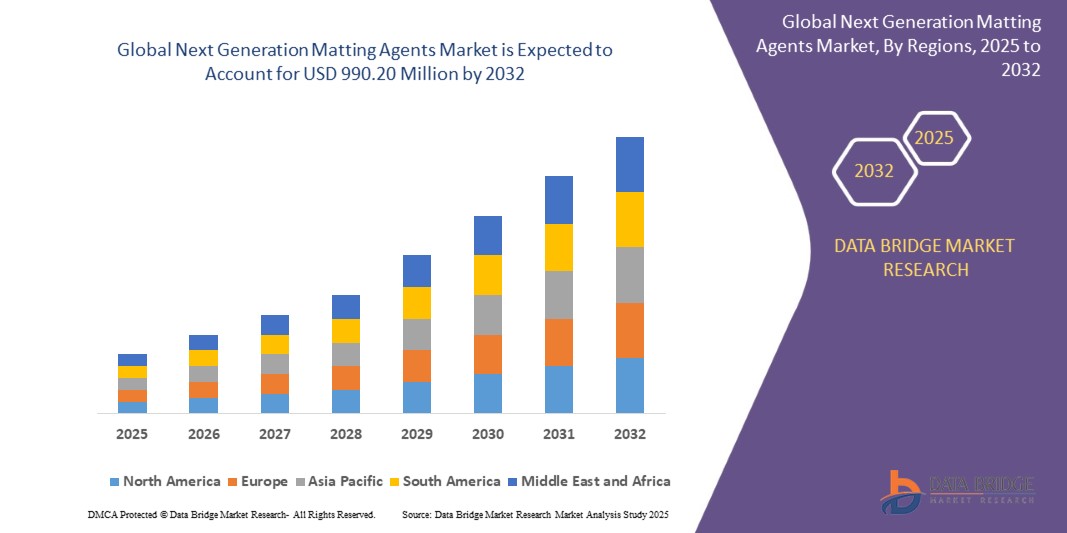
What is the Global Next Generation Matting Agents Market Size and Growth Rate?
- The global next generation matting agents market size was valued at USD 442.26 million in 2024 and is expected to reach USD 990.20 million by 2032, at a CAGR of 10.60% during the forecast period
- Next-generation matting agents refer to advanced materials used in coatings, paints, and other surface treatments to impart a matte or non-glossy finish. These agents play a crucial role in controlling the surface appearance of coatings by reducing light reflection and glare
- Unsuch as traditional matting agents, the next generation ones often exhibit improved performance, including enhanced efficiency, reduced impact on coating clarity, and better compatibility with various formulations. These innovations contribute to achieving desired aesthetic effects in a wide range of applications while addressing challenges associated with gloss control in surface coatings
What are the Major Takeaways of Next Generation Matting Agents Market?
- As industries such as automotive, construction, and furniture continue to prioritize coatings with superior properties such as durability, scratch resistance, and enhanced aesthetics, there is a growing need for advanced matting agents
- Next generation matting agents, with their ability to achieve desired surface characteristics while maintaining other coating properties, are becoming essential in formulations
- The market is witnessing a surge as manufacturers seek innovative solutions to meet the evolving requirements of modern coatings, fostering the adoption of these advanced matting agents in the industry
- North America dominated the next generation matting agents market with the largest revenue share of 39.14% in 2024, driven by rising demand for high-performance coatings and advanced surface finishing technologies across industries such as automotive, construction, and industrial applications
- Asia-Pacific next generation matting agents market is poised to grow at the fastest CAGR of 12.05% from 2025 to 2032, driven by rapid industrialization, rising construction activities, and expanding automotive production in countries such as China, Japan, and India
- The Inorganic Matting Agents segment dominated the market with the largest revenue share of 62.4% in 2024, driven by their superior thermal stability, chemical resistance, and consistent matting performance across diverse coating systems
Report Scope and Next Generation Matting Agents Market Segmentation
|
Attributes |
Next Generation Matting Agents Key Market Insights |
|
Segments Covered |
|
|
Countries Covered |
North America
Europe
Asia-Pacific
Middle East and Africa
South America
|
|
Key Market Players |
|
|
Market Opportunities |
|
|
Value Added Data Infosets |
In addition to the insights on market scenarios such as market value, growth rate, segmentation, geographical coverage, and major players, the market reports curated by the Data Bridge Market Research also include in-depth expert analysis, pricing analysis, brand share analysis, consumer survey, demography analysis, supply chain analysis, value chain analysis, raw material/consumables overview, vendor selection criteria, PESTLE Analysis, Porter Analysis, and regulatory framework. |
What is the Key Trend in the Next Generation Matting Agents Market?
Sustainable and High-Performance Formulations Driving Innovation
- A significant and accelerating trend in the global next generation matting agents market is the shift towards eco-friendly, high-performance formulations that meet regulatory standards while enhancing surface functionality. Manufacturers are focusing on low-VOC, bio-based, and waterborne technologies to align with global sustainability goals
- For instance, leading companies are developing silica-based and wax-based matting agents with improved scratch resistance and gloss control, specifically designed for industrial coatings and high-end automotive finishes
- In additionally, technological advancements such as nano-structured particles are enabling superior dispersion and long-term durability, creating opportunities for specialized applications in wood, plastic, and architectural coatings
- The integration of sustainable materials with high-performance attributes allows companies to cater to both environmental regulations and consumer demand for premium finishes
- This trend is fundamentally reshaping product portfolios as key players expand R&D to create solutions that balance aesthetic appeal, functionality, and eco-compliance
- The demand for innovative, sustainable matting agents is growing rapidly across automotive, industrial, and decorative coatings, positioning eco-advanced solutions as a key differentiator in the competitive landscape
What are the Key Drivers of Next Generation Matting Agents Market?
- Increasing demand for premium surface finishes across automotive, industrial, and architectural applications is a significant growth driver. Consumers and manufacturers seek coatings with enhanced aesthetics, scratch resistance, and durability
- For instance, in March 2024, Evonik Industries introduced a new line of silica matting agents designed for waterborne industrial coatings, offering improved performance while reducing environmental impact. Such innovations are expected to propel market expansion
- Stringent environmental regulations promoting low-VOC and sustainable solutions are encouraging the shift toward bio-based and waterborne matting agents
- Furthermore, the rise of high-performance coatings in sectors such as aerospace and electronics is creating demand for advanced matting agents capable of providing consistent gloss control and functional properties
- Growing urbanization and infrastructure development globally are increasing the use of decorative and protective coatings, further boosting demand for specialized matting solutions
Which Factor is challenging the Growth of the Next Generation Matting Agents Market?
- The high cost of advanced formulations, particularly those involving nano-materials or bio-based components, poses a barrier to widespread adoption, especially in price-sensitive markets
- For instance, premium nano-structured matting agents often require specialized production processes, making them significantly more expensive than traditional alternatives
- In additionally, technical challenges such as achieving uniform dispersion and compatibility with various resin systems can hinder product performance in certain applications
- The availability of cheaper conventional matting agents continues to limit the adoption of next-generation products in developing regions where cost considerations outweigh performance benefits
- Overcoming these challenges will require cost-optimization strategies, greater consumer education on long-term benefits, and continuous advancements in formulation technologies to make next-generation solutions more accessible
How is the Next Generation Matting Agents Market Segmented?
The market is segmented on the basis of type and application.
• By Type
On the basis of type, the next generation matting agents market is segmented into Organic Matting Agents and Inorganic Matting Agents. The Inorganic Matting Agents segment dominated the market with the largest revenue share of 62.4% in 2024, driven by their superior thermal stability, chemical resistance, and consistent matting performance across diverse coating systems. Industries such as automotive, industrial, and architectural coatings prefer inorganic agents due to their excellent durability and compatibility with waterborne and solvent-based formulations.
The Organic Matting Agents segment is anticipated to witness the fastest CAGR of 20.3% from 2025 to 2032, fueled by growing demand in applications requiring flexibility, smooth surface finishes, and lower density. Their increasing adoption in plastics, wood coatings, and eco-friendly formulations further supports segment growth.
• By Application
On the basis of application, the next generation matting agents market is segmented into Leather Coating, UV Coating, Coil Coating, Ink, and Others. The UV Coating segment held the largest market revenue share of 38.7% in 2024, driven by rising demand for high-performance, scratch-resistant, and visually appealing finishes in electronics, packaging, and furniture applications. Increasing use of energy-efficient UV curing technologies has further propelled its dominance.
The Leather Coating segment is expected to witness the fastest CAGR of 18.9% from 2025 to 2032, owing to rising applications in automotive interiors, footwear, and premium consumer goods. Demand is supported by innovations in low-VOC and sustainable leather coatings to meet regulatory standards.
Which Region Holds the Largest Share of the Next Generation Matting Agents Market?
- North America dominated the next generation matting agents market with the largest revenue share of 39.14% in 2024, driven by rising demand for high-performance coatings and advanced surface finishing technologies across industries such as automotive, construction, and industrial applications
- Consumers and manufacturers in the region highly value innovative matting solutions that offer superior durability, chemical resistance, and aesthetic appeal, particularly in premium products
- This strong market position is further supported by high R&D investments, robust regulatory frameworks favoring sustainable coatings, and the presence of leading market players, establishing North America as a hub for technological advancements in matting agents
U.S. Next Generation Matting Agents Market Insight
The U.S. next generation matting agents market captured the largest revenue share in 2024 within North America, fueled by increased adoption of eco-friendly coatings and high-performance surface finishing materials. Industries such as automotive, aerospace, and furniture are driving demand due to the shift towards low-VOC and sustainable formulations. The rising trend of advanced architectural coatings and investments in smart material technologies further propel market expansion, positioning the U.S. as a critical growth driver for North America.
Europe Next Generation Matting Agents Market Insight
The Europe next generation matting agents market is projected to expand at a substantial CAGR throughout the forecast period, primarily driven by stringent environmental regulations and growing demand for specialty coatings in industrial and consumer applications. Increasing urbanization and construction activities, coupled with the demand for aesthetic finishes and durable protective coatings, are fostering adoption. European manufacturers are also focusing on energy-efficient and sustainable solutions, accelerating innovation in both organic and inorganic matting agents for diverse end-user applications.
U.K. Next Generation Matting Agents Market Insight
The U.K. next generation matting agents market is anticipated to grow at a noteworthy CAGR during the forecast period, driven by the increasing demand for premium coatings in automotive and architectural applications. Shifts toward low-emission and bio-based coatings are further encouraging manufacturers to adopt advanced matting agents. The U.K.’s strong industrial base and expanding export markets continue to create new opportunities for growth in the matting agents sector.
Germany Next Generation Matting Agents Market Insight
The Germany next generation matting agents market is expected to expand at a considerable CAGR during the forecast period, fueled by its leadership in industrial coatings, automotive production, and material innovations. German manufacturers prioritize eco-conscious and high-performance solutions, driving adoption of advanced inorganic matting agents. Strong infrastructure and focus on R&D support the integration of next-generation technologies, making Germany a key contributor to Europe’s overall market growth.
Which Region is the Fastest Growing Region in the Next Generation Matting Agents Market?
Asia-Pacific next generation matting agents market is poised to grow at the fastest CAGR of 12.05% from 2025 to 2032, driven by rapid industrialization, rising construction activities, and expanding automotive production in countries such as China, Japan, and India. Government initiatives promoting eco-friendly and energy-efficient coatings are further driving demand. As Asia-Pacific emerges as a manufacturing hub for coatings and chemicals, the affordability and accessibility of advanced matting agents are expanding, boosting market penetration across both industrial and consumer applications.
Japan Next Generation Matting Agents Market Insight
The Japan next generation matting agents market is gaining momentum due to advanced coating technologies, rising demand for sustainable finishes, and growth in high-end automotive and electronics sectors. Japanese manufacturers emphasize precision, performance, and environmental compliance, which is fueling adoption of both organic and inorganic matting agents. Increasing R&D in UV-curable and waterborne coatings further supports market expansion in Japan.
China Next Generation Matting Agents Market Insight
The China next generation matting agents market accounted for the largest market revenue share in Asia-Pacific in 2024, driven by rapid industrial growth, urbanization, and increasing investments in infrastructure and automotive sectors. Strong domestic manufacturing capabilities and competitive pricing make China a key supplier of matting agents globally. The push toward smart cities and sustainable construction is further boosting demand for advanced coating solutions, positioning China as a central growth engine for the region.
Which are the Top Companies in Next Generation Matting Agents Market?
The next generation matting agents industry is primarily led by well-established companies, including:
- W.R. Grace (U.S.)
- Evonik Industries (Germany)
- Honeywell (U.S.)
- Michelman (U.S.)
- Lubrizol (U.S.)
- Hongsheng (China)
- Baltimore Innovations Ltd. (U.K.)
- W. R. Grace & Co.-Conn. (U.S.)
- Imerys (France)
- PQ Corporation (U.S.)
- Huber Engineered Materials (U.S.)
- Huntsman International LLC (U.S.)
- Deuteron GmbH (Germany)
- Lu’An Jietonda New Material Co., Ltd. (China)
- Thomas Swan & Co. Ltd. (U.K.)
- PPG Industries, Inc. (U.S.)
What are the Recent Developments in Global Next Generation Matting Agents Market?
- In March 2023, BYK, a subsegment of ALTANA, introduced three new additives under its CERAFLOUR product line, featuring corn starch-based polymers with wax-such as properties to enhance sustainability. These additives provide excellent matting while maintaining high transparency, reinforcing BYK’s commitment to eco-friendly innovations. This launch strengthens BYK’s position as a leader in sustainable matting technologies
- In March 2023, BYK officially inaugurated its second manufacturing facility in China, expanding its laboratories and administrative operations in Shanghai. With an initial production capacity of 4,750 tonnes, the integrated site at Shanghai Chemical Industry Park (SCIP) forms part of a larger expansion project. This investment emphasizes BYK’s strategic growth in Asia-Pacific to meet rising regional demand
- In March 2023, AkzoNobel Aerospace Coatings unveiled Aerofleet Coatings Management, a digital, data-driven service designed to help airlines and fleet operators optimize coating replacement and maintenance schedules for individual aircraft. This service reflects AkzoNobel’s focus on digital transformation and efficiency enhancements in aerospace coatings
- In August 2022, Evonik's Coating Additives business line announced an expansion of its ACEMATT precipitated matting agents production capacity at its Taiwan facility. This strategic move is aimed at meeting the increasing global demand for advanced matting solutions
- In July 2022, Evonik introduced three new silicas with ultra-deep matting, high transparency, and fine surface haptics. Suitable for universal use in water- and solvent-based systems, as well as in pigmented and clear formulations, these silicas broaden Evonik’s portfolio of high-performance matting agents

- Interactive Data Analysis Dashboard
- Company Analysis Dashboard for high growth potential opportunities
- Research Analyst Access for customization & queries
- Competitor Analysis with Interactive dashboard
- Latest News, Updates & Trend analysis
- Harness the Power of Benchmark Analysis for Comprehensive Competitor Tracking
Data collection and base year analysis are done using data collection modules with large sample sizes. The stage includes obtaining market information or related data through various sources and strategies. It includes examining and planning all the data acquired from the past in advance. It likewise envelops the examination of information inconsistencies seen across different information sources. The market data is analysed and estimated using market statistical and coherent models. Also, market share analysis and key trend analysis are the major success factors in the market report. To know more, please request an analyst call or drop down your inquiry.
The key research methodology used by DBMR research team is data triangulation which involves data mining, analysis of the impact of data variables on the market and primary (industry expert) validation. Data models include Vendor Positioning Grid, Market Time Line Analysis, Market Overview and Guide, Company Positioning Grid, Patent Analysis, Pricing Analysis, Company Market Share Analysis, Standards of Measurement, Global versus Regional and Vendor Share Analysis. To know more about the research methodology, drop in an inquiry to speak to our industry experts.
Data Bridge Market Research is a leader in advanced formative research. We take pride in servicing our existing and new customers with data and analysis that match and suits their goal. The report can be customized to include price trend analysis of target brands understanding the market for additional countries (ask for the list of countries), clinical trial results data, literature review, refurbished market and product base analysis. Market analysis of target competitors can be analyzed from technology-based analysis to market portfolio strategies. We can add as many competitors that you require data about in the format and data style you are looking for. Our team of analysts can also provide you data in crude raw excel files pivot tables (Fact book) or can assist you in creating presentations from the data sets available in the report.