


What is the Next-Generation Sequencing (NGS) Diagnostics Marke Size and Growth Rate?
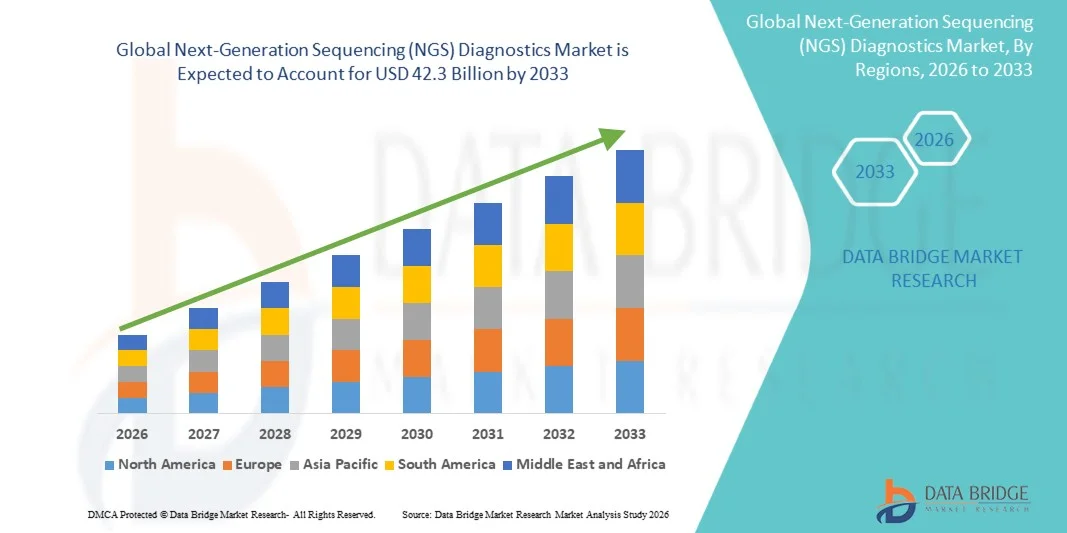
- As per Data Bridge Market Research Analysis the global next-generation sequencing (NGS) diagnostics market size was valued at USD 11.3 billion in 2025and is expected to reach USD 42.3 billion by 2033, at a CAGR of 18% during the forecast period
- Market expansion is driven by increasing adoption of precision medicine, rapid advancements in sequencing technologies, and growing demand for high-throughput genomic analysis in clinical diagnostics.
- Rising prevalence of cancer, rare genetic disorders, and infectious diseases is significantly boosting the integration of NGS in routine diagnostic workflows across healthcare systems.
Market Size & Forecast
Global Market Value (2025): USD 11.3 billion
Expected Market Value (2033): USD 42.3 billion
Forecast CAGR (2026–2033): 18%
What are the Major Takeaways of Next-Generation Sequencing (NGS) Diagnostics Marke?
- Next-Generation Sequencing enables high-speed, large-scale analysis of DNA and RNA, transforming diagnostics by allowing comprehensive genomic profiling in a single workflow.
- The technology is increasingly used for early disease detection, treatment selection, and monitoring disease progression, particularly in oncology and rare disease diagnostics.
- Expanding applications in infectious disease surveillance and outbreak tracking (e.g., pathogen sequencing) are further strengthening market adoption globally.
- North America currently dominates the market with a 41.9% revenue share in 2025, due to strong healthcare infrastructure, high adoption of precision medicine, and robust presence of leading sequencing technology providers.
- Asia-Pacific is expected to be the fastest-growing region with a CAGR of 18% during the forecast period, due to expanding genomic research initiatives, increasing healthcare investments, and rising adoption of molecular diagnostics in emerging economies.
- The Targeted Sequencing & Resequencing segment dominated the market with the largest revenue share of 38.6% in 2025, driven by its high accuracy, cost-effectiveness, and strong clinical utility in diagnosing genetic mutations associated with oncology and rare diseases. Its widespread adoption in clinical laboratories is further supported by faster turnaround time and established use in diagnostic workflows.
Report Scope and Next-Generation Sequencing (NGS) Diagnostics Market Segmentation
|
Attributes |
Next-Generation Sequencing (NGS) Diagnostics Key Market Insights |
|
Segments Covered |
|
|
Countries Covered |
North America
Europe
Asia-Pacific
Middle East and Africa
South America
|
|
Key Market Players |
|
|
Market Opportunities |
|
|
Value Added Data Infosets |
In addition to the insights on market scenarios such as market value, growth rate, segmentation, geographical coverage, and major players, the market reports curated by the Data Bridge Market Research also include in-depth expert analysis, patient epidemiology, pipeline analysis, pricing analysis, and regulatory framework |
What is the Key Trend in the Next-Generation Sequencing (NGS) Diagnostics Marke?
“Expansion of Clinical Genomics and AI-Driven Bioinformatics Integration”
- A major trend shaping the market is the integration of AI, machine learning, and cloud-based bioinformatics platforms for faster and more accurate genomic interpretation.
- Clinical adoption of NGS is shifting from research settings to routine diagnostics, especially in oncology for tumor profiling and therapy selection.
- Increasing use of liquid biopsy combined with NGS is enabling non-invasive cancer detection and monitoring.
- Growth of multi-omics approaches (genomics, transcriptomics, epigenomics) is enhancing disease understanding and personalized treatment strategies.
- Portable and automated sequencing platforms are improving turnaround time and enabling decentralized genomic testing.
Next-Generation Sequencing (NGS) Diagnostics Market Dynamics
Driver
“Rising Demand for Precision Medicine and Genomic-Based Diagnostics”
- Increasing focus on personalized healthcare is driving widespread adoption of NGS-based diagnostics.
- Pharmaceutical companies are using sequencing data to identify biomarkers and develop targeted therapies.
- Expanding applications in oncology, rare diseases, and pharmacogenomics are significantly accelerating market growth.
- Government genomic initiatives and large-scale sequencing programs are further supporting adoption across clinical and research settings.
- Continuous reduction in sequencing costs is making genomic testing more accessible globally.
Restraint/Challenge
“High Data Complexity and Regulatory Constraints”
- Massive data generation from sequencing requires advanced computational infrastructure and skilled bioinformatics expertise.
- Lack of standardized data interpretation frameworks can lead to variability in diagnostic outcomes.
- Regulatory approval processes for clinical NGS tests remain complex and time-consuming in several regions.
- High initial investment in sequencing platforms and supporting software limits adoption in resource-constrained settings.
- Data privacy and genomic data security concerns also present challenges for widespread clinical integration.
How is the Next-Generation Sequencing (NGS) Diagnostics Marke Segmented?
The market is segmented on the basis of technology, product, application, and end user.
- By Technology
On the basis of technology, the global Next-Generation Sequencing (NGS) diagnostics market is segmented into Whole Genome Sequencing (WGS), Whole Exome Sequencing (WES), Targeted Sequencing & Resequencing, RNA Sequencing (RNA-Seq), De novo Sequencing, Methylation Sequencing, and ChIP Sequencing. The Targeted Sequencing & Resequencing segment dominated the market with the largest revenue share of 38.6% in 2025, driven by its high accuracy, cost-effectiveness, and strong clinical utility in diagnosing genetic mutations associated with oncology and rare diseases. Its widespread adoption in clinical laboratories is further supported by faster turnaround time and established use in diagnostic workflows.
The RNA Sequencing (RNA-Seq) segment is expected to witness the fastest growth during the forecast period, fueled by increasing demand for transcriptomics-based research, cancer biomarker discovery, and gene expression profiling. Expanding applications in precision medicine and functional genomics are further accelerating adoption globally.
- By Product
On the basis of product, the global Next-Generation Sequencing (NGS) diagnostics market is segmented into Sequencing Platforms/Instruments, Consumables, Software & Data Analysis Tools, and Services. The Sequencing Platforms/Instruments segment dominated the market in 2025, driven by strong demand for high-throughput sequencing systems and continuous technological advancements improving speed, accuracy, and scalability. Increasing adoption of automated and integrated sequencing platforms across clinical and research settings further supports segment dominance.
The Software & Data Analysis Tools segment is expected to witness the fastest growth during the forecast period, driven by rising complexity of genomic data and increasing reliance on AI-driven bioinformatics solutions for accurate interpretation, storage, and visualization of sequencing results.
- By Application
On the basis of application, the market is segmented into Oncology, Rare Genetic Diseases, Infectious Disease Diagnostics, Reproductive Health & Prenatal Testing, Pharmacogenomics / Personalized Medicine, and Genetic Screening. The Oncology segment accounted for the largest market revenue share in 2025, driven by widespread use of NGS in tumor profiling, cancer mutation detection, and treatment selection. Increasing prevalence of cancer and growing adoption of precision oncology are further strengthening segment dominance.
The Infectious Disease Diagnostics segment is expected to witness the fastest growth during the forecast period, fueled by rising demand for pathogen sequencing, outbreak surveillance, and rapid identification of emerging infectious diseases.
- By End User
On the basis of end user, the global Next-Generation Sequencing (NGS) diagnostics market is segmented into Hospitals & Clinical Laboratories, Academic & Research Institutes, Pharmaceutical & Biotechnology Companies, and Diagnostic Centers / Reference Labs. The Hospitals & Clinical Laboratories segment dominated the market in 2025, supported by increasing integration of NGS into routine diagnostic workflows, strong clinical adoption, and rising demand for advanced molecular testing in patient care.
The Diagnostic Centers / Reference Labs segment is expected to witness the fastest growth during the forecast period, driven by increasing outsourcing of genomic testing, cost efficiency, and expanding availability of specialized sequencing services.
Which Region Holds the Largest Share of the Next-Generation Sequencing (NGS) Diagnostics Marke?
- North America currently dominates the market with a 41.9% revenue share in 2025, due to strong healthcare infrastructure, high adoption of precision medicine, and robust presence of leading sequencing technology providers.
- High concentration of advanced genomic research centers and well-established clinical laboratory networks further strengthens regional leadership in NGS diagnostics adoption.
- Strong government and private sector investments in large-scale genomic initiatives and cancer research programs are accelerating clinical integration of sequencing technologies across the region.
U.S. Next-Generation Sequencing (NGS) Diagnostics Market Insight
The U.S. NGS diagnostics market is highly advanced and dominates the global landscape due to strong adoption of precision medicine, widespread integration of genomic testing in oncology, and a well-established clinical laboratory network. The presence of major sequencing technology companies, combined with strong reimbursement frameworks and continuous innovation in genomic diagnostics, is accelerating clinical adoption across hospitals and research institutions.
Europe Next-Generation Sequencing (NGS) Diagnostics Market Insight
Europe’s NGS diagnostics market is steadily expanding, supported by strong regulatory frameworks, increasing government-funded genomic research programs, and rising demand for personalized medicine. Countries across the region are actively integrating NGS into clinical workflows for cancer and rare disease diagnostics, while strong collaboration between research institutes and healthcare systems is enhancing market penetration.
U.K. Next-Generation Sequencing (NGS) Diagnostics Market Insight
The U.K. market is growing significantly due to national-scale genomic initiatives, strong public healthcare infrastructure, and increasing focus on early disease detection and precision medicine. Extensive use of NGS in oncology and rare genetic disorder diagnosis, along with strong data-driven healthcare programs, is supporting widespread clinical adoption across the country.
Germany Next-Generation Sequencing (NGS) Diagnostics Market Insight
Germany’s NGS diagnostics market is driven by advanced healthcare infrastructure, strong biotechnology research ecosystem, and increasing use of genomic sequencing in clinical diagnostics. Growing emphasis on precision medicine, coupled with high investment in life sciences and diagnostic innovation, is supporting adoption across hospitals, academic institutes, and diagnostic laboratories.
Asia-Pacific Next-Generation Sequencing (NGS) Diagnostics Market Insight
The Asia-Pacific region is expected to witness the fastest growth, driven by rising healthcare investments, expanding genomic research initiatives, and increasing burden of genetic and infectious diseases. Rapid improvements in healthcare infrastructure, growing awareness of molecular diagnostics, and expanding access to cost-effective sequencing technologies are accelerating market adoption across emerging economies.
Japan Next-Generation Sequencing (NGS) Diagnostics Market Insight
Japan’s market is expanding due to its aging population, strong focus on precision medicine, and advanced healthcare system. High adoption of NGS in cancer genomics, rare disease research, and personalized treatment strategies, supported by government initiatives in genomic medicine, is strengthening the market outlook.
India Next-Generation Sequencing (NGS) Diagnostics Market Insight
India’s NGS diagnostics market is growing rapidly due to increasing prevalence of genetic and chronic diseases, rising healthcare awareness, and expanding diagnostic infrastructure. Strong growth in biotechnology capabilities, improving access to advanced sequencing technologies, and increasing adoption in clinical and research applications are driving significant market expansion.
Which are the Top Companies in Next-Generation Sequencing (NGS) Diagnostics Marke?
The Next-generation sequencing (NGS) diagnostics industry is primarily led by well-established companies, including:
- Illumina Inc. (U.S.)
- Thermo Fisher Scientific (U.S.)
- Oxford Nanopore Technologies (U.K.)
- BGI Genomics (China)
- Agilent Technologies (U.S.)
- Roche Sequencing Solutions (Switzerland)
- Pacific Biosciences (PacBio) (U.S.)
- QIAGEN N.V. (Netherlands)
- PerkinElmer Genomics (U.S.)
- Bio-Rad Laboratories (U.S.)
What are the Recent Developments in Global Next-generation sequencing (NGS) diagnostics Market?
- In May 2025, QIAGEN acquired Genoox to strengthen its AI-powered clinical genomics portfolio, integrating the Franklin platform to enhance NGS data interpretation across targeted panels, WES, and WGS, improving diagnostic speed and accuracy in clinical laboratories.
- In June 2025, Illumina expanded its multiomics and sequencing capabilities through strategic acquisitions and platform enhancements, including moves to strengthen high-throughput sequencing ecosystems and support advanced clinical oncology and population genomics applications.
- In June 2025, Illumina also advanced its proteomics and multiomics strategy by acquiring SomaLogic assets, enabling integration of proteomic biomarkers with NGS-based workflows for improved disease profiling and precision diagnostics.
- In 2025, Thermo Fisher Scientific expanded its clinical NGS offering through enhanced oncology assays and integrated sequencing workflows, supporting faster turnaround genomic profiling and strengthening its position in precision medicine diagnostics.

- Interactive Data Analysis Dashboard
- Company Analysis Dashboard for high growth potential opportunities
- Research Analyst Access for customization & queries
- Competitor Analysis with Interactive dashboard
- Latest News, Updates & Trend analysis
- Harness the Power of Benchmark Analysis for Comprehensive Competitor Tracking
Data collection and base year analysis are done using data collection modules with large sample sizes. The stage includes obtaining market information or related data through various sources and strategies. It includes examining and planning all the data acquired from the past in advance. It likewise envelops the examination of information inconsistencies seen across different information sources. The market data is analysed and estimated using market statistical and coherent models. Also, market share analysis and key trend analysis are the major success factors in the market report. To know more, please request an analyst call or drop down your inquiry.
The key research methodology used by DBMR research team is data triangulation which involves data mining, analysis of the impact of data variables on the market and primary (industry expert) validation. Data models include Vendor Positioning Grid, Market Time Line Analysis, Market Overview and Guide, Company Positioning Grid, Patent Analysis, Pricing Analysis, Company Market Share Analysis, Standards of Measurement, Global versus Regional and Vendor Share Analysis. To know more about the research methodology, drop in an inquiry to speak to our industry experts.
Data Bridge Market Research is a leader in advanced formative research. We take pride in servicing our existing and new customers with data and analysis that match and suits their goal. The report can be customized to include price trend analysis of target brands understanding the market for additional countries (ask for the list of countries), clinical trial results data, literature review, refurbished market and product base analysis. Market analysis of target competitors can be analyzed from technology-based analysis to market portfolio strategies. We can add as many competitors that you require data about in the format and data style you are looking for. Our team of analysts can also provide you data in crude raw excel files pivot tables (Fact book) or can assist you in creating presentations from the data sets available in the report.













