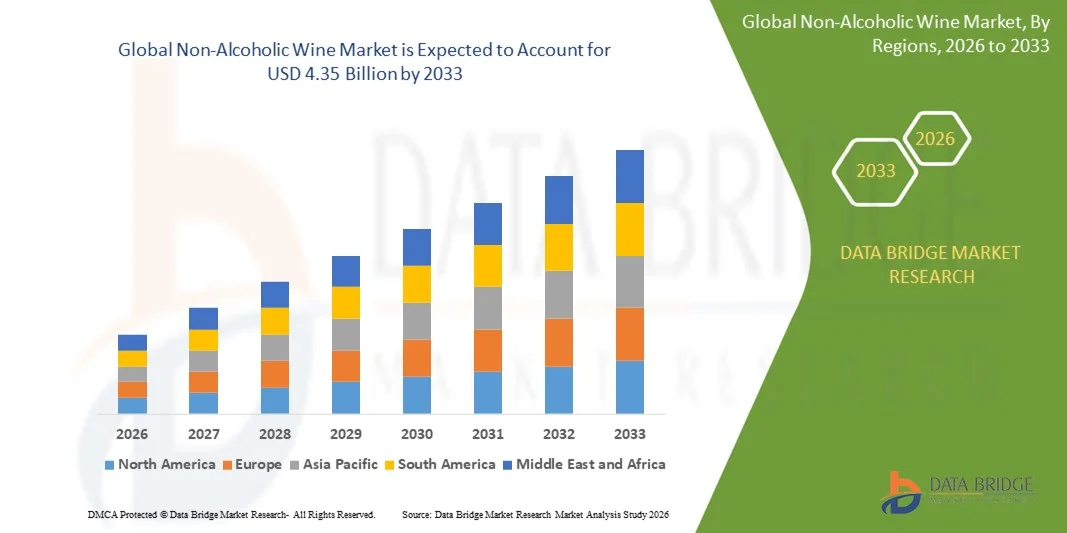
Global Non-Alcoholic Wine Market Size
- The global Non-Alcoholic Wine Market size was valued at USD 2.57 billion in 2025 and is expected to reach USD 4.35 billion by 2033, at a CAGR of 6.79% during the forecast period.
- The market growth is primarily driven by increasing health consciousness among consumers, rising preference for low- and no-alcohol beverages, and growing awareness about the harmful effects of excessive alcohol consumption.
- Additionally, expanding distribution channels, product innovation, and the introduction of premium non-alcoholic wine varieties are enhancing consumer accessibility and appeal. These factors are collectively contributing to the rising adoption of non-alcoholic wines, thereby significantly propelling the market’s growth.
Global Non-Alcoholic Wine Market Analysis
- Non-alcoholic wines, offering alcohol-free alternatives to traditional wines, are increasingly popular in both social and health-conscious settings due to their ability to provide a similar taste experience without the effects of alcohol, making them suitable for a wide range of consumers.
- The rising demand for non-alcoholic wines is primarily fueled by growing health awareness, increasing cases of alcohol-related health concerns, and a shift in consumer preference toward low- and no-alcohol beverages.
- North America dominated the Global Non-Alcoholic Wine Market with the largest revenue share of 34.9% in 2025, characterized by high health consciousness, strong disposable incomes, and a well-established retail and e-commerce presence, with the U.S. witnessing substantial growth in premium and flavored non-alcoholic wine offerings, driven by innovations from both established beverage companies and startups focusing on organic and low-sugar variants.
- Asia-Pacific is expected to be the fastest-growing region in the Global Non-Alcoholic Wine Market during the forecast period due to increasing urbanization, rising disposable incomes, and growing awareness of healthier lifestyle choices among consumers.
- The Alcohol-Free segment dominated the market with the largest revenue share of 61.5% in 2025, driven by growing health consciousness, stricter regulations on alcohol consumption, and increasing preference for completely alcohol-free options among consumers.
Report Scope and Global Non-Alcoholic Wine Market Segmentation
|
Attributes |
Non-Alcoholic Wine Key Market Insights |
|
Segments Covered |
|
|
Countries Covered |
North America
Europe
Asia-Pacific
Middle East and Africa
South America
|
|
Key Market Players |
|
|
Market Opportunities |
|
|
Value Added Data Infosets |
In addition to the insights on market scenarios such as market value, growth rate, segmentation, geographical coverage, and major players, the market reports curated by the Data Bridge Market Research also include in-depth expert analysis, pricing analysis, brand share analysis, consumer survey, demography analysis, supply chain analysis, value chain analysis, raw material/consumables overview, vendor selection criteria, PESTLE Analysis, Porter Analysis, and regulatory framework. |
Global Non-Alcoholic Wine Market Trends
Enhanced Experience Through AI and Personalized Recommendations
- A significant and accelerating trend in the global Non-Alcoholic Wine Market is the integration of artificial intelligence (AI) and digital recommendation systems, which are enhancing consumer experiences by offering personalized product suggestions based on taste preferences, dietary requirements, and past purchase behavior.
- For instance, platforms such as Vivino and Dry Drinker use AI algorithms to recommend non-alcoholic wine options tailored to individual user profiles, enabling consumers to discover new varieties without trial and error. Similarly, some e-commerce retailers provide AI-driven pairing suggestions for meals or social occasions, enhancing the overall wine-drinking experience.
- AI integration also enables features such as predicting flavor profiles, suggesting ideal serving temperatures, and providing food-pairing recommendations. For example, tools like Noughty’s digital platform analyze user ratings and feedback to refine future suggestions, offering a more tailored and interactive buying experience.
- The seamless integration of AI-driven recommendations with online platforms and mobile applications allows users to explore, compare, and purchase non-alcoholic wines efficiently. Through a single interface, consumers can manage their preferences, track their favorite brands, and receive curated suggestions, creating a highly personalized and convenient experience.
- This trend towards smarter, data-driven, and consumer-focused wine selection is fundamentally reshaping expectations in the non-alcoholic wine market. Consequently, companies such as Freixenet and Leitz are developing AI-enhanced platforms that provide curated recommendations, tasting notes, and personalized subscription options.
- The demand for non-alcoholic wines paired with AI-enabled personalization is growing rapidly across both retail and direct-to-consumer channels, as consumers increasingly prioritize convenience, discovery, and tailored experiences in their beverage choices.
Global Non-Alcoholic Wine Market Dynamics
Driver
Growing Need Due to Health Awareness and Lifestyle Shifts
- The increasing focus on health and wellness among consumers, coupled with the growing preference for low- and no-alcohol beverages, is a significant driver for the heightened demand for non-alcoholic wines.
- For instance, in 2025, Freixenet launched a range of premium non-alcoholic sparkling wines targeting health-conscious consumers and social drinkers seeking sophisticated alternatives to traditional wines. Such initiatives by key companies are expected to drive the non-alcoholic wine market growth during the forecast period.
- As consumers become more aware of the health risks associated with excessive alcohol consumption, non-alcoholic wines offer similar taste experiences and social enjoyment without the negative effects of alcohol, providing a compelling alternative to conventional wines.
- Furthermore, the rising popularity of wellness-oriented lifestyles and alcohol-free social trends is making non-alcoholic wines an integral choice for celebrations, dining experiences, and casual drinking, expanding their adoption across diverse consumer segments.
- The convenience of ready-to-drink options, availability in multiple flavors, and compatibility with food pairings are key factors propelling the adoption of non-alcoholic wines in both retail and hospitality sectors. The trend toward premiumization and increasing availability through e-commerce and supermarkets further contributes to market growth.
Restraint/Challenge
Taste Perception and Premium Pricing Concerns
- Perceptions regarding taste differences between alcoholic and non-alcoholic wines pose a significant challenge to broader market penetration. Some consumers are hesitant to adopt non-alcoholic wines due to concerns that the flavor profile may not match traditional wines.
- For instance, earlier product launches with limited flavor complexity received mixed reviews, prompting companies to invest in improved fermentation and flavor-enhancement technologies to meet consumer expectations.
- Addressing these taste perception challenges through advanced production techniques, better labeling, and consumer education on pairing and usage is crucial for building trust and acceptance. Companies such as Leitz and Noughty emphasize their natural fermentation processes and high-quality ingredients in marketing campaigns to reassure potential buyers. Additionally, the relatively higher price of premium non-alcoholic wines compared to conventional wines can be a barrier to adoption, particularly in price-sensitive markets or for casual consumers.
- While prices are gradually becoming more competitive, the perceived premium for high-quality non-alcoholic wines can still limit widespread adoption, especially among consumers who prioritize cost over health benefits.
- Overcoming these challenges through flavor innovation, competitive pricing strategies, and increased awareness of the health and social benefits of non-alcoholic wines will be vital for sustained market growth.
Global Non-Alcoholic Wine Market Scope
Non-alcoholic wine market is segmented on the basis of product type, category and distribution channel.
- By Product Type
On the basis of product type, the Global Non-Alcoholic Wine Market is segmented into Alcohol-Free and 0.5% Alcohol by Volume (ABV) wines. The Alcohol-Free segment dominated the market with the largest revenue share of 61.5% in 2025, driven by growing health consciousness, stricter regulations on alcohol consumption, and increasing preference for completely alcohol-free options among consumers. Alcohol-free wines are widely adopted for social occasions, celebrations, and family-friendly gatherings, providing the traditional wine experience without the effects of alcohol.
The 0.5% ABV segment is expected to witness the fastest CAGR of 18.9% from 2026 to 2033, fueled by consumer demand for low-alcohol alternatives that retain more authentic wine characteristics and flavor profiles. Producers are increasingly innovating in this segment with premium options, improved fermentation techniques, and diverse grape varieties to appeal to connoisseurs seeking a near-traditional wine experience without full alcohol content.
- By Category
On the basis of category, the Global Non-Alcoholic Wine Market is segmented into Plain and Flavored wines. The Plain wine segment held the largest revenue share of 55.3% in 2025, owing to its wide acceptance among traditional wine consumers who prefer a taste profile closer to conventional wines. Plain non-alcoholic wines are especially popular in premium and organic segments due to their minimal additives and authentic grape characteristics.
The Flavored segment is anticipated to witness the fastest CAGR of 21.4% from 2026 to 2033, driven by the rising demand for innovative and experiential beverages among younger consumers and health-conscious millennials. Flavored non-alcoholic wines, including fruit-infused and botanical variants, are gaining popularity in social settings, casual dining, and e-commerce platforms, allowing brands to differentiate their offerings and attract a broader consumer base with unique taste experiences.
- By Distribution Channel
On the basis of distribution channel, the Global Non-Alcoholic Wine Market is segmented into Store-Based and Non-Store-Based channels. The Store-Based segment dominated the market with the largest revenue share of 62.7% in 2025, driven by the established presence of supermarkets, hypermarkets, specialty wine shops, and on-premise retail outlets. Consumers often prefer in-store purchases for the ability to examine packaging, seek recommendations, and experience product sampling.
The Non-Store-Based segment is expected to witness the fastest CAGR of 22.1% from 2026 to 2033, fueled by the rapid growth of e-commerce platforms, online wine subscription services, and direct-to-consumer sales. Increasing smartphone penetration, convenient doorstep delivery, and personalized recommendation systems are making online channels increasingly attractive, particularly among millennials and urban consumers seeking convenience and variety in their non-alcoholic wine purchases.
Global Non-Alcoholic Wine Market Regional Analysis
- North America dominated the Global Non-Alcoholic Wine Market with the largest revenue share of 34.9% in 2025, driven by increasing health awareness, changing lifestyle preferences, and a growing trend toward alcohol-free alternatives.
- Consumers in the region highly value the availability of premium, flavored, and organic non-alcoholic wines, as well as the ability to enjoy wine in social and professional settings without the effects of alcohol.
- This widespread adoption is further supported by high disposable incomes, a mature retail and e-commerce infrastructure, and the rising popularity of wellness-focused beverages, establishing non-alcoholic wines as a preferred choice for both everyday consumption and special occasions across residential and hospitality sectors.
U.S. Non-Alcoholic Wine Market Insight
The U.S. non-alcoholic wine market captured the largest revenue share of 78% in North America in 2025, fueled by rising health consciousness, changing lifestyle preferences, and increasing demand for alcohol-free alternatives in social and professional settings. Consumers are prioritizing wellness-oriented beverages, low- or zero-alcohol options, and premium non-alcoholic wines for casual consumption and celebrations. The growing availability of flavored and organic variants, combined with robust retail and e-commerce channels, further propels market growth. Moreover, increasing awareness of alcohol-related health risks and the trend toward mindful drinking are significantly contributing to the expansion of the U.S. non-alcoholic wine market.
Europe Non-Alcoholic Wine Market Insight
The Europe non-alcoholic wine market is projected to expand at a substantial CAGR throughout the forecast period, primarily driven by rising health awareness, stringent labeling regulations, and growing demand for low- and no-alcohol beverages. Urbanization, higher disposable incomes, and the popularity of wellness-focused lifestyles are fostering market adoption. European consumers are also drawn to premium and flavored non-alcoholic wines for social occasions, restaurants, and hospitality settings. The region is experiencing significant growth across residential and commercial consumption, with both traditional and modern retail channels contributing to accessibility.
U.K. Non-Alcoholic Wine Market Insight
The U.K. non-alcoholic wine market is anticipated to grow at a noteworthy CAGR during the forecast period, driven by increasing consumer preference for healthier drinking habits and the rise of alcohol-free social trends. Concerns regarding alcohol-related health effects and the popularity of alcohol-free events encourage both households and businesses to opt for non-alcoholic wines. The country’s strong e-commerce infrastructure and well-developed retail network further support widespread availability and adoption of non-alcoholic wine products.
Germany Non-Alcoholic Wine Market Insight
The Germany non-alcoholic wine market is expected to expand at a considerable CAGR during the forecast period, fueled by rising health awareness, increasing demand for premium alcohol-free beverages, and a preference for sustainable and organic options. Germany’s focus on high-quality food and beverage products, combined with strong distribution networks, promotes the adoption of non-alcoholic wines in both households and hospitality sectors. Consumers increasingly seek innovative flavor variants and quality options that provide an authentic wine experience without alcohol.
Asia-Pacific Non-Alcoholic Wine Market Insight
The Asia-Pacific non-alcoholic wine market is poised to grow at the fastest CAGR of 23% during the forecast period of 2026 to 2033, driven by increasing urbanization, rising disposable incomes, and growing health consciousness in countries such as China, Japan, and India. The region’s expanding middle class and the rising popularity of wellness and lifestyle-oriented beverages are driving adoption. Additionally, growing awareness of alcohol-free alternatives in restaurants, hotels, and e-commerce platforms is accelerating market penetration.
Japan Non-Alcoholic Wine Market Insight
The Japan non-alcoholic wine market is gaining momentum due to the country’s health-focused culture, aging population, and increasing interest in alcohol-free alternatives for both social and everyday consumption. Japanese consumers value premium, flavored, and organic non-alcoholic wines, often pairing them with meals or enjoying them in hospitality settings. The integration of alcohol-free options into restaurants, cafes, and retail channels is further fueling growth, alongside the convenience of online purchasing.
China Non-Alcoholic Wine Market Insight
The China non-alcoholic wine market accounted for the largest market revenue share in Asia-Pacific in 2025, attributed to rapid urbanization, rising disposable incomes, and increasing health awareness among the middle class. China is witnessing a growing acceptance of alcohol-free beverages in residential, commercial, and hospitality settings. Government initiatives promoting healthier lifestyles, coupled with the availability of diverse and affordable non-alcoholic wine options from domestic and international brands, are key factors driving the market.
Global Non-Alcoholic Wine Market Share
The Non-Alcoholic Wine industry is primarily led by well-established companies, including:
• Freixenet Group (Spain)
• Torres Winery (Spain)
• Sutter Home Winery (U.S.)
• Nicolas Feuillatte (France)
• Barefoot Wines (U.S.)
• Carl Jung (Germany)
• Eisberg (Germany)
• Leitz Wine (Germany)
• Leitz Eins-Zero (Germany)
• Pierre Chavin (France)
• Lindeman’s (Australia)
• Echo Falls (U.K.)
• Vina Maipo (Chile)
• Deluxe Beverages (U.S.)
• Codorniu (Spain)
• Arbor Mist (U.S.)
• Menade (Spain)
• Natureo (Spain)
• St. Regis Wines (U.K.)
• Villa Jolanda (Italy)
What are the Recent Developments in Global Non-Alcoholic Wine Market?
- In April 2024, Barefoot Wines, a leading global wine brand, launched a new line of premium non-alcoholic wines in South Africa, aiming to cater to the rising demand for alcohol-free alternatives in both residential and hospitality settings. This launch highlights the company’s commitment to innovation and meeting the growing health-conscious consumer base, while strengthening its presence in the expanding global non-alcoholic wine market.
- In March 2024, Freixenet Group, a renowned Spanish winery, introduced its 0.0% alcohol sparkling wine range in the U.S., specifically targeting restaurants, hotels, and social events. The initiative underscores Freixenet’s focus on offering high-quality, alcohol-free options for professional and leisure consumption, reflecting the increasing preference for mindful drinking and healthier lifestyle choices.
- In March 2024, Nicolas Feuillatte, in partnership with select Japanese distributors, launched a premium flavored non-alcoholic wine collection designed to appeal to urban, health-conscious consumers. This development emphasizes the growing trend of flavored and innovative non-alcoholic beverages, expanding the market’s appeal across both residential and hospitality sectors.
- In February 2024, Sutter Home Winery, a leading U.S. producer of alcohol-free wines, partnered with major e-commerce platforms to create an online-exclusive non-alcoholic wine marketplace. This collaboration aims to increase accessibility, improve distribution efficiency, and cater to the rising online demand for alcohol-free alternatives, demonstrating the brand’s commitment to innovation and consumer convenience.
- In January 2024, Torres Winery, a prominent Spanish wine producer, unveiled its new line of organic non-alcoholic wines at the Vinexpo Paris 2024 exhibition. The launch, featuring zero-alcohol and low-calorie options, highlights Torres’ focus on sustainability, health-conscious products, and premium quality, catering to the growing global demand for sophisticated, alcohol-free wine experiences.

- Interactive Data Analysis Dashboard
- Company Analysis Dashboard for high growth potential opportunities
- Research Analyst Access for customization & queries
- Competitor Analysis with Interactive dashboard
- Latest News, Updates & Trend analysis
- Harness the Power of Benchmark Analysis for Comprehensive Competitor Tracking
Global Non Alcoholic Wine Market, Supply Chain Analysis and Ecosystem Framework
To support market growth and help clients navigate the impact of geopolitical shifts, DBMR has integrated in-depth supply chain analysis into its Global Non Alcoholic Wine Market research reports. This addition empowers clients to respond effectively to global changes affecting their industries. The supply chain analysis section includes detailed insights such as Global Non Alcoholic Wine Market consumption and production by country, price trend analysis, the impact of tariffs and geopolitical developments, and import and export trends by country and HSN code. It also highlights major suppliers with data on production capacity and company profiles, as well as key importers and exporters. In addition to research, DBMR offers specialized supply chain consulting services backed by over a decade of experience, providing solutions like supplier discovery, supplier risk assessment, price trend analysis, impact evaluation of inflation and trade route changes, and comprehensive market trend analysis.
Data collection and base year analysis are done using data collection modules with large sample sizes. The stage includes obtaining market information or related data through various sources and strategies. It includes examining and planning all the data acquired from the past in advance. It likewise envelops the examination of information inconsistencies seen across different information sources. The market data is analysed and estimated using market statistical and coherent models. Also, market share analysis and key trend analysis are the major success factors in the market report. To know more, please request an analyst call or drop down your inquiry.
The key research methodology used by DBMR research team is data triangulation which involves data mining, analysis of the impact of data variables on the market and primary (industry expert) validation. Data models include Vendor Positioning Grid, Market Time Line Analysis, Market Overview and Guide, Company Positioning Grid, Patent Analysis, Pricing Analysis, Company Market Share Analysis, Standards of Measurement, Global versus Regional and Vendor Share Analysis. To know more about the research methodology, drop in an inquiry to speak to our industry experts.
Data Bridge Market Research is a leader in advanced formative research. We take pride in servicing our existing and new customers with data and analysis that match and suits their goal. The report can be customized to include price trend analysis of target brands understanding the market for additional countries (ask for the list of countries), clinical trial results data, literature review, refurbished market and product base analysis. Market analysis of target competitors can be analyzed from technology-based analysis to market portfolio strategies. We can add as many competitors that you require data about in the format and data style you are looking for. Our team of analysts can also provide you data in crude raw excel files pivot tables (Fact book) or can assist you in creating presentations from the data sets available in the report.