What is the Global Non-Anticoagulant Rodenticide Market Size and Growth Rate?
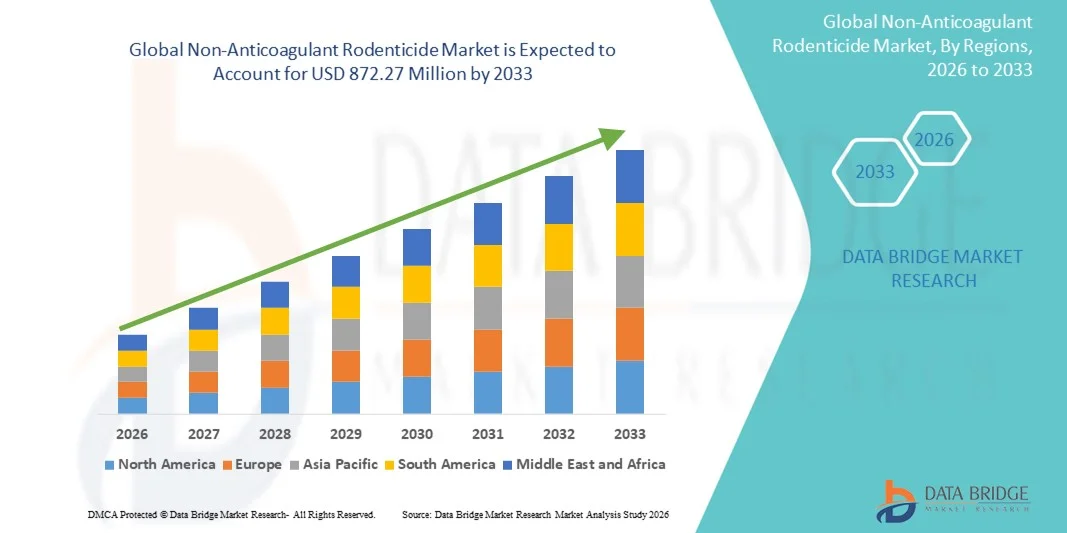
- The global non-anticoagulant rodenticide market size was valued at USD 599.46 million in 2025 and is expected to reach USD 872.27 million by 2033, at a CAGR of 4.80% during the forecast period
- The non-anticogulant rodenticide market is expected to gain growth, due to the rise in damages due to rodent attacks. Also, the displacement of rodents due to urbanization and rapid technological advancements are also expected to drive the market for non-anticogulant rodenticide
- The impact of climatic changes on rodent proliferation and rise in concerns regarding vector-based disease outbreaks encourage public health initiatives are also such asly to lift the growth of the non-anticogulant rodenticide market
What are the Major Takeaways of Non-Anticoagulant Rodenticide Market?
- The increase in prevalence of pest-related diseases and high demand for pest control are also the major driving factors leading towards the growth of the non-anticogulant rodenticide market
- However, the strict regulations and the ban on the use of rodenticides in developed countries and rise in the use of mechanical methods for rodent control are expected to curb the growth of the non-anticogulant rodenticide market
- North America dominated the non-anticoagulant rodenticide market with a 39.6% revenue share in 2025, driven by rising urban rodent infestations, stringent sanitation standards, and high adoption of advanced rodent control solutions across the U.S. and Canada
- Asia-Pacific is projected to record the fastest CAGR of 10.2% from 2026 to 2033, driven by rapid urbanization, rising rodent infestations in densely populated cities, and expanding warehousing and food logistics sectors across China, India, Japan, and Southeast Asia
- The Bromethalin segment dominated the market with an estimated revenue share of 36.4% in 2025, owing to its fast-acting neurotoxic mechanism, high efficacy against anticoagulant-resistant rodent populations, and widespread use in residential, commercial, and agricultural environments
Report Scope and Non-Anticoagulant Rodenticide Market Segmentation
|
Attributes |
Non-Anticoagulant Rodenticide Key Market Insights |
|
Segments Covered |
|
|
Countries Covered |
North America
Europe
Asia-Pacific
Middle East and Africa
South America
|
|
Key Market Players |
|
|
Market Opportunities |
|
|
Value Added Data Infosets |
In addition to the insights on market scenarios such as market value, growth rate, segmentation, geographical coverage, and major players, the market reports curated by the Data Bridge Market Research also include in-depth expert analysis, pricing analysis, brand share analysis, consumer survey, demography analysis, supply chain analysis, value chain analysis, raw material/consumables overview, vendor selection criteria, PESTLE Analysis, Porter Analysis, and regulatory framework. |
What is the Key Trend in the Non-Anticoagulant Rodenticide Market?
Growing Shift Toward Eco-Friendly and Humane Rodent Control Solutions
- The non-anticoagulant rodenticide market is witnessing a significant shift toward eco-friendly, fast-acting, and species-specific rodent control formulations, driven by rising environmental concerns and the need to reduce risks to pets, wildlife, and humans. Modern solutions such as cholecalciferol, bromethalin, zinc phosphide, and fertility-control baits are gaining traction as safer alternatives to traditional anticoagulants
- For instance, SenesTech expanded commercialization of its fertility-control technology, ContraPest, which reduces rodent populations by managing reproduction instead of relying on toxic lethal baits
- Increasing concerns about secondary poisoning, bait resistance, and regulatory pressure on anticoagulant-based products are accelerating the transition toward non-anticoagulant, low-toxicity rodent control methods
- Manufacturers are developing pet-safe formulations, gel baits, soft baits, smart trap integrations, and targeted feeding systems to ensure effective and responsible rodent management in residential, commercial, agricultural, and urban environments
- Advancements in behavior-based attractants, improved palatability, and rapid-action active ingredients are driving product innovation and improving rodent mortality rates even in resistant populations
- As sustainability, humane pest control, and regulatory compliance strengthen globally, Non-Anticoagulant Rodenticides will remain central to the next generation of responsible pest management solutions
What are the Key Drivers of Non-Anticoagulant Rodenticide Market?
- Rising awareness regarding the limitations of anticoagulants, including resistance development, secondary poisoning, and ecological risks, is accelerating demand for non-anticoagulant, target-specific rodent control solutions across sectors
- For instance, in 2025, Rentokil Initial and Rollins Inc. expanded deployment of toxic-free and rapid-action rodent control technologies, including smart trapping and non-anticoagulant bait systems, across North America and Europe
- Growing need for safer rodent control in food processing, agriculture, warehousing, hospitality, and residential environments is pushing adoption of products with reduced toxicity and minimal environmental impact
- Technological advancements such as improved bait matrices, enhanced attractant blends, reproductive interference solutions, and precision rodent monitoring systems are boosting market penetration
- Rapid urbanization, rising rodent infestation levels, climate-driven pest migration, and stringent sanitation requirements are strengthening demand across Asia-Pacific, U.S., and Europe
- Supported by increasing R&D in non-anticoagulant actives and sustainable pest management, the global Non-Anticoagulant Rodenticide market is expected to maintain strong growth momentum in the coming years
Which Factor is Challenging the Growth of the Non-Anticoagulant Rodenticide Market?
- High production costs associated with advanced bait formulations, humane control technologies, and innovative delivery systems restrict large-scale adoption, especially in cost-sensitive regions
- For instance, the rising cost of raw materials and global supply disruptions in 2024–2025 impacted production of zinc phosphide, cholecalciferol, and bromethalin-based baits across major manufacturers
- Strict regulatory frameworks governing rodenticide toxicity, environmental safety, and residue limits increase compliance burdens for producers, particularly in the U.S. and Europe
- Limited awareness among small farms and rural regions about modern, safer rodent control options slows market penetration of non-anticoagulant products
- Competition from integrated pest management (IPM) solutions, smart trapping, ultrasonic devices, and biological control approaches reduces reliance on chemical rodenticides in some countries
- To overcome these challenges, companies are investing in cost-optimized formulations, environmentally responsible actives, advanced monitoring tools, and educational outreach, ensuring effective and sustainable rodent control adoption globally
How is the Non-Anticoagulant Rodenticide Market Segmented?
The non-anticoagulant rodenticide market is segmented on the basis of type, mode of application, rodent type and end use.
- By Type
Based on type, the Non-Anticoagulant Rodenticide market is segmented into Bromethalin, Cholecalciferol, Strychnine, and Zinc Phosphide. The Bromethalin segment dominated the market with an estimated revenue share of 36.4% in 2025, owing to its fast-acting neurotoxic mechanism, high efficacy against anticoagulant-resistant rodent populations, and widespread use in residential, commercial, and agricultural environments. Its single-feed action, low secondary-poisoning risk, and strong performance in high-infestation zones continue to drive adoption across U.S., Europe, and Asia-Pacific.
The Cholecalciferol segment is expected to grow at the fastest CAGR during 2026–2033, supported by increasing demand for environmentally responsible, low-toxicity rodent control solutions. Its reduced hazard to non-target species, lower accumulation risks, and suitability for integrated pest management (IPM) programs are driving preference over harsher chemical formulations. Zinc phosphide and strychnine retain niche relevance in large outdoor agricultural fields, but regulatory restrictions limit their broader market penetration.
- By Mode of Application
On the basis of mode of application, the market is segmented into Pellets, Sprays, Blocks, and Powder. The Blocks segment dominated the market with an estimated revenue share of 41.7% in 2025, driven by its long shelf life, high weather resistance, suitability for both indoor/outdoor use, and effectiveness against multiple rodent species. Block baits are preferred by pest control companies, warehouses, and large commercial facilities due to their durability and ease of deployment in bait stations.
The Pellet segment is projected to grow at the fastest CAGR during 2026–2033, boosted by increasing use in agriculture, industrial premises, and hard-to-reach infestation zones. Pellets provide enhanced palatability, strong attractant properties, and rapid action, making them ideal for high-infestation environments. Spray and powder forms remain significant for specialized applications but limited by environmental regulations and handling safety requirements.
- By Rodent Type
By rodent type, the market includes Rats, Mouse, Hamsters, Chipmunks, and Others. The Rats segment dominated the market with a revenue share of 52.9% in 2025, as rats pose the highest threat to food storage, urban infrastructure, agriculture, and public health. Rising rat infestations driven by urbanization, climate change, and increasing waste generation are strengthening product demand across residential and commercial settings. Non-anticoagulant formulations are particularly preferred for rat control due to increasing resistance to anticoagulant baits.
The Mouse segment is expected to grow at the fastest CAGR between 2026–2033, driven by growing infestations in residential households, retail stores, and food processing units. Smaller habitat sizes, high reproduction rates, and strong attraction to food storage areas increase demand for safe and targeted mouse-control solutions. Hamsters, chipmunks, and other rodents hold smaller market shares due to limited commercial relevance.
- By End Use
Based on end use, the market is categorized into Agricultural Fields, Warehouses, Pest Control Companies, Urban Centers, Residential, and Commercial. The Pest Control Companies segment dominated the market with an estimated revenue share of 33.8% in 2025, as professional pest control providers increasingly adopt non-anticoagulant formulations due to their rapid action, compliance with safety regulations, and effectiveness against resistant rodent populations. High demand from food processing units, logistics hubs, and commercial buildings further strengthens this segment.
The Urban Centers segment is expected to grow at the fastest CAGR during 2026–2033, driven by rising rodent pressure in densely populated cities, waste accumulation, aging drainage systems, and climate-driven urban migration of rodents. Residential and commercial users continue adopting safer, low-toxicity formulations to avoid risks to pets, children, and wildlife. Agricultural fields and warehouses remain important end-use sectors but are affected by stricter environmental regulations.
Which Region Holds the Largest Share of the Non-Anticoagulant Rodenticide Market?
- North America dominated the non-anticoagulant rodenticide market with a 39.6% revenue share in 2025, driven by rising urban rodent infestations, stringent sanitation standards, and high adoption of advanced rodent control solutions across the U.S. and Canada. Strong presence of leading pest control companies, rapid adoption of non-anticoagulant actives, and government regulations limiting anticoagulant use have accelerated regional dominance
- Increasing deployment of smart trapping systems, eco-friendly rodenticides, and IPM-based rodent control programs further supports market growth. The region’s well-structured commercial, residential, and food safety ecosystems fuel consistent demand for fast-acting, low-toxicity rodenticide formulations
- High rodent activity in urban centers, expanding warehousing infrastructure, and rising food contamination risks continue to drive market expansion across North America
U.S. Non-Anticoagulant Rodenticide Market Insight
The U.S. is the largest contributor to the North American market, backed by widespread rodent infestations in major metropolitan areas and strict public health regulations across residential, commercial, and industrial sectors. The country’s early adoption of non-anticoagulant baits—including cholecalciferol, bromethalin, and zinc phosphide—supports strong market penetration. Leading players are focusing on innovative bait matrices, pet-safe formulations, and integrated monitoring solutions to improve control efficiency. Increasing investments in urban pest management, rising demand from food processing facilities, and strong pest control service networks strengthen the U.S. market’s leadership.
Canada Non-Anticoagulant Rodenticide Market Insight
Canada contributes steadily to regional revenue, driven by rodent pressure in agricultural lands, grain storage facilities, and cold-weather urban habitats. Government emphasis on environmentally responsible pest management, coupled with rising adoption of non-anticoagulant baits in farms and commercial properties, supports market growth. Increasing collaboration between pest control firms and research institutions is promoting the use of safer, rapid-action rodent control formulations suited for Canada’s unique climate and infestation patterns.
Asia-Pacific Non-Anticoagulant Rodenticide Market Insight
Asia-Pacific is projected to record the fastest CAGR of 10.2% from 2026 to 2033, driven by rapid urbanization, rising rodent infestations in densely populated cities, and expanding warehousing and food logistics sectors across China, India, Japan, and Southeast Asia. Growing awareness of food safety, public hygiene, and environmentally responsible pest control is accelerating the shift from anticoagulant to non-anticoagulant solutions. Increasing investment in commercial pest management, government sanitation programs, and integrated pest control initiatives further propel market expansion.
China Non-Anticoagulant Rodenticide Market Insight
China dominates the Asia-Pacific market, driven by growing rodent challenges in urban centers, large-scale food storage facilities, and agricultural regions. Government-led sanitation campaigns, strict food safety enforcement, and expanding pest control service networks strengthen demand for rapid-acting, low-residue rodenticide products. Increasing adoption of modern IPM frameworks and high-volume consumption in commercial and industrial sectors further support China’s leading position.
India Non-Anticoagulant Rodenticide Market Insight
India is emerging as a strong growth market, fueled by high infestation levels in urban areas, food retail chains, warehouses, and agricultural storage units. Government initiatives focused on public health, cleaner cities, and improved grain storage infrastructure are boosting adoption of non-anticoagulant rodenticides. Rising presence of pest control companies, growth of organized retail, and increasing awareness among households and farms are strengthening India’s role in regional expansion.
Europe Non-Anticoagulant Rodenticide Market Insight
Europe holds a substantial share, supported by strict environmental regulations restricting anticoagulant use, increasing adoption of sustainable rodent control solutions, and high demand from food processing, hospitality, and commercial sectors. Countries such as Germany, France, and the U.K. are rapidly transitioning toward low-toxicity and targeted rodent control technologies. Strong regulatory compliance culture and advanced pest management frameworks drive consistent product demand.
Germany Non-Anticoagulant Rodenticide Market Insight
Germany leads the European market due to its highly regulated pest control environment, strong emphasis on ecological safety, and rising need for rapid-action rodenticides in agricultural and urban sectors. Investments in innovative bait systems, digital monitoring tools, and wildlife-safe rodent control solutions support Germany’s growing market share.
U.K. Non-Anticoagulant Rodenticide Market Insight
The U.K. market is expanding steadily as regulators continue tightening limitations on anticoagulants, driving demand for alternatives such as bromethalin and cholecalciferol. Increasing rodent activity in urban centers, strong professional pest control networks, and rising commercial hygiene requirements support market growth. Manufacturers are focusing on pet-safe, weather-resistant formulations tailored for diverse U.K. environments.
Which are the Top Companies in Non-Anticoagulant Rodenticide Market?
The non-anticoagulant rodenticide industry is primarily led by well-established companies, including:
- BASF SE (Germany)
- Bayer AG (Germany)
- Syngenta (Switzerland)
- UPL (India)
- Liphatech, Inc. (U.S.)
- JT Eaton (U.S.)
- NEOGEN Corporation (U.S.)
- Pelgar International (U.K.)
- Rentokil Initial Plc (U.K.)
- SenesTech, Inc. (U.S.)
- Anticimex (Sweden)
- Bell Labs (U.S.)
- Abell Group of Companies (U.S.)
- Impex Europa S.L. (Spain)
- Rollins, Inc. (U.S.)
- The Terminix International Company Limited (U.S.)
- Ecolab (U.S.)
- Truly Nolen of America, Inc. (U.S.)
- Futura GmbH (Germany)
- Bioguard Pest Solutions (U.S.)
What are the Recent Developments in Global Non-Anticoagulant Rodenticide Market?
- In April 2023, Target Specialty Products launched the Strike MAX CITO Paste, a fast-acting commercial rodenticide paste designed for convenient application. Engineered as a soft bait suitable for both indoor and outdoor use, its rapid performance is driven by its key component, brodifacoum, ensuring effective rodent control. This development strengthens Target Specialty Products’ portfolio in professional rodent management
- In January 2022, Syngenta Crop Protection AG finalized the acquisition of two advanced bio-insecticides, UniSpore and NemaTrident, from BIONEMA, a U.K.-based biocontrol technology company. This move expands Syngenta’s capability to target a broad spectrum of insects and pests across ornamentals, horticulture, forestry, and turf sectors, offering customers more diverse and sustainable protection solutions. This acquisition reinforces Syngenta’s strategic commitment toward biological crop protection
- In June 2022, FGV Agri Services Sdn. Bhd. introduced the eco-friendly rodenticide Butik S, formulated specifically for paddy crops in Malaysia. Developed as part of the Paddy Production Incentive Scheme (SIPP), the product is designed for compatibility with cage owl integration and features an anticoagulant bait crafted with highly attractive elements in its shape, weight, and color. This launch enhances sustainable pest control practices in Malaysian agriculture
- In July 2021, Bayer AG, a member of the British Pest Control Association, rolled out Harmonix Rodent Paste, a cholecalciferol-based rodenticide created for professional users. It is suitable for application in open areas and burrows, offering a modern and efficient alternative to traditional rodent control products. This introduction supports Bayer’s continued advancement in responsible pest management
- In September 2021, Bell Labs introduced Contrac California Bromethalin, a newly registered rodenticide formulated with the potent single-feed active ingredient bromethalin. This bait provides rapid control of rodent populations through an effective neurotoxic mode of action. This launch further strengthens Bell Labs’ position in high-performance rodenticide solutions

- Interactive Data Analysis Dashboard
- Company Analysis Dashboard for high growth potential opportunities
- Research Analyst Access for customization & queries
- Competitor Analysis with Interactive dashboard
- Latest News, Updates & Trend analysis
- Harness the Power of Benchmark Analysis for Comprehensive Competitor Tracking
Data collection and base year analysis are done using data collection modules with large sample sizes. The stage includes obtaining market information or related data through various sources and strategies. It includes examining and planning all the data acquired from the past in advance. It likewise envelops the examination of information inconsistencies seen across different information sources. The market data is analysed and estimated using market statistical and coherent models. Also, market share analysis and key trend analysis are the major success factors in the market report. To know more, please request an analyst call or drop down your inquiry.
The key research methodology used by DBMR research team is data triangulation which involves data mining, analysis of the impact of data variables on the market and primary (industry expert) validation. Data models include Vendor Positioning Grid, Market Time Line Analysis, Market Overview and Guide, Company Positioning Grid, Patent Analysis, Pricing Analysis, Company Market Share Analysis, Standards of Measurement, Global versus Regional and Vendor Share Analysis. To know more about the research methodology, drop in an inquiry to speak to our industry experts.
Data Bridge Market Research is a leader in advanced formative research. We take pride in servicing our existing and new customers with data and analysis that match and suits their goal. The report can be customized to include price trend analysis of target brands understanding the market for additional countries (ask for the list of countries), clinical trial results data, literature review, refurbished market and product base analysis. Market analysis of target competitors can be analyzed from technology-based analysis to market portfolio strategies. We can add as many competitors that you require data about in the format and data style you are looking for. Our team of analysts can also provide you data in crude raw excel files pivot tables (Fact book) or can assist you in creating presentations from the data sets available in the report.