


Global Non-Dairy Toppings Market Size
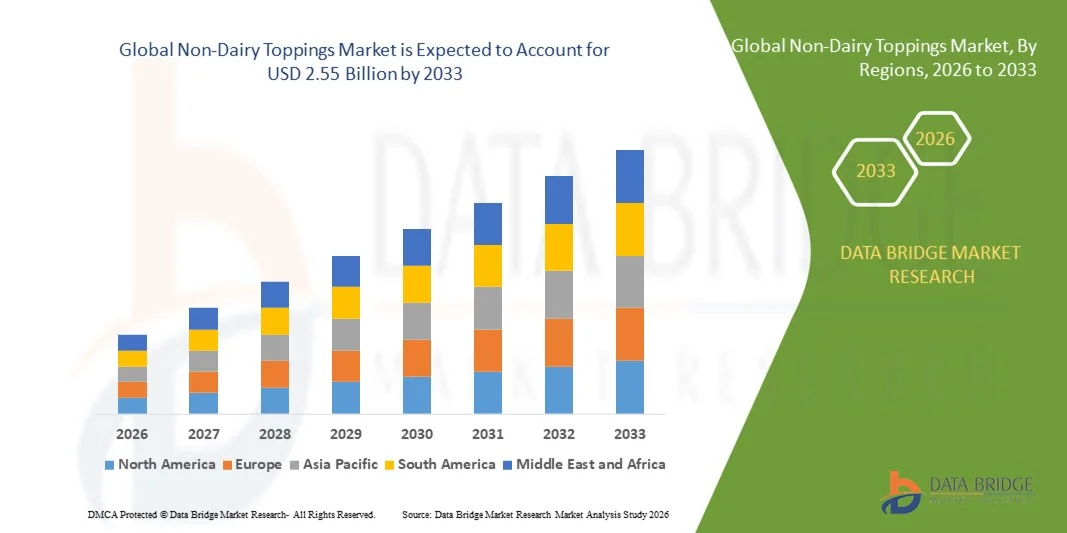
- The global Non-Dairy Toppings Market size was valued at USD 1.35 billion in 2025 and is projected to reach USD 2.55 billion by 2033, growing at a CAGR of 8.22% during the forecast period.
- The market expansion is primarily driven by the rising adoption of plant-based diets, increasing lactose intolerance awareness, and the growing popularity of vegan and health-conscious lifestyles, which are fueling demand for dairy alternatives across foodservice and retail sectors.
- Additionally, continuous innovation in flavor, texture, and formulation, along with the introduction of sustainable and clean-label ingredients, is enhancing product appeal and consumer acceptance. These factors are collectively propelling the rapid growth of the global non-dairy toppings industry.
Global Non-Dairy Toppings Market Analysis
- Non-dairy toppings, derived from plant-based sources such as soy, almond, coconut, and oats, are becoming essential ingredients in modern food and beverage applications across residential and commercial settings due to their versatility, lactose-free composition, and alignment with vegan and health-focused lifestyles.
- The surging demand for non-dairy toppings is primarily driven by the rising popularity of plant-based diets, increasing cases of lactose intolerance, and a growing preference for sustainable and cruelty-free food products among consumers worldwide.
- Europe dominated the Global Non-Dairy Toppings Market, accounting for the largest revenue share of 32.2% in 2025, supported by a strong presence of major plant-based food manufacturers, high consumer awareness of vegan products, and continuous product innovations in the U.S. and Canada across bakery, confectionery, and beverage segments.
- Asia-Pacific is expected to be the fastest-growing region in the Global Non-Dairy Toppings Market during the forecast period, driven by rapid urbanization, increasing disposable incomes, and the rising acceptance of Western-style desserts and café culture in emerging economies such as China, India, and Indonesia.
- The Whip Cream segment dominated the market with the largest revenue share of 43.2% in 2025, driven by its extensive use in bakery, confectionery, and beverage applications.
Report Scope and Global Non-Dairy Toppings Market Segmentation
|
Attributes |
Non-Dairy Toppings Key Market Insights |
|
Segments Covered |
|
|
Countries Covered |
North America
Europe
Asia-Pacific
Middle East and Africa
South America
|
|
Key Market Players |
|
|
Market Opportunities |
|
|
Value Added Data Infosets |
In addition to the insights on market scenarios such as market value, growth rate, segmentation, geographical coverage, and major players, the market reports curated by the Data Bridge Market Research also include in-depth expert analysis, pricing analysis, brand share analysis, consumer survey, demography analysis, supply chain analysis, value chain analysis, raw material/consumables overview, vendor selection criteria, PESTLE Analysis, Porter Analysis, and regulatory framework. |
Global Non-Dairy Toppings Market Trends
Product Innovation and Clean-Label Formulations Enhancing Consumer Appeal
- A significant and accelerating trend in the global Non-Dairy Toppings Market is the continuous innovation in plant-based formulations and the growing emphasis on clean-label, natural, and sustainable ingredients. Manufacturers are increasingly developing products that not only replicate the texture and taste of dairy toppings but also align with consumer preferences for healthier and eco-friendly alternatives.
- For instance, Rich Products Corporation and Upfield Holdings have introduced plant-based whipped toppings made from oat, coconut, and soy, offering enhanced stability, improved flavor, and cleaner ingredient profiles without artificial additives. Similarly, Kerry Group has focused on developing non-dairy toppings with reduced sugar and trans-fat content, catering to the expanding health-conscious demographic.
- The integration of food technology and ingredient innovation enables manufacturers to improve texture, mouthfeel, and aeration properties in non-dairy toppings, making them nearly indistinguishable from traditional dairy-based versions. Advanced processing techniques, such as enzymatic modification and emulsification technology, are also enhancing product performance in bakery and beverage applications.
- Furthermore, the rising demand for vegan certification and allergen-free labeling is driving companies to reformulate products with natural stabilizers, plant proteins, and sustainable oils, thereby strengthening their position among ethically and health-driven consumers.
- This growing trend toward clean-label, functional, and innovative formulations is reshaping the competitive landscape of the non-dairy toppings industry. Key players are investing heavily in R&D, flavor diversification, and packaging innovations to meet the evolving expectations of modern consumers and foodservice operators.
- As a result, the demand for non-dairy toppings that combine superior taste, texture, and nutritional benefits is expanding rapidly across both retail and commercial segments, positioning innovation and clean-label transparency as core drivers of market growth.
Global Non-Dairy Toppings Market Dynamics
Driver
Growing Demand Driven by Health Awareness and Plant-Based Lifestyle Adoption
- The increasing consumer shift toward healthier, sustainable, and plant-based diets, coupled with rising awareness of lactose intolerance and dairy allergies, is a major driver fueling the global Non-Dairy Toppings Market.
- For instance, in April 2025, Upfield Holdings launched an innovative oat-based whipped topping under its Violife brand, designed to cater to vegan consumers seeking cleaner, dairy-free dessert options. Similarly, Rich Products Corporation expanded its range of plant-based whipping creams tailored for both retail and foodservice sectors, emphasizing natural ingredients and improved texture.
- As consumers increasingly prioritize nutritional value, ethical sourcing, and environmental sustainability, non-dairy toppings are emerging as preferred alternatives to traditional dairy toppings across bakeries, cafés, and quick-service restaurants. These products not only align with health-conscious eating habits but also address growing concerns about animal welfare and carbon footprint reduction.
- Furthermore, the rise of plant-based innovations in the broader food industry—spanning ice creams, beverages, and desserts—is reinforcing the role of non-dairy toppings as an essential complementary category. Manufacturers are introducing toppings with enhanced flavor profiles, improved aeration, and extended shelf life, driving adoption across global markets.
- The convenience of ready-to-use, long-lasting non-dairy toppings and their compatibility with various recipes are key factors supporting their widespread use in both household and commercial applications. The trend toward vegan cafés, functional foods, and plant-forward bakery products continues to accelerate market growth worldwide.
Restraint/Challenge
High Production Costs and Limited Availability of Raw Materials
- The relatively high production costs associated with non-dairy toppings, primarily due to the expensive sourcing and processing of plant-based ingredients, pose a significant restraint on market expansion. Ingredients such as almond, coconut, and oat extracts often require advanced processing to achieve the desired texture and flavor, increasing overall manufacturing expenses.
- For instance, fluctuations in raw material prices—such as coconut oil and soy protein—can significantly impact production margins, especially for manufacturers operating in emerging economies with limited local supply chains.
- Another major challenge lies in the limited availability and inconsistent quality of plant-based ingredients in certain regions, which affects both production scalability and product standardization. This issue is particularly evident in markets with underdeveloped cold-chain infrastructure or restricted access to specialized ingredients.
- To overcome these challenges, leading companies are investing in supply chain optimization, sustainable sourcing partnerships, and localized ingredient production. Additionally, advances in food technology and formulation techniques are helping manufacturers reduce costs while maintaining quality and performance.
- While the cost gap between dairy and non-dairy toppings is gradually narrowing, price sensitivity among consumers in developing regions remains a challenge. Expanding affordability through economies of scale, strategic pricing, and product diversification will be crucial to ensuring sustained market growth in the years ahead.
Global Non-Dairy Toppings Market Scope
The non-dairy toppings market is segmented on the basis of type, form, base ingredient, application and distribution channel.
- By Type
On the basis of type, the Global Non-Dairy Toppings Market is segmented into Whip Cream, Pouring Cream, Spooning, and Others. The Whip Cream segment dominated the market with the largest revenue share of 43.2% in 2025, driven by its extensive use in bakery, confectionery, and beverage applications. Whip cream is widely favored for its light texture, creamy consistency, and versatility in both hot and cold preparations, making it a staple in desserts and coffee toppings. The growing popularity of plant-based whipped toppings, especially in Western markets, further contributes to its dominance.
The Pouring Cream segment is expected to witness the fastest CAGR from 2026 to 2033, fueled by increasing usage in culinary sauces, dessert bases, and ready-to-eat meals. Its ease of application, smooth texture, and compatibility with vegan recipes make it an emerging favorite among both home consumers and professional chefs globally.
- By Form
On the basis of form, the Global Non-Dairy Toppings Market is segmented into Liquid, Powder, and Frozen. The Liquid segment held the largest market share of 46.5% in 2025, attributed to its easy usability, natural taste, and wide applicability across bakery, beverage, and dessert formulations. Liquid non-dairy toppings are preferred by manufacturers and consumers for their ready-to-use nature and consistent performance in various foodservice operations.
The Powder segment is projected to register the fastest growth rate during 2026–2033, owing to its long shelf life, cost efficiency, and convenience in storage and transport. Powdered non-dairy toppings are gaining traction in industrial food production and instant beverage mixes, where reconstitution flexibility and stability are key advantages, especially in developing regions.
- By Base Ingredient
On the basis of base ingredient, the Global Non-Dairy Toppings Market is categorized into Soy Milk, Vegetable Oil, Almond Milk, Coconut Milk, and Others. The Soy Milk segment dominated the market with the largest share of 38.9% in 2025, driven by its high protein content, creamy texture, and affordability compared to other plant-based alternatives. Soy-based toppings have established a strong presence in bakeries and confectioneries, particularly in Asia-Pacific and North America.
The Coconut Milk segment is anticipated to grow at the fastest CAGR from 2026 to 2033, propelled by the rising popularity of tropical flavors and its perception as a natural, allergen-free, and sustainable ingredient. Coconut-based toppings are increasingly being adopted in vegan desserts, beverages, and ice creams, appealing to consumers seeking indulgence with health benefits.
- By Application
On the basis of application, the Global Non-Dairy Toppings Market is segmented into Bakery, Confectionery, Processed Fruits, Frozen Desserts, Beverages, and Others. The Bakery segment held the largest market share of 41.7% in 2025, owing to the growing demand for vegan pastries, cakes, and muffins using dairy-free alternatives. The versatility of non-dairy toppings in frosting, glazing, and filling applications makes them indispensable in modern bakery products.
The Frozen Desserts segment is expected to exhibit the fastest CAGR during 2026–2033, supported by the global rise in plant-based ice creams and frozen treats. Manufacturers are launching innovative non-dairy frozen toppings to cater to the expanding consumer base seeking healthy indulgence without compromising taste or texture.
- By Distribution Channel
on the basis of distribution channel, the Global Non-Dairy Toppings Market is segmented into Specialty Food Stores, E-Commerce, Modern Stores, and Others. The Modern Stores segment dominated the market with the largest share of 44.5% in 2025, supported by the wide availability of branded plant-based products, attractive packaging, and strong in-store promotions. Supermarkets and hypermarkets remain key retail outlets for non-dairy toppings due to their convenience and product variety.
The E-Commerce segment is projected to record the fastest CAGR from 2026 to 2033, driven by rising digitalization, improved logistics, and the popularity of online grocery shopping. The convenience of doorstep delivery and the ability to compare diverse plant-based options online are accelerating the growth of online sales for non-dairy toppings globally.
Global Non-Dairy Toppings Market Regional Analysis
- Europe dominated the Global Non-Dairy Toppings Market with the largest revenue share of 32.2% in 2025, driven by the rising popularity of plant-based diets, increasing awareness of lactose intolerance, and strong consumer demand for healthier and sustainable food alternatives.
- Consumers in the region highly value the taste, texture, and nutritional benefits of non-dairy toppings, along with the growing variety of vegan and clean-label options available across bakery, confectionery, and beverage applications.
- This widespread adoption is further supported by high disposable incomes, a well-established food processing industry, and the presence of leading plant-based product manufacturers. The growing preference for vegan desserts and dairy-free beverages across the U.S. and Canada continues to position North America as a key market for non-dairy topping innovations in both retail and foodservice sectors.
U.S. Non-Dairy Toppings Market Insight
The U.S. non-dairy toppings market captured the largest revenue share of 81% in 2025 within North America, fueled by the rapid adoption of plant-based diets and growing demand for vegan bakery and dessert products. Consumers are increasingly prioritizing health, sustainability, and lactose-free alternatives, driving strong demand across foodservice and retail channels. The rise of vegan cafés, specialty bakeries, and plant-based beverage chains further supports market growth. Moreover, innovations in flavor, texture, and clean-label formulations by key players such as Rich Products Corporation and Upfield Holdings are enhancing product appeal. The integration of non-dairy toppings in ready-to-eat and convenience foods continues to expand the market’s footprint across the U.S.
Europe Non-Dairy Toppings Market Insight
The Europe non-dairy toppings market is projected to grow at a substantial CAGR during the forecast period, driven by strict food regulations, rising consumer health awareness, and the growing adoption of vegan and flexitarian diets. The increasing demand for sustainable and cruelty-free products, coupled with innovations in plant-based dairy substitutes, is boosting market expansion across the region. European consumers are particularly drawn to products with natural ingredients, reduced sugar, and no artificial additives. Additionally, the popularity of vegan bakeries, confectionery products, and café beverages continues to foster growth across both Western and Eastern Europe.
U.K. Non-Dairy Toppings Market Insight
The U.K. non-dairy toppings market is anticipated to grow at a noteworthy CAGR during the forecast period, supported by the country’s strong vegan movement and rising preference for sustainable, plant-based desserts. Growing consumer concerns about animal welfare and lactose intolerance are driving the shift toward non-dairy whipping creams and pouring toppings. The U.K.’s robust retail infrastructure and widespread availability of plant-based product lines in supermarkets and cafés are further accelerating adoption. Additionally, product innovation by local brands emphasizing organic and allergen-free formulations is contributing to continued market expansion.
Germany Non-Dairy Toppings Market Insight
The Germany non-dairy toppings market is expected to expand at a considerable CAGR throughout the forecast period, driven by growing awareness of health and sustainability, coupled with high demand for premium plant-based products. Germany’s advanced food manufacturing sector and its focus on innovation and eco-friendly production promote the adoption of non-dairy toppings in bakery, confectionery, and beverage applications. Consumers in Germany show strong interest in organic, clean-label, and ethically sourced ingredients, aligning with the nation’s sustainability priorities. The integration of non-dairy toppings in both retail and commercial foodservice sectors continues to propel market growth.
Asia-Pacific Non-Dairy Toppings Market Insight
The Asia-Pacific non-dairy toppings market is poised to record the fastest CAGR of 24% from 2026 to 2033, driven by rising disposable incomes, urbanization, and the growing trend of plant-based eating in countries such as China, Japan, and India. Increasing Western influence on dessert culture and expanding vegan product availability are key growth catalysts. Government initiatives promoting healthier and sustainable diets are also supporting adoption. Furthermore, as APAC evolves into a production hub for plant-based ingredients and food products, the affordability and accessibility of non-dairy toppings are expanding rapidly, reaching a broader consumer base.
Japan Non-Dairy Toppings Market Insight
The Japan non-dairy toppings market is gaining traction due to the country’s technological innovation in food processing and growing consumer interest in healthy, dairy-free lifestyles. Japanese consumers emphasize quality, flavor, and convenience, driving demand for non-dairy whipped toppings and dessert creams in both home and commercial use. The integration of non-dairy toppings into bakery, café, and beverage applications is expanding rapidly. Moreover, Japan’s aging population is fostering demand for easily digestible, lactose-free food options, further supporting market growth across both retail and foodservice sectors.
China Non-Dairy Toppings Market Insight
The China non-dairy toppings market accounted for the largest revenue share in the Asia-Pacific region in 2025, driven by rising middle-class income, rapid urbanization, and increased awareness of plant-based nutrition. China is emerging as one of the largest consumers of plant-based food products, with non-dairy toppings gaining popularity across cafés, bakeries, and quick-service restaurants. The country’s strong domestic manufacturing base and growing focus on sustainable food innovation have accelerated market development. Additionally, government support for environmentally friendly food technologies and expanding e-commerce channels are enabling widespread availability of non-dairy toppings across urban and semi-urban regions.
Global Non-Dairy Toppings Market Share
The Non-Dairy Toppings industry is primarily led by well-established companies, including:
• Rich Products Corporation (U.S.)
• Upfield Holdings (Netherlands)
• Conagra Brands, Inc. (U.S.)
• Kerry Group plc (Ireland)
• FrieslandCampina Kievit B.V. (Netherlands)
• Elmhurst 1925 (U.S.)
• Tate & Lyle PLC (U.K.)
• Danone S.A. (France)
• Soy Delicious (U.S.)
• Alpro (Belgium)
• Oatly AB (Sweden)
• Blue Diamond Growers (U.S.)
• Hain Celestial Group (U.S.)
• Imagine Foods (U.S.)
• Nestlé S.A. (Switzerland)
• Bellamy’s Organic (Australia)
• So Delicious Dairy Free (U.S.)
• Better Than Milk (U.S.)
• Biona Organic (Germany)
• Earth’s Own (Canada)
What are the Recent Developments in Global Non-Dairy Toppings Market?
- In April 2023, Rich Products Corporation, a global leader in plant-based food solutions, launched a new line of oat-based whipped toppings in the European market, aimed at expanding its non-dairy product portfolio for bakery and café applications. This initiative reflects the company’s commitment to innovation in plant-based formulations and to meeting the rising consumer demand for healthier, lactose-free dessert alternatives. By leveraging its global R&D capabilities, Rich Products continues to strengthen its presence in the rapidly growing Global Non-Dairy Toppings Market.
- In March 2023, Upfield Holdings, under its popular Violife brand, introduced a next-generation coconut-based pouring cream across North America. Specifically designed for use in desserts, sauces, and beverages, this product features improved texture, natural ingredients, and clean-label formulations. The launch underscores Upfield’s dedication to sustainability and plant-based innovation, while addressing the surging demand for dairy-free, allergen-friendly toppings among health-conscious consumers.
- In March 2023, Kerry Group plc expanded its non-dairy toppings production facility in India, aiming to enhance regional supply capabilities and support the increasing demand for vegan bakery and confectionery ingredients across the Asia-Pacific region. The expansion integrates advanced processing technologies to improve product consistency and shelf life, reinforcing Kerry Group’s strategic focus on local production, food innovation, and sustainable growth within the plant-based sector.
- In February 2023, FrieslandCampina Kievit B.V., a key player in the food ingredients industry, announced a strategic partnership with a leading Asian beverage manufacturer to develop customized powdered non-dairy topping solutions for coffee and tea applications. This collaboration aims to deliver creamy, stable, and flavorful topping options suited to regional taste preferences, strengthening FrieslandCampina’s position in the fast-growing foodservice and beverage topping segments.
- In January 2023, Conagra Brands, Inc. unveiled its new line of frozen non-dairy dessert toppings under the Reddi-wip brand at the Winter Fancy Food Show 2023 in the U.S. These innovative products, made from almond and coconut bases, are formulated to provide a rich, creamy taste with reduced environmental impact. The launch highlights Conagra’s focus on expanding its vegan product portfolio, combining taste, convenience, and sustainability to meet evolving consumer preferences in the global non-dairy toppings market.

- Interactive Data Analysis Dashboard
- Company Analysis Dashboard for high growth potential opportunities
- Research Analyst Access for customization & queries
- Competitor Analysis with Interactive dashboard
- Latest News, Updates & Trend analysis
- Harness the Power of Benchmark Analysis for Comprehensive Competitor Tracking
Global Non Dairy Toppings Market, Supply Chain Analysis and Ecosystem Framework
To support market growth and help clients navigate the impact of geopolitical shifts, DBMR has integrated in-depth supply chain analysis into its Global Non Dairy Toppings Market research reports. This addition empowers clients to respond effectively to global changes affecting their industries. The supply chain analysis section includes detailed insights such as Global Non Dairy Toppings Market consumption and production by country, price trend analysis, the impact of tariffs and geopolitical developments, and import and export trends by country and HSN code. It also highlights major suppliers with data on production capacity and company profiles, as well as key importers and exporters. In addition to research, DBMR offers specialized supply chain consulting services backed by over a decade of experience, providing solutions like supplier discovery, supplier risk assessment, price trend analysis, impact evaluation of inflation and trade route changes, and comprehensive market trend analysis.
Data collection and base year analysis are done using data collection modules with large sample sizes. The stage includes obtaining market information or related data through various sources and strategies. It includes examining and planning all the data acquired from the past in advance. It likewise envelops the examination of information inconsistencies seen across different information sources. The market data is analysed and estimated using market statistical and coherent models. Also, market share analysis and key trend analysis are the major success factors in the market report. To know more, please request an analyst call or drop down your inquiry.
The key research methodology used by DBMR research team is data triangulation which involves data mining, analysis of the impact of data variables on the market and primary (industry expert) validation. Data models include Vendor Positioning Grid, Market Time Line Analysis, Market Overview and Guide, Company Positioning Grid, Patent Analysis, Pricing Analysis, Company Market Share Analysis, Standards of Measurement, Global versus Regional and Vendor Share Analysis. To know more about the research methodology, drop in an inquiry to speak to our industry experts.
Data Bridge Market Research is a leader in advanced formative research. We take pride in servicing our existing and new customers with data and analysis that match and suits their goal. The report can be customized to include price trend analysis of target brands understanding the market for additional countries (ask for the list of countries), clinical trial results data, literature review, refurbished market and product base analysis. Market analysis of target competitors can be analyzed from technology-based analysis to market portfolio strategies. We can add as many competitors that you require data about in the format and data style you are looking for. Our team of analysts can also provide you data in crude raw excel files pivot tables (Fact book) or can assist you in creating presentations from the data sets available in the report.













