


Non Networked Sound Masking System Market Size
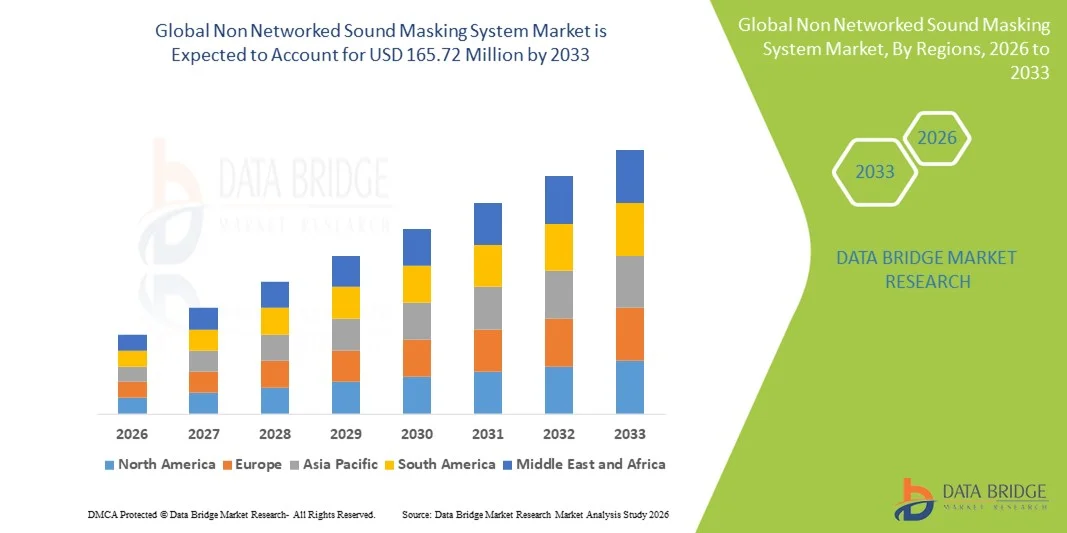
- The global non networked sound masking system market size was valued at USD 120.16 million in 2025 and is expected to reach USD 165.72 million by 2033, at a CAGR of 4.10% during the forecast period
- The market growth is largely fuelled by the rising adoption of open office layouts and the increasing need for privacy in commercial spaces
- Growing awareness of acoustic comfort and employee productivity is driving investments in sound masking solutions across corporate offices, healthcare facilities, and educational institutions
Non Networked Sound Masking System Market Analysis
- The market is witnessing steady growth due to the preference for standalone, plug-and-play sound masking systems that require minimal maintenance and technical support
- Increasing emphasis on improving workplace environment quality and adherence to acoustic standards in commercial buildings is further supporting market expansion
- North America dominated the non networked sound masking system market with the largest revenue share in 2025, driven by increasing awareness of acoustic privacy and growing adoption of workplace wellness initiatives. Businesses and institutions are investing in sound masking solutions to enhance employee focus, reduce distractions, and create more productive environments
- Asia-Pacific region is expected to witness the highest growth rate in the global non networked sound masking system market, driven by rising commercial infrastructure development, adoption of modern office layouts, and government initiatives promoting workplace wellness and productivity
- The Conventional segment held the largest market revenue share in 2025, driven by its proven performance, reliability, and ease of integration into a variety of office and commercial spaces. Conventional systems are widely deployed across workplaces, educational institutions, and healthcare facilities to provide consistent acoustic privacy and reduce distractions
Report Scope and Non Networked Sound Masking System Market Segmentation
|
Attributes |
Non Networked Sound Masking System Key Market Insights |
|
Segments Covered |
|
|
Countries Covered |
North America
Europe
Asia-Pacific
Middle East and Africa
South America
|
|
Key Market Players |
|
|
Market Opportunities |
|
|
Value Added Data Infosets |
In addition to the market insights such as market value, growth rate, market segments, geographical coverage, market players, and market scenario, the market report curated by the Data Bridge Market Research team includes in-depth expert analysis, import/export analysis, pricing analysis, production consumption analysis, and pestle analysis. |
Non Networked Sound Masking System Market Trends
Rising Adoption of Sound Masking Solutions in Commercial and Office Spaces
- The growing emphasis on acoustic privacy in open office layouts is driving the adoption of non networked sound masking systems. These systems help reduce distractions, improve employee concentration, and enhance overall workplace productivity, making them a preferred solution for modern office environments. In addition, companies are realizing that better acoustics contribute to employee wellness and reduce stress-related absenteeism, which further encourages investment in sound masking technologies
- Increasing demand for affordable and easy-to-install sound masking solutions is accelerating adoption in small and mid-sized commercial spaces. These systems provide localized noise control without the need for complex networked infrastructure, making them ideal for cost-conscious organizations. Furthermore, businesses appreciate that these systems can be quickly scaled or relocated to adapt to changing office layouts or expansions
- The simplicity and reliability of non networked systems make them attractive for retrofit applications in existing office buildings. Facility managers benefit from quick deployment, minimal maintenance, and improved acoustic comfort without extensive renovations. Non networked solutions are also compatible with a wide variety of building architectures and HVAC systems, increasing their appeal for older or diverse office spaces
- For instance, in 2023, several co-working spaces across Europe reported enhanced employee satisfaction and reduced noise complaints after installing non networked sound masking units in shared work areas. Surveys showed measurable improvements in focus and collaboration, demonstrating tangible workplace productivity gains, which is expected to drive further adoption in similar commercial environments
- While adoption is growing, the market’s expansion depends on continuous product innovation, customization for diverse environments, and awareness of acoustic health benefits. Manufacturers must focus on compact, efficient, and scalable solutions to fully capitalize on this trend, while also offering training and support for proper installation and system optimization
Non Networked Sound Masking System Market Dynamics
Driver
Growing Demand for Acoustic Privacy and Employee Productivity in Open Offices
- The increasing prevalence of open office layouts is pushing organizations to implement sound masking systems as a key solution for maintaining acoustic privacy. Noise reduction helps minimize distractions, improve focus, and enhance collaboration, boosting overall productivity. The rising adoption of hybrid work models and flexible office spaces is further increasing the demand for adaptable acoustic solutions
- Businesses are increasingly aware of the direct link between workplace acoustics and employee performance. The desire to create comfortable and distraction-free environments is driving the routine deployment of non networked systems in corporate offices, educational institutions, and healthcare facilities. Moreover, companies are incorporating sound masking into wellness programs to promote mental well-being and employee satisfaction
- Government regulations and corporate wellness programs emphasizing employee health are further supporting market growth. Organizations are incentivized to implement solutions that improve environmental quality and reduce noise-induced stress. In addition, certification standards such as WELL and LEED encourage the use of acoustic improvement technologies, indirectly boosting market demand
- For instance, in 2022, several multinational corporations in North America introduced acoustic improvement initiatives, leading to increased installation of non networked sound masking systems across office campuses. These deployments not only enhanced productivity but also demonstrated measurable improvements in employee engagement and retention, reinforcing the market’s growth potential
- While demand is increasing, optimizing system placement, educating facility managers, and ensuring cost-effective deployment remain essential to sustain market growth. Manufacturers and service providers must offer robust support, design flexibility, and post-installation monitoring to maximize effectiveness and client satisfaction
Restraint/Challenge
High Initial Installation Costs and Limited Awareness Among Small Enterprises
- The upfront cost of high-quality non networked sound masking systems can be a barrier for small and medium-sized businesses, limiting widespread adoption. Organizations with tight budgets often prioritize other office upgrades over acoustic solutions. Cost-conscious buyers may also delay investment despite recognizing the long-term productivity and wellness benefits
- Many small enterprises and facilities lack awareness of the benefits of sound masking, leading to underutilization of available solutions. The absence of proper acoustic planning can result in ineffective implementation and reduced impact on employee comfort. Education and training programs are needed to help small businesses understand both technical requirements and potential ROI
- Market penetration is also restricted by the need for technical expertise in installation and calibration. Improper setup can reduce system efficiency, limiting noise reduction and user satisfaction, particularly in irregularly shaped or multi-zone office spaces. This complexity can discourage small facilities from adopting sound masking solutions unless supported by professional services
- For instance, in 2023, surveys in Asia-Pacific revealed that over 60% of small offices had no access to formal sound masking solutions due to cost concerns and lack of knowledge about acoustic management. This gap highlights an untapped market segment that could drive growth if affordability and awareness are addressed
- While technology continues to advance, addressing cost, awareness, and installation challenges remains critical. Stakeholders must focus on user-friendly, affordable, and scalable products to unlock the long-term potential of the non networked sound masking system market. Additional innovations such as modular designs, wireless deployment options, and DIY-friendly systems could further expand market adoption
Non Networked Sound Masking System Market Scope
The market is segmented on the basis of product, application, masking used, quiet technology, and machine type
- By Product
On the basis of product, the non networked sound masking system market is segmented into Conventional and Unconventional. The Conventional segment held the largest market revenue share in 2025, driven by its proven performance, reliability, and ease of integration into a variety of office and commercial spaces. Conventional systems are widely deployed across workplaces, educational institutions, and healthcare facilities to provide consistent acoustic privacy and reduce distractions.
The Unconventional segment is expected to witness the fastest growth rate from 2026 to 2033, driven by innovative designs, compact form factors, and adaptability to irregular layouts. Unconventional systems are gaining traction in modern co-working spaces, hotels, and retrofit applications where aesthetic integration and flexible deployment are critical, offering efficient noise control without extensive structural modifications.
- By Application
On the basis of application, the market is segmented into Hospitals and Healthcare, Hotels, Offices, Education, Home, Banks, Pharmacies, Waiting Rooms, Reception Areas, Public Hallways, and Others. The Offices segment held the largest share in 2025, owing to the growing need for acoustic privacy in open-plan layouts and enhanced employee productivity. Offices continue to implement sound masking solutions as part of workplace wellness and operational efficiency initiatives.
The Hospitals and Healthcare segment is expected to witness the fastest growth from 2026 to 2033, driven by increased awareness of patient comfort, stress reduction, and confidentiality requirements. Healthcare facilities are adopting non networked systems to minimize noise-related disturbances in patient rooms, waiting areas, and corridors, improving overall care quality and operational environment.
- By Masking Used
On the basis of masking used, the market is segmented into Frequency Masking and Temporal Masking. The Frequency Masking segment held the largest revenue share in 2025, attributed to its ability to provide uniform sound coverage across a variety of spaces and its compatibility with standard architectural layouts. Frequency masking helps maintain consistent acoustic levels and reduces the perception of unwanted noise.
The Temporal Masking segment is expected to witness the fastest growth rate from 2026 to 2033, fueled by its advanced noise modulation capabilities and suitability for dynamic environments. Temporal masking is increasingly adopted in educational institutions, hotels, and high-traffic commercial areas, where variable noise patterns require adaptive acoustic control.
- By Quiet Technology
On the basis of quiet technology, the market is segmented into QT 100, QT 200, and QT 600. The QT 200 segment held the largest share in 2025, driven by its balance of performance, coverage, and affordability. It is commonly deployed across offices, hotels, and healthcare facilities, providing effective noise reduction without requiring complex installation procedures.
The QT 600 segment is expected to witness the fastest growth from 2026 to 2033, driven by its enhanced acoustic range, energy efficiency, and integration with smart facility management systems. QT 600 systems are preferred for large-scale commercial buildings and modern co-working spaces, offering superior sound masking with minimal maintenance.
- By Machine Type
On the basis of machine type, the market is segmented into Automatic and Regular. The Regular segment held the largest revenue share in 2025, due to its simplicity, reliability, and widespread adoption in standard commercial and office environments. Regular machines are favored for their cost-effectiveness, ease of operation, and minimal technical requirements.
The Automatic segment is expected to witness the fastest growth rate from 2026 to 2033, driven by automation capabilities, adaptive sound control, and integration with intelligent building systems. Automatic machines are increasingly preferred in technologically advanced offices, healthcare facilities, and public spaces, offering real-time acoustic adjustments and improved operational efficiency.
Non Networked Sound Masking System Market Regional Analysis
- North America dominated the non networked sound masking system market with the largest revenue share in 2025, driven by increasing awareness of acoustic privacy and growing adoption of workplace wellness initiatives. Businesses and institutions are investing in sound masking solutions to enhance employee focus, reduce distractions, and create more productive environments
- Consumers and facility managers in the region highly value the ease of installation, low maintenance requirements, and immediate effectiveness offered by non networked sound masking systems. The technology is increasingly integrated into offices, healthcare facilities, and educational institutions to improve environmental comfort
- This widespread adoption is further supported by the presence of large commercial spaces, high disposable incomes, and corporate initiatives emphasizing employee well-being, establishing sound masking systems as a preferred solution for improving acoustic privacy
U.S. Non Networked Sound Masking System Market Insight
The U.S. market captured the largest revenue share in 2025 within North America, fueled by the increasing prevalence of open-plan offices and government regulations promoting workplace wellness. Organizations are prioritizing acoustic comfort to boost employee productivity, reduce stress, and enhance collaboration. The adoption of non networked systems is also supported by facility managers seeking cost-effective, scalable, and easy-to-deploy solutions without the complexity of networked infrastructures.
Europe Non Networked Sound Masking System Market Insight
The Europe market is expected to witness the fastest growth rate from 2026 to 2033, driven by strict occupational health and safety regulations and rising demand for noise reduction in corporate, educational, and healthcare environments. European businesses are increasingly focused on sustainable, low-energy, and low-maintenance solutions, while architectural trends favoring open layouts are encouraging the integration of sound masking systems.
U.K. Non Networked Sound Masking System Market Insight
The U.K. market is projected to experience rapid growth from 2026 to 2033 due to heightened awareness of acoustic health and workplace productivity benefits. The adoption is fueled by the rise of co-working spaces, commercial office renovations, and the preference for simple, reliable solutions that do not require extensive networked infrastructure. The strong presence of facility management companies further supports widespread deployment.
Germany Non Networked Sound Masking System Market Insight
Germany is expected to witness significant market growth from 2026 to 2033, supported by government initiatives promoting employee wellness and noise reduction in offices. The well-developed corporate infrastructure, coupled with increasing focus on open-plan office designs, encourages adoption of sound masking systems. Companies are leveraging these systems to maintain privacy, enhance comfort, and comply with workplace regulations.
Asia-Pacific Non Networked Sound Masking System Market Insight
The Asia-Pacific market is projected to witness the fastest growth rate from 2026 to 2033, driven by rapid urbanization, growing commercial and office space developments, and rising awareness of acoustic health. Countries such as China, Japan, and India are seeing increased implementation of sound masking systems in offices, hospitals, and educational institutions. The availability of cost-effective solutions, combined with regional government support for healthy workplace environments, is accelerating market expansion.
Japan Non Networked Sound Masking System Market Insight
The Japan market is expected to grow rapidly from 2026 to 2033, supported by the country’s emphasis on workplace efficiency, technological innovation, and open-office adoption. Japanese businesses are increasingly installing non networked sound masking systems to improve employee concentration, reduce noise complaints, and enhance overall comfort in commercial and healthcare environments.
China Non Networked Sound Masking System Market Insight
China accounted for the largest revenue share in Asia-Pacific in 2025, driven by the expanding commercial office sector, rising disposable incomes, and rapid urbanization. Organizations are adopting cost-effective non networked sound masking systems to improve acoustic privacy, productivity, and employee satisfaction. The push toward modern office environments and smart building integrations is further propelling market growth in the country.
Non Networked Sound Masking System Market Share
The Non Networked Sound Masking System industry is primarily led by well-established companies, including:
- Biamp Systems (U.S.)
- K.R. Moeller Associates Ltd. (U.K.)
- Lencore (U.S.)
- AtlasIED (U.S.)
- Soft dB (U.S.)
- Oeler Industries, Inc. (U.S.)
- PRO ACOUSTICS LLC (U.S.)
- AET GB Limited (U.K.)
- Jade Communications (U.S.)
- Pro Circuit, Inc. (U.S.)
- Dukane AV (U.S.)
- Lowell Manufacturing (U.S.)
- Sound of Silence (U.S.)
- Soundmask Global Pty Ltd. (Australia)
- American Sound Masking, LLC (U.S.)
- Florida Sound Masking, Inc. (U.S.)
- General Sound (U.S.)
- Bizco Technologies (U.S.)
- RMON Networks, Inc. (U.S.)
- Sound Management Group (U.S.)
- Herman Miller, Inc. (U.S.)

- Interactive Data Analysis Dashboard
- Company Analysis Dashboard for high growth potential opportunities
- Research Analyst Access for customization & queries
- Competitor Analysis with Interactive dashboard
- Latest News, Updates & Trend analysis
- Harness the Power of Benchmark Analysis for Comprehensive Competitor Tracking
Data collection and base year analysis are done using data collection modules with large sample sizes. The stage includes obtaining market information or related data through various sources and strategies. It includes examining and planning all the data acquired from the past in advance. It likewise envelops the examination of information inconsistencies seen across different information sources. The market data is analysed and estimated using market statistical and coherent models. Also, market share analysis and key trend analysis are the major success factors in the market report. To know more, please request an analyst call or drop down your inquiry.
The key research methodology used by DBMR research team is data triangulation which involves data mining, analysis of the impact of data variables on the market and primary (industry expert) validation. Data models include Vendor Positioning Grid, Market Time Line Analysis, Market Overview and Guide, Company Positioning Grid, Patent Analysis, Pricing Analysis, Company Market Share Analysis, Standards of Measurement, Global versus Regional and Vendor Share Analysis. To know more about the research methodology, drop in an inquiry to speak to our industry experts.
Data Bridge Market Research is a leader in advanced formative research. We take pride in servicing our existing and new customers with data and analysis that match and suits their goal. The report can be customized to include price trend analysis of target brands understanding the market for additional countries (ask for the list of countries), clinical trial results data, literature review, refurbished market and product base analysis. Market analysis of target competitors can be analyzed from technology-based analysis to market portfolio strategies. We can add as many competitors that you require data about in the format and data style you are looking for. Our team of analysts can also provide you data in crude raw excel files pivot tables (Fact book) or can assist you in creating presentations from the data sets available in the report.













