


What is the Non-VKA Oral Anticoagulants (NOACs) Market Size and Overview?
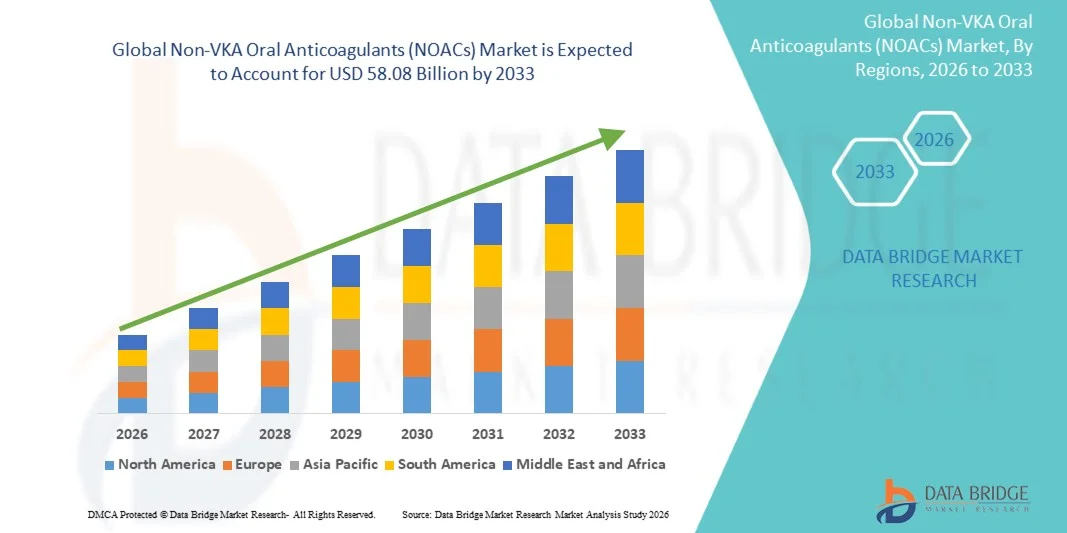
As per Data Bridge Market Research analysis, the global non-VKA oral anticoagulants (NOACs) market was valued at USD 38.42 Billion in 2025 and is projected to reach USD 58.08 Billion by 2033, growing at a CAGR of 5.30% from 2026 to 2033. Growth is being driven by the rising global burden of atrial fibrillation and venous thromboembolism, a continued clinical shift away from warfarin, and the convenience of fixed-dose oral regimens that do not require routine coagulation monitoring.
NOACs, including apixaban, rivaroxaban, dabigatran, and edoxaban, have become the preferred anticoagulation therapy across most developed markets due to their predictable pharmacokinetics, lower risk of intracranial bleeding relative to warfarin, and reduced need for dietary restriction or dose titration. At the same time, the market is entering a transitional phase as key branded molecules approach patent expiry, opening the door to generic competition that is expected to reshape pricing dynamics and expand patient access over the forecast period.
Key Market Trends & Insights
- North America dominated the global NOACs market with the largest revenue share of 41.20% in 2025, supported by high atrial fibrillation diagnosis rates, strong payer coverage, and rapid physician adoption of DOACs over warfarin.
- The apixaban segment led the market with a 36.80% share in 2025, driven by its favorable bleeding-risk profile, strong clinical trial evidence, and broad use across stroke prevention and venous thromboembolism indications.
- Asia-Pacific is expected to be the fastest-growing region at a CAGR of 6.60% from 2026 to 2033, fueled by rising cardiovascular disease prevalence, expanding healthcare access, and growing physician preference for DOACs over conventional anticoagulants in China, India, and Japan.
- The direct factor Xa Inhibitors segment dominates the mechanism-of-action category with a 68.50% share in 2025, reflecting the widespread clinical preference for apixaban, rivaroxaban, and edoxaban over direct thrombin inhibitors.
- The atrial fibrillation (Stroke Prevention) segment accounts for the largest indication share at 52.30% in 2025, owing to the high global prevalence of non-valvular atrial fibrillation and established treatment guidelines favoring NOACs as first-line therapy.
- The first U.S. generic versions of rivaroxaban and apixaban received regulatory clearance in 2025, marking the beginning of a broader patent-cliff cycle expected to reshape competitive dynamics through 2028.
- The retail pharmacies distribution channel holds the largest share at 47.10% in 2025, while Online Pharmacies is the fastest-growing channel, registering a projected CAGR of 7.20% through 2033.
Market Size & Forecast
- Global Market Value (2025): USD 38.42 Billion
- Expected Market Value (2033): USD 58.08 Billion
- Forecast CAGR (2026–2033): 5.30%
- Leading Region in 2025: North America
- Fastest Growing Region: Asia-Pacific
Report Scope and Non-VKA Oral Anticoagulants (NOACs) Market Segmentation
|
Attributes |
Non-VKA Oral Anticoagulants (NOACs) Key Market Insights |
|
Segments Covered |
|
|
Countries Covered |
North America
Europe
Asia-Pacific
Middle East and Africa
South America
Rest of South America |
|
Key Market Players |
|
|
Market Opportunities |
|
|
Value Added Data Infosets |
In addition to the insights on market scenarios such as market value, growth rate, segmentation, geographical coverage, and major players, the market reports curated by the Data Bridge Market Research also include in-depth expert analysis, geographically represented company-wise production and capacity, network layouts of distributors and partners, detailed and updated price trend analysis and deficit analysis of supply chain and demand. |
What is the Key Trend in the Non-VKA Oral Anticoagulants (NOACs) Market?
Trend: Onset of the Patent Cliff and Rising Generic Penetration
The non-VKA oral anticoagulants (NOACs) market is entering a transformative phase as several blockbuster anticoagulants approach the expiration of their patent exclusivity, creating significant opportunities for generic manufacturers. Generic rivaroxaban has begun entering key markets following regulatory approvals, while generic versions of apixaban are expected to follow as ongoing patent litigation and exclusivity periods conclude. Leading generic manufacturers from India, China, and Europe are expanding manufacturing capacity and investing in bioequivalence studies to capitalize on the growing demand for affordable anticoagulant therapies.
For instance, Lupin Limited received U.S. FDA approval for its first generic rivaroxaban tablets in 2025, expanding access to cost-effective anticoagulation therapy in the U.S. market. In addition, manufacturers such as Teva, Viatris, Sandoz, Dr. Reddy's Laboratories, and Aurobindo Pharma continue advancing development programs for generic NOACs across multiple global markets.
This transition is expected to lower treatment costs, improve patient access in emerging economies, and intensify pricing competition while significantly expanding the overall adoption of NOAC therapy worldwide.
Non-VKA Oral Anticoagulants (NOACs) Market Dynamics
Key Market Driver: Rising Global Burden of Atrial Fibrillation and Venous Thromboembolism
The increasing global prevalence of non-valvular atrial fibrillation (NVAF) and venous thromboembolism (VTE), driven by population aging, sedentary lifestyles, obesity, hypertension, diabetes, and cardiovascular disease, continues to expand the eligible patient population requiring long-term oral anticoagulation therapy.
Clinical guidelines published by major cardiovascular organizations, including the European Society of Cardiology (ESC), American Heart Association (AHA), and American College of Cardiology (ACC), increasingly recommend NOACs over vitamin K antagonists such as warfarin because of their predictable pharmacokinetic profiles, lower risk of intracranial hemorrhage, fewer drug and dietary interactions, and elimination of routine international normalized ratio (INR) monitoring.
In addition, increasing physician awareness, expanding cardiovascular screening programs, and growing adoption of evidence-based treatment protocols are accelerating prescription volumes across hospitals, specialty clinics, and outpatient settings. Continuous expansion of clinical evidence supporting NOAC use across multiple cardiovascular indications further strengthens long-term market growth.
Key Restraint/Challenge: Bleeding Risk, High Treatment Cost, and Absence of Routine Monitoring Assays
Despite their significant clinical advantages, NOACs continue to present challenges associated with major bleeding events, particularly among elderly patients and individuals with renal impairment or multiple comorbidities. Although dedicated reversal agents such as idarucizumab for dabigatran and andexanet alfa for factor Xa inhibitors have improved the management of life-threatening bleeding, their limited availability and relatively high cost continue to restrict widespread utilization in several healthcare systems.
Furthermore, unlike warfarin, routine laboratory assays for accurately measuring anticoagulant activity remain limited in many clinical settings, complicating management during emergency surgery or severe bleeding episodes. The comparatively higher acquisition cost of branded NOACs compared with generic warfarin also remains a significant barrier to adoption in lower-income countries and reimbursement-constrained healthcare systems. These factors continue to limit broader utilization across parts of Asia-Pacific, Latin America, the Middle East, and Africa despite growing clinical preference for NOAC therapy.
Key Market Opportunity: Patent Expiries and Expansion into Emerging Markets
Upcoming patent expirations for leading NOAC molecules present substantial growth opportunities for generic pharmaceutical manufacturers to expand global access to oral anticoagulant therapy while reducing treatment costs. Increasing availability of generic rivaroxaban, followed by anticipated launches of generic apixaban and other NOACs, is expected to significantly improve affordability across both developed and emerging healthcare markets.
Simultaneously, expanding healthcare infrastructure, rising awareness of atrial fibrillation and stroke prevention, growing health insurance coverage, and improving cardiovascular diagnostic capabilities across India, China, Brazil, Mexico, Southeast Asia, and the Middle East are creating favorable conditions for increased NOAC adoption. Governments are investing in cardiovascular disease prevention programs, while pharmaceutical companies continue expanding local manufacturing and distribution capabilities to meet rising demand. Furthermore, increasing physician education regarding direct oral anticoagulants and expanding use in outpatient care settings are expected to accelerate market penetration, creating significant long-term opportunities for both branded and generic NOAC manufacturers.
How is the Non-VKA Oral Anticoagulants (NOACs) Market Segmented?
The NOACs market is segmented on the basis of drug type, mechanism of action, indication/application, distribution channel, and end user.
- By Drug Type
On the basis of drug type, the global NOACs market is segmented into apixaban, rivaroxaban, dabigatran, edoxaban, betrixaban, and others. The apixaban segment led the market with a 36.80% share in 2025, supported by strong clinical trial evidence of reduced bleeding risk and its broad approval across stroke prevention, VTE treatment, and post-surgical prophylaxis indications.
The Rivaroxaban segment is expected to witness a notable CAGR of 5.60% from 2026 to 2033, aided by its once-daily dosing convenience and expanding use in cardiovascular risk-reduction indications alongside emerging generic availability.
- By Mechanism of Action
On the basis of mechanism of action, the market is segmented into direct Factor Xa inhibitors and direct thrombin inhibitors. The direct factor Xa Inhibitors segment dominated the market with a 68.50% share in 2025, driven by the widespread clinical preference for apixaban, rivaroxaban, and edoxaban over dabigatran, the leading direct thrombin inhibitor.
The Direct Thrombin Inhibitors segment is expected to witness steady growth at a CAGR of 4.80% from 2026 to 2033, supported by dabigatran’s continued use and the availability of a dedicated reversal agent that supports its use in higher-risk patients.
- By Indication/Application
On the basis of indication, the market is segmented into atrial fibrillation (stroke prevention), venous thromboembolism treatment & prevention, post-surgical thromboprophylaxis, acute coronary syndrome, and others. The atrial fibrillation segment dominated the market with a 52.30% share in 2025, owing to the high global prevalence of non-valvular atrial fibrillation and established treatment guidelines favoring NOACs.
The venous thromboembolism treatment & prevention segment is anticipated to witness the fastest CAGR of 6.10% from 2026 to 2033, supported by rising diagnosis rates of deep vein thrombosis and pulmonary embolism and growing adoption of fixed-dose oral regimens in outpatient settings.
- By Distribution Channel
On the basis of distribution channel, the market is segmented into hospital pharmacies, retail pharmacies, and online pharmacies. The retail pharmacies segment dominated the market with a 47.10% share in 2025, supported by the long-term, refill-based nature of anticoagulation therapy and broad accessibility across community pharmacy networks.
The online pharmacies segment is projected to witness the fastest CAGR of 7.20% from 2026 to 2033, driven by rising adoption of e-pharmacy platforms, home delivery of maintenance medications, and growing patient preference for digital prescription refill services.
- By End User
On the basis of end user, the market is segmented into hospitals, specialty clinics, and homecare & ambulatory care settings. The hospitals segment dominated the market with a 44.60% share in 2025, owing to the central role of hospitals in treatment initiation, dose titration, and management of acute thromboembolic events.
The homecare & ambulatory care settings segment is expected to register the fastest CAGR of 6.30% from 2026 to 2033, reflecting the growing shift toward long-term outpatient anticoagulation management supported by remote monitoring and pharmacist-led adherence programs.
North America Non-VKA Oral Anticoagulants (NOACs) Market Insight
The North America NOACs market accounted for the largest revenue share of 41.20% in 2025 and is expected to maintain its leadership throughout the forecast period, supported by the high prevalence of atrial fibrillation, venous thromboembolism, and other cardiovascular disorders requiring long-term anticoagulation therapy. The region benefits from well-established clinical guidelines, comprehensive healthcare infrastructure, favorable reimbursement policies, and strong physician preference for direct oral anticoagulants over warfarin due to their superior safety profile and ease of administration. The U.S. continues to dominate regional revenue, driven by broad Medicare and commercial insurance coverage, high adoption of evidence-based cardiovascular therapies, and increasing utilization of NOACs across stroke prevention and venous thromboembolism management. The recent introduction of generic rivaroxaban is expected to improve affordability while accelerating patient access to anticoagulation therapy. In addition, increasing awareness of stroke prevention, expanding cardiovascular screening programs, and continuous updates to professional society guidelines continue to strengthen long-term market growth across North America.
Europe Non-VKA Oral Anticoagulants (NOACs) Market Insight
The Europe NOACs market remains a mature yet steadily growing market, supported by structured reimbursement systems, strong cardiovascular disease management programs, and widespread implementation of evidence-based treatment guidelines issued by the European Society of Cardiology (ESC). Countries including Germany, France, the U.K., Italy, and Spain continue to represent the largest regional markets due to their advanced healthcare infrastructure, aging populations, and high diagnosis rates of atrial fibrillation and venous thromboembolism. Increasing availability of generic NOACs is improving treatment affordability while enabling broader patient access through national healthcare systems. In addition, continuous physician education, expanding cardiovascular screening initiatives, and increasing adoption of outpatient anticoagulation management programs continue to strengthen demand across the region. Growing emphasis on reducing stroke-related healthcare costs is expected to further support long-term market expansion.
Asia-Pacific Non-VKA Oral Anticoagulants (NOACs) Market Insight
The Asia-Pacific NOACs market is expected to witness the fastest growth during the forecast period with a CAGR of 6.60%, driven by rapidly increasing cardiovascular disease prevalence, expanding healthcare infrastructure, rising healthcare expenditure, and improving access to modern anticoagulation therapies. Countries including China, Japan, India, South Korea, and Australia are witnessing substantial growth in atrial fibrillation diagnosis due to aging populations and increasing prevalence of hypertension, diabetes, obesity, and other cardiovascular risk factors. Governments across the region are investing heavily in cardiovascular disease prevention, hospital modernization, and broader health insurance coverage, improving access to advanced anticoagulant therapies. In addition, expanding domestic pharmaceutical manufacturing and increasing generic production capacity are improving affordability and supporting greater market penetration. These factors are expected to position Asia-Pacific as the fastest-growing regional market throughout the forecast period.
Japan Non-VKA Oral Anticoagulants (NOACs) Market Insight
The Japan NOACs market is supported by one of the world's oldest populations, resulting in a high prevalence of atrial fibrillation and age-related thromboembolic disorders. Strong domestic clinical research, particularly by companies such as Daiichi Sankyo, together with well-established treatment guidelines and comprehensive national health insurance coverage, continues to encourage widespread adoption of NOAC therapy. Japanese physicians increasingly prefer NOACs over warfarin because of their predictable anticoagulant effects, lower intracranial bleeding risk, and reduced need for routine coagulation monitoring. Continued investment in cardiovascular disease prevention, expanding elderly care services, and increasing awareness of stroke prevention are expected to sustain stable market growth over the forecast period.
China Non-VKA Oral Anticoagulants (NOACs) Market Insight
The China NOACs market is experiencing rapid growth, driven by the country's expanding burden of cardiovascular disease, rising prevalence of atrial fibrillation, and increasing government focus on stroke prevention and chronic disease management. Ongoing healthcare reforms, expanding hospital infrastructure, and broader medical insurance coverage are improving patient access to advanced anticoagulant therapies. China has also emerged as a major manufacturing hub for generic pharmaceuticals, with domestic companies significantly increasing production capacity in anticipation of global NOAC patent expirations. Rising physician awareness, improving diagnostic capabilities, expanding cardiovascular screening programs, and increasing adoption of direct oral anticoagulants over conventional vitamin K antagonists continue to strengthen market demand. Furthermore, ongoing investments in pharmaceutical research, regulatory modernization, and local generic manufacturing are expected to accelerate long-term market penetration across both urban and rural healthcare settings.
Which are the Top Companies in Non-VKA Oral Anticoagulants (NOACs) Market?
The NOACs industry is primarily led by well-established pharmaceutical companies, including:
- Bayer AG (Germany)
- Bristol-Myers Squibb Company (U.S.)
- Pfizer Inc. (U.S.)
- Boehringer Ingelheim GmbH (Germany)
- Daiichi Sankyo Company, Limited (Japan)
- Johnson & Johnson (U.S.)
- Teva Pharmaceutical Industries Ltd. (Israel)
- Viatris Inc. (U.S.)
- Sun Pharmaceutical Industries Ltd. (India)
- Sandoz Group AG (Switzerland)
- Lupin Limited (India)
- Dr. Reddy’s Laboratories Ltd. (India)
- Micro Labs Limited (India)
- Zydus Lifesciences Ltd. (India)
- Aurobindo Pharma Limited (India)
- Cipla Ltd. (India)
- Torrent Pharmaceuticals Ltd. (India)
- Alkem Laboratories Ltd. (India)
- Cadila Pharmaceuticals Ltd. (India)
- AstraZeneca plc (U.K.)
What are Latest Developments in Non-VKA Oral Anticoagulants (NOACs) Market?
- In March 2025, the U.S. FDA approved the first generic versions of rivaroxaban 2.5 mg tablets, indicated for reducing major cardiovascular and thrombotic events in patients with coronary artery disease and peripheral artery disease, marking the beginning of generic entry for a leading branded NOAC.
- In 2025, Lupin Limited received regulatory approval to market generic rivaroxaban formulations, with broader-strength approvals expected as additional patents and exclusivities expire through 2027.

- Interactive Data Analysis Dashboard
- Company Analysis Dashboard for high growth potential opportunities
- Research Analyst Access for customization & queries
- Competitor Analysis with Interactive dashboard
- Latest News, Updates & Trend analysis
- Harness the Power of Benchmark Analysis for Comprehensive Competitor Tracking
Data collection and base year analysis are done using data collection modules with large sample sizes. The stage includes obtaining market information or related data through various sources and strategies. It includes examining and planning all the data acquired from the past in advance. It likewise envelops the examination of information inconsistencies seen across different information sources. The market data is analysed and estimated using market statistical and coherent models. Also, market share analysis and key trend analysis are the major success factors in the market report. To know more, please request an analyst call or drop down your inquiry.
The key research methodology used by DBMR research team is data triangulation which involves data mining, analysis of the impact of data variables on the market and primary (industry expert) validation. Data models include Vendor Positioning Grid, Market Time Line Analysis, Market Overview and Guide, Company Positioning Grid, Patent Analysis, Pricing Analysis, Company Market Share Analysis, Standards of Measurement, Global versus Regional and Vendor Share Analysis. To know more about the research methodology, drop in an inquiry to speak to our industry experts.
Data Bridge Market Research is a leader in advanced formative research. We take pride in servicing our existing and new customers with data and analysis that match and suits their goal. The report can be customized to include price trend analysis of target brands understanding the market for additional countries (ask for the list of countries), clinical trial results data, literature review, refurbished market and product base analysis. Market analysis of target competitors can be analyzed from technology-based analysis to market portfolio strategies. We can add as many competitors that you require data about in the format and data style you are looking for. Our team of analysts can also provide you data in crude raw excel files pivot tables (Fact book) or can assist you in creating presentations from the data sets available in the report.












