


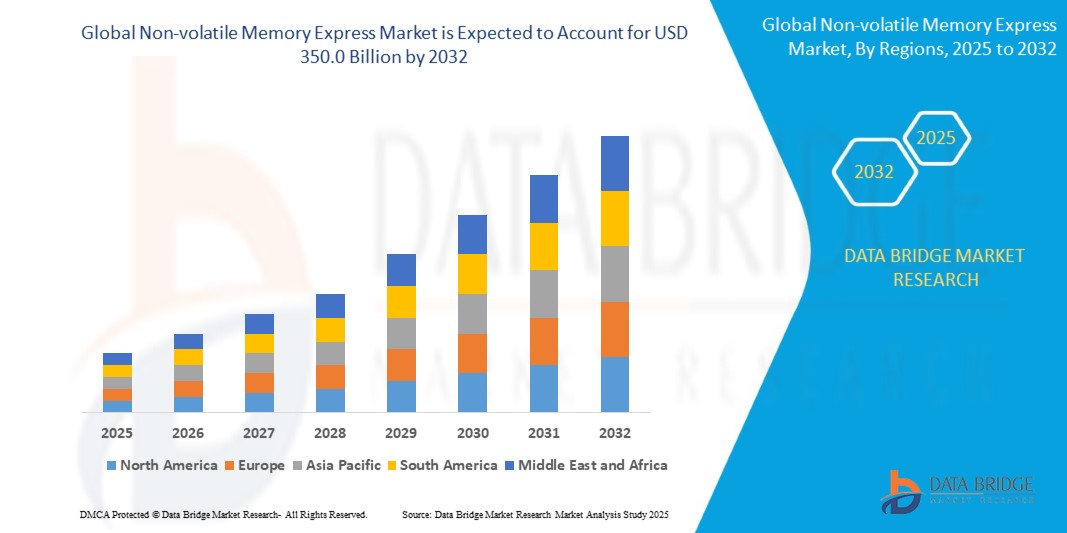
Non-volatile Memory Express Market Size
- The Non-volatile Memory Express Market was valued at USD 60.0 billion in 2025 and is projected to reach USD 350.0 billion by 2032, growing at a CAGR of 29.5% during the forecast period.
- Growth is driven by increasing enterprise workloads, demand for scalable storage infrastructure, the rise of AI/ML workloads, and widespread cloud adoption.
Non-volatile Memory Express Market Analysis
- NVMe enables high-speed, low-latency communication between storage devices and CPUs by leveraging the PCIe interface, significantly outperforming traditional protocols like SATA and SAS. This makes it ideal for modern enterprise workloads and real-time data processing.
- The adoption of NVMe over Fabrics (NVMe-oF) is revolutionizing data center architectures, allowing enterprises to scale storage infrastructure efficiently across cloud, edge, and on-premises environments.
- AI, machine learning, and high-performance computing applications are driving demand for NVMe SSDs due to their ability to handle intensive workloads with consistent throughput and minimal delay.
- The rise of edge computing and IoT is increasing demand for compact, ruggedized NVMe solutions that can support fast data access and durability in harsh environments.
- Organizations are replacing legacy systems with NVMe to reduce power consumption, optimize rack space, and improve overall storage efficiency—especially in sectors like BFSI, healthcare, and telecom.
Report Scope and Non-volatile Memory Express Market Segmentation
|
Attributes |
Non-volatile Memory Express Market Insights |
|
Segments Covered |
|
|
Countries Covered |
North America
Europe
Asia-Pacific
Middle East and Africa
South America
|
|
Key Market Players |
|
|
Market Opportunities |
|
|
Value Added Data Infosets |
In addition to the insights on market scenarios such as market value, growth rate, segmentation, geographical coverage, and major players, the market reports curated by the Data Bridge Market Research also include import export analysis, production capacity overview, production consumption analysis, price trend analysis, climate change scenario, supply chain analysis, value chain analysis, raw material/consumables overview, vendor selection criteria, PESTLE Analysis, Porter Analysis, and regulatory framework. |
Non-volatile Memory Express Market Trends
High-Speed Storage, Fabric Innovation, and AI-Centric Infrastructure Reshaping NVMe Adoption
- A key and rapidly accelerating trend in the NVMe market is the integration of NVMe over Fabrics (NVMe-oF). This approach extends NVMe’s high-speed performance across distributed network environments, enabling data centers to overcome traditional bottlenecks in scale-out storage systems.
- The rise of AI and machine learning applications is reshaping storage requirements, pushing enterprises and cloud providers to adopt NVMe for its ultra-low latency, parallelism, and ability to handle data-intensive workloads like real-time analytics and deep learning.
- With the deployment of PCIe Gen 4 and Gen 5 interfaces, NVMe drives now deliver even faster throughput and IOPS, making them foundational for 5G infrastructure, autonomous technologies, and edge computing frameworks that require split-second data access.
- Organizations are moving away from SATA/SAS protocols toward fully NVMe-based architectures, reducing footprint, improving energy efficiency, and maximizing storage density in enterprise racks and high-performance computing systems.
- Storage vendors are innovating with intelligent NVMe controllers and software-defined storage stacks that optimize performance, power consumption, and reliability—especially for multi-tenant and virtualized environments where efficiency is critical.
Non-volatile Memory Express Market Dynamics
Driver
Explosion in Data Generation and Need for Low-Latency Access Driving NVMe Adoption
- The exponential growth in unstructured data from applications such as AI, IoT, 5G, and video surveillance is compelling organizations to adopt high-performance storage architectures. NVMe offers significantly lower latency and higher IOPS than traditional storage interfaces, making it essential for real-time data-intensive workloads.
- Enterprises and hyperscalers are leveraging NVMe to power mission-critical operations like real-time analytics, AI/ML model training, and virtualization—workloads that demand ultra-fast throughput and consistent low-latency performance.
- As infrastructure modernization accelerates, NVMe is rapidly replacing SATA and SAS-based SSDs due to its compact footprint, energy efficiency, and support for PCIe Gen 4 and Gen 5 interfaces.
- The growing deployment of edge data centers and localized compute nodes is boosting demand for compact, rugged NVMe SSDs that ensure high-speed performance and reliability in remote or harsh environments.
- With the expansion of hybrid and multi-cloud architectures, enterprises are increasingly adopting NVMe-based storage arrays to enable faster replication, seamless access, and high availability across distributed systems.
Restraint/Challenge
High Implementation Cost and Integration Complexity
- One of the major barriers to widespread NVMe adoption is the high upfront cost of transitioning from traditional SATA/SAS-based infrastructure to NVMe-based systems. These costs include NVMe SSDs, compatible motherboards, and PCIe interface upgrades—posing a financial challenge, especially for small and medium enterprises.
- Integration with existing legacy systems—including storage networks, operating systems, and data management frameworks—can be technically complex and resource-intensive. This often requires system downtime, reconfiguration of storage architectures, and skilled personnel for deployment and troubleshooting.
- Many organizations lack the in-house IT capabilities to manage NVMe implementation, particularly in hybrid or multi-cloud environments. As a result, they rely on external integrators or managed service providers, increasing total cost of ownership and deployment timelines.
- Ensuring compatibility across ecosystems (e.g., NVMe-oF, virtualization platforms, containerized environments) adds complexity, requiring thorough planning and customization for different use cases and workloads.
- Additionally, software licensing fees, firmware updates, and the need for continuous performance tuning create long-term operational burdens. These challenges are particularly pronounced in developing markets, where infrastructure modernization budgets are constrained.
Non-volatile Memory Express Market Scope
The market is segmented on the basis of communication standard, component, deployment type, end user and industry vertical.
• By Communication Standard
The NVMe market is segmented by communication standards into TCP/IP, Fibre Channel, and InfiniBand. TCP/IP leads the segment due to its broad compatibility with existing IT infrastructure and scalability across cloud-native environments. Fibre Channel is preferred in high-throughput enterprise storage systems for its reliability and dedicated bandwidth. InfiniBand is gaining traction in high-performance computing (HPC) and AI/ML workloads due to its ultra-low latency and superior data transfer rates.
• By Component
Components include Hardware, Software, and Services. Hardware accounts for the largest share in 2025, led by rapid adoption of NVMe SSDs, PCIe interface cards, and high-density storage arrays. Software, including NVMe management tools, drivers, and APIs, is growing steadily as enterprises prioritize storage optimization, virtualization, and orchestration. Services—covering deployment, integration, performance tuning, and lifecycle support—are essential to ensure compatibility, scalability, and ongoing performance in complex IT environments.
•By Deployment Type
Deployment is categorized into On-Premises and Cloud. On-premises deployment remains dominant among regulated industries such as finance and healthcare that require tight control over data residency and security. Cloud deployment is expanding rapidly, driven by hyperscalers and SaaS providers seeking cost-effective scalability, automated storage provisioning, and fast data access in multi-tenant environments.
• By End User
End users include Enterprises, Government Bodies, Cloud Service Providers, and Others. Enterprises are the largest segment, with NVMe adoption supporting databases, analytics, virtualization, and business-critical applications. Cloud Service Providers are emerging as key adopters due to NVMe’s ability to deliver low-latency and high-throughput storage across distributed data centers. Government and public sector use is also rising, particularly in areas like smart cities, defense, and digital record management.
• By Industry Vertical
The NVMe market serves verticals such as BFSI, Healthcare, Retail, IT & Telecom, Manufacturing, and Others. BFSI leads due to real-time transaction processing and fraud detection needs. Healthcare uses NVMe for rapid image retrieval, EMR systems, and diagnostics analytics. Retail benefits from high-speed inventory management and personalization engines.IT & Telecom and Manufacturing rely on NVMe to handle high-volume data streams and edge computing workloads in industrial automation and network optimization.
Non-volatile Memory Express Market Regional Analysis
- North America dominates the Non-Volatile Memory Express (NVMe) Market with the largest revenue share in 2025, driven by widespread enterprise adoption, strong demand for low-latency storage in AI and cloud workloads, and early deployment of NVMe-over-Fabrics (NVMe-oF). The presence of major cloud providers and data center operators in the region accelerates market growth.
- In particular, the U.S. benefits from early deployment of NVMe-over-Fabrics (NVMe-oF), widespread digitization in financial services, and rising investment in high-performance computing (HPC) infrastructure. The presence of major cloud service providers and tech giants further accelerates the regional adoption of NVMe-based storage platforms.
- The Europe NVMe Market is projected to grow steadily throughout the forecast period, fueled by the digital transformation of banking, telecom, and manufacturing sectors. GDPR-compliant data storage infrastructure and national cloud initiatives in countries like Germany, France, and the UK are driving investment in secure, high-performance NVMe-based storage platforms.
- The Asia-Pacific NVMe Market is expected to grow at the fastest CAGR through 2032, driven by booming cloud adoption, growing smartphone and IoT ecosystems, and the rise of AI-powered digital services. Government-led initiatives in countries like China, Japan, South Korea, and India to build sovereign cloud platforms and smart infrastructure are creating sustained demand for next-gen NVMe storage.
- The MEA NVMe market is gaining traction, propelled by digital transformation initiatives, smart city projects, and expanding cloud infrastructure. Countries like UAE and Saudi Arabia are heavily investing in AI-driven government services, fintech, and healthcare, which require fast, reliable storage solutions. Increasing adoption of NVMe in data centers and enterprise storage is further boosting regional market growth.
- South America's NVMe market is gradually expanding due to the rising adoption of cloud-based services, digital banking, and e-commerce. Brazil leads the region with growing demand from financial institutions, telecom providers, and IT firms seeking high-speed storage for data-intensive workloads. Investments in data centers and digital infrastructure under national digitalization strategies are driving NVMe adoption across the continent.
United States
The U.S. NVMe Market captured the largest revenue share within North America in 2025. The country benefits from a highly advanced cloud ecosystem, strong presence of hyperscalers like AWS, Google Cloud, and Microsoft Azure, and widespread enterprise IT modernization. Ongoing deployment of NVMe SSDs across edge computing, AI training platforms, and government infrastructure makes the U.S. a global leader in next-generation storage adoption.
Europe
The Europe NVMe Market is projected to grow steadily throughout the forecast period, fueled by the digital transformation of banking, telecom, and manufacturing sectors. GDPR-compliant data storage infrastructure and national cloud initiatives in countries like Germany, France, and the UK are driving investment in secure, high-performance NVMe-based storage platforms.
Germany
Germany leads the European NVMe market due to its leadership in Industry 4.0, precision manufacturing, and smart factory ecosystems. Enterprises are rapidly deploying NVMe storage for real-time machine analytics, automotive R&D, and integrated supply chain management. Government-backed AI and HPC programs are further fueling NVMe demand across enterprise IT environments.
France
France’s NVMe Market is expanding due to strong national cloud infrastructure investments, digital health initiatives, and the modernization of enterprise and public sector IT systems. The demand for high-speed, scalable, and secure data storage across research, e-governance, and fintech sectors is accelerating NVMe SSD and NVMe-oF deployments across the country.
China
China dominates the Asia-Pacific NVMe market in revenue as of 2025, driven by massive hyperscale data center development, national AI and cloud computing strategies, and a highly competitive domestic tech sector. The country’s strong semiconductor ecosystem and state-backed infrastructure investment have accelerated the integration of NVMe SSDs in cloud servers, edge devices, and high-throughput AI applications.
South Arabia
Saudi Arabia is at the forefront of NVMe adoption in the Middle East, driven by its Vision 2030 initiatives, smart city projects like NEOM, and large-scale digital transformation in government, healthcare, and financial sectors. Increased investments in hyperscale data centers and AI-driven platforms are accelerating demand for high-performance NVMe storage.
Brazil
Brazil leads South America’s NVMe market, fueled by rapid digitalization in banking, telecom, and e-commerce. The government’s push for data localization and cloud adoption, combined with rising investments in edge computing and IT infrastructure, is propelling NVMe deployment across both public and private sectors.
Non-volatile Memory Express Market Share
The Non-Volatile Memory Express (NVMe) Market is primarily led by a combination of global semiconductor giants, SSD manufacturers, and enterprise storage providers who are actively investing in high-speed, low-latency storage technologies:
- Samsung Electronics – (South Korea)
- Intel Corporation – (US)
- Western Digital Corporation – (US)
- Micron Technology – (US)
- Toshiba Corporation – (Japan)
- SK Hynix – (South Korea)
- Seagate Technology – (US)
- Kingston Technology – (US)
- ADATA Technology – (Taiwan)
- Transcend Information – (Taiwan)
- Corsair Memory – (US)
- Kioxia Holdings Corporation – (Japan)
- Crucial (Micron Consumer Brand) – (US)
- SanDisk (Western Digital Brand) – (US)
- Mushkin Enhanced MFG – (US)
- Plextor (Lite-On Technology Corporation) – (Taiwan)
- Patriot Memory – (US)
- Silicon Power – (Taiwan)
- PNY Technologies – (US)
- Biwin Storage Technology – (China)
Latest Developments in Non-volatile Memory Express Market
- In February 2025, Samsung Electronics unveiled its next-generation PM9D3a NVMe SSD, designed for PCIe Gen 5 enterprise environments. The SSD offers up to 14 GB/s sequential read speeds and improved energy efficiency for hyperscale data centers.
- In January 2025, Kioxia introduced its CM7 Series of enterprise NVMe SSDs with dual-port PCIe Gen 5 support. The drives target mission-critical applications in financial services, healthcare, and telecom sectors, with enhanced endurance and reliability.
- In November 2024, Intel’s Solidigm (a SK hynix company) launched the P5336 NVMe SSD, offering ultra-high capacity (up to 61.44 TB) and low-latency performance for AI training and data lake applications.
- In September 2024, Micron Technology expanded its 9400 series with new NVMe SSD models optimized for mixed workload environments. The SSDs deliver up to 2.5 million IOPS, targeting enterprise IT and AI-driven cloud computing platforms.

- Interactive Data Analysis Dashboard
- Company Analysis Dashboard for high growth potential opportunities
- Research Analyst Access for customization & queries
- Competitor Analysis with Interactive dashboard
- Latest News, Updates & Trend analysis
- Harness the Power of Benchmark Analysis for Comprehensive Competitor Tracking
Global Non Volatile Memory Express Market, Supply Chain Analysis and Ecosystem Framework
To support market growth and help clients navigate the impact of geopolitical shifts, DBMR has integrated in-depth supply chain analysis into its Global Non Volatile Memory Express Market research reports. This addition empowers clients to respond effectively to global changes affecting their industries. The supply chain analysis section includes detailed insights such as Global Non Volatile Memory Express Market consumption and production by country, price trend analysis, the impact of tariffs and geopolitical developments, and import and export trends by country and HSN code. It also highlights major suppliers with data on production capacity and company profiles, as well as key importers and exporters. In addition to research, DBMR offers specialized supply chain consulting services backed by over a decade of experience, providing solutions like supplier discovery, supplier risk assessment, price trend analysis, impact evaluation of inflation and trade route changes, and comprehensive market trend analysis.
Data collection and base year analysis are done using data collection modules with large sample sizes. The stage includes obtaining market information or related data through various sources and strategies. It includes examining and planning all the data acquired from the past in advance. It likewise envelops the examination of information inconsistencies seen across different information sources. The market data is analysed and estimated using market statistical and coherent models. Also, market share analysis and key trend analysis are the major success factors in the market report. To know more, please request an analyst call or drop down your inquiry.
The key research methodology used by DBMR research team is data triangulation which involves data mining, analysis of the impact of data variables on the market and primary (industry expert) validation. Data models include Vendor Positioning Grid, Market Time Line Analysis, Market Overview and Guide, Company Positioning Grid, Patent Analysis, Pricing Analysis, Company Market Share Analysis, Standards of Measurement, Global versus Regional and Vendor Share Analysis. To know more about the research methodology, drop in an inquiry to speak to our industry experts.
Data Bridge Market Research is a leader in advanced formative research. We take pride in servicing our existing and new customers with data and analysis that match and suits their goal. The report can be customized to include price trend analysis of target brands understanding the market for additional countries (ask for the list of countries), clinical trial results data, literature review, refurbished market and product base analysis. Market analysis of target competitors can be analyzed from technology-based analysis to market portfolio strategies. We can add as many competitors that you require data about in the format and data style you are looking for. Our team of analysts can also provide you data in crude raw excel files pivot tables (Fact book) or can assist you in creating presentations from the data sets available in the report.













