


 Market Analysis and Insights : Global Non-Wood Microcrystalline Market
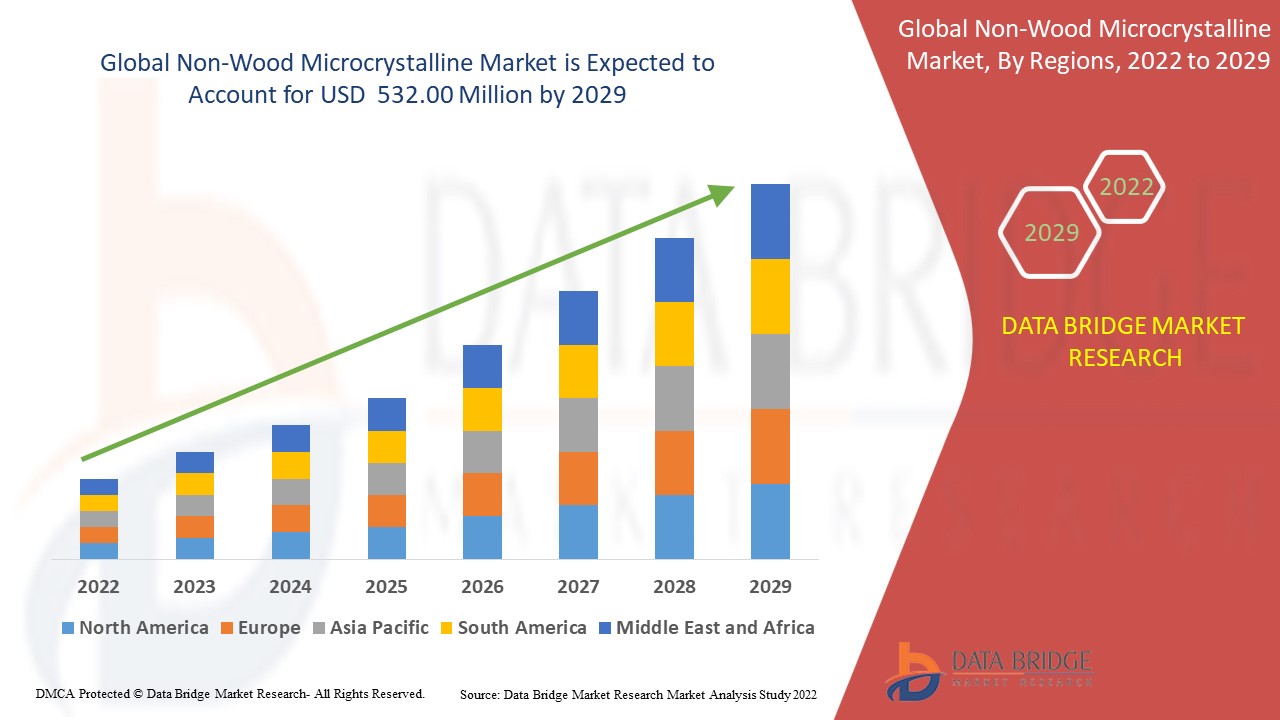
Data Bridge Market Research analyses that the non-wood microcrystalline market will witness a CAGR of 6.1% for the forecast period of 2022-2029 and is likely to reach at USD 532.00 million by the end of the forecast period of 2022-2029.
Non-wood microcrystalline cellulose is partially depolymerized cellulose in its pure form that is produced from cellulose precursor. Acid hydrolysis, reactive extrusion, steam explosion, and enzyme-mediated synthesis are all methods for producing microcrystalline cellulose. Microcrystalline cellulose is widely used in the food and beverage industries, as well as the pharmaceutical and personal care industries. Microcrystalline cellulose is added to processed foods in the food and beverage industry to create a creamy and smooth mouth feel.
The rise in the pharmaceutical industry is expected to drive the growth of the non-wood microcrystalline cellulose market during the forecast period. Furthermore, the increasing use of microcrystalline cellulose (MCC) as a pharmaceutical excipient is expected to drive the microcrystalline cellulose (MCC) market.
The increased demand for non-wood microcrystalline cellulose as the processed food industry develops is expected to cushion the growth of the microcrystalline cellulose (MCC) market. Furthermore, the increase in demand from developing countries, as well as the development of non-wood-based microcrystalline cellulose, will provide potential opportunities for the growth of the non-wood microcrystalline cellulose market in the coming years.
However, on the other hand, the availability of substitutes for specific food and beverage and pharmaceutical applications is expected to hinder the growth of the microcrystalline cellulose (MCC) market during the forecast period. In the near future, the ability to produce low-cost non-wood microcrystalline cellulose may pose a further challenge to the growth of the non-wood microcrystalline cellulose market.
This non-wood microcrystalline market report provides details of new recent developments, trade regulations, import export analysis, production analysis, value chain optimization, market share, impact of domestic and localised market players, analyses opportunities in terms of emerging revenue pockets, changes in market regulations, strategic market growth analysis, market size, category market growths, application niches and dominance, product approvals, product launches, geographical expansions, technological innovations in the market. To gain more info on non-wood microcrystalline market contact Data Bridge Market Research for an Analyst Brief, our team will help you take an informed market decision to achieve market growth. Product approvals, product launches, geographical expansions, technology
Global Non-Wood Microcrystalline Market Scope and Market Size
The non-wood microcrystalline market is segmented on the basis of process and end-user industry. The growth amongst the different segments helps you in attaining the knowledge related to the different growth factors expected to be prevalent throughout the market and formulate different strategies to help identify core application areas and the difference in your target markets.
- On the basis of process, the non-wood microcrystalline market is segmented into reactive extrusion, enzyme mediated, mechanical grinding, ultra-sonication, steam explosion, and acid hydrolysis.
- On the basis of application, the non-wood microcrystalline market is segmented into food and beverages, pharmaceutical, personal care, paints and coatings, others.
Non-Wood Microcrystalline Market Country Level Analysis
The non-wood microcrystalline market is segmented on the basis of process and end-user industry.
The countries covered in the non-wood microcrystalline market report are U.S., Canada and Mexico in North America, Germany, France, U.K., Netherlands, Switzerland, Belgium, Russia, Italy, Spain, Turkey, Rest of Europe in Europe, China, Japan, India, South Korea, Singapore, Malaysia, Australia, Thailand, Indonesia, Philippines, Rest of Asia-Pacific (APAC) in the Asia-Pacific (APAC), Saudi Arabia, U.A.E, Israel, Egypt, South Africa, Rest of Middle East and Africa (MEA) as a part of Middle East and Africa (MEA), Brazil, Argentina and Rest of South America as part of South America.
Asia-Pacific dominates the microcrystalline cellulose (MCC) market due to an increase in consumer purchasing of a wide range of personal care products. Furthermore, the region's obese population will drive the growth of the microcrystalline cellulose (MCC) market during the forecast period.
The country section of the non-wood microcrystalline market report also provides individual market impacting factors and changes in regulation in the market domestically that impacts the current and future trends of the market. Data points such as consumption volumes, production sites and volumes, import export analysis, price trend analysis, cost of raw materials, down-stream and upstream value chain analysis are some of the major pointers used to forecast the market scenario for individual countries. Also, presence and availability of global brands and their challenges faced due to large or scarce competition from local and domestic brands, impact of domestic tariffs and trade routes are considered while providing forecast analysis of the country data.
Competitive Landscape and Non-Wood Microcrystalline Market Share Analysis
The non-wood microcrystalline market competitive landscape provides details by competitor. Details included are company overview, company financials, revenue generated, market potential, investment in research and development, new market initiatives, global presence, production sites and facilities, production capacities, company strengths and weaknesses, product launch, product width and breadth, application dominance. The above data points provided are only related to the companies’ focus related to non-wood microcrystalline market.
Some of the major players operating in the non-wood microcrystalline market report DuPont, Dow, Rayonier Advanced Materials., FMC Corporation, Asahi Kasei Corporation, Roquette Frères, DFE Pharma, Accent Microcell Pvt. Ltd., JRS PHARMA, Sigachi Industries Pvt. Ltd., Ming Tai Chemical Co. Ltd, Scope Ingredients Pvt. Ltd., Chinainfo.org, Pfanstiehl, Inc., BASE SE, Clariant, TAITRA and Accent Microcell Pvt. Ltd., among others.
We can add as many competitors that you require data about in the format and data style you are looking

- Interactive Data Analysis Dashboard
- Company Analysis Dashboard for high growth potential opportunities
- Research Analyst Access for customization & queries
- Competitor Analysis with Interactive dashboard
- Latest News, Updates & Trend analysis
- Harness the Power of Benchmark Analysis for Comprehensive Competitor Tracking
Table of Content
1 INTRODUCTION
1.1 OBJECTIVES OF THE STUDY
1.2 MARKET DEFINITION
1.3 OVERVIEW OF GLOBAL NON-WOOD MICROCRYSTALLINE MARKET
1.4 CURRENCY AND PRICING
1.5 LIMITATION
1.6 MARKETS COVERED
2 MARKET SEGMENTATION
2.1 KEY TAKEAWAYS
2.2 ARRIVING AT THE GLOBAL NON-WOOD MICROCRYSTALLINE MARKET SIZE
2.3 VENDOR POSITIONING GRID
2.4 MARKETS COVERED
2.5 GEOGRAPHIC SCOPE
2.6 YEARS CONSIDERED FOR THE STUDY
2.7 RESEARCH METHODOLOGY
2.8 TECHNOLOGY LIFE LINE CURVE
2.9 MULTIVARIATE MODELLING
2.1 PRIMARY INTERVIEWS WITH KEY OPINION LEADERS
2.11 DBMR MARKET POSITION GRID
2.12 MARKET APPLICATION COVERAGE GRID
2.13 DBMR MARKET CHALLENGE MATRIX
2.14 SECONDARY SOURCES
2.15 GLOBAL NON-WOOD MICROCRYSTALLINE MARKET: RESEARCH SNAPSHOT
2.16 ASSUMPTIONS
3 MARKET OVERVIEW
3.1 DRIVERS
3.2 RESTRAINTS
3.3 OPPORTUNITIES
3.4 CHALLENGES
4 EXECUTIVE SUMMARY
5 PREMIUM INSIGHTS
5.1 TECHNOLOGICAL ADVANCEMENT BY MANUFACTURERS
5.2 PORTER’S FIVE FORCES
5.3 VENDOR SELECTION CRITERIA
5.4 PESTEL ANALYSIS
5.5 REGULATION COVERAGE
6 SUPPLY CHAIN ANALYSIS
6.1 OVERVIEW
6.2 LOGISTIC COST SCENARIO
6.3 IMPORTANCE OF LOGISTICS SERVICE PROVIDERS
7 CLIMATE CHANGE SCENARIO
7.1 ENVIRONMENTAL CONCERNS
7.2 INDUSTRY RESPONSE
7.3 GOVERNMENT’S ROLE
7.4 ANALYST RECOMMENDATIONS
8 GLOBAL NON-WOOD MICROCRYSTALLINE MARKET, BY PROCESS, 2020 -2029 (USD MILLION), (TONS)
8.1 OVERVIEW
8.2 REACTIVE EXTRUSION
8.2.1 DECOCTION EXTRACTION
8.2.2 MASERATION WITH ETHANOL
8.2.3 MASERATION WITH ETHANOL
8.3 ENZYME MEDIATED
8.4 MECHANICAL GRINDING
8.5 ULTRA SONICATION
8.6 STEAM EXPLOSION
8.7 ACID HYDROLYSIS
9 GLOBAL NON-WOOD MICROCRYSTALLINE MARKET, BY RAW MATERIAL, 2020 -2029 (USD MILLION)
9.1 OVERVIEW
9.2 AGRICULTURE WASTE
9.2.1 STALK
9.2.2 WHEAT STRAW
9.2.3 COCONUT COIR
9.2.4 BANANA STEM
9.2.5 SUGARCANE BAGASSE
9.2.6 PINEAPPLE LEAVES
9.3 FUNGI
9.4 BACTERIA
9.5 ALGAE
9.6 CORN COB
9.7 SOYBEAN HUSK
9.8 BAMBOO
9.9 COTTON POWDER
9.9.1 COTTON WOOL
9.9.2 COTTON FABRIC WASTE
10 GLOBAL NON-WOOD MICROCRYSTALLINE MARKET, BY PARTICLE SIZE, 2020 -2029 (USD MILLION)
10.1 OVERVIEW
10.2 SMALL
10.3 LARGE
10.4 EXTRA LARGE
11 GLOBAL NON-WOOD MICROCRYSTALLINE MARKET, BY APPLICATION , 2020 -2029 (USD MILLION)
11.1 OVERVIEW
11.2 PHARMACEUTICAL
11.3 FOOD
11.4 COSMETICS
11.5 OTHER
12 GLOBAL NON-WOOD MICROCRYSTALLINE MARKET, BY REGION , 2020 -2029 (USD MILLION) (TONS)
GLOBAL NON-WOOD MICROCRYSTALLINE MARKET, (ALL SEGMENTATION PROVIDED ABOVE IS REPRESENTED IN THIS CHAPTER BY COUNTRY)
12.1 NORTH AMERICA
12.1.1 U.S.
12.1.2 CANADA
12.1.3 MEXICO
12.2 EUROPE
12.2.1 GERMANY
12.2.2 U.K.
12.2.3 ITALY
12.2.4 FRANCE
12.2.5 SPAIN
12.2.6 RUSSIA
12.2.7 SWITZERLAND
12.2.8 TURKEY
12.2.9 BELGIUM
12.2.10 NETHERLANDS
12.2.11 REST OF EUROPE
12.3 ASIA-PACIFIC
12.3.1 JAPAN
12.3.2 CHINA
12.3.3 SOUTH KOREA
12.3.4 INDIA
12.3.5 SINGAPORE
12.3.6 THAILAND
12.3.7 INDONESIA
12.3.8 MALAYSIA
12.3.9 PHILIPPINES
12.3.10 AUSTRALIA & NEW ZEALAND
12.3.11 REST OF ASIA-PACIFIC
12.4 SOUTH AMERICA
12.4.1 BRAZIL
12.4.2 ARGENTINA
12.4.3 REST OF SOUTH AMERICA
12.5 MIDDLE EAST AND AFRICA
12.5.1 SOUTH AFRICA
12.5.2 EGYPT
12.5.3 SAUDI ARABIA
12.5.4 UNITED ARAB EMIRATES
12.5.5 ISRAEL
12.5.6 REST OF MIDDLE EAST AND AFRICA
13 GLOBAL NON-WOOD MICROCRYSTALLINE MARKET, COMPANY LANDSCAPE
13.1 COMPANY SHARE ANALYSIS: GLOBAL
13.2 COMPANY SHARE ANALYSIS: NORTH AMERICA
13.3 COMPANY SHARE ANALYSIS: EUROPE
13.4 COMPANY SHARE ANALYSIS: ASIA-PACIFIC
13.5 MERGERS AND ACQUISITIONS
13.6 NEW PRODUCT DEVELOPMENT AND APPROVALS
13.7 EXPANSIONS
13.8 PARTNERSHIP AND OTHER STRATEGIC DEVELOPMENTS
14 SWOT AND DATA BRIDGE MARKET RESEARCH ANALYSIS
15 GLOBAL NON-WOOD MICROCRYSTALLINE MARKET - COMPANY PROFILES
15.1 ASAHI KASEI CORPORATION
15.1.1 COMPANY SNAPSHOT
15.1.2 REVENUE ANALYSIS
15.1.3 PRODUCT PORTFOLIO
15.1.4 RECENT UPDATES
15.2 DUPONT
15.2.1 COMPANY SNAPSHOT
15.2.2 REVENUE ANALYSIS
15.2.3 PRODUCT PORTFOLIO
15.2.4 RECENT UPDATES
15.3 ROQUETTE FRÈRES.
15.3.1 COMPANY SNAPSHOT
15.3.2 REVENUE ANALYSIS
15.3.3 PRODUCT PORTFOLIO
15.3.4 RECENT UPDATES
15.4 DFE PHARMA
15.4.1 COMPANY SNAPSHOT
15.4.2 REVENUE ANALYSIS
15.4.3 PRODUCT PORTFOLIO
15.4.4 RECENT UPDATES
15.5 SIGACHI INDUSTRIES.
15.5.1 COMPANY SNAPSHOT
15.5.2 REVENUE ANALYSIS
15.5.3 PRODUCT PORTFOLIO
15.5.4 RECENT UPDATES
15.6 MINGTAI CHEMICAL CO., LTD.
15.6.1 COMPANY SNAPSHOT
15.6.2 REVENUE ANALYSIS
15.6.3 PRODUCT PORTFOLIO
15.6.4 RECENT UPDATES
15.7 PFANSTIEHL, INC.
15.7.1 SCOMPANY SNAPSHOT
15.7.2 REVENUE ANALYSIS
15.7.3 PRODUCT PORTFOLIO
15.7.4 RECENT UPDATES
*NOTE: THE COMPANIES PROFILED IS NOT EXHAUSTIVE LIST AND IS AS PER OUR PREVIOUS CLIENT REQUIREMENT. WE PROFILE MORE THAN 100 COMPANIES IN OUR STUDY AND HENCE THE LIST OF COMPANIES CAN BE MODIFIED OR REPLACED ON REQUEST
16 RELATED REPORTS
17 QUESTIONNAIRE
18 CONCLUSION
19 ABOUT DATA BRIDGE MARKET RESEARCH

Global Non Wood Microcrystalline Market, Supply Chain Analysis and Ecosystem Framework
To support market growth and help clients navigate the impact of geopolitical shifts, DBMR has integrated in-depth supply chain analysis into its Global Non Wood Microcrystalline Market research reports. This addition empowers clients to respond effectively to global changes affecting their industries. The supply chain analysis section includes detailed insights such as Global Non Wood Microcrystalline Market consumption and production by country, price trend analysis, the impact of tariffs and geopolitical developments, and import and export trends by country and HSN code. It also highlights major suppliers with data on production capacity and company profiles, as well as key importers and exporters. In addition to research, DBMR offers specialized supply chain consulting services backed by over a decade of experience, providing solutions like supplier discovery, supplier risk assessment, price trend analysis, impact evaluation of inflation and trade route changes, and comprehensive market trend analysis.
Data collection and base year analysis are done using data collection modules with large sample sizes. The stage includes obtaining market information or related data through various sources and strategies. It includes examining and planning all the data acquired from the past in advance. It likewise envelops the examination of information inconsistencies seen across different information sources. The market data is analysed and estimated using market statistical and coherent models. Also, market share analysis and key trend analysis are the major success factors in the market report. To know more, please request an analyst call or drop down your inquiry.
The key research methodology used by DBMR research team is data triangulation which involves data mining, analysis of the impact of data variables on the market and primary (industry expert) validation. Data models include Vendor Positioning Grid, Market Time Line Analysis, Market Overview and Guide, Company Positioning Grid, Patent Analysis, Pricing Analysis, Company Market Share Analysis, Standards of Measurement, Global versus Regional and Vendor Share Analysis. To know more about the research methodology, drop in an inquiry to speak to our industry experts.
Data Bridge Market Research is a leader in advanced formative research. We take pride in servicing our existing and new customers with data and analysis that match and suits their goal. The report can be customized to include price trend analysis of target brands understanding the market for additional countries (ask for the list of countries), clinical trial results data, literature review, refurbished market and product base analysis. Market analysis of target competitors can be analyzed from technology-based analysis to market portfolio strategies. We can add as many competitors that you require data about in the format and data style you are looking for. Our team of analysts can also provide you data in crude raw excel files pivot tables (Fact book) or can assist you in creating presentations from the data sets available in the report.













