


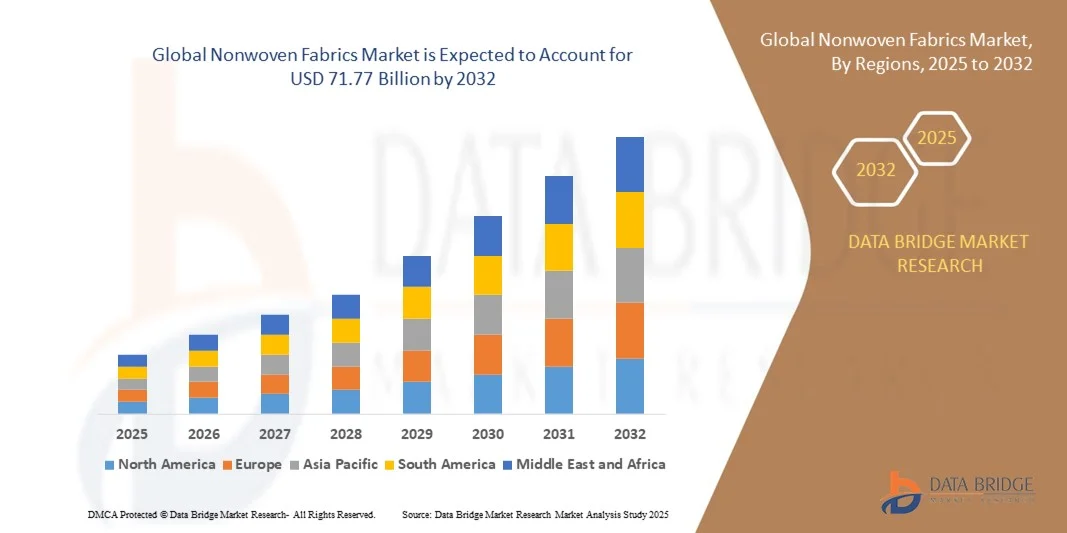
Global Nonwoven Fabrics Market Size
- The global Nonwoven Fabrics Market size was valued at USD 44.49 billion in 2024 and is expected to reach USD 71.77 billion by 2032, at a CAGR of 6.16% during the forecast period.
- The market growth is primarily driven by increasing demand across hygiene, medical, automotive, and construction industries, where nonwoven fabrics are favored for their durability, lightweight properties, and cost-effectiveness.
- Moreover, rising awareness of sustainable and eco-friendly materials, coupled with technological advancements in manufacturing processes such as spunbond, meltblown, and needle-punched nonwovens, is fueling adoption across various end-use applications. These factors are collectively propelling the market expansion and reinforcing the position of nonwoven fabrics as a critical material in modern industries.
Global Nonwoven Fabrics Market Analysis
- Nonwoven fabrics, produced by bonding fibers through mechanical, thermal, or chemical processes, are increasingly essential across hygiene, medical, automotive, and construction applications due to their durability, lightweight properties, and cost-effectiveness.
- The rising demand for nonwoven fabrics is primarily fueled by growth in disposable hygiene products, medical supplies, and industrial applications, along with increasing consumer preference for sustainable and eco-friendly materials.
- Asia-Pacific dominated the Global Nonwoven Fabrics Market with the largest revenue share of 34.3% in 2024, driven by established manufacturing infrastructure, high demand for hygiene and medical products, and the presence of key industry players, with the U.S. witnessing notable growth in nonwoven production and usage across healthcare, automotive, and construction sectors.
- North America is expected to be the fastest-growing region in the Global Nonwoven Fabrics Market during the forecast period due to rapid urbanization, increasing industrialization, and rising disposable incomes, which are boosting demand for hygiene, medical, and construction materials.
- The spunlaid segment dominated the market with the largest revenue share of 41.5% in 2024, driven by its cost-effectiveness, versatility, and suitability for large-scale production of hygiene, medical, and filtration products.
Report Scope and Global Nonwoven Fabrics Market Segmentation
|
Attributes |
Nonwoven Fabrics Key Market Insights |
|
Segments Covered |
|
|
Countries Covered |
North America
Europe
Asia-Pacific
Middle East and Africa
South America
|
|
Key Market Players |
|
|
Market Opportunities |
|
|
Value Added Data Infosets |
In addition to the insights on market scenarios such as market value, growth rate, segmentation, geographical coverage, and major players, the market reports curated by the Data Bridge Market Research also include import export analysis, production capacity overview, production consumption analysis, price trend analysis, climate change scenario, supply chain analysis, value chain analysis, raw material/consumables overview, vendor selection criteria, PESTLE Analysis, Porter Analysis, and regulatory framework. |
Global Nonwoven Fabrics Market Trends
Advanced Functionalities and Smart Material Integration
- A significant and accelerating trend in the global Nonwoven Fabrics Market is the incorporation of advanced functionalities and smart material technologies, such as antimicrobial coatings, biodegradable fibers, and filtration enhancements. These innovations are significantly improving the performance, sustainability, and versatility of nonwoven fabrics across diverse applications.
- For instance, medical nonwovens with antimicrobial or antiviral properties are increasingly used in surgical masks, gowns, and protective apparel, providing enhanced hygiene and safety in healthcare environments. Similarly, automotive nonwovens with sound-absorbing or thermal-regulating properties improve passenger comfort and vehicle efficiency.
- Smart material integration in nonwoven fabrics enables features such as self-cleaning surfaces, moisture management, and improved durability under harsh conditions. For example, some hygiene products utilize super-absorbent nonwoven layers to optimize fluid retention while maintaining breathability, while industrial filtration nonwovens are engineered to selectively trap particulates.
- The seamless incorporation of these advanced functionalities allows nonwoven fabrics to serve multiple purposes simultaneously, combining strength, filtration, comfort, and sustainability in a single material. This enables manufacturers to create more efficient and versatile products for healthcare, hygiene, construction, and automotive sectors.
- This trend toward smarter, multifunctional, and eco-conscious nonwoven fabrics is fundamentally reshaping end-user expectations, driving demand for innovative solutions. Consequently, companies such as Freudenberg, Ahlstrom-Munksjö, and Fibertex are developing high-performance nonwovens with integrated antimicrobial, biodegradable, and filtration-enhancing technologies.
- The demand for nonwoven fabrics with advanced functionalities and smart material integration is growing rapidly across medical, hygiene, automotive, and industrial sectors, as manufacturers and consumers increasingly prioritize performance, sustainability, and multifunctionality.
Global Nonwoven Fabrics Market Dynamics
Driver
Rising Demand Driven by Healthcare, Hygiene, and Industrial Applications
- The increasing need for hygiene, medical, and industrial solutions, coupled with rapid urbanization and industrialization, is a significant driver for the heightened demand for nonwoven fabrics.
- For instance, in 2024, Kimberly-Clark introduced next-generation nonwoven hygiene products with enhanced absorbency and antimicrobial properties, targeting both healthcare and consumer markets. Strategies like these by key players are expected to drive significant growth in the nonwoven fabrics market during the forecast period.
- As consumers and industries become more aware of hygiene standards, environmental safety, and product efficiency, nonwoven fabrics offer advanced features such as liquid absorption, filtration, and durability, providing a compelling upgrade over traditional materials like woven textiles or paper.
- Furthermore, the expanding applications of nonwovens in medical supplies, automotive interiors, construction insulation, and disposable hygiene products are making them an integral component of multiple industries, enabling improved product performance and compliance with regulatory standards.
- The versatility of nonwoven fabrics, lightweight design, cost-effectiveness, and compatibility with sustainable manufacturing processes are key factors propelling adoption across healthcare, hygiene, automotive, and industrial sectors. Increasing awareness of eco-friendly and biodegradable nonwovens further contributes to market growth.
Restraint/Challenge
Environmental Concerns and Raw Material Price Volatility
- Environmental concerns and the sustainability of synthetic nonwoven fabrics pose significant challenges to broader market adoption. Nonwovens made from polypropylene, polyester, or other petrochemical-based fibers face scrutiny due to their non-biodegradable nature and environmental footprint.
- For instance, increasing regulatory pressure in Europe and North America on single-use plastics and disposable materials has made some consumers and businesses hesitant to adopt traditional nonwoven products.
- Addressing these environmental concerns through the development of biodegradable, recyclable, or bio-based nonwovens is crucial for sustaining market growth. Companies such as Ahlstrom-Munksjö and Freudenberg are investing in sustainable fiber alternatives and eco-friendly production processes to mitigate environmental impact.
- Additionally, the volatility of raw material prices, particularly petroleum-based polymers used in synthetic nonwovens, can increase production costs and affect pricing strategies, creating barriers for cost-sensitive customers in emerging markets.
- While technological innovations and the shift toward sustainable materials are helping to alleviate these challenges, the perceived environmental impact and price fluctuations can still hinder rapid adoption in some regions. Overcoming these obstacles through eco-conscious product development, cost optimization, and regulatory compliance will be vital for sustained market growth.
Global Nonwoven Fabrics Market Scope
Nonwoven fabrics market is segmented on the basis of technology, material, function, layer, and application.
- By Technology
On the basis of technology, the Global Nonwoven Fabrics Market is segmented into spunlaid, drylaid, wetlaid, and others. The spunlaid segment dominated the market with the largest revenue share of 41.5% in 2024, driven by its cost-effectiveness, versatility, and suitability for large-scale production of hygiene, medical, and filtration products. Spunlaid nonwovens are widely used in disposable diapers, wipes, surgical masks, and industrial filters due to their strong mechanical properties and high productivity.
The wetlaid segment is expected to witness the fastest CAGR of 18.7% from 2025 to 2032, fueled by rising demand in specialty applications such as medical and high-performance filtration products. Wetlaid nonwovens offer superior uniformity, fine fiber distribution, and excellent strength, making them suitable for advanced hygiene, industrial, and technical applications across multiple end-use industries.
- By Material
On the basis of material, the Global Nonwoven Fabrics Market is segmented into polypropylene (PP), polyethylene (PE), polyester, nylon, polyurethane, rayon, wood pulp, and others. The polypropylene (PP) segment dominated the market with the largest revenue share of 38.6% in 2024, owing to its affordability, lightweight nature, and wide use in hygiene products, medical disposables, and packaging. PP nonwovens are particularly favored in diapers, masks, and wipes for their excellent liquid absorption and strength.
The polyester segment is expected to witness the fastest CAGR of 19.3% from 2025 to 2032, driven by growing demand in automotive, construction, and industrial applications. Polyester nonwovens offer high durability, thermal stability, and resistance to chemical degradation, making them ideal for filtration, insulation, geotextiles, and durable hygiene applications.
- By Function
On the basis of function, the Global Nonwoven Fabrics Market is segmented into disposable and non-disposable. The disposable segment dominated the market with the largest revenue share of 55.2% in 2024, driven by high demand for single-use hygiene and medical products such as diapers, surgical masks, gowns, and wipes. Disposable nonwovens provide convenience, hygiene, and cost-effectiveness, making them indispensable in healthcare, personal care, and industrial sectors.
The non-disposable segment is expected to witness the fastest CAGR of 17.8% from 2025 to 2032, fueled by rising demand for reusable products and durable industrial applications. Non-disposable nonwovens are increasingly used in automotive interiors, construction materials, geotextiles, and home furnishings due to their durability, strength, and eco-conscious appeal.
- By Layer
On the basis of layer, the Global Nonwoven Fabrics Market is segmented into single layer and multilayer. The multilayer segment dominated the market with the largest revenue share of 47.6% in 2024, owing to its enhanced performance in filtration, medical, hygiene, and industrial applications. Multilayer nonwovens provide superior strength, fluid retention, and filtration efficiency, making them ideal for surgical masks, air and liquid filters, diapers, and wipes.
The single-layer segment is expected to witness the fastest CAGR of 18.1% from 2025 to 2032, driven by demand for lightweight, cost-effective solutions in disposable hygiene products, packaging, and apparel. Single-layer nonwovens are easier to produce, flexible, and widely used in applications where moderate strength and functionality are sufficient.
- By Application
On the basis of application, the Global Nonwoven Fabrics Market is segmented into construction, textiles, personal care, filtration, and others. The personal care segment dominated the market with the largest revenue share of 42.8% in 2024, fueled by rising demand for diapers, wipes, feminine hygiene products, and adult incontinence products. Nonwoven fabrics in personal care provide absorbency, softness, and hygiene benefits, driving widespread consumer adoption.
The filtration segment is expected to witness the fastest CAGR of 20.2% from 2025 to 2032, driven by industrial and environmental regulations requiring advanced air, water, and liquid filtration solutions. Nonwoven fabrics are increasingly used in HVAC systems, industrial filtration, medical filtration, and water treatment applications due to their customizable porosity, durability, and high efficiency.
Global Nonwoven Fabrics Market Regional Analysis
- Asia-Pacific dominated the Global Nonwoven Fabrics Market with the largest revenue share of 34.3% in 2024, driven by the increasing demand for hygiene products, medical disposables, and industrial nonwoven applications.
- Consumers and industries in the region prioritize high-performance nonwovens for applications such as surgical masks, wipes, diapers, filtration, and construction materials, emphasizing quality, durability, and compliance with regulatory standards.
- This widespread adoption is further supported by well-established manufacturing infrastructure, high disposable incomes, and strong awareness of sustainable and innovative nonwoven solutions, positioning the region as a key market for both disposable and durable nonwoven products across healthcare, personal care, automotive, and industrial sectors.
U.S. Nonwoven Fabrics Market Insight
The U.S. nonwoven fabrics market captured the largest revenue share of 81% in North America in 2024, driven by the robust demand for hygiene products, medical disposables, and industrial applications. Rising awareness of personal care, healthcare safety, and filtration efficiency is fueling adoption across consumer and industrial sectors. The growing preference for high-performance nonwovens in products such as diapers, wipes, surgical masks, and air filters, combined with a well-established manufacturing base, further propels market growth. Additionally, innovations in spunlaid and multilayer nonwovens are contributing to enhanced product performance and application versatility, cementing the U.S. as a leading market globally.
Europe Nonwoven Fabrics Market Insight
The Europe nonwoven fabrics market is projected to expand at a substantial CAGR during the forecast period, driven by increasing demand in healthcare, personal care, automotive, and industrial sectors. Stringent quality and environmental regulations are encouraging manufacturers to adopt high-performance and sustainable nonwoven materials. Urbanization and technological advancements in hygiene and filtration products are further fostering market growth. European consumers and industries prioritize innovative, eco-friendly, and high-efficiency nonwoven solutions, creating opportunities in both disposable and durable nonwoven segments.
U.K. Nonwoven Fabrics Market Insight
The U.K. nonwoven fabrics market is anticipated to grow at a noteworthy CAGR during the forecast period, propelled by rising demand for disposable hygiene products, medical applications, and filtration materials. Increased awareness of hygiene, sustainability, and eco-conscious materials is encouraging adoption across healthcare, personal care, and industrial applications. The U.K.’s strong manufacturing infrastructure, combined with a well-established supply chain and e-commerce penetration for consumer goods, is supporting the distribution and adoption of innovative nonwoven products.
Germany Nonwoven Fabrics Market Insight
The Germany nonwoven fabrics market is expected to expand at a considerable CAGR during the forecast period, driven by the country’s focus on industrial innovation, sustainability, and high-quality manufacturing. Germany’s demand for advanced nonwovens in automotive, filtration, construction, and medical applications is rising due to stringent regulations and an emphasis on environmentally friendly materials. The integration of durable and high-performance nonwovens into industrial and commercial applications is increasingly prevalent, aligning with German consumers’ and businesses’ expectations for quality and reliability.
Asia-Pacific Nonwoven Fabrics Market Insight
The Asia-Pacific nonwoven fabrics market is poised to grow at the fastest CAGR of 24% during the forecast period, fueled by rapid urbanization, rising disposable incomes, and expanding healthcare and personal care sectors in countries such as China, India, and Japan. Government initiatives promoting hygiene, sanitation, and environmental sustainability are further boosting demand. The region’s emergence as a major manufacturing hub for nonwoven materials is enhancing affordability and accessibility, driving adoption across medical, personal care, industrial, and construction applications.
Japan Nonwoven Fabrics Market Insight
The Japan nonwoven fabrics market is gaining momentum due to the country’s advanced healthcare infrastructure, aging population, and strong emphasis on hygiene and safety. Increasing adoption of disposable medical and personal care products, along with innovations in multilayer and spunlaid nonwovens, is fueling market growth. Japan’s focus on high-quality and technologically advanced nonwovens for medical, filtration, and industrial applications ensures sustained demand across residential and commercial sectors.
China Nonwoven Fabrics Market Insight
The China nonwoven fabrics market accounted for the largest revenue share in Asia-Pacific in 2024, driven by rapid urbanization, growth of the middle class, and increasing healthcare and hygiene awareness. The country’s booming manufacturing sector, rising domestic consumption, and initiatives supporting sanitary and medical products are key factors propelling market growth. Affordable nonwoven solutions for personal care, filtration, and industrial applications, coupled with strong local production capabilities, are driving widespread adoption across multiple sectors.
Global Nonwoven Fabrics Market Share
The Nonwoven Fabrics industry is primarily led by well-established companies, including:
• Berry Global Group, Inc. (U.S.)
• Freudenberg Performance Materials (Germany)
• 3M Company (U.S.)
• Ahlstrom-Munksjö (Finland)
• Kimberly-Clark Corporation (U.S.)
• First Quality Enterprises (U.S.)
• Omni Nonwoven (U.S.)
• DuPont de Nemours, Inc. (U.S.)
• Locust Group (U.S.)
• Lydall, Inc. (U.S.)
• Hengan International Group (China)
• Shandong Chenming Paper Holdings (China)
• Autoneum (Switzerland)
• Avgol Nonwovens (Israel)
• Sandler AG (Germany)
• Aica Kogyo Co., Ltd. (Japan)
• Glanzstoff Nonwovens (Austria)
• Reemay, Inc. (U.S.)
• Jiangsu Sanfangxiang Group (China)
• Propex Operating Company, LLC (U.S.)
What are the Recent Developments in Global Nonwoven Fabrics Market?
- In April 2023, Berry Global Group, Inc., a global leader in engineered materials, launched a strategic initiative in South Africa to expand the production and distribution of high-performance nonwoven fabrics for healthcare, hygiene, and industrial applications. This initiative underscores the company’s commitment to providing innovative, reliable solutions tailored to the specific needs of the local market, while strengthening its position in the rapidly growing Global Nonwoven Fabrics Market. By leveraging advanced manufacturing technologies and global expertise, Berry Global is addressing regional demand for sustainable and high-quality nonwoven materials.
- In March 2023, Freudenberg Performance Materials, a Germany-based materials company, introduced a next-generation spunbond nonwoven fabric designed for medical and filtration applications. The new material offers enhanced strength, breathability, and liquid repellency, highlighting Freudenberg’s focus on innovation and performance. This development reflects the company’s commitment to meeting the evolving requirements of healthcare and industrial sectors worldwide, ensuring broader adoption of high-quality nonwoven solutions.
- In March 2023, 3M Company successfully expanded its nonwoven production capacity in Bengaluru, India, aimed at supporting urban hygiene and healthcare initiatives. The project leverages 3M’s advanced materials expertise to produce nonwoven fabrics for medical masks, filtration systems, and personal protective equipment. This initiative emphasizes the growing significance of nonwovens in public safety and healthcare, contributing to safer, more resilient communities.
- In February 2023, Ahlstrom-Munksjö, a leading provider of specialty nonwovens, announced a strategic partnership with regional hygiene product manufacturers in North America to develop sustainable, high-performance nonwoven materials for wipes and medical applications. The collaboration aims to enhance product performance, streamline production, and meet growing demand for eco-friendly and effective nonwoven solutions, underscoring Ahlstrom-Munksjö’s dedication to innovation in the global market.
- In January 2023, Kimberly-Clark Corporation unveiled its latest line of nonwoven fabrics for personal care and medical applications at the International Hygienic Products Expo 2023. The new fabrics, incorporating advanced fiber technology and multilayer structures, offer improved absorbency, durability, and comfort. This launch highlights Kimberly-Clark’s commitment to integrating advanced materials technology into nonwoven solutions, providing consumers and industries with enhanced functionality, sustainability, and performance.

- Interactive Data Analysis Dashboard
- Company Analysis Dashboard for high growth potential opportunities
- Research Analyst Access for customization & queries
- Competitor Analysis with Interactive dashboard
- Latest News, Updates & Trend analysis
- Harness the Power of Benchmark Analysis for Comprehensive Competitor Tracking
Global Nonwoven Fabrics Market, Supply Chain Analysis and Ecosystem Framework
To support market growth and help clients navigate the impact of geopolitical shifts, DBMR has integrated in-depth supply chain analysis into its Global Nonwoven Fabrics Market research reports. This addition empowers clients to respond effectively to global changes affecting their industries. The supply chain analysis section includes detailed insights such as Global Nonwoven Fabrics Market consumption and production by country, price trend analysis, the impact of tariffs and geopolitical developments, and import and export trends by country and HSN code. It also highlights major suppliers with data on production capacity and company profiles, as well as key importers and exporters. In addition to research, DBMR offers specialized supply chain consulting services backed by over a decade of experience, providing solutions like supplier discovery, supplier risk assessment, price trend analysis, impact evaluation of inflation and trade route changes, and comprehensive market trend analysis.
Data collection and base year analysis are done using data collection modules with large sample sizes. The stage includes obtaining market information or related data through various sources and strategies. It includes examining and planning all the data acquired from the past in advance. It likewise envelops the examination of information inconsistencies seen across different information sources. The market data is analysed and estimated using market statistical and coherent models. Also, market share analysis and key trend analysis are the major success factors in the market report. To know more, please request an analyst call or drop down your inquiry.
The key research methodology used by DBMR research team is data triangulation which involves data mining, analysis of the impact of data variables on the market and primary (industry expert) validation. Data models include Vendor Positioning Grid, Market Time Line Analysis, Market Overview and Guide, Company Positioning Grid, Patent Analysis, Pricing Analysis, Company Market Share Analysis, Standards of Measurement, Global versus Regional and Vendor Share Analysis. To know more about the research methodology, drop in an inquiry to speak to our industry experts.
Data Bridge Market Research is a leader in advanced formative research. We take pride in servicing our existing and new customers with data and analysis that match and suits their goal. The report can be customized to include price trend analysis of target brands understanding the market for additional countries (ask for the list of countries), clinical trial results data, literature review, refurbished market and product base analysis. Market analysis of target competitors can be analyzed from technology-based analysis to market portfolio strategies. We can add as many competitors that you require data about in the format and data style you are looking for. Our team of analysts can also provide you data in crude raw excel files pivot tables (Fact book) or can assist you in creating presentations from the data sets available in the report.













