


Novel Drug Delivery Systems In Cancer Therapy Market Size
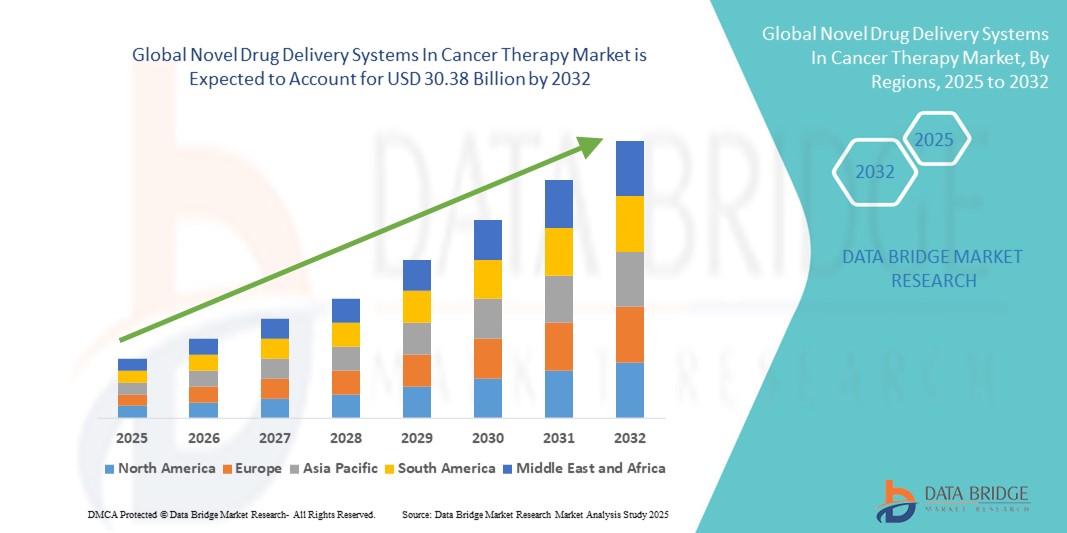
- The global novel drug delivery systems in cancer therapy market size was valued at USD 17.23 billion in 2024 and is expected to reach USD 30.38 billion by 2032, at a CAGR of7.34% during the forecast period
- The market growth is largely fueled by the increasing global burden of cancer and the rising demand for more effective, targeted, and minimally invasive treatment options, which has led to rapid advancements in drug delivery technologies across oncology care
- Furthermore, growing investment in nanotechnology, biotechnology, and precision medicine, along with the need to reduce systemic toxicity and improve therapeutic outcomes, is establishing Novel Drug Delivery Systems as a preferred choice in cancer therapy. These converging factors are accelerating the uptake of innovative delivery platforms, thereby significantly boosting the industry's growth
Novel Drug Delivery Systems In Cancer Therapy Market Analysis
- Novel Drug Delivery Systems (NDDS) are increasingly pivotal in advancing cancer therapy by enabling precise, controlled, and targeted delivery of anti-cancer agents, improving efficacy while minimizing systemic toxicity. These systems—including nanoparticles, liposomes, and polymeric micelles—offer enhanced bioavailability, reduced side effects, and better tumor site accumulation
- The growing adoption of NDDS in oncology is primarily driven by rising cancer prevalence, increased demand for personalized therapies, and ongoing innovations in nanomedicine and controlled-release formulations
- North America dominated the global novel drug delivery systems in cancer therapy market, accounting for the largest revenue share of 41.5% in 2024. The region's dominance is attributed to strong R&D funding, the presence of major biotechnology firms, and early regulatory approvals for novel oncology therapies. In particular, the U.S. leads the region, driven by the integration of precision medicine approaches and growing clinical trials for advanced drug delivery platforms
- Asia-Pacific is expected to be the fastest growing region in the global novel drug delivery systems in cancer therapy market with a CAGR of 10.9% during 2025–2032, owing to rising healthcare expenditure, rapid urbanization, a growing elderly population, and increasing awareness of targeted cancer treatments in countries such as China, India, and Japan. Strategic collaborations between local pharma firms and global biotechnology innovators are further boosting regional growth
- The targeted drug delivery segment dominated the global novel drug delivery systems in cancer therapy market with a share of 38.5% in 2024, driven by increasing adoption of precision medicine approaches in oncology
Report Scope and Novel Drug Delivery Systems In Cancer Therapy Market Segmentation
|
Attributes |
Novel Drug Delivery Systems In Cancer Therapy Key Market Insights |
|
Segments Covered |
|
|
Countries Covered |
North America
Europe
Asia-Pacific
Middle East and Africa
South America
|
|
Key Market Players |
|
|
Market Opportunities |
|
|
Value Added Data Infosets |
In addition to the insights on market scenarios such as market value, growth rate, segmentation, geographical coverage, and major players, the market reports curated by the Data Bridge Market Research also include in-depth expert analysis, pricing analysis, brand share analysis, consumer survey, demography analysis, supply chain analysis, value chain analysis, raw material/consumables overview, vendor selection criteria, PESTLE Analysis, Porter Analysis, and regulatory framework. |
Novel Drug Delivery Systems In Cancer Therapy Market Trends
Enhanced Precision Through Targeted and Controlled Drug Delivery Systems
- A significant and accelerating trend in the global novel drug delivery systems in cancer therapy market is the integration of targeted, controlled-release technologies such as nanoparticles, liposomes, micelles, and polymer-drug conjugates, which enhance therapeutic precision and minimize off-target toxicity
- For instance, liposomal formulations such as Doxil (liposomal doxorubicin) are widely adopted due to their ability to deliver chemotherapeutic agents directly to tumor sites, improving drug retention in cancer cells while reducing cardiotoxicity and systemic exposure
- Increasing clinical adoption of polymeric micelles and solid lipid nanoparticles (SLNs) is enabling improved solubility of hydrophobic anticancer drugs, enhancing absorption, and ensuring longer circulation times, which directly support better patient outcomes
- Stimuli-responsive drug delivery systems—such as those triggered by pH, temperature, or enzymatic activity—are gaining traction for their ability to release active agents specifically within the tumor microenvironment, thereby reducing systemic toxicity and increasing therapeutic index
- Companies are also focusing on ligand-targeted delivery systems, which use monoclonal antibodies or peptides to direct drugs specifically to cancer cell receptors like HER2, EGFR, or folate receptors. This method is proving effective for treating aggressive and resistant cancer types such as triple-negative breast cancer
- With increasing investment in personalized medicine, novel drug delivery systems are being developed to align with patient-specific genetic and phenotypic profiles. This precision approach enhances therapeutic efficacy while limiting adverse effects, and is supported by growing usage of companion diagnostics in oncology
Novel Drug Delivery Systems In Cancer Therapy Market Dynamics
Driver
Growing Need Due to Rising Cancer Incidence and Precision Therapy Adoption
- The increasing global incidence of cancer and the urgent need for more effective and targeted therapies are major drivers of growth in the global novel drug delivery systems in cancer therapy market
- For instance, according to the WHO, cancer accounted for nearly 10 million deaths globally in 2023, reinforcing the demand for drug delivery platforms that enhance efficacy while minimizing toxicity
- Novel drug delivery technologies—such as liposomes, nanoparticles, and antibody-drug conjugates (ADCs)—enable precise targeting of cancer cells, thereby improving patient outcomes and reducing off-target effects
- Pharmaceutical companies are actively investing in next-generation delivery systems to improve bioavailability, control drug release, and enable site-specific action. This innovation is particularly valuable in addressing resistance mechanisms in aggressive cancers
- The adoption of minimally invasive delivery routes, including transdermal, intranasal, and implant-based systems, is gaining traction, especially for patients with compromised immune systems or those unable to tolerate systemic chemotherapy
- The rising emphasis on personalized medicine and the use of companion diagnostics are also encouraging the development of customized delivery systems tailored to individual tumor profiles
- Government support through fast-track approvals and funding for cancer research is further accelerating the development and commercialization of novel delivery systems, particularly in the U.S., Europe, and Japan
Restraint/Challenge
Complex Manufacturing and Regulatory Challenges
- Despite the immense promise, the novel drug delivery systems in cancer therapy market faces significant hurdles related to complex manufacturing processes and stringent regulatory oversight
- Many novel delivery platforms, such as lipid nanoparticles or polymeric carriers, require specialized facilities, skilled personnel, and advanced equipment, driving up production costs and limiting scalability
- Regulatory agencies such as the FDA and EMA impose rigorous safety and efficacy standards on new delivery systems, particularly when they involve nanotechnology or immunoconjugates. This can delay market entry and increase the cost of clinical development
- The lack of standardization in analytical testing methods and quality control poses additional barriers, particularly in ensuring batch-to-batch consistency and long-term stability of complex formulations
- In some regions, underdeveloped infrastructure and limited access to high-end manufacturing or cold chain capabilities hinder the large-scale deployment of advanced drug delivery products
- Intellectual property issues and patent cliffs also affect market dynamics, as biosimilar or generic versions of delivery technologies remain challenging to replicate accurately due to formulation intricacies
- To overcome these restraints, companies must invest in advanced R&D partnerships, regulatory strategy planning, and global manufacturing networks to facilitate wider adoption and reduce development bottlenecks
Novel Drug Delivery Systems In Cancer Therapy Market Scope
The market is segmented on the basis of type, delivery technology, administration mechanism, and application.
- By Type
On the basis of type, the global novel drug delivery systems in cancer therapy market is segmented into nanoparticles, liposomes, microspheres, monoclonal antibodies, polymeric micelles, and others. The nanoparticles segment dominated the market with the largest revenue share of 34.1% in 2024, driven by their high efficacy in targeted delivery and tumor penetration.
The monoclonal antibodies segment is projected to register the fastest CAGR of 12.8% from 2025 to 2032, due to their critical role in personalized oncology therapies and antibody-drug conjugates.
- By Delivery Technology
On the basis of delivery technology, the market is segmented into injectable, oral, transdermal, inhalation, and implantable systems. The injectable segment held the largest market share of 46.7% in 2024, owing to its widespread use in administering chemotherapeutic agents and biologics.
The implantable systems segment is anticipated to grow at the fastest CAGR of 11.3% from 2025 to 2032, supported by rising demand for localized, sustained drug release solutions.
- By Administration Mechanism
On the basis of administration mechanism, the market is segmented into targeted drug delivery, controlled release, stimuli-responsive release, and localized delivery. The targeted drug delivery segment accounted for the largest share of 38.5% in 2024, driven by increasing adoption of precision medicine approaches in oncology.
The stimuli-responsive release segment is expected to register the fastest CAGR of 13.4% from 2025 to 2032, due to rising investments in smart delivery platforms responding to tumor microenvironmental changes.
- By Application
On the basis of application, the market is segmented into breast cancer, lung cancer, colorectal cancer, prostate cancer, and others. The breast cancer segment dominated with a market share of 29.8% in 2024, reflecting its high global incidence and broad therapeutic pipeline utilizing novel delivery approaches.
The lung cancer segment is projected to expand at the fastest CAGR of 12.6% from 2025 to 2032, driven by the growing adoption of inhalation and targeted delivery therapies in NSCLC.
Novel Drug Delivery Systems In Cancer Therapy Market Regional Analysis
- North America dominated the novel drug delivery systems in cancer therapy market with the largest revenue share of 41.5% in 2024, driven by a high prevalence of cancer, advanced healthcare infrastructure, and strong investments in R&D focused on targeted and personalized drug delivery solutions
- Healthcare providers in the region increasingly value the clinical efficacy, reduced toxicity, and improved patient outcomes associated with novel drug delivery platforms such as nanoparticles, liposomes, and monoclonal antibodies
- This growing adoption is further supported by the presence of major pharmaceutical and biotechnology companies, favorable regulatory frameworks, and rapid technological innovation, positioning North America as a leader in advanced cancer therapeutics
U.S. Novel Drug Delivery Systems in Cancer Therapy Market Insight
The U.S. novel drug delivery systems in cancer therapy market captured the largest revenue share of 84% in 2024 within North America, fueled by the growing burden of cancer and increasing demand for precise and efficient treatment modalities. The U.S. is witnessing strong adoption of nanocarriers, antibody-drug conjugates, and polymer-based drug systems as part of the shift toward personalized oncology care. Furthermore, government support for cancer research, a robust clinical trial landscape, and early access to emerging technologies are accelerating market expansion across academic and commercial sectors.
Europe Novel Drug Delivery Systems in Cancer Therapy Market Insight
The Europe novel drug delivery systems in cancer therapy market is projected to expand at a substantial CAGR throughout the forecast period, driven by a growing focus on patient-centered care and advancements in drug formulation technologies. Strong regulatory emphasis on safety and efficacy, coupled with increased adoption of targeted delivery approaches across multiple cancer types, is shaping market growth. In addition, rising cancer incidence, particularly among aging populations, and collaborations between academia and industry are promoting innovative delivery solutions across European countries.
U.K. Novel Drug Delivery Systems in Cancer Therapy Market Insight
The U.K. novel drug delivery systems in cancer therapy market is anticipated to grow at a noteworthy CAGR during the forecast period, supported by increasing adoption of advanced treatment delivery systems in the National Health Service (NHS). Strategic government initiatives, investments in cancer genomics, and the nation's leadership in pharmaceutical R&D are fostering rapid innovation. The strong presence of biotech firms and a growing emphasis on reducing chemotherapy side effects are further accelerating the deployment of novel delivery platforms.
Germany Novel Drug Delivery Systems in Cancer Therapy Market Insight
The Germany novel drug delivery systems in cancer therapy market is expected to expand at a considerable CAGR during the forecast period, bolstered by the country’s strong biopharmaceutical ecosystem and rising demand for precision oncology. Germany’s commitment to sustainable, patient-specific treatment models is encouraging the integration of nanomedicine, liposomal formulations, and biodegradable delivery systems. In addition, public and private research funding, along with increasing participation in clinical studies, continues to drive innovation and adoption.
Asia-Pacific Novel Drug Delivery Systems in Cancer Therapy Market Insight
The Asia-Pacific novel drug delivery systems in cancer therapy market is poised to grow at the fastest CAGR of 10.9% from 2025 to 2032, driven by the rising cancer burden, rapid urbanization, and improving healthcare infrastructure in countries such as China, Japan, and India. The region's emphasis on affordable and scalable healthcare solutions is pushing pharmaceutical companies to adopt advanced delivery platforms. In addition, growing investments in biotechnology and supportive government policies aimed at innovation and access are fueling strong market expansion across APAC.
Japan Novel Drug Delivery Systems in Cancer Therapy Market Insight
The Japan novel drug delivery systems in cancer therapy market is gaining momentum due to its aging population, cutting-edge research capabilities, and increasing demand for safe, convenient, and effective cancer treatments. The country’s leadership in nanotechnology and medical innovation is contributing to the adoption of smart delivery systems such as micelles and biodegradable implants. Moreover, partnerships between academic institutions and pharmaceutical firms are promoting the clinical translation of experimental therapies into commercial products.
China Novel Drug Delivery Systems in Cancer Therapy Market Insight
The China novel drug delivery systems in cancer therapy market accounted for the largest market revenue share in Asia-Pacific in 2024, supported by its rapidly growing healthcare sector, expansive cancer patient pool, and government-led initiatives for pharmaceutical innovation. China’s robust manufacturing capabilities and strategic focus on nanomedicine and biologics are driving the local development and commercialization of novel drug delivery systems. The rise of domestic biotech firms, combined with international collaborations, is positioning China as a competitive force in the global cancer therapeutics landscape.
Novel Drug Delivery Systems In Cancer Therapy Market Share
The novel drug delivery systems in cancer therapy industry is primarily led by well-established companies, including:
- Johnson & Johnson and its affiliates (U.S.)
- Pfizer Inc. (U.S.)
- Merck & Co., Inc. (U.S.)
- AstraZeneca (U.K.)
- F. Hoffmann-La Roche Ltd (Switzerland)
- Bristol-Myers Squibb Company (U.S.)
- Amgen Inc. (U.S.)
- Novartis AG (Switzerland)
- GSK plc (U.K.)
- Lilly (U.S.)
- AbbVie Inc. (U.S.)
- Seagen Inc. (U.S.)
- BIND Therapeutics (U.S.)
- BlueWillow Biologics (U.S.)
- Celsion Corporation (U.S.)
- Celgene Corporation (U.S.)
- NantKwest Inc. (U.S.)
- Strata Oncology (U.S.)
- Tarveda Therapeutics (U.S.)
- Selecta Biosciences, Inc. (U.S.)
Latest Developments in Global Novel Drug Delivery Systems In Cancer Therapy Market
- In July 2025, Pfizer Inc., in partnership with BIND Therapeutics, launched a next-generation targeted nanoparticle drug delivery platform for treating solid tumors including metastatic breast and pancreatic cancers. This novel platform uses PEGylated polymers and tumor-targeting ligands to enhance therapeutic efficacy while minimizing systemic toxicity. The collaboration reinforces Pfizer’s commitment to advancing precision oncology through innovative delivery technologies
- In July 2025, Roche announced promising Phase II clinical trial results for its injectable micellar chemotherapy formulation designed for glioblastoma treatment. The micelles demonstrated superior tumor penetration and retention, significantly improving therapeutic outcomes compared to standard approaches. This innovation highlights Roche’s leadership in intratumoral drug delivery systems targeting complex brain tumors
- In July 2025, Biocon Ltd., a global biopharmaceutical leader based in India, introduced an oral nanoparticle-based paclitaxel formulation that bypasses first-pass metabolism. This new delivery system is aimed at improving bioavailability and patient compliance, especially for metastatic breast cancer patients. The product is currently being rolled out under India’s fast-track oncology regulatory framework
- In July 2025, a report by GlobeNewswire indicated that the global Novel Drug Delivery Systems in Cancer Therapy market is projected to grow significantly through 2032. The study attributes growth to rising R&D in liposomes, biodegradable implants, microneedles, dendrimers, and ADCs. The report highlights key players’ focus on enhancing targeted cancer treatments, particularly across North America, Europe, and Asia-Pacific

- Interactive Data Analysis Dashboard
- Company Analysis Dashboard for high growth potential opportunities
- Research Analyst Access for customization & queries
- Competitor Analysis with Interactive dashboard
- Latest News, Updates & Trend analysis
- Harness the Power of Benchmark Analysis for Comprehensive Competitor Tracking
Data collection and base year analysis are done using data collection modules with large sample sizes. The stage includes obtaining market information or related data through various sources and strategies. It includes examining and planning all the data acquired from the past in advance. It likewise envelops the examination of information inconsistencies seen across different information sources. The market data is analysed and estimated using market statistical and coherent models. Also, market share analysis and key trend analysis are the major success factors in the market report. To know more, please request an analyst call or drop down your inquiry.
The key research methodology used by DBMR research team is data triangulation which involves data mining, analysis of the impact of data variables on the market and primary (industry expert) validation. Data models include Vendor Positioning Grid, Market Time Line Analysis, Market Overview and Guide, Company Positioning Grid, Patent Analysis, Pricing Analysis, Company Market Share Analysis, Standards of Measurement, Global versus Regional and Vendor Share Analysis. To know more about the research methodology, drop in an inquiry to speak to our industry experts.
Data Bridge Market Research is a leader in advanced formative research. We take pride in servicing our existing and new customers with data and analysis that match and suits their goal. The report can be customized to include price trend analysis of target brands understanding the market for additional countries (ask for the list of countries), clinical trial results data, literature review, refurbished market and product base analysis. Market analysis of target competitors can be analyzed from technology-based analysis to market portfolio strategies. We can add as many competitors that you require data about in the format and data style you are looking for. Our team of analysts can also provide you data in crude raw excel files pivot tables (Fact book) or can assist you in creating presentations from the data sets available in the report.












