




Global Nuclear Magnetic Resonance Spectroscopy Market
Market Size in USD Million
CAGR :
% 
 USD
776.13 Million
USD
1,082.78 Million
2025
2033
USD
776.13 Million
USD
1,082.78 Million
2025
2033
 Forecast Period Forecast Period |
2026 –2033 |
 Market Size (Base Year) Market Size (Base Year) |
USD 776.13 Million |
 Market Size (Forecast Year) Market Size (Forecast Year) |
USD 1,082.78 Million |
 CAGR CAGR |
% |
| Major Markets Players |
|
Nuclear Magnetic Resonance Spectroscopy Market Size
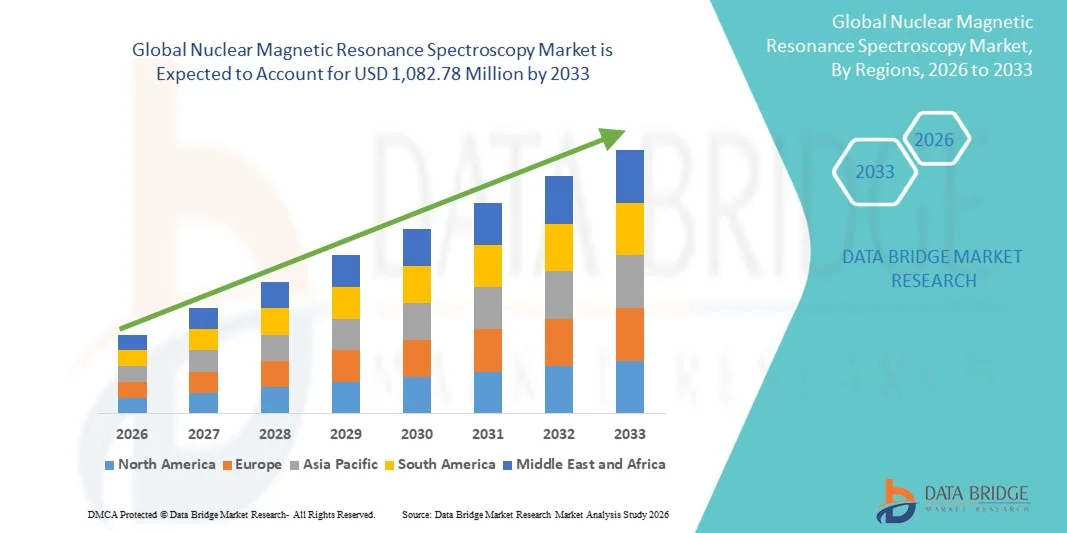
- The global nuclear magnetic resonance spectroscopy market size was valued at USD 776.13 million in 2025 and is expected to reach USD 1,082.78 million by 2033, at a CAGR of 4.25% during the forecast period
- The market growth is largely fueled by the increasing adoption of advanced analytical techniques in pharmaceutical research, biotechnology, and chemical industries, along with continuous technological advancements in high-field NMR instruments and software-driven spectral analysis
- Furthermore, rising demand for precise molecular structure determination, drug discovery applications, and quality control in complex biological and chemical studies is positioning NMR spectroscopy as a critical analytical tool. These converging factors are accelerating the uptake of NMR solutions, thereby significantly boosting the industry's growth
Nuclear Magnetic Resonance Spectroscopy Market Analysis
- Nuclear Magnetic Resonance (NMR) spectroscopy, a powerful analytical technique used for determining molecular structure, dynamics, and chemical environment of compounds, is increasingly essential in pharmaceutical research, biotechnology, chemical analysis, and academic studies due to its high precision, non-destructive nature, and ability to provide detailed structural insights
- The escalating demand for NMR spectroscopy is primarily fueled by the growing investments in drug discovery and development, expanding applications in proteomics and metabolomics, and rising need for advanced analytical tools for complex molecular characterization and quality control in life sciences and chemical industries
- North America dominated the nuclear magnetic resonance spectroscopy market with the largest revenue share of 39.6% in 2025, characterized by strong pharmaceutical R&D activity, advanced research infrastructure, and the presence of major instrument manufacturers, with the U.S. leading adoption in drug development and academic research institutions
- Asia-Pacific is expected to be the fastest growing region in the NMR spectroscopy market during the forecast period due to expanding pharmaceutical manufacturing, increasing government funding for scientific research, and rapid growth of biotechnology and academic research sectors in countries such as China, India, and Japan
- The 500 MHz segment dominated the nuclear magnetic resonance spectroscopy market with a market share of 41.3% in 2025, driven by its optimal balance between resolution, sensitivity, and operational cost, making it widely preferred in pharmaceutical research, chemical analysis, and academic applications
Report Scope and Nuclear Magnetic Resonance Spectroscopy Market Segmentation
|
Attributes |
Nuclear Magnetic Resonance Spectroscopy Key Market Insights |
|
Segments Covered |
|
|
Countries Covered |
North America
Europe
Asia-Pacific
Middle East and Africa
South America
|
|
Key Market Players |
|
|
Market Opportunities |
|
|
Value Added Data Infosets |
In addition to the insights on market scenarios such as market value, growth rate, segmentation, geographical coverage, and major players, the market reports curated by the Data Bridge Market Research also include in-depth expert analysis, patient epidemiology, pipeline analysis, pricing analysis, and regulatory framework |
Nuclear Magnetic Resonance Spectroscopy Market Trends
“Advancing Precision Through High-Field Systems and Digital Automation”
- A significant and accelerating trend in the global nuclear magnetic resonance spectroscopy market is the increasing adoption of ultra-high-field NMR systems combined with advanced digital automation and AI-assisted spectral interpretation, significantly improving analytical accuracy and throughput in complex molecular studies
- For instance, Bruker’s 900 MHz and higher-field NMR systems are being widely deployed in advanced research institutes to achieve superior resolution for biomolecular and structural chemistry applications
- Integration of AI-driven software in NMR spectroscopy enables automated peak assignment, faster data processing, and improved interpretation of complex spectra, reducing dependency on highly specialized operators. For instance, modern Bruker TopSpin-based platforms incorporate intelligent processing tools that enhance workflow efficiency in pharmaceutical research
- The growing combination of NMR spectroscopy with complementary analytical techniques such as mass spectrometry and chromatography is enabling more comprehensive molecular characterization in drug discovery and materials science
- Increasing adoption of cryogen-free and compact benchtop NMR systems is expanding accessibility to smaller laboratories and academic institutions, reducing infrastructure constraints while supporting routine chemical analysis
- This trend toward highly automated, high-resolution, and integrated analytical ecosystems is reshaping expectations in research laboratories. Consequently, companies are developing cryogen-free and compact NMR systems to improve accessibility and reduce operational complexity
- The demand for advanced NMR systems is increasing across pharmaceutical, academic, and chemical research sectors as organizations prioritize higher precision, faster analysis, and improved structural elucidation capabilities
Nuclear Magnetic Resonance Spectroscopy Market Dynamics
Driver
“Rising Demand Driven by Drug Discovery and Advanced Molecular Research”
- The increasing demand for precise molecular structure determination in pharmaceutical R&D, biotechnology, and chemical research is a major driver for the growth of the nuclear magnetic resonance spectroscopy market
- For instance, in April 2025, major pharmaceutical research institutions expanded investment in high-field NMR infrastructure to accelerate drug discovery and biomolecular analysis capabilities
- As drug pipelines become more complex, researchers increasingly rely on NMR spectroscopy for impurity profiling, protein structure analysis, and compound verification, making it a critical analytical tool in life sciences
- Furthermore, the expansion of academic and government-funded research programs in structural biology and materials science is strengthening adoption across global laboratories
- Growing demand for personalized medicine and biologics development is further driving reliance on NMR spectroscopy for detailed molecular-level characterization of complex biological compounds
- Increasing industrial focus on quality control and regulatory compliance in pharmaceuticals is also boosting adoption of NMR techniques for accurate and non-destructive chemical analysis
- The ability of NMR spectroscopy to provide non-destructive, highly detailed molecular insights continues to drive its integration into pharmaceutical development workflows and advanced chemical research applications
Restraint/Challenge
“High Equipment Cost and Technical Complexity Limiting Wider Adoption”
- The high cost of advanced NMR spectroscopy systems, including ultra-high-field magnets and cryogenic maintenance requirements, poses a significant challenge to broader market adoption, particularly among small and mid-sized laboratories
- For instance, installation and operational costs of 500 MHz and above NMR systems can limit accessibility for academic institutions and research facilities with constrained funding
- In addition, the complexity of operation and requirement for highly trained personnel to interpret spectral data creates a barrier to efficient utilization in less specialized environments
- Limited portability and large physical infrastructure requirements of high-field NMR systems further restrict deployment in decentralized or field-based research applications
- Dependence on expensive maintenance and helium-based cooling systems increases long-term operational costs, creating financial pressure for end-users
- While automation and AI-based tools are improving usability, the need for technical expertise in system calibration and maintenance continues to restrict widespread deployment
- Overcoming these challenges through development of cost-effective, cryogen-free systems and simplified software interfaces will be essential for expanding adoption across emerging research markets
Nuclear Magnetic Resonance Spectroscopy Market Scope
The market is segmented on the basis of type and end user.
- By Type
On the basis of type, the nuclear magnetic resonance spectroscopy market is segmented into Sub-100 MHz, 300–400 MHz, 500 MHz, 900 MHz and More MHz. The 500 MHz segment dominated the market with the largest revenue share of 41.3% in 2025, driven by its optimal balance of resolution, sensitivity, and operational cost. It is widely preferred in pharmaceutical research, chemical analysis, and academic laboratories due to its ability to deliver high-quality spectra without the extreme infrastructure demands of ultra-high-field systems. Researchers commonly select 500 MHz instruments for routine structural elucidation and medium-complexity biomolecular studies. In addition, its strong installed base across universities and R&D centers supports continuous demand. The segment also benefits from compatibility with a broad range of applications, making it a standard choice for general-purpose advanced NMR analysis. Growing drug discovery activities further reinforce its dominance in global research ecosystems.
The 900 MHz and More MHz segment is expected to witness the fastest growth rate of 22.4% from 2026 to 2033, fueled by increasing demand for ultra-high-resolution molecular characterization. These systems are essential for advanced structural biology, protein folding studies, and complex biomolecular interactions that require extremely high spectral resolution. For instance, leading research institutes and national laboratories are increasingly investing in 900 MHz-class instruments for frontier life science research. Their ability to deliver superior sensitivity enables breakthroughs in drug-target interaction studies and precision medicine. However, their high cost and infrastructure requirements limit adoption to well-funded academic and government research centers. Despite this, rising funding in advanced scientific research is expected to accelerate their adoption globally.
- By End User
On the basis of end user, the nuclear magnetic resonance spectroscopy market is segmented into academic, pharmaceutical and biotechnology industries, chemical industry, agriculture and food industries, oil and gas industries, and others. The Pharmaceutical and Biotechnology Industries segment dominated the market with the largest revenue share of 44.8% in 2025, driven by extensive use of NMR spectroscopy in drug discovery, molecular structure determination, and quality control processes. Pharmaceutical companies rely heavily on NMR for impurity profiling, compound verification, and biomolecular research. For instance, major drug development pipelines increasingly depend on NMR-based analysis for protein-ligand interaction studies and formulation validation. The segment also benefits from rising investments in biologics and personalized medicine, where precise molecular insights are critical. Strong regulatory requirements for drug safety and efficacy further support continuous adoption. In addition, ongoing R&D expansion across global pharma companies ensures sustained demand for high-field NMR systems.
The Academic segment is expected to witness the fastest growth rate of 20.8% from 2026 to 2033, driven by increasing government funding, expanding research infrastructure, and rising focus on advanced chemical and biological studies. Universities and research institutions are increasingly adopting NMR spectroscopy for structural chemistry, metabolomics, and materials science research. For instance, growing collaborations between academic institutes and pharmaceutical companies are boosting access to advanced NMR equipment. The availability of shared instrumentation facilities is also enabling broader usage among researchers. Furthermore, rising interest in interdisciplinary research across life sciences and nanotechnology is expanding application scope. Continuous investment in scientific education and research infrastructure is expected to further accelerate growth in this segment.
Nuclear Magnetic Resonance Spectroscopy Market Regional Analysis
- North America dominated the nuclear magnetic resonance spectroscopy market with the largest revenue share of 39.6% in 2025, characterized by strong pharmaceutical R&D activity, advanced research infrastructure, and the presence of major instrument manufacturers
- Research institutions and pharmaceutical companies in the region highly value the precision, high-resolution capabilities, and advanced analytical performance offered by NMR spectroscopy for drug discovery and molecular structure elucidation
- This widespread adoption is further supported by high research funding, a strong biotechnology ecosystem, and continuous technological advancements in high-field NMR systems, establishing NMR spectroscopy as a critical analytical tool across academic, pharmaceutical, and chemical research sectors
U.S. Nuclear Magnetic Resonance Spectroscopy Market Insight
The U.S. nuclear magnetic resonance spectroscopy market captured the largest revenue share of 78% in 2025 within North America, driven by strong pharmaceutical R&D investment and the rapid expansion of advanced life sciences research infrastructure. Researchers and industry players are increasingly prioritizing high-precision analytical tools for drug discovery, biomolecular studies, and chemical characterization. The growing presence of leading instrument manufacturers, combined with extensive academic–industry collaboration, further propels market growth. Moreover, the integration of AI-enabled data processing platforms and high-field NMR systems is significantly contributing to the market’s expansion.
Europe Nuclear Magnetic Resonance Spectroscopy Market Insight
The Europe nuclear magnetic resonance spectroscopy market is projected to expand at a substantial CAGR throughout the forecast period, primarily driven by strong regulatory standards in pharmaceuticals and increasing demand for high-quality analytical techniques in chemical and life sciences research. The rise in government-funded research initiatives and growing focus on structural biology are fostering adoption of NMR technologies. European research institutions are also drawn to the precision and reliability offered by advanced spectroscopy systems. The region is witnessing strong growth across academic, pharmaceutical, and industrial research applications, with NMR being widely integrated into both fundamental research and applied sciences.
U.K. Nuclear Magnetic Resonance Spectroscopy Market Insight
The U.K. nuclear magnetic resonance spectroscopy market is anticipated to grow at a noteworthy CAGR during the forecast period, driven by increasing investments in biomedical research and the expanding drug discovery ecosystem. Concerns around improving pharmaceutical innovation and research accuracy are encouraging greater adoption of high-field NMR systems. The country’s strong academic base and globally recognized universities further support demand for advanced analytical instrumentation. In addition, collaboration between research institutes and biotech companies, along with strong funding from public research councils, is expected to continue stimulating market growth.
Germany Nuclear Magnetic Resonance Spectroscopy Market Insight
The Germany nuclear magnetic resonance spectroscopy market is expected to expand at a considerable CAGR during the forecast period, fueled by increasing focus on precision engineering, chemical research, and pharmaceutical innovation. Germany’s well-established industrial and research infrastructure promotes the adoption of advanced analytical tools, particularly in chemistry and materials science applications. The integration of NMR spectroscopy with automation and digital data systems is becoming increasingly prevalent across laboratories. Moreover, the country’s strong emphasis on technological advancement and high-quality research output is aligning well with the demand for sophisticated spectroscopy solutions.
Asia-Pacific Nuclear Magnetic Resonance Spectroscopy Market Insight
The Asia-Pacific nuclear magnetic resonance spectroscopy market is poised to grow at the fastest CAGR of 23% during the forecast period of 2026 to 2033, driven by rapid expansion of pharmaceutical manufacturing, rising research funding, and growing biotechnology development in countries such as China, Japan, and India. The region’s increasing focus on drug discovery and life sciences innovation is accelerating adoption of advanced analytical tools. Furthermore, the availability of cost-effective manufacturing capabilities for scientific instruments is improving accessibility. Government initiatives supporting scientific research and digital transformation are also strengthening market expansion across academic and industrial sectors.
Japan Nuclear Magnetic Resonance Spectroscopy Market Insight
The Japan nuclear magnetic resonance spectroscopy market is gaining momentum due to its strong high-technology ecosystem, advanced research capabilities, and increasing demand for precision-based analytical techniques. The country places significant emphasis on pharmaceutical innovation and structural biology research, driving adoption of high-field NMR systems. Integration of spectroscopy with AI-based analysis and automation is further enhancing research efficiency. Moreover, Japan’s aging population and strong healthcare research focus are encouraging advancements in drug discovery and biomolecular studies, supporting long-term market growth.
India Nuclear Magnetic Resonance Spectroscopy Market Insight
The India nuclear magnetic resonance spectroscopy market accounted for the largest market revenue share in Asia-Pacific in 2025, attributed to rapid expansion of pharmaceutical production, growing academic research infrastructure, and increasing investment in biotechnology. India is emerging as a key hub for drug development and chemical research, driving demand for advanced analytical instrumentation. The expansion of government-supported research programs and rising collaboration between academia and industry are further supporting growth. In addition, increasing focus on affordable research technologies and the establishment of new laboratories are significantly propelling market adoption.
Nuclear Magnetic Resonance Spectroscopy Market Share
The Nuclear Magnetic Resonance Spectroscopy industry is primarily led by well-established companies, including:
- Bruker Corporation (U.S.)
- JEOL Ltd. (Japan)
- Thermo Fisher Scientific Inc. (U.S.)
- Oxford Instruments plc (U.K.)
- Magritek Ltd. (New Zealand)
- Nanalysis Scientific Corp. (Canada)
- Anasazi Instruments, Inc. (U.S.)
- Spinlock SRL (Italy)
- Shanghai Huantong Magnetic Technology Co., Ltd. (China)
- Advanced Magnetic Resonance Limited (U.K.)
- QOneTec GmbH (Germany)
- Oxford Instruments Nanoscience Inc. (U.S.)
- Magritek GmbH (Germany)
- Nanalysis Corp. (Canada)
- Spinlock Instruments (Italy)
What are the Recent Developments in Global Nuclear Magnetic Resonance Spectroscopy Market?
- In April 2026, Bruker introduced new AI-enabled NMR workflow and structural biology solutions at ENC 2026, enhancing automation, spectral interpretation, and high-throughput analysis in advanced research applications. The development strengthens integration of artificial intelligence with high-field NMR systems, enabling faster and more accurate molecular structure determination
- In August 2025, Oxford Instruments launched the X-Pulse 90 benchtop NMR spectrometer, expanding its nuclear magnetic resonance portfolio with a 90 MHz broadband system designed for advanced research and routine chemical analysis. The system enhances multinuclear capabilities, enabling improved structural characterization across pharmaceuticals, polymers, and materials science applications
- In November 2024, researchers advanced optical Dynamic Nuclear Polarization (DNP) NMR technology, significantly improving sensitivity for solid-state and high-resolution spectroscopy applications. The innovation enables stronger nuclear spin polarization, allowing detection of weak molecular signals previously difficult to analyze
- In November 2024, the Natural Products Magnetic Resonance Database (NP-MRD) expanded its global NMR spectral repository, becoming one of the largest platforms for metabolomics and natural product research data. The update includes millions of spectral entries and improved predictive modeling tools for chemical structure analysis. It enhances data accessibility for researchers in drug discovery and chemical biology
- In May 2021, advancements in high-field NMR spectroscopy enabled nanoscale structural analysis under extreme conditions, significantly improving resolution for complex chemical and biological systems. The study demonstrated enhanced capability to analyze materials under high pressure and specialized environments
SKU-
Get online access to the report on the World's First Market Intelligence Cloud

- Interactive Data Analysis Dashboard
- Company Analysis Dashboard for high growth potential opportunities
- Research Analyst Access for customization & queries
- Competitor Analysis with Interactive dashboard
- Latest News, Updates & Trend analysis
- Harness the Power of Benchmark Analysis for Comprehensive Competitor Tracking
Research Methodology
Data collection and base year analysis are done using data collection modules with large sample sizes. The stage includes obtaining market information or related data through various sources and strategies. It includes examining and planning all the data acquired from the past in advance. It likewise envelops the examination of information inconsistencies seen across different information sources. The market data is analysed and estimated using market statistical and coherent models. Also, market share analysis and key trend analysis are the major success factors in the market report. To know more, please request an analyst call or drop down your inquiry.
The key research methodology used by DBMR research team is data triangulation which involves data mining, analysis of the impact of data variables on the market and primary (industry expert) validation. Data models include Vendor Positioning Grid, Market Time Line Analysis, Market Overview and Guide, Company Positioning Grid, Patent Analysis, Pricing Analysis, Company Market Share Analysis, Standards of Measurement, Global versus Regional and Vendor Share Analysis. To know more about the research methodology, drop in an inquiry to speak to our industry experts.
Customization Available
Data Bridge Market Research is a leader in advanced formative research. We take pride in servicing our existing and new customers with data and analysis that match and suits their goal. The report can be customized to include price trend analysis of target brands understanding the market for additional countries (ask for the list of countries), clinical trial results data, literature review, refurbished market and product base analysis. Market analysis of target competitors can be analyzed from technology-based analysis to market portfolio strategies. We can add as many competitors that you require data about in the format and data style you are looking for. Our team of analysts can also provide you data in crude raw excel files pivot tables (Fact book) or can assist you in creating presentations from the data sets available in the report.












