


Nursing Education Market Overview
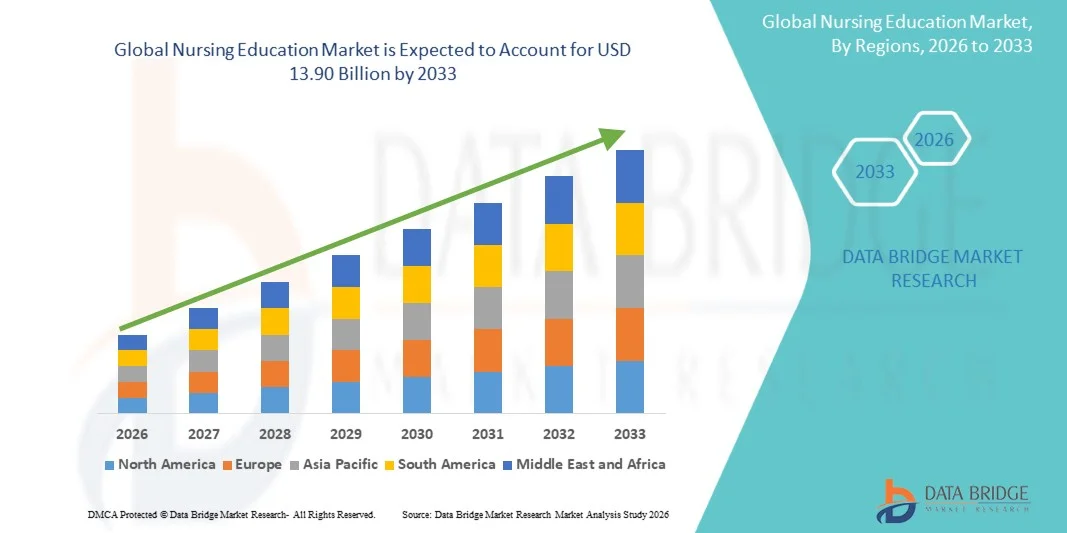
The Nursing Education Market was valued at USD 9.50 billion in 2025 and is projected to reach USD 13.90 billion by 2033, growing at a CAGR of 4.88% from 2026 to 2033. The market is witnessing steady growth driven by the rising global demand for qualified nursing professionals, increasing healthcare workforce shortages, and expanding investments in healthcare education infrastructure across developed and emerging economies.
The growing burden of chronic diseases, aging populations, and increasing healthcare service utilization are prompting governments, academic institutions, and healthcare organizations to strengthen nursing education programs and workforce development initiatives. Traditional classroom-based learning is increasingly being complemented by digital learning platforms, simulation-based training, and virtual clinical education, enabling more accessible, flexible, and competency-focused nursing education. Furthermore, supportive government policies, accreditation standards, and the growing emphasis on advanced nursing practice and specialized clinical skills continue to drive adoption of innovative educational technologies and training models worldwide.
Key Market Trends & Insights
- North America dominated the Nursing Education Market with the largest revenue share of 36.42% in 2025, supported by a well-established healthcare education ecosystem, strong nursing workforce demand, and significant investments in academic and clinical training programs.
- The Baccalaureate Degree (BS) segment led the market with a 44.62% share in 2025, driven by increasing employer preference for bachelor's-prepared nurses, growing emphasis on evidence-based practice, and expanding requirements for advanced clinical competencies.
- Asia-Pacific is expected to be the fastest-growing region at a CAGR of 8.1% from 2026 to 2033, fueled by expanding healthcare infrastructure, rising healthcare workforce shortages, and increasing government support for nursing education in countries such as China, India, and Indonesia.
- Diploma is the fastest-growing type, projected to register a CAGR of 7.9%, reflecting the surge in demand for cost-effective and shorter-duration nursing education programs.
- The On-Campus segment dominated the mode of education category with a 58.47% revenue share in 2025, led by the strong emphasis on hands-on clinical training, laboratory experience, and direct faculty interaction.
- Graduate accounted for 71.26% of the market, preferred by the substantial number of students pursuing foundational nursing qualifications required for professional licensure.
- The Nursing Programs in Colleges segment is the fastest-growing application category, with a CAGR of 7.7%, driven by the increasing demand for accessible and workforce-oriented nursing education.
Market Size & Forecast
- Global Market Value (2025): USD 9.50 Billion
- Expected Market Value (2033): USD 13.90 Billion
- Forecast CAGR (2026–2033): 4.88%
- Leading Region in 2025: North America
- Fastest Growing Region: Asia Pacific
Report Scope and Nursing Education Market Segmentation
|
Attributes |
Nursing Education Key Market Insights |
|
Segments Covered |
|
|
Countries Covered |
North America · U.S. · Canada · Mexico Europe · Germany · France · U.K. · Netherlands · Switzerland · Belgium · Russia · Italy · Spain · Turkey · Rest of Europe Asia-Pacific · China · Japan · India · South Korea · Singapore · Malaysia · Australia · Thailand · Indonesia · Philippines · Rest of Asia-Pacific Middle East and Africa · Saudi Arabia · U.A.E. · South Africa · Egypt · Israel · Rest of Middle East and Africa South America · Brazil · Argentina · Rest of South America |
|
Key Market Players |
· Elsevier (Netherlands) · Wolters Kluwer N.V. (Netherlands) · Laerdal Medical AS (Norway) · Ascend Learning, LLC (U.S.) · ATI Nursing Education (U.S.) · Assessment Technologies Institute, L.L.C. (U.S.) · Sentinel U® (U.S.) · UbiSim, Inc. (U.S.) · Intulect, Inc. (U.S.) · Oxford University Press (U.K.) · Pearson Education, Inc. (U.K.) · McGraw Hill LLC (U.S.) · Jones & Bartlett Learning, LLC (U.S.) · F. A. Davis Company (U.S.) · Springer Publishing Company (U.S.) · SCHOLAR Simulations, LLC (U.S.) · 3T Competence LLC (U.S.) · SciGence, LLC (U.S.) · ArchieMD, Inc. (U.S.) · PREVISE STUDIO Pvt. Ltd. (India) |
|
Market Opportunities |
· Expansion of simulation-based and virtual clinical training platforms · Growing demand for specialized nursing programs · Increasing adoption of online and hybrid nursing education models |
|
Value Added Data Infosets |
In addition to the insights on market scenarios such as market value, growth rate, segmentation, geographical coverage, and major players, the market reports curated by the Data Bridge Market Research also include in-depth expert analysis, patient epidemiology, pipeline analysis, pricing analysis, and regulatory framework. |
Nursing Education Market Trends
Trend: Growing Adoption of Simulation-Based and Digital Learning
Nursing education providers are increasingly adopting simulation-based learning technologies to enhance clinical competency, improve decision-making skills, and provide safe practice environments without direct patient risk. The integration of virtual simulation platforms enables detailed assessment of learner performance and clinical reasoning abilities. Universities and nursing schools are similarly leveraging digital learning solutions to deliver standardized, competency-based education modules, while virtual reality and augmented reality technologies create immersive environments that closely replicate real-world healthcare settings.
For instance, in March 2025, the National League for Nursing expanded initiatives supporting virtual simulation and technology-enhanced nursing education programs across academic institutions.
Nursing Education Market Dynamics
Key Market Driver: Growing Demand for Skilled Nursing Professionals
The rapid expansion of healthcare services and increasing prevalence of chronic diseases have created substantial demand for qualified nursing professionals capable of delivering high-quality patient care across diverse clinical settings. Healthcare providers, academic institutions, and government agencies are investing in nursing education as a core component of workforce development strategies, reducing staffing shortages, accelerating competency development, and improving healthcare delivery outcomes. For instance, in 2024, the World Health Organization continued emphasizing the expansion of nursing education capacity to address global healthcare workforce gaps and rising care demands
Key Restraint/Challenge: High Cost of Advanced Nursing Training Infrastructure
A significant restraint in the Nursing Education Market is the high upfront investment required for advanced training infrastructure. Modern programs integrate simulation laboratories, digital learning platforms, clinical skills centers, and immersive educational technologies, demanding substantial expenditure on procurement, implementation, and ongoing maintenance. The total cost of ownership extends to software subscriptions, periodic technology upgrades, and faculty training requirements, making adoption difficult for smaller institutions, community colleges, and resource-constrained educational organizations.
For instance, the establishment of advanced simulation centers by leading healthcare universities during 2024–2025 illustrates the scale of financial commitment required for modern nursing education infrastructure, reflecting the broader challenge of adoption beyond well-funded institutions.
Key Market Opportunity: Expansion of Online and Hybrid Nursing Education Models
The expansion of online and hybrid nursing education presents a significant market opportunity. Digitally enabled platforms can deliver flexible, accessible learning experiences, support continuous competency assessment, and expand educational access for working professionals and underserved populations. The development of cloud-based learning environments and virtual clinical training solutions is further democratizing access to nursing education, opening growth opportunities across cost-sensitive markets in Asia-Pacific, Latin America, and the Middle East.
For instance, in 2025, several leading nursing schools expanded hybrid degree pathways and virtual clinical education programs to increase enrollment capacity and improve access to professional nursing training.
Nursing Education Market Scope
The nursing education market is segmented on the basis of type, mode of education, courses, application, and end user.
- By Type
On the basis of type, the Nursing Education Market is segmented into Associate Degree (AD) and Baccalaureate Degree (BS), and Diploma. The Baccalaureate Degree (BS) segment dominated the market with a 44.62% share in 2025, owing to increasing employer preference for bachelor's-prepared nurses, growing emphasis on evidence-based practice, and expanding requirements for advanced clinical competencies. BS programs provide comprehensive education in nursing theory, leadership, patient care, and healthcare management. Many healthcare organizations prioritize BS-qualified nurses due to their broader clinical knowledge and improved patient outcome capabilities. Government initiatives and professional nursing associations continue to encourage bachelor's-level education to strengthen healthcare workforce quality. The segment also benefits from strong pathways toward advanced practice and postgraduate nursing education. These advantages continue to support its leading position in the Nursing Education Market.
The Diploma segment is projected to register the fastest growth at a CAGR of 7.9% from 2026 to 2033, driven by rising demand for cost-effective and shorter-duration nursing education programs. Diploma courses offer accelerated entry into the healthcare workforce, helping address nursing shortages in several countries. Increasing investments in vocational healthcare training institutions are supporting program expansion. These programs are particularly attractive in emerging economies where affordability and accessibility remain key priorities. Growing demand for frontline healthcare professionals is further stimulating enrollment. Government-backed workforce development initiatives and healthcare infrastructure expansion are expected to sustain strong growth throughout the forecast period.
- By Mode of Education
On the basis of mode of education, the Nursing Education Market is segmented into on-campus, distance, and online. The On-Campus segment dominated the market with a 58.47% share in 2025, supported by the strong emphasis on hands-on clinical training, laboratory experience, and direct faculty interaction. Nursing education requires practical skill development and supervised clinical exposure, making traditional campus-based learning highly preferred. Educational institutions continue to invest heavily in simulation laboratories and advanced training facilities. Accreditation bodies also emphasize structured clinical experiences that are easier to deliver through on-campus programs. The model promotes stronger peer collaboration and professional development. These advantages continue to make on-campus education the leading mode globally.
The Online segment is anticipated to witness the fastest growth at a CAGR of 8.4% from 2026 to 2033, driven by increasing digitalization of education and growing demand for flexible learning options. Online platforms enable students and working professionals to access nursing education remotely without geographic constraints. Advancements in virtual simulation technologies and digital assessment tools are significantly improving learning outcomes. Educational institutions are expanding online offerings to reach broader student populations. Rising internet penetration and growing acceptance of e-learning are further accelerating adoption. The segment is also benefiting from increasing demand for continuing education and professional certification programs.
- By Courses
On the basis of courses, the Nursing Education Market is segmented into post graduate and graduate. The Graduate segment accounted for the largest market share of 71.26% in 2025, owing to the substantial number of students pursuing foundational nursing qualifications required for professional licensure. Graduate programs serve as the primary entry pathway into the nursing profession across most countries. Growing healthcare workforce shortages are encouraging governments and institutions to increase graduate enrollment capacity. These programs provide essential clinical competencies and theoretical knowledge for diverse healthcare settings. Rising awareness regarding career opportunities in nursing is also supporting enrollment growth. The segment continues to benefit from strong demand across both developed and emerging healthcare markets.
The Post Graduate segment is expected to register the fastest growth at a CAGR of 8.1% from 2026 to 2033, driven by increasing demand for advanced clinical expertise and specialized nursing roles. Healthcare systems are increasingly relying on highly skilled nursing professionals to manage complex patient care requirements. Postgraduate education supports specialization in areas such as critical care, oncology, mental health, and advanced practice nursing. Rising emphasis on leadership development and evidence-based practice is further supporting enrollment. Healthcare employers are offering incentives for advanced qualifications to improve care quality. Growing recognition of specialized nursing roles is expected to sustain strong market expansion.
- By Application
On the basis of application, the Nursing Education Market is segmented into conventional universities and nursing programs in colleges. The Conventional Universities segment dominated the market with a 62.18% share in 2025, supported by their extensive academic infrastructure, research capabilities, and broad program offerings. Universities provide comprehensive nursing education pathways ranging from undergraduate to doctoral programs. Their strong affiliations with hospitals and healthcare organizations enhance clinical training opportunities. Accreditation standards and academic reputation also attract a significant proportion of nursing students. Continuous investment in educational technologies and simulation facilities strengthens learning outcomes. These factors collectively contribute to the segment’s dominant market position.
The Nursing Programs in Colleges segment is projected to witness the fastest growth at a CAGR of 7.7% from 2026 to 2033, driven by increasing demand for accessible and workforce-oriented nursing education. Colleges often offer flexible admission criteria and shorter educational pathways that appeal to a wider student population. Expanding healthcare workforce requirements are encouraging governments to increase support for college-based nursing programs. These institutions play a critical role in addressing regional nursing shortages. Lower tuition costs and community-based learning opportunities further enhance their attractiveness. Rising investments in vocational and technical healthcare education are expected to accelerate segment growth.
- By End User
On the basis of end user, the Nursing Education Market is segmented into hospitals and home healthcare services. The Hospitals segment led the market with a 68.35% share in 2025, driven by their significant role in clinical training, workforce development, and continuing nursing education. Hospitals serve as the primary settings for practical nursing instruction and competency assessment. Increasing patient volumes and healthcare service demand are creating a need for continuous nurse training and skill enhancement. Many hospitals collaborate directly with educational institutions to support clinical placements and residency programs. Investments in simulation-based learning and professional development initiatives are further supporting growth. The segment remains central to nursing education delivery worldwide.
The Home Healthcare Services segment is expected to record the fastest growth at a CAGR of 8.6% from 2026 to 2033, fueled by the growing shift toward community-based and home-centered care models. Aging populations and increasing prevalence of chronic diseases are driving demand for skilled home healthcare nurses. Educational providers are expanding training programs focused on remote patient management, elderly care, and home-based clinical services. Healthcare systems are increasingly emphasizing cost-effective alternatives to hospital-based treatment. Technological advancements in telehealth and remote monitoring are creating new competency requirements for nursing professionals. These trends are expected to significantly accelerate demand for specialized nursing education aligned with home healthcare services.
Nursing Education Market Regional Analysis
North America dominated the Nursing Education Market with the largest revenue share of 36.42% in 2025, supported by a well-established healthcare education ecosystem, strong nursing workforce demand, and significant investments in academic and clinical training programs. The region also benefits from rigorous accreditation standards, widespread adoption of simulation-based learning technologies, and growing integration of digital education platforms across nursing institutions. Increasing healthcare workforce shortages, expanding continuing education requirements, and rising enrollment in undergraduate and advanced nursing programs continue to drive market growth. Growing emphasis on competency-based training and specialized nursing education further strengthens North America’s leadership position in the global market.
U.S. Nursing Education Market Insight
The U.S. nursing education market is witnessing strong growth due to rising demand for qualified nursing professionals, increasing healthcare workforce shortages, and expanding investments in advanced nursing training programs. The country’s well-established healthcare and academic ecosystem, along with growing adoption of simulation-based learning, online education platforms, and competency-based training models, is driving demand across universities, colleges, and healthcare institutions. In addition, growing emphasis on improving patient care quality and addressing the shortage of registered nurses is accelerating enrollment across nursing education programs.
Europe Nursing Education Market Insight
The Europe nursing education market remains a major contributor to global revenue, driven by strong government support, healthcare workforce development initiatives, and high demand for skilled nursing professionals. The widespread adoption of simulation-based training, digital learning platforms, and advanced clinical education programs is supporting market expansion across the region. Increasing investments in healthcare education infrastructure, coupled with stringent professional qualification standards and growing demand for specialized nursing roles, continue to enhance the adoption of nursing education programs throughout Europe.
U.K. Nursing Education Market Insight
The U.K. nursing education market is experiencing steady growth, supported by rising demand for healthcare professionals, expanding nursing enrollment programs, and increasing investments in workforce development initiatives. Growing adoption of simulation technologies, digital learning platforms, and flexible education pathways is contributing to market growth. Furthermore, integration of virtual clinical training, competency-based learning approaches, and advanced educational technologies is improving training effectiveness and educational outcomes, positioning the U.K. as a key innovation hub in the nursing education industry.
Germany Nursing Education Market Insight
The Germany nursing education market is expanding steadily due to the country’s strong healthcare infrastructure, advanced educational capabilities, and increasing demand for qualified nursing professionals. Universities, vocational institutions, and healthcare organizations are increasingly investing in nursing programs to address workforce shortages and improve care quality. Continuous advancements in simulation-based training, digital education technologies, and clinical competency development, along with strong government focus on healthcare workforce sustainability, are further driving market growth in Germany.
Asia-Pacific Nursing Education Market Insight
The Asia-Pacific nursing education market is expected to witness rapid growth, driven by expanding healthcare infrastructure, rising healthcare workforce requirements, and increasing investments in nursing education across countries such as China, India, and Japan. Growing awareness regarding healthcare quality, rising adoption of digital learning technologies, and increasing demand for accessible and cost-effective education solutions are supporting regional market expansion. In addition, the growing burden of chronic diseases and expanding healthcare services are accelerating nursing education enrollment across academic and professional sectors.
Japan Nursing Education Market Insight
The Japan nursing education market is witnessing consistent growth due to rising investments in healthcare workforce development, nursing training technologies, and elderly care education initiatives. Educational institutions, healthcare providers, and research organizations are increasingly adopting simulation-based learning and advanced training methodologies to strengthen nursing competencies. Moreover, increasing integration of digital learning platforms and the country’s focus on addressing healthcare challenges associated with an aging population are further contributing to market growth.
China Nursing Education Market Insight
The China nursing education market is growing rapidly, driven by expanding healthcare infrastructure, increasing government support for healthcare workforce development, and rising demand for qualified nursing professionals. Growing adoption of digital education platforms, simulation-based training technologies, and competency-focused learning models across academic and healthcare institutions is significantly boosting market demand. In addition, rising investments in healthcare education, increasing awareness regarding professional nursing standards, and rapid modernization of healthcare services are positioning China as one of the fastest-growing markets for nursing education globally.
Nursing Education Market Share
The nursing education industry is primarily led by well-established companies, including:
- Elsevier (Netherlands)
- Wolters Kluwer N.V. (Netherlands)
- Laerdal Medical AS (Norway)
- Ascend Learning, LLC (U.S.)
- ATI Nursing Education (U.S.)
- Assessment Technologies Institute, L.L.C. (U.S.)
- Sentinel U® (U.S.)
- UbiSim, Inc. (U.S.)
- Intulect, Inc. (U.S.)
- Oxford University Press (U.K.)
- Pearson Education, Inc. (U.K.)
- McGraw Hill LLC (U.S.)
- Jones & Bartlett Learning, LLC (U.S.)
- A. Davis Company (U.S.)
- Springer Publishing Company (U.S.)
- SCHOLAR Simulations, LLC (U.S.)
- 3T Competence LLC (U.S.)
- SciGence, LLC (U.S.)
- ArchieMD, Inc. (U.S.)
- PREVISE STUDIO Pvt. Ltd. (India)
Latest Developments in Nursing Education Market
- In July 2024, the government of Uttar Pradesh, India, announced initiatives to strengthen nursing education and workforce development during the National Conference on Nursing Excellence and Leadership. The program emphasized simulation-based learning, digitalization of nursing education, leadership development, and scholarships for nursing students, highlighting the growing focus on modernizing nursing training infrastructure
- In June 2024, researchers introduced VR-NRP (Virtual Reality Neonatal Resuscitation Program), an immersive virtual reality training platform designed to improve neonatal resuscitation education for healthcare professionals, including nurses. The platform demonstrated strong potential for delivering effective, accessible, and scalable clinical training, particularly for remote and underserved regions
- In December 2023, a study published in BMC Nursing demonstrated the effectiveness and feasibility of virtual reality simulation in nursing education. The research found that immersive VR scenarios can provide authentic clinical learning experiences, improve learner engagement, and complement traditional simulation-based education, supporting wider adoption of VR technologies in nursing curricula
- In April 2023, Sentinel U released findings from its Nursing Simulation Research Grant program showing that virtual simulation integrated into nursing curricula improved students’ clinical judgment, critical decision-making abilities, confidence levels, and examination performance. The study reinforced the growing role of virtual simulation technologies in addressing clinical training limitations
- In January 2022, Wolters Kluwer and Laerdal Medical launched the next generation of vSim for Nursing, a virtual simulation solution designed to deliver higher clinical fidelity and more realistic patient encounters. The platform was developed to strengthen clinical judgment, improve nursing competency, and help institutions overcome limitations in clinical placement availability

- Interactive Data Analysis Dashboard
- Company Analysis Dashboard for high growth potential opportunities
- Research Analyst Access for customization & queries
- Competitor Analysis with Interactive dashboard
- Latest News, Updates & Trend analysis
- Harness the Power of Benchmark Analysis for Comprehensive Competitor Tracking
Data collection and base year analysis are done using data collection modules with large sample sizes. The stage includes obtaining market information or related data through various sources and strategies. It includes examining and planning all the data acquired from the past in advance. It likewise envelops the examination of information inconsistencies seen across different information sources. The market data is analysed and estimated using market statistical and coherent models. Also, market share analysis and key trend analysis are the major success factors in the market report. To know more, please request an analyst call or drop down your inquiry.
The key research methodology used by DBMR research team is data triangulation which involves data mining, analysis of the impact of data variables on the market and primary (industry expert) validation. Data models include Vendor Positioning Grid, Market Time Line Analysis, Market Overview and Guide, Company Positioning Grid, Patent Analysis, Pricing Analysis, Company Market Share Analysis, Standards of Measurement, Global versus Regional and Vendor Share Analysis. To know more about the research methodology, drop in an inquiry to speak to our industry experts.
Data Bridge Market Research is a leader in advanced formative research. We take pride in servicing our existing and new customers with data and analysis that match and suits their goal. The report can be customized to include price trend analysis of target brands understanding the market for additional countries (ask for the list of countries), clinical trial results data, literature review, refurbished market and product base analysis. Market analysis of target competitors can be analyzed from technology-based analysis to market portfolio strategies. We can add as many competitors that you require data about in the format and data style you are looking for. Our team of analysts can also provide you data in crude raw excel files pivot tables (Fact book) or can assist you in creating presentations from the data sets available in the report.













